
Key Points
- A recognized TEFL certification opens doors for teaching English in Asia regardless of nationality or background.
- Teaching in Asia offers high salaries, cultural immersion, and professional growth opportunities, with long-term career prospects.
- The personal transformation and skills gained from TEFL in Asia develop lasting confidence, adaptability, and cross-cultural understanding.
Many people believe that teaching English in Asia is reserved for native speakers with insider connections. That misconception stops capable, motivated individuals from pursuing one of the most rewarding international careers available today. The truth is that accredited TEFL certification levels the playing field entirely. Whether you are a recent graduate, a career changer, or someone craving cultural adventure, a recognised TEFL qualification opens real doors across Asia and beyond. This guide covers the career, financial, and personal advantages of teaching English in Asia, so you can make a confident, informed decision about your next chapter.
Table of Contents
- Why TEFL is the passport to global teaching
- Top benefits of teaching English in Asia with TEFL
- Salary prospects and job security for TEFL teachers in Asia
- Long-term career impact and professional growth
- Why the real benefit of TEFL in Asia is personal transformation
- Get started: your next step towards teaching in Asia
- Frequently asked questions
Key Takeaways
| Point | Details |
|---|---|
| TEFL unlocks new markets | Teaching English in Asia with TEFL opens opportunities regardless of your native language or country. |
| High salaries and job security | TEFL-certified teachers enjoy strong salaries, benefits, and stable contracts in top Asian countries. |
| Path to global careers | A TEFL in Asia is the foundation for future international teaching or leadership roles. |
| Personal growth included | Working in Asia as a TEFL teacher accelerates cultural understanding and self-confidence. |
Why TEFL is the passport to global teaching
The first question most people ask is whether their background is suitable. Many assume that accent, nationality, or professional history will disqualify them. TEFL, which stands for Teaching English as a Foreign Language, is the internationally recognised standard that replaces those assumptions with evidence. It demonstrates that you can plan lessons, manage a classroom, and support language learners effectively, regardless of where you were born.
Understanding TEFL basics is the natural starting point. A TEFL qualification tells employers, visa authorities, and school administrators that you have met a credible benchmark. This matters enormously in Asia, where recruitment processes are often formal and school reputations depend on hiring certified professionals. In markets like Japan, South Korea, Vietnam, and Thailand, schools receive hundreds of applications. A TEFL certificate, particularly one accredited by a respected body like Trinity College London, moves your application to the top of the pile.
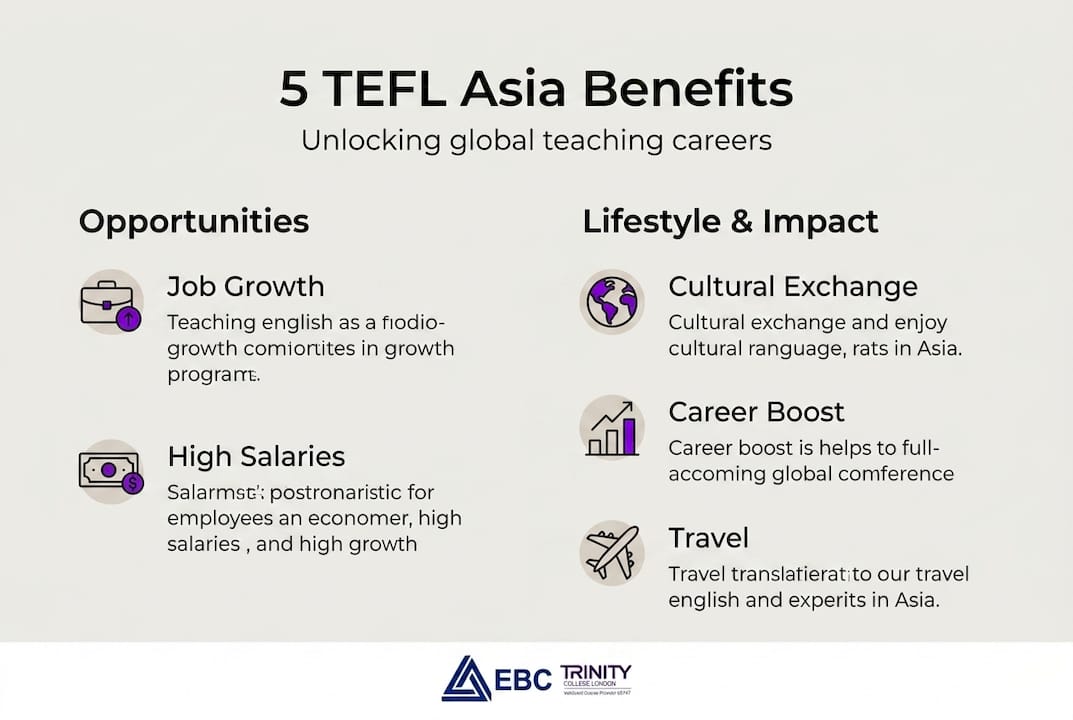
There is a practical dimension too. Many Asian countries require proof of formal teacher training to issue a work visa. Without that proof, employment is not possible through legitimate channels. Certification to teach abroad removes that barrier entirely, giving you access to accredited schools across Asia even as a non-native speaker.
Here are the key barriers TEFL removes:
- Visa eligibility: Many Asian work visas require formal teacher training documentation
- School shortlisting: Certified teachers are prioritised by reputable institutions
- Competitive salary access: TEFL credentials qualify you for higher pay bands
- Non-native speaker acceptance: Accreditation demonstrates ability, not just origin
- Global mobility: A recognised TEFL qualification transfers across multiple countries
The countries needing English teachers span an enormous range of contexts, from private language academies and international schools to government programmes and corporate training providers. TEFL qualifies you for all of them.
Pro Tip: When choosing a TEFL provider, always confirm that they offer dedicated job placement support for Asia. A certificate alone is valuable, but a provider with active recruitment networks in your target country dramatically shortens the time from qualification to your first contract.
Top benefits of teaching English in Asia with TEFL
Asia is the fastest-growing market for TEFL-certified teachers globally, and the reasons are easy to understand. Demand for English language education has grown consistently across East and South-East Asia as economies expand and international business connections deepen. This creates a reliable, ongoing need for qualified teachers that shows no sign of slowing.
The personal benefits of teaching in Asia are substantial. You gain real immersion in cultures, languages, and communities that most people only encounter through travel. Living and working in Japan, South Korea, China, or Vietnam means building genuine relationships, learning a new language through daily life, and developing a level of adaptability that no classroom at home can replicate.
Professionally, the variety is remarkable. TEFL teachers in Asia work across:
- Private language academies, known locally as hagwons in Korea or eikaiwa in Japan
- State and government schools through official placement programmes
- International and bilingual schools with competitive packages
- Corporate English training for business professionals
- Online platforms serving Asian learners directly
For those interested in teaching children in Asia, the opportunity is particularly broad. Young learner education is a major growth area, with governments across Asia investing heavily in primary and secondary English provision.
| Benefit | Asia | Other regions |
|---|---|---|
| Job availability | Very high | Moderate |
| Salary with benefits | Competitive | Variable |
| Cultural immersion | Rich and diverse | Varies by country |
| Career progression | Strong | Limited in some areas |
| Long-term demand | Growing steadily | Mixed |
The combination of professional opportunity, lifestyle appeal, and cultural richness makes Asia uniquely compelling for TEFL-certified teachers.
Salary prospects and job security for TEFL teachers in Asia
TEFL-qualified teachers in Asia typically earn salaries that allow comfortable living, often with significant benefits on top. The exact figures vary by country and employer, but the overall picture is genuinely competitive.

| Country | Monthly salary (approx.) | Common benefits |
|---|---|---|
| Japan | £1,800 to £2,500 | Housing allowance, flight reimbursement |
| South Korea | £1,600 to £2,200 | Free housing, health insurance, severance pay |
| China | £1,200 to £2,000 | Free housing, flights, end-of-contract bonus |
| Thailand | £700 to £1,100 | Health cover, visa support |
| Vietnam | £800 to £1,300 | Flexible scheduling, bonus options |
Teaching in Japan or South Korea is particularly attractive for those seeking financial stability. Roles in Japan frequently include free or subsidised housing, annual flight reimbursement, and generous paid leave. In South Korea, government-sponsored programmes like EPIK provide national health insurance and a severance payment equivalent to one month’s salary at the end of each contract.
These benefits mean your disposable income stretches further than the base salary suggests. Many TEFL teachers in Asia save a significant portion of their earnings while covering all living costs, which is a remarkable position compared to entry-level roles at home.
“Arriving in Seoul with my TEFL certificate, I was genuinely surprised by how structured the job offer was. Housing sorted, insurance covered, and a clear salary from day one. I had more financial security than in my previous job back home.” — EBC TEFL graduate, South Korea
Pro Tip: When reviewing a contract offer in Asia, check whether the housing benefit is a free apartment or a housing allowance. The difference is significant. A free apartment maximises your savings, whereas an allowance requires you to budget carefully depending on local rental costs.
Long-term career impact and professional growth
A TEFL posting in Asia is rarely just a gap year. For many teachers, it becomes the foundation of a long and varied international career. TEFL supports further education and leadership advancement in ways that few entry-level roles can match.
After two to three years in the classroom, many TEFL teachers naturally progress into senior or specialist roles. These include:
- Director of Studies: Overseeing curriculum and teacher performance in private schools
- Teacher trainer: Training newly arrived TEFL teachers, often with a DELTA or MA TESOL qualification
- Curriculum developer: Designing materials for language schools, publishers, or government programmes
- Academic coordinator: Managing learning outcomes in international or bilingual schools
The academic pathways are equally accessible. Trinity College London’s CertTESOL is widely respected as a stepping stone to postgraduate study. An MA TESOL or the Cambridge DELTA qualification can follow, both of which qualify you for university-level roles and senior management positions. Exploring how to teach English in China, for instance, reveals a market with a particularly strong appetite for experienced, credentialed educators at all levels.
Beyond education, the skills gained through TEFL are genuinely transferable. Employers across many sectors value what TEFL develops:
- Clear communication and presentation ability
- Cross-cultural sensitivity and interpersonal awareness
- Curriculum planning and structured thinking
- Confidence in public speaking and group facilitation
- Resilience and problem-solving under pressure
Pro Tip: When updating your CV after a TEFL posting, frame your experience in terms of outcomes. Rather than listing duties, describe what your students achieved and how you measured progress. This positions TEFL experience as concrete professional development, not just travel.
Why the real benefit of TEFL in Asia is personal transformation
We talk a great deal about salaries, visas, and career trajectories, and rightly so. But after working with TEFL graduates who have taught across Asia, the feedback that stands out most is rarely about money. It is about who they became.
Teaching in a country where you do not share the language or cultural background forces a kind of growth that is difficult to manufacture any other way. You learn patience. You develop genuine empathy. You stop defaulting to assumptions. The experience of studying and living abroad reshapes how you understand people, and that understanding stays with you.
The contrarian view worth stating clearly: career advantages are a bonus. The deeper value of TEFL in Asia is that it builds the kind of person who can operate effectively and compassionately in any context, anywhere in the world. That is not a soft benefit. It is the most durable professional asset you will ever develop.
Get started: your next step towards teaching in Asia
If you are ready to move from curiosity to action, EBC TEFL is here to support you at every stage. We offer globally-recognised TEFL certification through Trinity College London, giving your qualification the international credibility that Asian schools and visa authorities respect.
Not sure whether to pursue TEFL or TESOL? Our team can walk you through the options, including flexible online and in-person pathways designed to fit around your existing commitments. We also provide free lifetime job placement support, so we remain your partner long after you receive your certificate. Book a free consultation today and take the first concrete step towards your teaching career in Asia.
Frequently asked questions
Do you need a degree to teach English in Asia with TEFL?
Some Asian schools hire non-degree holders with TEFL certification, though a degree is preferred in countries like Japan and South Korea. Requirements vary by country and employer, so it is worth researching your specific destination.
How long does it take to get TEFL certified for Asia?
TEFL programmes offer flexible completion timelines ranging from four weeks to several months, depending on whether you study online, in person, or through a blended format. Most accredited courses can be completed within four to twelve weeks.
Which Asian countries offer the best TEFL teaching salaries?
Japan, South Korea, and China consistently lead Asia for TEFL teacher pay and job benefits, including housing, health insurance, and flight reimbursement. These three countries are the most popular destinations for teachers prioritising financial return.
Is TEFL certification necessary to teach English in Asia?
Most reputable schools require TEFL for legal work visas and competitive hiring processes. Without formal certification, you are largely limited to informal or unregulated positions that offer less security and lower pay.
Can I teach English in Asia as a non-native speaker with TEFL?
Non-native speakers with TEFL are hired across various Asian markets, particularly when they demonstrate strong English proficiency and hold an accredited qualification. Your certificate is evidence of ability, and many schools prioritise that over your country of origin.
Recommended
- 6 Top Benefits of Trinity CertTESOL for Teaching Abroad – EBC TEFL courses
- International TEFL Career Steps: Your Path to Global Teaching – EBC TEFL courses
- How to Succeed in Online TEFL and Launch a Global Teaching Career – EBC TEFL courses
- Master TEFL Job Search Methods for Global Teaching Success EBC TEFL courses EBC TEFL courses
- International Study Experience Explained: 30% Career Boost