
Key Points
- Choosing an accredited TESOL certification is essential for securing reputable teaching roles worldwide and in Europe.
- The certification process involves course selection, practical teaching, assessments, and obtaining official recognition.
- Building a global teaching career benefits from strategic planning, specialization, and leveraging language and cultural immersion opportunities.
Choosing the right TESOL certification route is one of the most important decisions you will make as an aspiring English teacher. With dozens of courses available worldwide, it can feel overwhelming to identify which qualifications employers actually respect, which programmes prepare you for real classrooms, and which pathways lead to genuine job opportunities in Europe and beyond. This guide cuts through the noise. Whether you are a recent graduate, a career changer, or someone who simply wants to teach abroad, understanding the TESOL certification process step by step will give you the confidence to move forward and the knowledge to choose wisely.
If you are comparing teaching qualifications, understanding what Ofqual Level 5 means can help you interpret qualification levels and make a more informed decision about your training.
Table of Contents
- Understanding TESOL and why accreditation matters
- Step-by-step TESOL certification process
- Choosing the right TESOL programme: Online vs classroom and location factors
- Common mistakes and how to avoid them
- What to expect after you qualify: Jobs, placement, and career progression
- What most TESOL guides miss: Building a global teaching career that fits your goals
- Start your TESOL journey: Explore accredited training and job placement
- Frequently asked questions
Key Takeaways
| Point | Details |
|---|---|
| Accredited TESOL is critical | Choose a globally accredited TESOL course to maximise job opportunities and ease visa processes. |
| Follow the step-by-step process | Understanding the sequence from entry requirements to final assessment ensures smoother, faster qualification. |
| Decide on format and location | Select training—online or in-person—and the best region for your career plans, especially if aiming for Europe. |
| Avoid common pitfalls | Double-check a course’s accreditation, value hands-on practice, and seek support throughout training. |
| Career impact after certification | Expect strong job prospects and mobility worldwide, especially in well-supported markets like Europe. |
Understanding TESOL and why accreditation matters
TESOL stands for Teaching English to Speakers of Other Languages. It is a broad field that covers teaching English in any context where the learner’s first language is not English. TEFL (Teaching English as a Foreign Language) is a related term, often used interchangeably, though TEFL typically refers to teaching in countries where English is not the official language. For a clear breakdown of these distinctions, this TEFL introduction explained overview is a useful starting point.
The most critical factor when choosing any certification is accreditation. Not all TESOL certificates carry the same weight with employers, schools, or immigration authorities. Accredited TESOL certifications are widely recognised and required for reputable English teaching roles abroad. This matters enormously when you are applying for a teaching position in Spain, France, or Italy, where schools and language academies regularly ask for proof of accredited training.
Here is a quick comparison of the most recognised certification types:
| Certification | Awarding body | Format | Global recognition |
|---|---|---|---|
| Trinity CertTESOL | Trinity College London | In-person or online | Very high |
| CELTA | Cambridge Assessment | In-person or blended | Very high |
| Trinity CertPT | Trinity College London | Online | Growing rapidly |
| Other Generic TEFL | Various providers | In-person or online | Low to moderate |
When comparing your options, the CELTA vs Trinity CertTESOL comparison is worth reading before you commit. Both are highly regarded, but they differ in structure, assessment style, and cost. The accredited Trinity CertTESOL online route has grown significantly in popularity because it combines institutional credibility with flexible delivery.
Key reasons to prioritise an accredited course:
- Employers in Europe, Asia, and the Middle East often require proof of accreditation
- Accredited courses carry weight in visa and work permit applications
- They are assessed by external examiners, ensuring a consistent and rigorous standard
- They include practical teaching components that non-accredited courses rarely offer
If you are considering the Trinity CertTESOL qualification, think about what you want from the course and how its training, teaching practice and feedback could support your professional goals.
Pro Tip: To verify a programme’s accreditation status, visit the awarding body’s official website (such as Trinity College London’s course finder) and search for the provider directly. Never rely solely on the course provider’s own marketing claims.
Step-by-step TESOL certification process
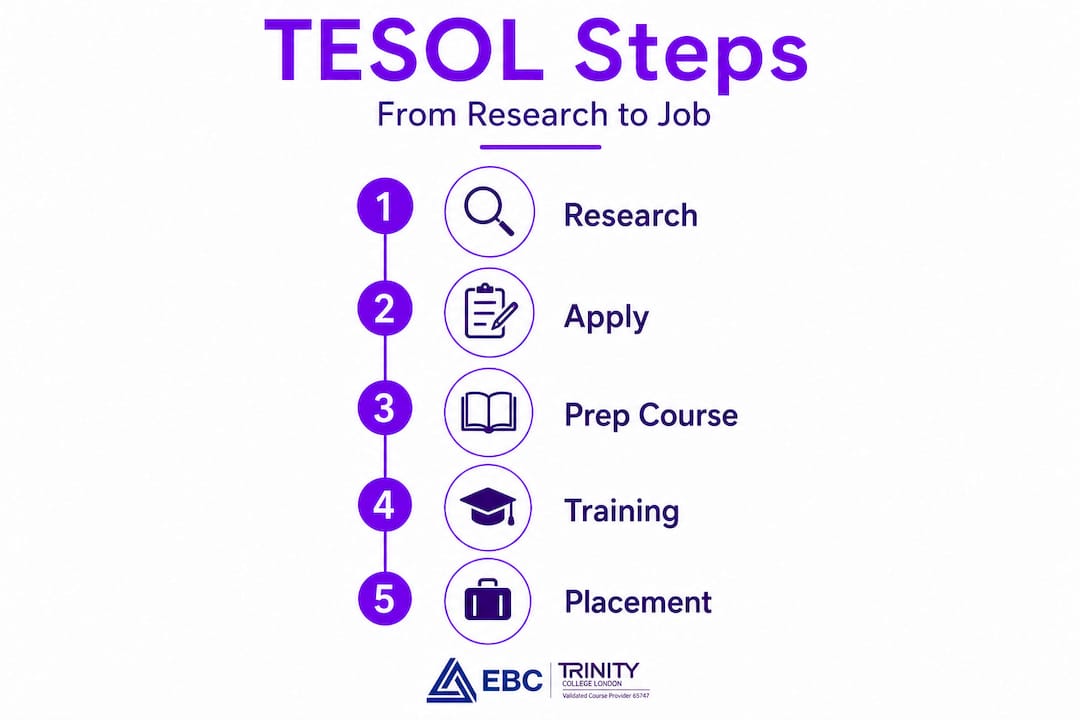
With a clear understanding of TESOL accreditation, it is time to break down each step towards certification. The full TESOL certification steps process is more structured than many candidates expect, but each stage builds logically on the last.
The typical TESOL certification involves pre-entry requirements, classroom training, practical teaching, and assessment stages. Here is a numbered walkthrough:
Check your entry requirements. Most accredited TESOL programmes require a good standard of written and spoken English. You will typically need at least an upper-intermediate level (B2 on the CEFR scale) if English is not your first language. Some providers also require a background check, particularly if you will be working with younger learners.
Select an accredited provider. Research providers carefully. Look for those affiliated with Trinity College London or another recognised awarding body. Consider location, format (online or in-person), cost, and the level of job placement support offered after graduation.
Submit your application. Most programmes require a written application, and some include a short interview or pre-course task to assess your suitability. Use this stage to ask questions about teaching practice arrangements and tutor support.
Complete the coursework. TESOL courses cover lesson planning, language awareness, learner psychology, and classroom management. You will study how adults learn language, how to teach grammar and vocabulary effectively, and how to adapt your teaching for different learner needs. In-person courses typically run for four to five weeks full-time; online versions may span eight to twelve weeks part-time.
Undertake observed teaching practice. This is non-negotiable in accredited programmes. You will teach real learners under the supervision of an experienced tutor who provides structured feedback. For guidance on performing well in this stage, the resource on passing Trinity CertTESOL covers common pitfalls and practical preparation strategies.
Complete assessed assignments. Depending on your programme, these may include a language awareness task, a learner profile, a teaching practice portfolio, and a written assignment on language analysis. External examiners assess your work against national standards.
Receive your certificate. Once you pass all components, your awarding body issues your certificate. This is your passport to teaching roles worldwide.
Here is a realistic timeline for each stage:
| Stage | Typical duration |
|---|---|
| Research and application | 2 to 4 weeks |
| Pre-course preparation | 1 to 2 weeks |
| Core coursework | 4 to 12 weeks |
| Teaching practice | Integrated throughout |
| Assessment and results | 2 to 6 weeks after completion |
Pro Tip: Start your language awareness revision before the course begins. Many candidates are caught off guard by grammar terminology such as modal verbs, gerunds, and conditionals. A week of focused preparation can significantly reduce early course stress and free up mental energy for lesson planning.
Choosing the right TESOL programme: Online vs classroom and location factors
Having mapped out the core certification process, let us tackle the key decision of choosing your study mode and where to complete your TESOL. Online TESOL programmes offer flexibility, while in-person courses provide immersive classroom experience. Neither is universally superior. The right choice depends on your lifestyle, budget, and career goals.
| Feature | Online TESOL | In-person TESOL |
|---|---|---|
| Flexibility | High: study around existing commitments | Low to moderate: fixed schedule |
| Teaching practice | Arranged with real learners (often online) | Face-to-face with real learners |
| Networking opportunities | Limited unless course includes live sessions | Strong: daily contact with peers and tutors |
| Cost | Often lower | Includes accommodation and travel if abroad |
| Immersion in target country | No | Yes, if studying in Europe |
For teachers who want to teach face-to-face and also build online skills, the option to teach online and face-to-face is increasingly popular and practical.
Location matters more than many candidates realise. Completing your TESOL in Spain, France, or Italy, for example, gives you immediate cultural immersion, local networking contacts, and in many cases the beginnings of a professional reputation in the country where you want to work. The Trinity CertPT online course suits those who plan to teach in digital environments, while an in-person programme in Europe suits those aiming for a language academy or school placement.
Key considerations when choosing your programme location and format:
- Career target: If you plan to teach in a specific country, completing your training there builds local contacts and familiarity with the education system
- Visa requirements: Some European countries require in-country training before issuing a teaching visa or work permit
- Personal learning style: If you thrive in structured, social environments, in-person training is likely to suit you better
- Cost and logistics: Online programmes reduce travel and accommodation costs but require strong self-discipline and time management
Find out what taking an online Trinity CertTESOL course involves and consider whether its study format suits your circumstances and career goals.
Pro Tip: If you are aiming for a position in Europe and are unsure whether to study online or in-person, book a free consultation with your chosen provider before you apply. Many providers, including EBC TEFL, offer personalised guidance to help you match your study format to your target teaching destination.
Common mistakes and how to avoid them
Once you have chosen your TESOL programme, avoiding classic missteps can make all the difference to your progress and confidence. Many candidates underestimate the importance of hands-on teaching practice and support when selecting a TESOL course. This is one of the most costly errors you can make, because teaching practice is exactly what employers value most in newly qualified teachers.
Here are the most common mistakes candidates make, and how to avoid them:
- Not verifying accreditation. Always check the awarding body’s official website before you pay any fees. A non-accredited certificate may not be accepted by employers or visa authorities.
- Underestimating the workload. TESOL certification, particularly at Trinity CertTESOL level, is academically demanding. Plan for at least two to three hours of study per day during an intensive course.
- Skipping or minimising teaching practice. Some candidates try to rush through observed lessons or treat them as a tick-box exercise. In reality, this is where your skills develop most rapidly. Treat every observed lesson as a genuine learning opportunity.
- Neglecting tutor feedback. After each observed lesson, you will receive written and verbal feedback. Candidates who actively engage with this feedback and apply it in subsequent lessons progress noticeably faster than those who ignore it.
- Failing to network. Your classmates are your future professional network. Many teaching job leads come through personal recommendations. Build relationships from day one.
For a broader understanding of how different TESOL education pathways compare in terms of support and outcomes, it is worth exploring the full range of options before committing.
“The candidates who succeed most in their TESOL training are those who treat every lesson, every piece of feedback, and every conversation with their peers as a learning experience. Certification is a process, not a product.”
What to expect after you qualify: Jobs, placement, and career progression
With your TESOL certificate in hand, it is vital to know what job and career doors will open and how to make the most of them. Accredited TESOL graduates enjoy better job opportunities, global placement support, and career mobility than holders of non-accredited certificates. This is not a small distinction. Accreditation is frequently the deciding factor in a hiring decision.
The types of roles open to newly certified TESOL teachers include:
- Language academy teacher (very common in Spain, France, and Italy)
- Private tutoring (in-person and online)
- Business English teacher for corporate clients
- Primary or secondary school English assistant
- Online English teacher for international platforms
- University language department assistant
For a full picture of the TESOL certification abroad benefits, including specific European markets, the evidence strongly favours choosing an accredited, internationally recognised course from the outset.
Career progression for new TESOL teachers is often faster than people expect. Within two to three years, many teachers move into senior teacher or director of studies roles, particularly in language academies across Europe. Some go on to specialise in Business English, CLIL (Content and Language Integrated Learning), or teacher training itself. Others use their initial teaching experience as a springboard into postgraduate study in applied linguistics or education management.

Job placement support is a vital factor when selecting your provider. Lifetime job placement assistance, the kind offered by EBC TEFL globally, means you are not left to navigate the job market alone after graduation. This is especially valuable in Europe, where local market knowledge and employer contacts make an enormous difference to how quickly you secure a role.
What most TESOL guides miss: Building a global teaching career that fits your goals
Stepping back from the practical steps, it is worth looking at your TESOL journey from a broader, career-building perspective. Most guides give you a checklist and stop there. The checklist is necessary but it is nowhere near enough.
The teachers who build genuinely rewarding international careers are those who treat their certification as the beginning of a professional identity, not the end of a process. Choosing the right first role matters as much as choosing the right course. A position in a well-managed language academy in Madrid or Lyon will teach you more in twelve months than three years of isolated private tutoring. Mentorship from an experienced director of studies can shape your pedagogy in ways that no coursebook ever will.
We also see, time and again, that candidates who specialise early tend to advance faster. If you know you want to work in corporate environments, focus on Business English from your first year. If you are drawn to younger learners, seek out schools in countries where English is part of the national curriculum. The education pathways for TESOL are genuinely diverse, and aligning your pathway with your actual interests leads to better teaching and longer careers.
Finally, the global dimension of your career is something to plan for, not stumble into. Europe offers some of the most accessible and rewarding entry-level teaching markets in the world, particularly Spain, France, and Italy. A one-year study and work programme in one of these countries gives you accredited training, language skills, cultural immersion, and professional contacts simultaneously. That is a foundation most candidates wish they had built from the start.
Start your TESOL journey: Explore accredited training and job placement
If this guide has clarified your next steps, you are already ahead of most aspiring TESOL teachers. The difference between hoping for an international teaching career and actually building one comes down to the decisions you make now: choosing an accredited course, completing rigorous teaching practice, and accessing genuine job placement support.
EBC TEFL offers Trinity College London accredited TESOL certification alongside one-year study and work abroad programmes in Spain, France, and Italy. Whether you are looking to earn your certificate for teaching English abroad or need a complete guide through the TESOL certification global guide, EBC TEFL provides free lifetime job placement assistance and personalised support from application through to employment. Book your free consultation today and find the programme that fits your goals.
Frequently asked questions
How long does it take to get TESOL certified?
Most TESOL courses are completed within 4 to 12 weeks, depending on whether you study full-time or part-time, as TESOL courses typically range from several weeks to a few months.
Is TESOL certification valid worldwide?
Yes, provided it is accredited. Accredited TESOL certifications are widely recognised for international job opportunities, and are particularly valued in Europe and Asia.
Do I need teaching experience before enrolling in a TESOL course?
No prior teaching experience is usually required, though a good standard of English and a background check are common prerequisites, as you do not need teaching experience for most TESOL programmes.
What is the biggest challenge during TESOL certification?
Most candidates find balancing coursework and teaching practice the most demanding aspect. Balancing coursework and practical teaching is consistently cited as the main challenge, so structured time management is essential.
Can I work in Europe with a TESOL certificate?
Yes. Accredited TESOL certificates are essential for job and visa eligibility across Europe, and are a recognised requirement for English teaching positions in Spain, France, Italy, and beyond.
Recommended
- International TEFL Career Steps: Your Path to Global Teaching – EBC TEFL courses
- Step-by-step guide to becoming an English teacher abroad – EBC TEFL courses
- Applying for TEFL Jobs Abroad: Your Complete Step-by-Step Guide – EBC TEFL courses
- TESOL Certification Steps: Guide to Global English Teaching – EBC TEFL courses