
Key Points
- CertTESOL is a highly regarded international teaching qualification that requires only tertiary-level or equivalent experience and C1 English proficiency.
- The course prepares candidates for global teaching roles by developing lesson design, classroom management, and language awareness skills.
If you are exploring how to qualify for CertTESOL, you are already thinking about one of the most respected teaching certifications available globally. Without a recognised qualification, landing consistent, well-paid English teaching roles abroad is genuinely difficult. Employers in Japan, Brazil, Spain, Germany, and beyond actively filter for credentialled candidates. This guide covers everything you need: eligibility requirements, preparation strategies, the qualification process itself, and how CertTESOL positions you for a successful international teaching career.
Table of Contents
- Key takeaways
- CertTESOL eligibility requirements explained
- How to prepare for the CertTESOL course
- The step-by-step process to qualify
- CertTESOL and your global job prospects
- Common myths and obstacles about CertTESOL
- My honest take on qualifying for CertTESOL
- How Ebcteflcourse supports your CertTESOL qualification
- FAQ
Key takeaways
| Point | Details |
|---|---|
| Eligibility is specific but accessible | You need tertiary-level academic background or equivalent, plus C1 English proficiency. |
| A teaching degree is not required | Trinity recognises non-education backgrounds and relevant workplace experience. |
| Preparation determines success | Studying ELT theory and practising lesson planning before the course significantly improves outcomes. |
| CertTESOL carries global recognition | Major employers including the British Council accept CertTESOL as a high-standard entry qualification. |
| Myths can discourage strong candidates | Non-native speakers and mature learners are fully eligible with the right preparation. |
CertTESOL eligibility requirements explained
Understanding the formal entry criteria is the right place to start. Many people assume they are not eligible before they have even checked the actual requirements. The truth is more encouraging than you might expect.
Trinity College London states that applicants must hold qualifications for tertiary study or demonstrate equivalent potential through professional or workplace achievements. This means a university degree is not the only route in. Relevant work experience, professional qualifications, and demonstrable academic potential can all satisfy this criterion.
English language proficiency is non-negotiable. You must demonstrate C1 level proficiency across all four skills: reading, writing, speaking, and listening. This is assessed through the application interview and, in some cases, a written task. If you are not yet at C1, your first priority is getting there before applying. Ebcteflcourse has a dedicated resource on English proficiency standards that maps out exactly what C1 looks like in practice.
The core CertTESOL eligibility requirements also include:
- Age: Most providers require applicants to be at least 20 years old. Mature learners are actively welcomed and often bring professional skills that benefit the classroom.
- Language background: Both native and non-native English speakers are eligible. Non-native speakers must simply demonstrate the required C1 proficiency.
- Personal attributes: Teamwork and receptiveness to feedback are assessed during selection. Trinity expects candidates to work collaboratively and respond constructively to criticism throughout training.
- Identity and safeguarding: You will typically need to provide valid identification and may be subject to background checks depending on your location and the course provider.
Pro Tip: If you are concerned about meeting the academic entry threshold, gather evidence of professional achievements, published work, or workplace training before you apply. These can substitute for formal qualifications when presented clearly.
One point worth underlining: the CertTESOL is aligned with Level 5 on the UK’s Regulated Qualifications Framework, equivalent to first-year undergraduate study. This is a rigorous academic and practical qualification, which is precisely why employers worldwide respect it.
How to prepare for the CertTESOL course
Preparation is not optional. The CertTESOL is intensive, and candidates who arrive without any background knowledge of English language teaching genuinely struggle in the first weeks. Here is a practical sequence to follow before you enrol.
- Study ELT methodology basics. Read an introductory text on communicative language teaching and become familiar with terms like concept checking, elicitation, and scaffolding. You do not need to be an expert, but arriving with a foundation means you can absorb new material faster.
- Reach C1 English proficiency. If you are a non-native speaker, address any gaps in vocabulary range, grammatical accuracy, or spoken fluency before applying. Practise academic writing and formal spoken English regularly.
- Understand lesson planning structure. Learn the components of a standard EFL lesson plan: aims, language focus, anticipated problems, and staged activities. Even sketching out a few practice plans builds confidence for teaching practice.
- Develop classroom management awareness. Observe a class if you can, whether in person or through recorded lessons. Notice how teachers give instructions, manage timing, and handle unexpected responses from learners.
- Build your emotional resilience. The CertTESOL course involves regular, detailed feedback on your teaching. Candidates who take feedback personally, rather than professionally, find this the hardest aspect. Practise separating your identity from your performance.
- Practise academic writing. The course involves written assignments that require analytical thinking and clear argument construction. If academic writing is not your strength, work on it before you start.
Pro Tip: Spend at least two weeks before your course reading about phonology, specifically the phonemic chart and how English sounds are produced. This is consistently the area where new trainees feel least prepared, and a head start makes a genuine difference.
The course covers teaching methods, lesson planning, language systems, and classroom management, so the more of this groundwork you lay beforehand, the more you can focus on developing your actual teaching during the course rather than catching up on theory. A step-by-step resource from Ebcteflcourse on preparing for Trinity CertTESOL covers the specific preparation each component requires.

The step-by-step process to qualify
Knowing how to obtain CertTESOL means understanding how the course is structured and assessed. The CertTESOL application process begins well before the first day of teaching practice.
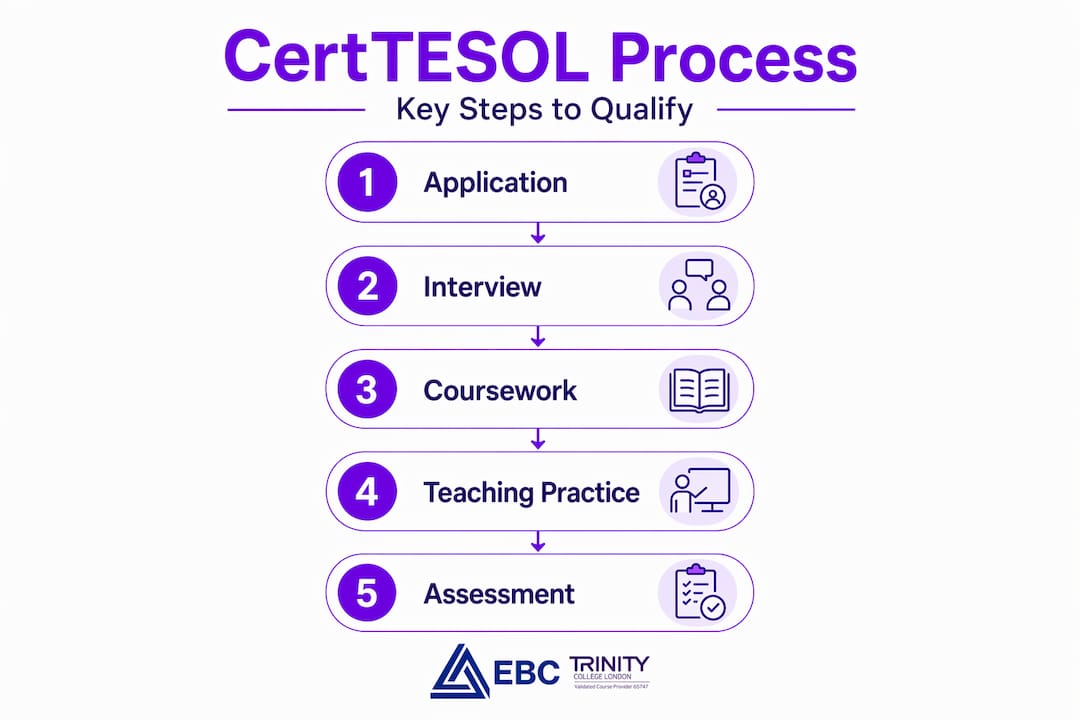
| Stage | What is involved |
|---|---|
| Pre-admission interview | Assessment of English proficiency, motivation, and course suitability |
| Course induction | Introduction to ELT theory, course expectations, and assessment criteria |
| Teaching practice | Observed lessons with real learners, with structured feedback after each session |
| Written assignments | Analytical tasks covering language awareness, learner profile, and materials evaluation |
| Final assessment | Review of all components; trainees must pass all elements to receive certification |
The CertTESOL course runs in full-time and part-time formats. Full-time programmes typically run for four to five weeks. Part-time options spread the same content across several months, making the qualification more manageable for those with work or family commitments.
Common challenges at each stage include:
- Pre-admission interview: Candidates who have not thought about why they want to teach, or who cannot articulate their motivation clearly, often struggle here. Preparing a genuine, specific answer about your motivation gives you a strong advantage. Ebcteflcourse’s guide on passing your pre-admission interview is worth reading before you book anything.
- Teaching practice: The first observed lesson is almost always the most difficult. Expect imperfection and focus on applying feedback rather than achieving a perfect lesson from the start.
- Written assignments: These require evidence of reflective practice. Describe what happened in your teaching, analyse why, and suggest what you would do differently. Superficial responses do not pass.
If you do not initially meet the entry conditions, most providers will advise you on specific gaps to address before reapplying. This is not a rejection. It is a targeted development plan.
Pre-admission interviews assess English skills, motivation, and suitability, so treating the application as part of your learning, rather than just a gateway, puts you in the right mindset from the beginning.
CertTESOL and your global job prospects
Qualifying for CertTESOL does far more than place a certificate on your CV. It signals to employers in Tokyo, Buenos Aires, Warsaw, and Nairobi that you have been through a demanding, standardised training programme with real classroom hours.
CertTESOL is accepted by the British Council and a broad range of major employers internationally. This is significant. The British Council is one of the largest English language teaching organisations in the world, operating in over 100 countries. Their acceptance of CertTESOL as a qualifying credential is a direct signal to every employer in their network.
Beyond the certificate itself, the qualification builds skills that translate directly into classroom confidence:
- Systematic lesson design: You learn to plan backwards from a learning aim, producing lessons that are purposeful rather than activity-based.
- Responsive teaching: Feedback-driven teaching practice trains you to read a room, adapt your pace, and modify language on the spot.
- Language awareness: You develop an analyst’s understanding of English grammar, phonology, and lexis. This is invaluable for explaining language accurately to learners.
- Professional credibility: The qualification’s alignment with Level 5 of the RQF is understood by international employers and academic institutions alike.
For those considering teaching in Europe specifically, the combination of CertTESOL and knowledge of working abroad as a teacher gives you a clearer picture of what to expect financially and professionally once you arrive.
Pro Tip: Ask prospective employers directly whether they accept CertTESOL before you commit to a contract. In most markets the answer is yes, but confirming it in writing protects you and demonstrates professional awareness.
Common myths and obstacles about CertTESOL
Misinformation stops too many capable people from applying. Here are the most common misconceptions, addressed directly.
Applicants do not need a teaching degree to enrol. Trinity explicitly recognises non-education academic backgrounds and values professional achievement over specific degree subjects.
- “I am not a native speaker, so I cannot qualify.” This is incorrect. Non-native English speakers qualify provided they demonstrate C1 proficiency. Ebcteflcourse has a thorough discussion of non-native speaker eligibility that addresses this directly.
- “I am too old to start.” There is no upper age limit. Mature candidates frequently perform well because their life and professional experience enriches their teaching approach.
- “The certificate alone will get me a work visa.” A teaching qualification is one factor in the visa process, not a guarantee of a visa itself. Requirements vary considerably by country and your nationality. Always research visa conditions for your specific situation before making plans.
- “The pre-admission interview is just a formality.” It is not. Preparation is required. Candidates who treat it casually are often surprised by the depth of questioning.
“The biggest barrier to getting into CertTESOL is usually in people’s heads, not in the official requirements.”
If you are concerned about the qualifications needed to teach English in your target region, Ebcteflcourse’s regional guides break down the requirements market by market.
My honest take on qualifying for CertTESOL
I have spoken with hundreds of aspiring teachers over the years, and I have noticed a consistent pattern. The people who struggle most are rarely those who lack ability. They are the ones who underestimate the course and arrive unprepared, or the ones who overestimate the importance of the certificate itself relative to their actual development as teachers.
In my experience, the candidates who succeed treat CertTESOL as the beginning of something, not the goal. They engage with every piece of feedback. They practise teaching in their own time. They read beyond the course materials. Non-native speakers who put serious effort into their preparation often outperform native speakers who coast on grammatical instinct alone.
The global teaching world is also more accepting of diverse backgrounds than many people realise. I have seen mature career-changers thrive in South Korea, non-native speakers excel in Spain, and candidates with non-traditional academic histories go on to teach in prestigious language schools across Latin America. What I have not seen succeed is complacency. The certificate is rigorous for good reason. Approach it with genuine commitment, and it will serve you well across a long career.
How Ebcteflcourse supports your CertTESOL qualification
Qualifying for CertTESOL requires the right guidance from people who know the process inside out. Ebcteflcourse offers Trinity College London accredited CertTESOL training with dedicated support at every stage, from pre-admission preparation through to global job placement.
With Ebcteflcourse, you gain access to expert trainers, structured course materials, and free lifetime job placement assistance that extends well beyond graduation. Whether you are looking to teach in Europe through one of the one-year study and work programmes in Spain, France, or Italy, or you want to launch your career anywhere across Asia, Latin America, or beyond, Ebcteflcourse’s global network is there to support you. Explore your pathway to teaching English abroad and book a free consultation today to take the first step with confidence.
FAQ
What are the CertTESOL entry requirements?
You need qualifications appropriate to tertiary education or equivalent professional experience, plus C1 English proficiency across all four language skills. A teaching degree is not required.
Can non-native speakers qualify for CertTESOL?
Yes. Non-native English speakers are fully eligible for CertTESOL provided they demonstrate C1 level proficiency in reading, writing, speaking, and listening.
How long does it take to complete CertTESOL?
Full-time CertTESOL programmes typically run for four to five weeks. Part-time formats spread the same content across several months to suit different schedules.
Does CertTESOL help with finding teaching jobs abroad?
CertTESOL is accepted by major employers including the British Council across more than 100 countries, making it one of the strongest entry qualifications for international English teaching roles.
Is a pre-admission interview required for CertTESOL?
Yes. Most providers conduct a pre-admission interview to assess your English proficiency, motivation, and suitability for the course demands before offering a place.
Recommended
- Step-by-Step Guide to Trinity CertTESOL Certification – EBC TEFL courses
- Trinity CertTESOL Step by Step Guide for Global Educators – EBC TEFL courses
- TESOL Certification Steps: Guide to Global English Teaching – EBC TEFL courses
- Preparing for Trinity CertTESOL: Your Complete Success Guide – EBC TEFL courses