
Key Points
- Practical training in TEFL provides supervised teaching hours that improve classroom management, pacing, and communication skills. It often involves 20 to 30 observed hours, enhancing employability and confidence in real classroom settings. Most reputable courses integrate practical components, making teachers more competitive globally and better prepared from day one.
Most people assume that passing a TEFL certification exam means they are ready to walk into a classroom and teach. That assumption is where a lot of new teachers run into trouble. The role of practical training in TEFL is not a bonus feature or an optional add-on. It is the component that separates teachers who can explain grammar from teachers who can actually run a room. Whether you are planning to teach in Japan, Colombia, Poland, or South Africa, what happens during your practicum will shape your first year in the classroom more than any textbook ever could.
Table of Contents
- Key takeaways
- What practical training in TEFL actually involves
- Challenges new teachers face without a practicum
- How practical training improves teaching skills and job readiness
- TEFL courses with and without practical training compared
- How to get the most from your TEFL practicum
- My honest view on practical training in TEFL
- Start your TEFL journey with practical training built in
- FAQ
Key takeaways
| Point | Details |
|---|---|
| Practicum builds real skills | Supervised teaching practice develops classroom management, pacing, and adaptability that theory alone cannot give you. |
| Employers notice the difference | Hiring schools worldwide prefer candidates with practicum experience as it reduces onboarding time and improves performance. |
| Reflection accelerates growth | Recording lessons and acting on tutor feedback converts classroom errors into professional development faster than self-study. |
| Course format matters | Programmes that combine online theory with in-person teaching practice produce more confident, job-ready teachers. |
| Accreditation signals quality | Trinity College London accredited courses require structured practical components, giving graduates a globally recognised credential. |
What practical training in TEFL actually involves
Practical training is any structured activity that puts you in front of real or simulated learners before you take your first paid teaching role. It goes well beyond reading about TEFL teaching methodologies in a course manual.
The core components you will typically encounter include:
- Teaching practicum: Supervised sessions where you deliver lessons to actual language learners, usually in groups of varying levels and backgrounds.
- Micro-teaching: Short, focused teaching episodes observed by trainers and peers, designed to practise specific skills such as instruction-giving or error correction.
- Classroom observation: Watching experienced teachers work, then analysing what they did and why, building your critical eye before you step up yourself.
- Lesson planning with feedback: Submitting plans before teaching, receiving tutor input, then reflecting on how the lesson differed from your plan in practice.
Typical practicum durations range from 20 to 30 hours for weekend workshop formats, up to full month-long intensive programmes. The Trinity CertTESOL, for example, builds practical teaching hours directly into its assessment criteria, which is one reason it carries weight with employers across more than 100 countries.
Practical training works because it creates a feedback loop. You plan, teach, receive observations, reflect, and teach again. Each cycle tightens the gap between what you intended and what actually happened in the room.
Pro Tip: Keep a brief teaching journal after every practicum session. Note one thing that worked, one thing that did not, and one adjustment you will make next time. Over a five-week course, this habit produces a personal development record that is genuinely useful in job interviews.
Challenges new teachers face without a practicum
Theory-only TEFL training leaves you with knowledge and very little experience of applying it under pressure. The challenges that appear in your first real classroom are predictable. They are also largely preventable with adequate practical experience.
Here are the most common problems novice teachers report when they have had no supervised teaching practice:
- Lesson timing collapses. A plan that looked balanced on paper runs 15 minutes short or overruns badly. Weak time management is one of the most frequently cited problems in early teaching practice, and it only becomes visible when you are standing in front of a class.
- Communication clarity breaks down. Writing clear board instructions or giving unambiguous activity directions feels straightforward until learners stare back at you with blank expressions.
- Diverse learner levels derail lessons. Mixed-ability groups are the norm in most schools worldwide. Managing fast finishers while supporting slower learners simultaneously is a skill that takes practice, not reading.
- Confidence dissolves under silence. When a class goes quiet or an activity flops, inexperienced teachers freeze, over-explain, or resort to filler. This is one of the hardest moments in teaching, and practicum is where you learn to handle it calmly.
- Overdependence on notes. Reading from a lesson plan rather than engaging with the room is a habit that signals inexperience immediately to any observer or employer.
“Real confidence in teaching is a calm, controlled presence that allows you to respond to what the learners actually need, not what your notes say should happen next.” Source
Without practical training, these challenges surface on the job, often in front of students in a foreign country, with no mentor in sight. That is a difficult and unnecessary way to start your teaching career.
How practical training improves teaching skills and job readiness

The TEFL training benefits that come directly from practicum experience are not vague confidence boosts. They are specific, transferable skills that make you a better teacher from day one and a stronger candidate in a competitive global job market.
Here is what improves with structured teaching practice:
- Classroom management: You learn to read the room, manage transitions between activities, and maintain pace without referring to a script.
- Instruction-giving: Short, staged instructions that learners actually follow are a craft. You develop this through repetition and direct feedback.
- Learner engagement: You discover which activity types energise your particular group and how to adjust your approach mid-lesson when engagement drops.
- Adaptability: Practicum provides a controlled environment to make mistakes and recover from them before those mistakes happen in a paid role.
- Feedback integration: Learning to receive critical observations without defensiveness, and to act on them, is a professional skill that grows every time you teach and debrief.
The job market dimension is equally significant. Schools in South Korea, the UAE, Spain, Brazil, and across Southeast Asia consistently report that candidates with demonstrable teaching hours move through hiring processes faster. Practicum experience makes job seekers considerably more attractive because it reduces the school’s need to provide basic classroom training after hiring.
| Skill area | Without practicum | With practicum |
|---|---|---|
| Classroom management | Reactive and inconsistent | Proactive and structured |
| Lesson pacing | Frequently misjudged | Calibrated through experience |
| Learner communication | Unclear or over-complicated | Clear, staged, and confident |
| Feedback response | Defensive or passive | Reflective and constructive |
| Employer appeal | Limited without evidence | Strong with observed hours logged |
Pro Tip: Ask your course tutor to observe at least one lesson specifically for teacher talk time. Many new teachers speak for 70% of the lesson without realising it. Knowing your ratio early is one of the most useful pieces of data you can act on.
TEFL courses with and without practical training compared
Not all TEFL certifications are built the same way, and the difference matters far more than most course marketing material suggests.
Online-only programmes typically cover grammar, lesson planning theory, and an introduction to TEFL teaching methodologies through pre-recorded modules and written assignments. They are accessible, affordable, and flexible. What they cannot replicate is the experience of managing a live class. Online TEFL training paired with practicum and mentorship offers far more thorough preparation, particularly for teachers heading into competitive markets or taking roles with vulnerable learners.
| Feature | Online-only course | Practicum-inclusive 4-week course |
|---|---|---|
| Cost | €300 to €500 | €500 to €2,000 |
| Time commitment | Flexible, self-paced | Structured schedule with fixed sessions |
| Teaching hours logged | None | 6+ observed hours |
| Employer recognition | Variable | Stronger, especially with Trinity CertTESOL accreditation |
| Confidence on completion | Theoretical | Practical and tested |
| Suitability for competitive markets | Limited | High |
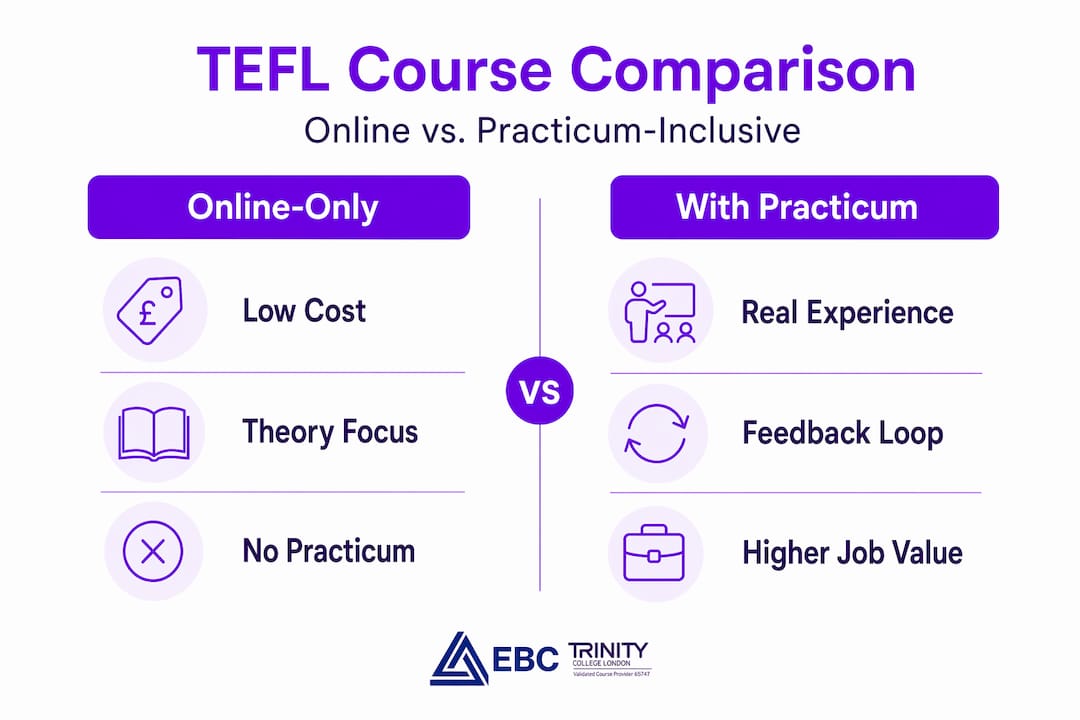
Reputable TEFL courses, like the Trinity CertTESOL are priced between €1,400 and €1,600, with practical components adding workshop or intensive training time. That additional investment typically pays for itself within the first month of employment, given that teachers with practicum credentials often secure better starting salaries and more desirable placements.
If you want to compare online and onsite options in detail before deciding, looking at what each format includes in terms of observed teaching hours is the single most useful filter you can apply.
How to get the most from your TEFL practicum
Choosing a course that includes practical training is step one. Using that training well is what determines your outcomes.
Before your practicum begins, ask these questions of any course provider:
- How many observed teaching hours are included and are they with real language learners?
- Will I receive written feedback after each session or only verbal comments?
- Is there a designated mentor or tutor who reviews my progress across the whole course?
- Does the course include post-practicum reflection tasks built into the assessment?
- Is the course moderated by a qualified, visiting external moderator?
During your teaching practice sessions, the habits that separate strong trainees from average ones are straightforward:
- Record your lessons where possible. Effective reflection often requires seeing yourself teach, not just remembering how it felt. Most trainees are surprised by what they notice on playback.
- Seek specific feedback. Ask your tutor to focus on one aspect per session, such as concept checking questions or activity staging. Broad feedback is harder to act on.
- Treat observation of peers as seriously as your own teaching. Watching others make mistakes and succeed gives you a wider reference point for your own development.
After your course, your practicum record becomes a genuine asset. Log your observed hours, the levels you taught, and the feedback themes that recurred. This information belongs in your CV, your cover letters, and your job interviews. It is concrete evidence of classroom skills that online-only graduates simply cannot offer.
Pro Tip: Ask your tutor to write a short summary of your observed teaching at the end of your practicum. A paragraph from a qualified Trinity-trained observer carries real weight with hiring schools, particularly in markets such as South Korea, Japan, and the Gulf states.
My honest view on practical training in TEFL
I have worked with aspiring teachers at every stage of preparation, and the pattern I keep seeing is the same one. The trainees who invest in practical training do not just pass their certifications. They arrive at their first teaching post with something you cannot download: real experience of being at the front of a room when things do not go to plan.
What I find most striking is how many new teachers underestimate lesson pacing specifically. They focus on grammar explanations or activity design, then the lesson overruns or falls apart because they never had to manage live timing before. Lesson pacing and adapting to live learner responses are skills perfected only through practicum. No amount of reading about them will substitute.
The emotional growth that comes from a well-supported teaching practicum is also something I feel strongly about. There is a particular kind of confidence that comes from having taught badly, received honest feedback, adjusted your approach, and taught better the following session. That cycle builds something permanent. Teachers who have been through it carry a resilience into their careers that serves them well in Tokyo, Bogotá, Prague, or anywhere else they end up working.
My honest advice: do not choose a TEFL course based on speed or cost alone. Practicum bridges the transition gap between studying TEFL and facing an actual classroom. That gap is real, and the teachers who try to skip it almost always find it again on the other side, just in a less forgiving context.
Start your TEFL journey with practical training built in
Ebcteflcourse offers globally recognised TEFL and TESOL certification programmes through Trinity College London, all of which include structured practical training components. Whether you are starting with an introduction to TEFL or pursuing the full Trinity CertTESOL, you receive observed teaching hours, expert tutor feedback, and mentorship support designed to make you classroom-ready from day one. Ebcteflcourse operates worldwide, supporting teachers into roles across Europe, Asia, the Americas, the Middle East, and beyond, with free lifetime job placement assistance included. If you want certification that opens doors globally, book a free consultation and find the right course for your goals.
FAQ
What is the role of practical training in TEFL?
Practical training in TEFL gives trainee teachers supervised experience in real classrooms before they take paid roles, building the classroom management, pacing, and communication skills that theory alone cannot develop.
How many hours of teaching practice does a TEFL course need?
Reputable TEFL programmes typically include between 20 and 30 observed teaching hours, with some intensive courses offering more within a month-long format.
Do employers really care about TEFL practicum experience?
Yes. Schools worldwide prefer candidates with documented teaching practice because it reduces onboarding costs and signals that the teacher can manage a live class from their first day.
Can online TEFL courses include a practical component?
Hybrid models that combine online theory with in-person or supervised practicum sessions are the most effective preparation for real-world teaching, and are increasingly common in accredited programmes.
How does practical training improve job prospects for TEFL teachers?
Teachers with practicum experience demonstrate measurable classroom skills, making them stronger candidates in competitive markets such as South Korea, Japan, the UAE, and across Latin America and Europe.