
Key Points
- Lesson planning in TEFL involves creating a structured framework with clear learning objectives and sequenced activities to guide effective instruction. It enhances teacher confidence, ensures course coherence, and improves employability across international markets. Flexibility, efficient design, and professional practice are essential for successful lesson implementation and career development.
Lesson planning in TEFL is the process of creating a structured framework that defines learning objectives, teaching activities, and the steps a teacher will take to guide students toward clear language goals within a single lesson. Known formally as instructional planning in language teaching, it is the foundation upon which every effective English lesson is built. The British Council describes a lesson plan as a written guide outlining aims, start and end points, and the steps in between, noting that experienced teachers may use minimal notes while beginners require considerably more detail. Whether you are preparing to teach in Japan, Brazil, Germany, or online, understanding lesson planning is the first skill that separates confident teachers from uncertain ones.
What is lesson planning in TEFL and why does it matter?
Lesson planning in TEFL is defined as the deliberate organisation of teaching content, timing, and activities to achieve specific language learning outcomes within a class period. It is not simply writing down what you plan to do. It is a professional act of anticipating student needs, predicting potential problems, and designing solutions before you enter the classroom.
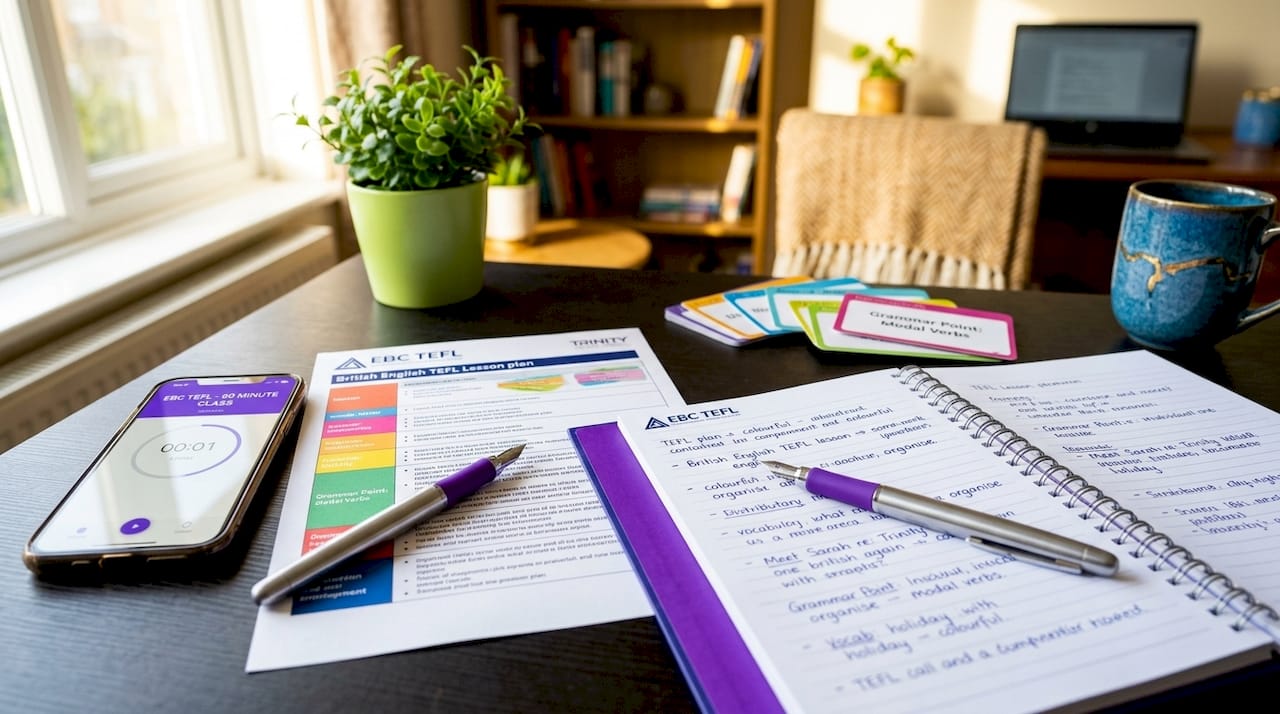
Effective lesson planning builds teacher confidence and professionalism by forcing you to think through every stage of instruction before it happens. A teacher who has planned thoroughly knows what to do when a grammar explanation lands flat or when students finish an activity ten minutes early. That readiness is visible to students and to employers.
The importance of lesson planning in TEFL extends beyond individual lessons. Across a course, well-designed plans create coherence, recycle vocabulary, and build skills progressively. Teachers who plan consistently produce more balanced lessons and are far better positioned to reflect on what worked and why, which is the engine of professional growth.
What key components make up an effective TEFL lesson plan?
A well-structured TEFL lesson plan contains several core elements that work together to keep instruction focused and student-centred. Understanding what a TEFL lesson plan should include gives you a reliable template you can adapt for any level, age group, or context worldwide.
The essential components are:
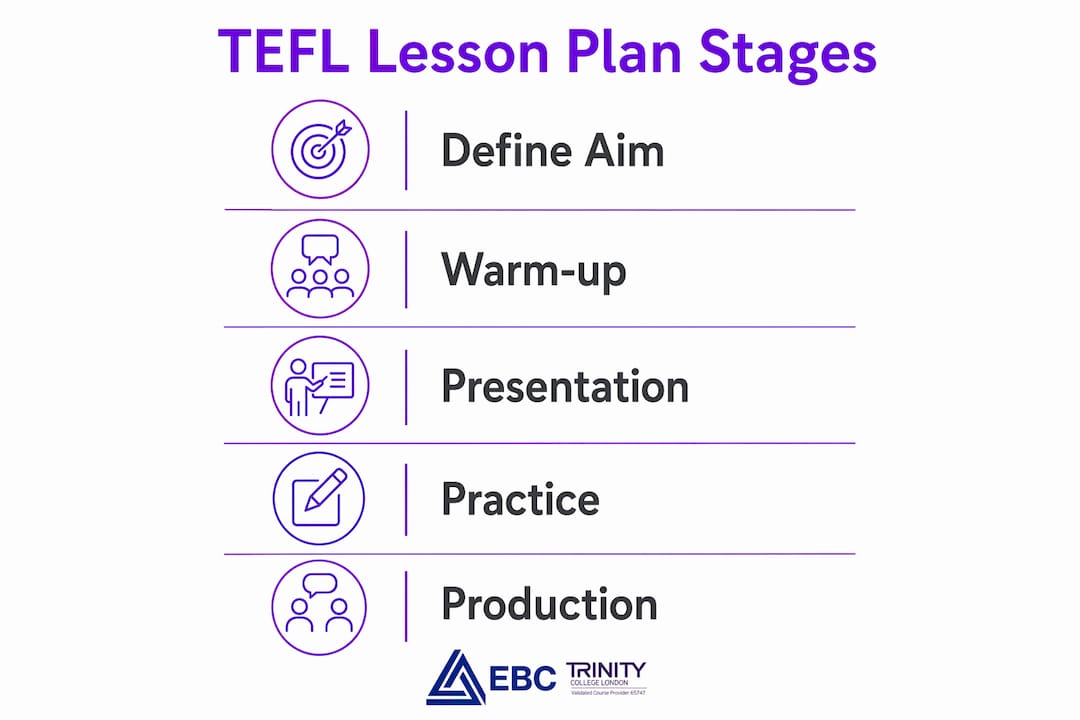
Learning objective: A single, specific aim written from the student’s perspective. For example, “Students will be able to describe their daily routines using the present simple tense.” Vague aims produce vague lessons.
Warm-up: A short activity (five to ten minutes) that activates prior knowledge, settles the class, and connects to the lesson topic. This could be a quick discussion question, a vocabulary game, or a short listening task.
Presentation: The stage where new language or a skill focus is introduced clearly, with context. This might involve a model dialogue, a reading text, or a grammar explanation supported by examples.
Guided practice: Controlled activities where students use the new language with support, such as gap-fill exercises, sentence transformation tasks, or structured speaking drills.
Free practice (production): Open tasks where students use the language independently and creatively, such as a role play, a written paragraph, or a group discussion.
Review and feedback: A closing stage that consolidates learning, addresses errors, and gives students a sense of what they have achieved.
Each stage should include an estimated time allocation and a note on interaction patterns, whether students work individually, in pairs, or in groups. A clear lesson structure with defined stages is what transforms a collection of activities into a coherent lesson.
Pro Tip: Keep your lesson aim to one specific language point or skill focus. Teachers who try to cover too much in a single lesson rarely cover anything well. One clear aim, taught thoroughly, produces better results than three aims taught superficially.
How do popular TEFL lesson planning models compare?
Two frameworks dominate TEFL lesson planning: PPP (Presentation, Practice, Production) and ESA (Engage, Study, Activate). Both are legitimate, and both have distinct strengths. Choosing between them depends on your learners, your lesson aim, and the context in which you teach.
PPP focuses on accuracy with a fixed, linear sequence. ESA, developed by Jeremy Harmer, prioritises engagement and uses a flexible, cyclic structure that can be reordered to suit the lesson. The table below compares the two models directly.
| Feature | PPP | ESA |
|---|---|---|
| Sequence | Fixed: Presentation → Practice → Production | Flexible: stages can be reordered or repeated |
| Primary focus | Accuracy and form | Engagement and motivation |
| Best suited for | Introducing new grammar or vocabulary directly | Mixed-ability classes, skills lessons, or motivating reluctant learners |
| Teacher role | Instructor and model | Facilitator and guide |
| Learner activity | Controlled, then freer | Varied; can revisit study stages multiple times |
| Risk | Can feel mechanical if overused | Requires more planning skill to manage flexibly |
PPP works well when you are introducing a discrete grammar point to lower-level learners who need a clear model before they practise. ESA suits situations where engagement is the priority, such as a teenage class that needs motivating before any language study can take place.
Blending both frameworks is often the most effective approach. A lesson might open with an ESA-style engage activity, move into a PPP-style presentation and practice sequence, and close with a free production task. Lesson planning frameworks are tools, not doctrines, and mixing them according to student needs produces better learning outcomes than rigid adherence to either model.
Pro Tip: If you are new to TEFL, start with PPP. Its predictable structure gives you a reliable scaffold while you develop classroom confidence. Once you feel secure, experiment with ESA’s boomerang or patchwork sequences to add variety and responsiveness to your lessons.
Why is flexibility important in TEFL lesson planning?
A lesson plan is a guide, not a script. The British Council is clear that plans should allow teachers to adapt in real time rather than follow a rigid sequence regardless of what is happening in the room. This distinction matters enormously in practice.
Classrooms are unpredictable. A grammar point you expected students to grasp in ten minutes might need twenty. A discussion activity might spark genuine interest and deserve more time. A planned activity might fall flat and need replacing on the spot. Teachers who treat their plan as fixed will either rush students or abandon good learning opportunities to stay on schedule.
Planning by stage aims with contingency ideas rather than scripting every word gives you both structure and the freedom to respond. Practically, this means building flexibility into your plan in the following ways:
Note a “fast finisher” extension task for each main activity so early completers stay engaged.
Mark one activity as “cuttable” if time runs short, so you always reach the production stage.
Write a brief contingency note: “If students struggle with the form, return to the model dialogue before moving to practice.”
Plan your lesson aim, not your lesson script. Know what students should be able to do by the end, and let that goal guide your decisions in the room.
Flexibility is also a signal of professional maturity. Employers and academic directors worldwide recognise the difference between a teacher who follows a plan mechanically and one who uses a plan as a thinking tool. The latter is far more employable across diverse teaching contexts, from language schools in South Korea to corporate English programmes in the UAE.
What are practical tips for creating TEFL lesson plans efficiently?
Creating effective TEFL lesson plans does not have to be time-consuming. The most common planning mistake new teachers make is over-scripting: writing out every question, every transition, and every possible student response. This approach takes hours and produces plans that are too rigid to use well.
Experienced teachers save time by shifting from full scripts to stage-aim notes with decision points. Here is a practical process for planning efficiently without sacrificing quality:
Write your aim first. Before selecting a single activity, write one sentence stating what students will be able to do by the end of the lesson. This filters every subsequent decision.
Choose a skeleton, not a new structure. Reuse a proven lesson framework such as PPP or ESA rather than designing a new structure from scratch each time. Adapt the content, not the architecture.
Select fewer, richer tasks. Overloading lessons with many activities wastes time and fragments learning. One well-designed role play produces more language use than four disconnected gap-fill exercises.
Use AI tools to brainstorm. Tools like ChatGPT can generate context-appropriate gap-fill exercises, discussion questions, or model dialogues in seconds. Use them to produce raw materials quickly, then edit for your specific class.
Build a resource bank. After each lesson, save what worked. A folder of reusable warm-ups, grammar presentations, and production tasks dramatically reduces planning time over a teaching career.
Plan for skills lessons differently. Reading and listening lessons benefit from fewer but larger stages built around purpose-driven tasks, rather than many small, disconnected activities that break the flow of authentic language engagement.
Pro Tip: Write your lesson plan the day before, not the morning of. Distance from the plan lets you review it with fresh eyes and spot gaps in timing or logic that are invisible when you are deep in the writing process.
How does lesson planning support your TEFL career globally?
Strong lesson planning skills are one of the most visible markers of a professional teacher, and they directly affect your employability in every teaching market worldwide. Schools in Japan, Spain, Mexico, Saudi Arabia, and beyond all conduct observed lessons as part of their hiring process. A well-structured, clearly reasoned lesson plan submitted alongside your CV signals that you understand pedagogy, not just English.
Adapting lesson plans for different learner profiles, from young learners in primary schools to business professionals in corporate settings, is a skill that opens doors to a far wider range of teaching positions. Teachers who can plan for children and adults alike, or for absolute beginners as confidently as for advanced learners, are genuinely versatile and far more attractive to international employers.
The career benefits of effective lesson planning extend beyond the hiring stage:
Consistent planning builds a portfolio of materials you can present to employers as evidence of your teaching practice.
Reflective planning, where you note what worked and revise for next time, accelerates professional development and supports applications for senior teaching roles.
Teachers who plan well receive better student feedback, which translates into contract renewals and strong references.
Accredited training programmes such as the Trinity CertTESOL include assessed lesson planning components precisely because employers treat planning ability as a core professional competency.
The essential skills that make TEFL teachers successful globally are built on a foundation of thoughtful, consistent lesson planning. It is not a bureaucratic requirement. It is the professional habit that separates teachers who grow from those who stagnate.
Key takeaways
Effective TEFL lesson planning requires a clear objective, a structured sequence of stages, and built-in flexibility to respond to real classroom conditions.
| Point | Details |
|---|---|
| Define your aim first | Write one specific learning objective before selecting any activity or resource. |
| Use proven frameworks | PPP suits accuracy-focused lessons; ESA suits engagement-led or mixed-ability classes. |
| Build in flexibility | Note contingency tasks and cuttable activities so you can adapt without losing your lesson aim. |
| Plan efficiently | Reuse lesson skeletons, choose fewer richer tasks, and use AI tools to generate materials quickly. |
| Planning builds careers | Strong planning skills signal professionalism and improve employability in teaching markets worldwide. |
Why I think new TEFL teachers underestimate lesson planning
Most new teachers treat lesson planning as a box to tick before the real work begins. That is the wrong way to think about it. In my experience, the lesson plan is where the real teaching happens. The moment you write your aim, you are forced to make a decision: what do I actually want my students to be able to do? That question, answered honestly, changes everything that follows.
The teachers I have seen grow fastest are the ones who treat their plans as thinking documents rather than performance scripts. They write, they question their own choices, they simplify. They arrive in the classroom knowing their aim so clearly that when the lesson goes sideways, they can improvise without losing direction. That is not a natural talent. It is a skill built through deliberate planning practice.
If you are just starting out, keep your first plans simple. One aim. Five stages. Clear timing. You can always add complexity later. What you cannot recover from easily is a lesson with no clear purpose, because your students will feel that absence even if they cannot name it.
— Jim
Start your TEFL journey with accredited training
If this guide has clarified what lesson planning in TEFL involves, the logical next step is training that puts these techniques into practice under expert guidance.
Ebcteflcourse offers Trinity College London accredited TEFL and TESOL programmes that include hands-on lesson planning training, observed teaching practice, and lifetime job placement support across teaching markets worldwide. Whether you want to teach in Asia, Latin America, the Middle East, or Europe, Ebcteflcourse prepares you with the planning skills and professional credentials that employers recognise. Explore the TEFL introduction course to see how structured training can launch your international teaching career. Book a free consultation today and take the first step.
FAQ
What is a TEFL lesson plan?
A TEFL lesson plan is a written framework that outlines the learning objective, teaching stages, activities, timing, and interaction patterns for a single English lesson. The British Council describes it as a guide covering aims, start and end points, and the steps in between.
What should a TEFL lesson plan include?
A TEFL lesson plan should include a specific learning objective, a warm-up, a presentation stage, guided practice, free production, and a review. Timing estimates and notes on interaction patterns (individual, pair, or group work) should accompany each stage.
Which is better for TEFL: PPP or ESA?
Neither model is universally superior. PPP suits lessons focused on introducing and practising a discrete grammar point accurately, while ESA suits lessons where engagement and motivation need to come first. Blending both frameworks according to learner needs produces the strongest results.
How long should a TEFL lesson plan be?
There is no fixed length. Beginners typically write more detailed plans to build confidence and clarity, while experienced teachers may use brief stage-aim notes. The plan should be detailed enough to guide your decisions in the classroom without becoming a script you feel compelled to follow word for word.
Does good lesson planning improve your chances of finding TEFL work?
Yes. Many schools worldwide include an observed lesson as part of their hiring process, and a clear, well-reasoned lesson plan submitted alongside your application demonstrates professional competence. Teachers trained in accredited programmes such as the Trinity CertTESOL, which assesses lesson planning directly, are consistently more competitive in global teaching job markets.