
If you want to teach English in China without a degree, you are asking one of the most searched questions in the TEFL space, and you deserve a clear answer over recycled forum speculation.
China holds the largest English teaching job market in the world, with an estimated 400 million people actively learning English.
In 2026 there is a lot of demand, but the legal framework is enforced more consistently than most online content suggests, and understanding it before investing time or money is the most important first step this guide will help you take.
What Does It Really Take to Teach English in China?
The requirements for legal English teaching jobs in China are set by the central government and applied consistently across provinces. No school or recruiter can create individual exceptions to the visa framework.
| Requirement | 2026 Status | Can TEFL replace it? |
| Bachelor’s degree (any subject) | Legal prerequisite for Z visa | No |
| 120-hour TEFL/TESOL certificate | Required by most employers | N/A |
| Z visa, employer-sponsored | Only legal work authorization | No |
| Apostilled criminal background check | Mandatory for all applicants | No |
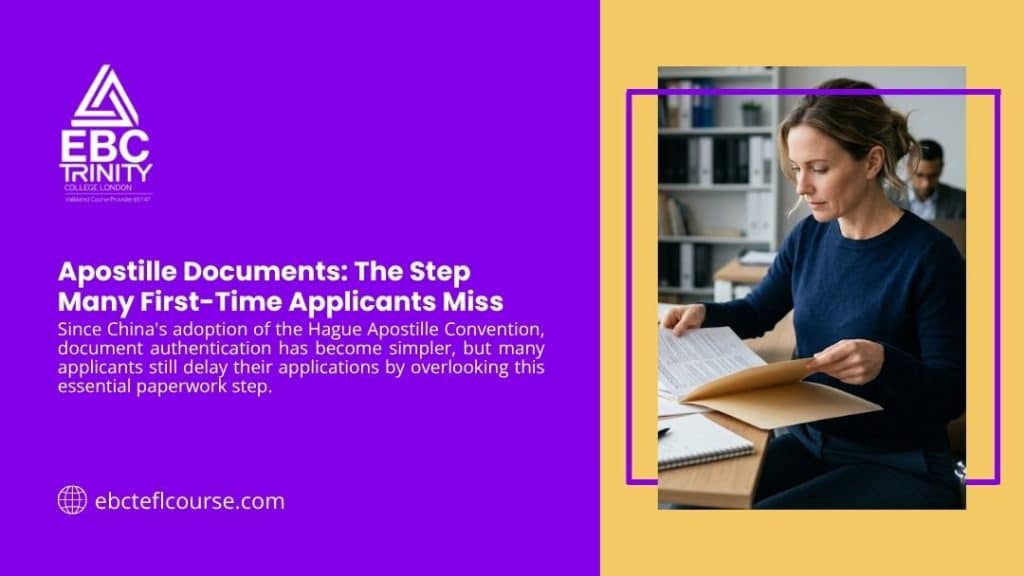
China joined the Hague Apostille Convention in late 2023, replacing the old triple-legalization process with a simpler apostille stamp for degree certificates and background check documents.
Degree, TEFL, Experience, and Work Visa Explained
The bachelor’s degree is the legal foundation. Without it, the Z visa application cannot begin.
The Z visa is China’s only valid work authorization for foreign English teachers, and the subject of the degree is irrelevant for visa purposes. Engineering, history, and business all qualify equally.
The 120-hour TEFL certification sits alongside the degree as a separate professional requirement. Having a TEFL certificate does not automatically replace a degree, and it was never designed to.
| Credential | Required | Can substitute for a degree? |
| Bachelor’s degree | Z visa application | Not replaceable |
| 120-hour TEFL | Most employer roles | No |
| Teaching experience | Senior positions | No |
Why China’s Requirements Matter More Than Internet Advice
Old forum posts created a persistent idea that enforcement gaps made the rules flexible. They were not flexible. They were under-enforced in certain periods.
In February 2026, Beijing and Shanghai resumed strict enforcement of credential thresholds for Category B foreign workers.
SAFEA now uses a points-based classification system, placing most English teachers in Category B, which requires a degree plus two years of experience, or 60 or more points on the evaluation framework.
Penalties for working without a Z visa include personal fines up to 20,000 RMB, deportation, and re-entry bans of one to five years. Employers who ignore the rules face fines between 10,000 and 100,000 RMB.
If you are researching requirements across Asia more broadly, understanding whether teaching English in Japan without a degree follows a similar structure is a useful parallel.
Both countries treat the degree as a legal threshold enforced at the visa stage, not a hiring preference left to individual schools.
Can You Teach English in China Without a Degree?
You cannot teach English in China without a degree through any legal full-time route available in 2026.
A bachelor’s degree from an accredited university is a hard legal requirement at the Z visa stage. No TEFL certification, amount of teaching experience, or level of English proficiency changes that.
| Scenario | Legal status | Risk level | Practical takeaway |
| Full-time teaching on Z visa | Requires degree | N/A | Not accessible without one |
| Teaching on tourist or business visa | Illegal | Very high | Fines, deportation, re-entry bans |
| Volunteer program in China | Varies by program | Lower | Short-term and unpaid only |
| Student exchange or internship | Program-specific | Medium | Not a career pathway |
What the Law and Employer Expectations Usually Require
China’s work permit system does not give individual schools any discretion over the degree requirement.
Only registered, licensed institutions can legally apply for a work permit on a teacher’s behalf.
A school willing to hire you but unable to provide Z visa sponsorship is either unlicensed or creating conditions that put you outside legal employment.
The legal standard is consistent: one accredited degree authenticated with an apostille, a 120-hour TEFL certificate, a clean criminal record, and employment through an authorized institution.
Why Some People Think It Is Possible Anyway
Two things keep this idea alive:
The first is outdated content. Posts written before China’s enforcement tightening in 2022 and 2023 described provincial grey areas that no longer apply consistently across the country.
The second is individual stories. Someone worked informally on a business visa for a few months and left without consequences.
That is a real event. It is also an illegal arrangement, not a repeatable strategy, and the risks tied to it in 2026 are considerably higher than when those stories first circulated.
Possible in conversation is not the same as legal in practice.
What Can You Do If You Do Not Have a Degree?
Not having a degree closes China for now. It does not close the broader English teaching market. The global ELT industry is valued at approximately $95 billion in 2026, with more than 2 million TEFL positions available worldwide each year.
| Option | Legal | Entry difficulty | Best for |
| TEFL + teach in eligible countries | Yes | Low | Those ready to teach now |
| Online ESL teaching | Yes | Low | Flexible schedule seekers |
| Complete a degree | Yes | Medium | Long-term China goal |
| Volunteer program abroad | Yes | Low | Building first classroom experience |
TEFL Certification as a First Step
Getting TEFL certified is the right first move regardless of where you end up teaching. It builds core classroom competence, opens paid roles in markets that do not require a degree, and strengthens any future China application once the degree is in place.
What TEFL certification specifically improves:
- Eligibility for paid positions in countries where a degree is not required
- Earning potential on online ESL platforms, ranging from $10 to $40 USD per hour and increasing with experience and specialization
- Professional credibility when applying to schools or developing a private client base
TEFL helps. For China specifically, it does not replace the degree requirement.
Other Legal or Lower-Risk Routes Worth Exploring
Several countries hire TEFL-certified teachers without a degree and offer paid, structured roles that build genuine professional experience.
Thailand and Vietnam are two of the most accessible starting points in Southeast Asia. Both accept 120-hour TEFL holders for paid positions without a bachelor’s degree as a prerequisite.
Within Asia, researching whether you can teach English in Korea without a degree is a productive next step. South Korea’s program-based visa categories create different entry points compared to China’s employer-sponsored work permit structure.
For those open to Europe, looking into whether you can teach English in Italy without a degree reveals a private language school market that operates under more flexible hiring conditions than East Asian markets generally allow.
These are not consolation choices. They are legitimate career starting points that build the classroom hours and professional credibility that competitive markets like China look for.
What Not to Waste Time On
A few things circulate in this space that consistently lead people the wrong direction:
- Recruiters promising Z visa sponsorship for non-degree candidates are either misinformed or working outside legal structures
- Volunteer programs in China are short-term and unpaid and do not convert into legal work permits
- “We will sort the visa later” from a potential employer is not a compromise, it is a signal that you would be working illegally
- Unaccredited TEFL certificates will not change your Z visa eligibility under any circumstances
None of these are shortcuts. All of them create risk with no reliable upside.
What Makes a Strong TEFL Candidate for China?
If China is the long-term goal, the productive question shifts from how to get in without a degree to how to build the strongest possible application for when that requirement is met.
| Profile asset | Why it matters | How to build it | Time needed |
| 120-hour TEFL certificate | Minimum hiring standard | Accredited online course | 4 to 12 weeks |
| Online ESL teaching experience | Proves real classroom competence | ESL teaching platforms | Ongoing |
| Lesson planning ability | Demonstrates pedagogical readiness | TEFL training and practice | Included in course |
| Authenticated documentation | Required for Z visa | Apostille services | 2 to 6 weeks |
Skills That Improve Your Chances
China’s private language centers serve students from kindergarteners through to corporate professionals.
Schools look for teachers who can explain grammar in plain terms, manage a class of beginners with confidence, and adapt lessons to different age groups and learning levels.
Online teaching experience carries real weight in this market.
Many strong applicants for English teaching jobs in China point to years of online ESL work as their primary proof of classroom capability. It does not replace the degree, but it builds everything else around it considerably.
Documents and Readiness Signals Employers Care About
When preparing for TEFL certification for China-bound applications, document quality matters as much as the certificate itself.
Employers and visa authorities look for:
- An authenticated bachelor’s degree with a current apostille stamp
- A 120-hour TEFL certificate from an internationally accredited provider
- A national criminal background check issued within six months of application
- A valid passport from one of the government-recognized nationality countries
Clean and complete documentation signals professionalism before an interview starts. In a competitive market, that matters.
Common Mistakes and Misconceptions
Most frustration around how to teach English in China without a degree traces back to the same assumptions. Addressing them directly removes confusion that most other content leaves unresolved.
| Myth | Fact |
| TEFL alone qualifies you for legal teaching | TEFL works alongside a degree, not in place of it |
| Any school can sponsor a Z visa | Only licensed, registered schools can legally issue work permits |
| One person’s story equals a strategy | Individual exceptions are not repeatable policy |
| Older posts saying “it’s possible” still apply | Enforcement has tightened significantly since 2022 |
“TEFL Alone Is Enough”
This is the most consistent false assumption in this space. A 120-hour TEFL certificate is a mandatory component of a China teaching application. It is not the foundation.
The degree is. TEFL strengthens a complete application. It does not complete an incomplete one, and no certification level changes the Z visa’s degree requirement.
“Any School Can Sponsor Me”
Only schools registered and licensed to hire foreign nationals can legally apply for a work permit on your behalf.
A school that wants to hire you but cannot provide Z visa sponsorship is either unlicensed or asking you to work without legal authorization.
Both scenarios carry consequences for the teacher.
“If One Person Did It, I Can Too”
Someone who taught informally in China years ago and left without consequences was operating in a different enforcement environment than 2026.
The legal risk tied to those arrangements has grown materially. Treating isolated outcomes as a planning basis is how people end up with fines, deportation records, and multi-year re-entry bans.
Frequently Asked Questions
Can you teach English in China without a degree?
No, a bachelor’s degree from an accredited university is a legal requirement for the Z visa, which is China’s only valid work authorization for English teachers. There are no exceptions at the application stage, regardless of experience or certification level.
Can I teach English in China without a degree if I have strong teaching experience?
No, teaching experience improves your points score under SAFEA’s evaluation framework but does not substitute for the degree in the Z visa application itself. Both are separate criteria evaluated independently.
Is a TEFL certificate enough to teach in China?
A TEFL certificate is required but not sufficient on its own. Legal English teaching jobs in China require both a 120-hour TEFL certification and a bachelor’s degree. One without the other does not meet the legal hiring standard.
What visa do you need to teach English in China?
The Z visa is China’s only legal work authorization for foreign English teachers. Teaching on a tourist or business visa is illegal and carries penalties including fines and re-entry bans of one to five years.
Can non-native speakers teach English in China?
China officially recognizes seven nationalities for native English-speaker classification under the Z visa framework: USA, UK, Canada, Ireland, Australia, New Zealand, and South Africa.
Some provinces have expanded their accepted nationality list. Non-native speakers face a significantly harder legal pathway and should verify current regional requirements directly.

Start Building the Profile That Opens the Right Doors
Getting TEFL certified now is the clearest, most productive step available, regardless of whether China is your immediate destination or a longer-term goal.
EBC TEFL Course has been training and placing English teachers for over 23 years, with more than 5,000 students trained and placed in jobs across global teaching markets.
Internationally accredited and 100% online, our programs are self-paced, mobile-friendly, and designed for people who are serious about building a real teaching career on their own schedule.
Start your certification with EBC TEFL Course today and build the credentials that make your application competitive when you are ready.