
Key Points
- Intercultural communicative competence (ICC) is essential for effective and appropriate cross-cultural language teaching. Developing ICC enhances student engagement, reduces cultural misunderstandings, and improves teachers’ adaptability in diverse classrooms worldwide. Overcoming systemic barriers through micro-activities and ongoing self-assessment fosters practical intercultural growth for TEFL professionals.
Intercultural communicative competence (ICC) is defined as the ability to communicate appropriately and effectively across cultural boundaries, combining linguistic knowledge with cultural awareness, openness, and sensitivity. For anyone considering teaching English as a foreign language, ICC is not a supplementary skill. It is the foundation of effective classroom practice. Research confirms that ICC in EFL classrooms is widely acknowledged as important, yet frequently underdeveloped in practice due to curriculum constraints and insufficient teacher training. Understanding the role of intercultural skills in TEFL gives you a measurable professional advantage, whether you plan to teach in East Asia, Latin America, the Middle East, or Europe.
How do intercultural skills enhance teaching English as a foreign language?
Intercultural competence in language teaching acts as a mediator between linguistic content and the cultural context in which that content carries meaning. A teacher who understands only grammar and vocabulary delivers half a lesson. The other half, the part that makes language stick, is the cultural layer: why certain phrases are polite in one context and offensive in another, how eye contact signals respect or challenge depending on the country, and why silence in a Japanese classroom is not disengagement but reflection.

Teachers with strong intercultural skills create classrooms where students feel seen. This matters enormously for language acquisition. When learners recognise their own cultural references in lesson materials, or when a teacher responds to a cultural misunderstanding with curiosity rather than correction, students become more willing to take the linguistic risks that accelerate fluency. ICC fosters cultural awareness and effective communication among learners, which directly supports their preparation for global citizenship.
Specific teacher behaviours that promote intercultural dialogue include:
- Inviting students to share how a concept or phrase translates culturally in their own language
- Using authentic materials from multiple English-speaking cultures, including Nigerian, Singaporean, and Australian English, rather than defaulting exclusively to British or American sources
- Structuring discussions that ask students to compare cultural norms rather than simply describe them
- Modelling cultural humility by acknowledging when the teacher does not know a cultural reference and treating that as a shared learning moment
- Responding to cultural misunderstandings with structured reflection rather than immediate correction
Pro Tip: When planning a lesson on idioms, ask students to find a cultural equivalent in their own language first. This single activity builds ICC, deepens vocabulary retention, and gives you real insight into your students’ cultural frameworks.
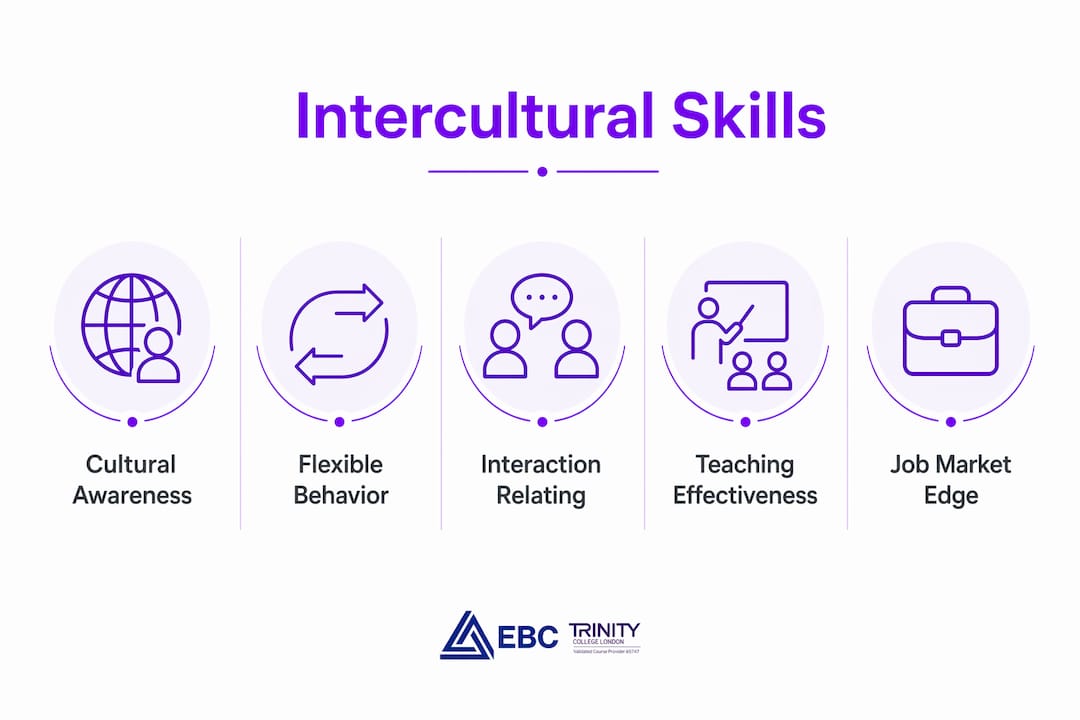
The correlation between intercultural skills and teaching effectiveness is well supported. Intercultural effectiveness behaviours, including flexible cultural behaviour, interaction relaxation, and context-sensitive communication, are observable and teachable. This means ICC is not a personality trait you either have or lack. It is a professional skill set you can build deliberately.
What challenges do TEFL teachers face in applying intercultural skills?
Knowing the importance of intercultural competence in language teaching and actually applying it in a classroom are two different things. Research consistently identifies a gap between teachers’ beliefs about ICC and their in-class practices. The causes are systemic, not personal.
The four most common barriers are:
- Curriculum and testing pressure. When national curricula prioritise grammar accuracy and exam scores, teachers face real tension between covering required content and creating space for cultural exploration. This is particularly acute in contexts such as South Korea, Japan, and parts of the Gulf region, where high-stakes English exams dominate the academic calendar.
- Limited ICC-focused training. Most initial teacher training programmes focus on lesson planning, classroom management, and linguistic knowledge. ICC-focused teacher training is frequently absent or treated as optional, leaving teachers without practical frameworks for integrating cultural content.
- Insufficient materials. Standard coursebooks often present a narrow, Western-centric view of English. Teachers who want to incorporate diverse cultural perspectives must frequently create or adapt their own materials, which takes time many do not have.
- The belief-practice gap. Systemic constraints including testing demands, curricula focus, and class size are identified as key barriers causing a gap between belief in and practice of ICC. Teachers who value intercultural learning often cannot act on that value within the structures they work in.
“Effective intercultural teaching requires more than attitude. It demands training aligned with curriculum and evaluation systems.” — Research insight from a Springer Nature study on EFL instructors’ in-class ICC practices.
The practical answer to these constraints is the micro-ICC approach. Rather than designing standalone cultural units, micro-ICC activities embedded into regular lessons can foster intercultural learning despite time pressures. A two-minute cultural comparison prompt at the start of a grammar lesson, a structured discussion question that asks students to consider how a topic is viewed differently across cultures, or a brief reflection on a culturally loaded vocabulary item: these are low-cost, high-impact ways to keep ICC alive within a constrained curriculum. You do not need a full lesson redesign. You need intentional moments.
How can TEFL teachers develop and measure their intercultural effectiveness?
The Intercultural Effectiveness Scale (IES) is the most validated instrument currently available for measuring intercultural competence behaviours in practising EFL teachers. A 2026 Frontiers study with Chilean EFL teachers confirmed the IES’s strong psychometric properties, making it a reliable tool for both self-assessment and programme evaluation. Chile’s national teacher training standards explicitly require intercultural and cultural analysis skills as part of English teaching programmes, reflecting a broader global shift towards treating ICC as a core professional standard rather than an elective quality.
The IES measures three observable dimensions of intercultural effectiveness: flexible cultural behaviour, interaction relaxation, and context-sensitive communication. Each dimension translates directly into classroom practice, which makes the scale useful not just for measurement but for targeted professional development.
| IES dimension | What it looks like in the classroom |
|---|---|
| Flexible cultural behaviour | Adjusting teaching style, examples, and expectations based on students’ cultural backgrounds |
| Interaction relaxation | Maintaining composure and openness during cross-cultural misunderstandings or unexpected student responses |
| Context-sensitive communication | Choosing language, tone, and content that fits the specific cultural and institutional setting |
Beyond the IES, rubrics and observable behaviour frameworks are essential to shift ICC teaching from informal goals to measurable classroom practices. A simple self-assessment checklist, reviewed weekly, can reveal patterns in your own teaching that are invisible in the moment. You might notice, for example, that you consistently use British cultural references in your examples, or that you rarely invite students to share their own cultural perspectives. These are fixable habits once you can see them.
Pro Tip: Use the IES dimensions as a personal observation framework. After each lesson, spend two minutes noting one moment where you demonstrated flexible cultural behaviour and one moment where you could have done better. Over a term, this builds a precise picture of your intercultural growth.
Professional development approaches that target ICC include peer observation with a cultural focus, reflective journalling, and participation in intercultural communication in TEFL training that goes beyond surface-level cultural facts. The goal is to develop intercultural skills in TEFL that are responsive, not just informational. Knowing that Thai students tend to avoid direct disagreement is information. Knowing how to create a classroom environment where they feel safe to express a different opinion is a skill.
Why intercultural skills open doors in the global TEFL job market
The benefits of cultural awareness in TEFL extend well beyond the classroom. Intercultural competence is now a recognised differentiator in competitive TEFL job markets across Asia, the Middle East, Africa, and Latin America. Employers in international schools, language institutes, and university English departments increasingly look for teachers who can demonstrate cultural adaptability, not just linguistic qualifications.
The career advantages of strong intercultural skills include:
- Higher employability in diverse settings. Schools in multicultural cities such as Dubai, Singapore, and São Paulo actively seek teachers who can manage classrooms with students from ten or more different national backgrounds simultaneously.
- Stronger student rapport. Teachers who demonstrate genuine cultural curiosity build trust faster. Trust accelerates learning. This is a measurable outcome that school directors notice.
- Better personal adaptation abroad. Cultural adjustment is one of the leading reasons new TEFL teachers leave their posts within the first year. Teachers with developed ICC navigate culture shock more effectively, settle into their communities faster, and report higher job satisfaction.
- Access to specialist roles. Intercultural skills support progression into roles such as curriculum development, teacher training, and cultural sensitivity in TEFL, which carry higher salaries and greater professional recognition.
- Contribution to global citizenship education. Higher intercultural competence in teachers correlates with more inclusive classrooms and better preparation of students for global citizenship. This is a quality that international schools and NGO-funded English programmes specifically value.
The essential skills for TEFL teachers increasingly include ICC as a core component, not an optional extra. If you are planning to teach in a country where you have limited prior cultural exposure, investing in intercultural skill development before you arrive is one of the most practical preparations you can make.
How EBC prepares you to teach with intercultural confidence
EBC equips aspiring English teachers with the intercultural competence and practical classroom skills needed to succeed in diverse teaching environments worldwide. Through Trinity College London accredited programmes, including the Trinity CertTESOL and specialist skills courses, you gain structured training that addresses real classroom challenges, including cultural adaptation, inclusive teaching, and cross-cultural communication.
Whether you are planning to teach in Asia, Latin America, the Middle East, or through one of EBC’s one-year study and work abroad programmes in Spain, France, or Italy, the training you receive is designed for global classrooms. EBC also provides free lifetime job placement support, giving you ongoing career guidance long after your certification is complete. Explore your options through the TEFL skills courses or take the first step with an introduction to teaching English abroad and book a free consultation today.
Key takeaways
Intercultural communicative competence is a measurable, teachable skill set that directly determines your effectiveness as a TEFL teacher and your success in adapting to life and work abroad.
| Point | Details |
|---|---|
| ICC is a core teaching skill | Intercultural competence combines cultural awareness with linguistic knowledge to improve student engagement and learning outcomes. |
| Systemic barriers are real but manageable | Curriculum pressure and limited training create a belief-practice gap; micro-ICC tasks offer a practical solution within constrained settings. |
| The IES provides a measurement framework | The Intercultural Effectiveness Scale measures flexible behaviour, interaction relaxation, and context-sensitive communication in EFL teachers. |
| ICC improves career prospects globally | Employers across Asia, the Middle East, Africa, and Latin America prioritise teachers who demonstrate cultural adaptability alongside qualifications. |
| Ongoing reflection builds ICC over time | Weekly self-assessment using observable behaviour frameworks accelerates intercultural skill development more reliably than one-off training. |
FAQ
What is the role of intercultural skills in TEFL?
Intercultural skills in TEFL enable teachers to communicate effectively across cultural boundaries, connect linguistic content to cultural context, and create inclusive classrooms where all students feel represented. Research confirms that ICC in EFL settings is acknowledged as important but frequently underdeveloped due to systemic constraints.
How can TEFL teachers develop intercultural competence?
Teachers can develop intercultural competence through structured training, peer observation with a cultural focus, and regular self-assessment using tools such as the Intercultural Effectiveness Scale. Embedding micro-ICC activities into everyday lessons is one of the most practical ways to build this skill within normal curriculum demands.
Does intercultural competence improve TEFL job prospects?
Yes. Schools in multicultural cities and international teaching contexts actively seek teachers who demonstrate cultural adaptability. Higher intercultural competence correlates with more inclusive classrooms, stronger student outcomes, and access to specialist roles in curriculum development and teacher training.
What is the Intercultural Effectiveness Scale?
The Intercultural Effectiveness Scale (IES) is a validated instrument that measures observable intercultural competence behaviours in EFL teachers across three dimensions: flexible cultural behaviour, interaction relaxation, and context-sensitive communication. A 2026 Frontiers study confirmed its strong psychometric properties for use in professional development and programme evaluation.
Why do TEFL teachers struggle to apply intercultural skills in class?
The primary barriers are curriculum and testing pressure, limited ICC-focused initial training, and a lack of culturally diverse teaching materials. Research identifies these systemic constraints as the main cause of the gap between teachers’ beliefs about ICC and their actual classroom practices.