
Key Points
- Assessment in TEFL involves collecting learner data to guide instruction and improve language acquisition. It encompasses diagnostic, formative, summative, and performance-based assessments, with frameworks like the CEFR providing standardized descriptors for measuring progress. Mastery of assessment techniques enhances teaching effectiveness and employability in the global TEFL market.
Assessment in TEFL is the structured process of collecting and analysing learner performance data to inform teaching decisions and improve language acquisition. Known formally as language assessment, it sits at the heart of every effective English lesson, whether you are teaching in Seoul, São Paulo, or Seville. Frameworks like the Common European Framework of Reference for Languages (CEFR), resources from the British Council, and research-backed tools such as formative feedback all fall under this umbrella. Understanding what assessment in TEFL means, and how to apply it, is one of the most practical skills you can develop as an aspiring English teacher.
What are the main types of assessment used in TEFL?
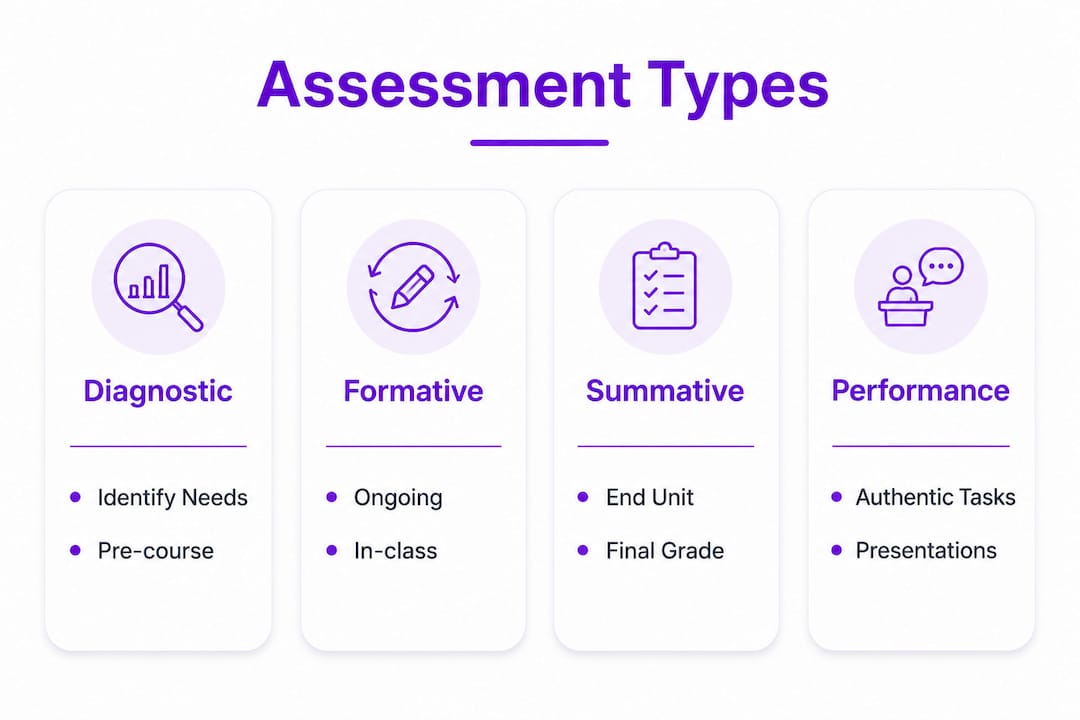
Assessment in TEFL divides into four core types, each serving a distinct purpose at a different stage of learning.
Diagnostic assessment happens at the start of a course or unit. It tells you what learners already know and where the gaps are. A placement test, a writing sample, or a short speaking task all function as diagnostic tools. Without this baseline, you risk pitching lessons too high or too low for your class.
Formative assessment is ongoing. It happens during lessons through activities, questions, and feedback. Formative assessment integrated into daily lessons improves grammar and writing structure significantly. That improvement comes because teachers can adjust their instruction in real time, before misunderstandings become habits.
Summative assessment evaluates learning at the end of a unit, term, or course. Examples include end-of-term written exams, oral proficiency tests, and portfolio reviews. Relying solely on summative tests can lead to missed early interventions and student anxiety. The risk is real: if you only measure learning at the finish line, you have no opportunity to redirect learners who are heading off course.
Performance-based assessment asks learners to demonstrate language in authentic contexts. Presentations, role plays, debates, and project work all qualify. This type is particularly valued in communicative language teaching because it mirrors real-world language use.
| Assessment Type | Purpose | Timing | Classroom Example |
|---|---|---|---|
| Diagnostic | Identify starting point | Course or unit start | Placement test, writing sample |
| Formative | Monitor ongoing progress | Throughout lessons | Exit tickets, peer feedback |
| Summative | Measure final achievement | End of unit or course | Written exam, oral test |
| Performance-based | Assess real-world language use | Mid or end of course | Presentation, role play |
Pro Tip: Never rely on just one type. A balanced mix of diagnostic, formative, summative, and performance-based tasks gives you the fullest picture of each learner’s progress.
How do formal and informal assessment methods work in TEFL?
Formal and informal assessment serve complementary roles in a TEFL classroom, and understanding both makes you a more adaptable teacher.

Formal assessment is planned, graded, and conducted under controlled conditions. It produces a mark or standardised score that can be reported to institutions, parents, or employers. Trinity College London examinations and Cambridge ESOL tests are well-known examples of formal assessment instruments used globally.
Informal assessment is continuous and observational. It happens during every lesson, often without learners realising they are being assessed. You watch how a student handles a group task, listen to pronunciation during a speaking activity, or note who is struggling with a grammar point. This information shapes your next lesson without the pressure of a formal test environment.
The two methods build a complete picture together. Formal results tell you where a learner stands against an external standard. Informal observations tell you why they are there and what to do next.
Examples of each method include:
- Formal: Written examinations, standardised placement tests, Trinity CertTESOL assessed lessons, IELTS-style tasks
- Formal: Graded oral interviews, structured portfolio assessments
- Informal: Teacher observation during pair work, quick comprehension checks, thumbs-up/thumbs-down responses
- Informal: Exit slips, anecdotal notes, learner self-reports at the end of a lesson
Pro Tip: Use informal assessment deliberately to reduce student anxiety. When learners do not feel constantly tested, they take more risks with language, which is exactly when real acquisition happens.
How does the CEFR guide assessment in TEFL classrooms?
The Common European Framework of Reference for Languages (CEFR) is the global standard for describing language proficiency, used by teachers, institutions, and employers across more than 40 countries. Its six levels, A1 through C2, provide a shared language for discussing what a learner can do at any given point.
CEFR descriptors cover speaking, listening, reading, and writing, and they are standard practice in TEFL assessment worldwide. Each descriptor is written as a “can do” statement. At B1, for example, a learner “can understand the main points of clear standard input on familiar matters.” That specificity makes it far easier to design assessment tasks that are appropriately pitched.
In practical terms, you use the CEFR to place new learners, track progress over a course, and set targets for upcoming lessons. A learner arriving at A2 and leaving at B1 has a measurable, internationally recognised achievement. That matters enormously when learners need to demonstrate their level to universities or employers worldwide.
| CEFR Level | Descriptor Summary | Typical Assessment Task |
|---|---|---|
| A1 | Can understand and use familiar everyday expressions | Picture description, simple Q&A |
| A2 | Can communicate in simple, routine tasks | Short written messages, guided dialogue |
| B1 | Can deal with most situations likely to arise whilst travelling | Opinion essay, informal interview |
| B2 | Can interact with a degree of fluency and spontaneity | Debate, report writing |
| C1 | Can express ideas fluently and spontaneously | Academic presentation, complex text analysis |
| C2 | Can understand virtually everything heard or read | Dissertation-level writing, advanced discussion |
The IATEFL community regularly publishes guidance on CEFR-aligned assessment design, making it a strong resource for teachers building their assessment literacy at any stage of their career.
What innovative assessment strategies work for large classes?
Large classes present a genuine challenge for TEFL teachers. When you have 30 or more learners, individual feedback becomes time-consuming and traditional testing becomes logistically difficult. Peer and self-assessment are the most practical solutions.
Peer and self-assessment reduce teacher workload while increasing learner autonomy and motivation. When learners assess each other’s writing or speaking, they engage more critically with the language. They also develop the metacognitive awareness that makes independent learners.
Self-assessment does carry one important risk. Comparing student self-assessment to teacher observation identifies crucial gaps for support. Some learners overestimate their ability; others underestimate it significantly. Calibration, the process of aligning a learner’s self-perception with actual performance, is a skill you actively teach rather than assume.
Effective monitoring is equally important. Transform monitoring from passive help into active assessment by planning what to listen for and how to use the information. Before a speaking task, decide whether you are listening for accuracy, fluency, or vocabulary range. That focus turns a walk around the classroom into a genuine data-collection exercise.
Here are five practical strategies for managing assessment in large classes:
- Use peer feedback rubrics. Give learners a simple checklist to assess a partner’s spoken or written output. This structures the feedback and teaches assessment criteria simultaneously.
- Build in a lesson proof point. Planning lesson stages with specific student output allows ongoing, practical assessment within lessons. A short written response or a spoken summary at the end of a task tells you immediately whether the objective was met.
- Rotate your monitoring focus. In one lesson, focus on pronunciation. In the next, track vocabulary use. Rotating your focus means you build a comprehensive profile over time without overwhelming yourself.
- Use exit tickets. A single question answered in writing at the end of a lesson takes two minutes and reveals exactly who understood the lesson and who did not.
- Calibrate self-assessment regularly. Ask learners to rate their confidence on a task before and after completing it, then compare their rating to your observation. Discuss discrepancies openly.
Pro Tip: Start peer assessment with low-stakes tasks like checking a partner’s vocabulary list. Build learner confidence in the process before using it for graded work.
Why does assessment mastery improve your TEFL job prospects?
Assessment proficiency is a direct signal of teaching quality, and employers worldwide recognise it. Schools in Japan, the UAE, Germany, and across Latin America consistently list assessment knowledge as a desirable skill in TEFL job advertisements. Understanding how to evaluate learners accurately tells a recruiter that you can plan lessons with purpose, track progress, and report outcomes clearly.
Your knowledge of TEFL assessment techniques also strengthens your lesson planning. When you know what you are measuring and why, every activity in your lesson has a clear function. That coherence shows in observed lessons, which are a standard part of the hiring process at many international schools.
Assessment literacy also builds your confidence in the classroom. Teachers who understand the difference between formative and summative evaluation, who can apply CEFR descriptors, and who can manage peer assessment in a class of 35 learners are simply more effective. That effectiveness translates directly into better student outcomes, stronger references, and faster career progression.
Assessment-related skills valued by TEFL recruiters globally include:
- Ability to design and interpret placement and progress tests
- Knowledge of CEFR levels and their practical application in lesson planning
- Experience with formative feedback techniques, including written and oral commentary
- Competence in managing peer and self-assessment activities
- Familiarity with formal assessment instruments such as Trinity College London examinations
- Capacity to track and report learner progress to parents, coordinators, and institutions
- Understanding of assessment validity, reliability, and washback effects on learning
Demonstrating these skills in your CV, cover letter, and observed lessons sets you apart in a competitive global market. Pairing them with a recognised qualification, such as the Trinity CertTESOL, gives you the credibility to back up those claims.
Key takeaways
Effective assessment in TEFL requires a balanced combination of diagnostic, formative, summative, and performance-based methods, guided by frameworks like the CEFR and applied consistently across formal and informal contexts.
| Point | Details |
|---|---|
| Assessment is systematic | Collect learner performance data deliberately to inform every teaching decision you make. |
| Balance all four types | Use diagnostic, formative, summative, and performance-based assessment together for a complete picture. |
| CEFR provides the standard | Align tasks to A1–C2 descriptors to set measurable, internationally recognised learning targets. |
| Informal assessment is powerful | Daily observation and feedback shape instruction without the pressure of formal testing. |
| Assessment skills boost employability | Recruiters worldwide value teachers who can design, apply, and report on learner assessment confidently. |
Build your assessment skills with EBC
EBC prepares teachers to assess learners with confidence, from their very first lesson to advanced professional practice. Through Trinity College London accredited programmes, including the Trinity CertTESOL, you gain hands-on experience with real assessment tasks, CEFR-aligned frameworks, and practical feedback techniques used by schools across Europe, Asia, the Americas, and beyond.
Whether you are starting out or looking to deepen your teaching expertise, EBC offers a full range of TEFL courses designed to build the skills that global employers are actively seeking. Explore your options and book a free consultation today to find the right programme for your goals.
FAQ
What is the difference between formative and summative assessment in TEFL?
Formative assessment happens continuously during lessons to guide teaching, while summative assessment evaluates overall learning at the end of a course or unit. Both are necessary for a complete picture of learner progress.
How does the CEFR help teachers assess english learners?
The CEFR provides “can do” descriptors across six levels, from A1 to C2, giving teachers a standardised framework for designing tasks, placing learners, and tracking measurable progress over time.
Can peer assessment work effectively in large TEFL classes?
Peer assessment reduces teacher workload and increases learner autonomy in large classes. Using structured rubrics and starting with low-stakes tasks makes the process manageable and productive for all learners.
Why is assessment literacy important for TEFL job applications?
Employers worldwide expect TEFL teachers to design, apply, and report on learner assessments accurately. Demonstrating this knowledge in your CV and observed lessons significantly strengthens your candidacy in competitive global markets.
What is a lesson proof point and why does it matter?
A lesson proof point is a specific student output, such as a written response or spoken summary, planned into a lesson to check whether the learning objective was met before moving to formal testing.