
Key Points
- Microteaching allows teacher trainees to practice specific instructional skills in short, focused lessons. It provides immediate feedback and reflection, building confidence and competence for full classroom teaching. This method enhances professional development and improves employability through structured, demonstrable skill mastery.
Microteaching is a teacher training method that involves delivering short, focused lessons to small groups to practise and improve specific instructional skills. Typically lasting 5–10 minutes with groups of 5–10 pupils, it strips away the complexity of a full classroom to let you concentrate on one skill at a time. Whether you are preparing for your first teaching role or refining your practice after years in the profession, microteaching gives you a controlled space to build real competence. Its applications extend well beyond teacher education, reaching into business training, counselling, and any field where communication skills matter.
How does microteaching work?
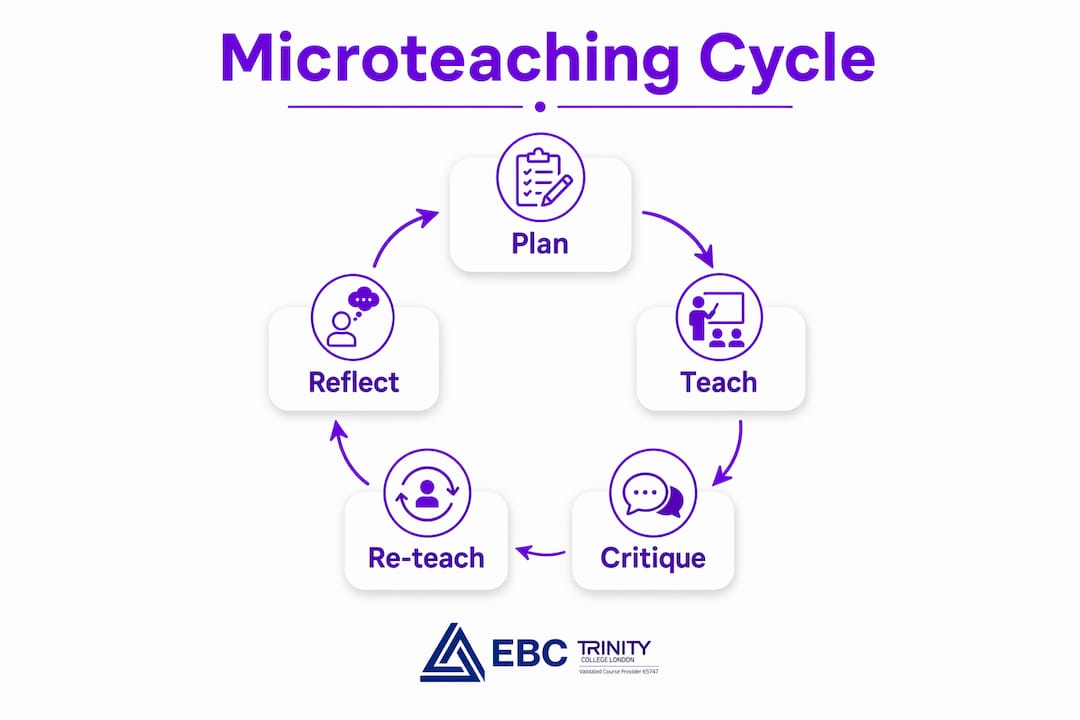
Microteaching follows a structured cycle that turns a brief teaching moment into a powerful learning experience. The process is deliberate and repeatable, which is what makes it so effective.
The standard cycle runs as follows:
- Plan your micro-lesson, focusing on one specific skill (30–60 minutes).
- Teach the lesson to a small group of peers or learners (5–10 minutes).
- Receive feedback from observers, focusing on observable behaviours (10–15 minutes).
- Reflect on the feedback and identify what to change.
- Revise your lesson plan based on what you have learned.
- Re-teach the revised lesson, applying the feedback directly (20–30 minutes for the full re-teach phase).
The teach, critique, re-teach framework is the engine of the whole process. Each phase builds on the last, and the re-teach phase is where genuine improvement happens. Treating it as a formality wastes the entire cycle. Observers play a critical role here. Their feedback must be specific and tied to what they actually saw. A comment like “you gave instructions without checking understanding” is constructive and actionable. A comment like “that was good” is not.
Video recording adds another layer of value. Watching yourself teach reveals habits you cannot notice in the moment, such as filler words, pacing issues, or missed opportunities to check comprehension. Many teacher training programmes now use video as a standard part of the microteaching cycle.
Pro Tip: Focus on one skill per session only. Trying to improve questioning technique, pacing, and board work simultaneously creates cognitive overload. Isolate one skill, master it, then move to the next.
What is microteaching used for: key applications and benefits
Microteaching is used to build specific teaching competencies in a low-risk environment. John Hattie’s research ranks microteaching as the 6th most effective method for improving student outcomes. That ranking reflects how much concentrated, feedback-driven practice matters compared to simply accumulating hours in front of a class.
The core applications and benefits include:
- Skill acquisition in the classroom. Microteaching targets six core pedagogical skills: set induction, explanation, probing questions, reinforcement, stimulus variation, and blackboard writing. Practising these in isolation builds a reliable toolkit for real lessons.
- Building confidence before full-sized classes. Teaching a group of five peers feels very different from facing thirty students. Microteaching closes that gap gradually, so you arrive in a real classroom with experience rather than anxiety.
- Preventing bad habits from forming. Immediate feedback catches problems early, before they become ingrained. A new teacher who learns to check comprehension in microteaching will carry that habit into every lesson they teach.
- Application beyond education. Microteaching extends into business and counselling to develop soft skills such as persuasion, negotiation, and active listening. It acts as a safe laboratory for skill experimentation in any communication-heavy profession.
- Continuous professional development. Microteaching supports reflective practice and professional growth among both novice and experienced teachers. It is not a one-time exercise but a repeatable tool you can return to throughout your career.
- Career advancement. Demonstrating that you have engaged in structured, reflective microteaching signals to employers that you take your professional development seriously. That matters in competitive global teaching markets.
The microteaching benefits are cumulative. Each session adds a layer of competence that compounds over time.
Microteaching vs traditional teaching practice

Microteaching and traditional teaching practice serve different purposes. Understanding the distinction helps you use both more effectively.
| Feature | Microteaching | Traditional teaching practice |
|---|---|---|
| Lesson length | 5–10 minutes | 45–60 minutes or longer |
| Group size | 5–10 peers or learners | 20–35 students |
| Skill focus | One isolated skill per session | Multiple skills managed simultaneously |
| Feedback timing | Immediate, after each session | Delayed, often after a full placement |
| Risk level | Low. Errors are expected and welcomed | Higher. Errors affect real learners |
| Reflective opportunity | Built into the cycle | Depends on mentor availability |
| Authenticity | Controlled and artificial | Authentic and unpredictable |
Microteaching simplifies teaching-learning complexities by scaling down class size, time, task, and content. That simplification is its greatest strength and its main limitation. A microteaching session cannot replicate the unpredictability of a real classroom: a student who refuses to engage, a lesson that runs over time, or a group with wildly different ability levels. These are experiences you can only gain through authentic practice.
The purpose of microteaching is not to replace full teaching practice. It is to prepare you for it. Think of it as the difference between a flight simulator and an actual flight. The simulator builds specific skills in a controlled environment. The real flight tests everything at once. You need both. Microteaching should complement your full teaching placement, not substitute for it.
Practical tips for effective microteaching sessions
Getting the most from microteaching requires deliberate preparation and honest self-assessment. The sessions are short, so every minute counts.
- Select one specific skill per session. Focusing on one skill at a time creates the cognitive space needed for genuine mastery. Decide before you plan whether you are working on questioning, explanation, or stimulus variation.
- Write a concise lesson plan. Your plan should describe exactly how you will demonstrate the target skill. Keep it to one page. The plan is a tool for focus, not a performance document.
- Give and seek specific feedback. Vague feedback wastes everyone’s time. Ask observers to note specific moments: “At minute three, you asked a closed question. How could you have made it open?” That level of detail drives real change.
- Treat the re-teach phase as the main event. The first teach is a data-collection exercise. The re-teach is where you apply what you have learned. Approach it with the same preparation you would give a real lesson.
- Avoid the perfection trap. Microteaching is intentionally about breaking a lesson down to isolate one skill for concentrated practice. It is not a performance. Expecting a flawless lesson defeats the purpose entirely.
- Use video where possible. Reviewing your own footage after a session reveals patterns that observers may miss and that you cannot see in real time.
Pro Tip: After each session, write three sentences: what you planned to do, what you actually did, and what you will change next time. This three-sentence reflection builds the habit of reflective teaching practice that employers value most.
How microteaching enhances employability and career prospects
Microteaching builds the kind of measurable, demonstrable competencies that employers across the world look for in teaching candidates. This is not a theoretical benefit. It shows up directly in how you perform at interview, in the classroom, and in formal assessments.
- Demonstrable teaching skills. Microteaching gives you specific examples to reference in interviews and applications. You can describe exactly which skills you practised, what feedback you received, and how you improved. That specificity is far more convincing than general claims about being a good communicator.
- Reflective practice habits. Microteaching fosters habits of continuous improvement that are critical for professional educator development. Schools and language institutes worldwide prioritise teachers who can self-assess and adapt.
- Preparation for certification. Programmes such as the Trinity CertTESOL incorporate microteaching as a core component of assessed teaching practice. Arriving at your course already familiar with the microteaching cycle gives you a significant advantage.
- Adaptability across diverse classrooms. Microteaching techniques transfer across contexts. Whether you are teaching Business English in Tokyo, CLIL in Madrid, or general English in São Paulo, the skill of isolating and refining your teaching behaviour remains relevant.
- Competitive edge in global markets. The global demand for qualified English teachers is substantial. Candidates who can demonstrate structured professional development in TEFL stand out in markets from East Asia to Latin America and the Middle East.
Microteaching also prepares you for peer observation, a standard feature of many international teaching roles. Teachers who have experienced structured feedback cycles are far more comfortable giving and receiving professional critique. That comfort translates directly into better collaboration and faster career progression. For educators interested in developing presentation and communication skills alongside microteaching practice, combining both approaches accelerates professional readiness considerably.
Take your microteaching skills further with EBC
Microteaching gives you the foundation. A globally recognised qualification gives you the credential to teach anywhere in the world.
EBC offers Trinity College London accredited TEFL and TESOL certification programmes that integrate microteaching into practical, assessed teaching components. The Trinity CertTESOL is recognised by employers across Europe, Asia, Latin America, and beyond. EBC also offers one-year study and work abroad programmes in Spain, France, and Italy, combining accredited teacher training with language study, cultural immersion, and part-time teaching opportunities. If you are ready to put your microteaching skills to work in a real classroom, certification to teach abroad is the logical next step. Book a free consultation with the EBC team to find the right programme for your goals.
Key takeaways
Microteaching is the most direct route to building specific, measurable teaching skills through structured practice, immediate feedback, and deliberate repetition.
| Point | Details |
|---|---|
| Core purpose | Microteaching isolates one teaching skill per session to enable focused, measurable improvement. |
| Structured cycle | The plan, teach, feedback, reflect, revise, re-teach cycle is what makes microteaching effective. |
| Feedback quality | Specific, behaviour-focused feedback drives real change. Vague comments produce no improvement. |
| Broader applications | Microteaching develops soft skills in business and counselling, not only in classroom teaching. |
| Career value | Demonstrable microteaching experience strengthens applications and prepares you for global teaching roles. |
FAQ
What is microteaching used for in teacher training?
Microteaching is used to isolate and practise specific pedagogical skills such as questioning, explanation, and stimulus variation in short, low-risk sessions. It prepares trainee teachers for full classroom practice by building competence and confidence incrementally.
How long does a microteaching session last?
A standard microteaching session lasts 5–10 minutes for the teaching phase, with the full cycle including planning, feedback, and re-teaching running to approximately 60–90 minutes in total.
What are the six core microteaching skills?
The six core skills are set induction, explanation, probing questions, reinforcement, stimulus variation, and blackboard writing. Each skill can be targeted individually across separate microteaching sessions.
Does microteaching replace real classroom experience?
Microteaching complements but does not replace authentic classroom teaching. It builds specific skills in a controlled environment, but full teaching practice is necessary to develop the ability to manage unpredictable, real-world classroom situations.
How does microteaching help with TEFL certification?
Microteaching is a core component of assessed teaching practice in programmes such as the Trinity CertTESOL. Familiarity with the microteaching cycle before your course begins gives you a practical advantage during assessed sessions and observed lessons.