
Key Points
- Mentoring in TEFL involves ongoing relationships where experienced teachers guide new instructors through practical and professional development. It enhances classroom skills, builds confidence, and reduces burnout for teachers working abroad. Choosing a high-quality mentoring program is crucial for long-term success and career growth.
Mentoring in TEFL is defined as a structured, ongoing relationship in which an experienced teacher guides a trainee or early-career instructor through the practical and professional demands of teaching English as a foreign language. The role of mentoring in TEFL goes far beyond classroom observation. It shapes how you think about teaching, how you respond to setbacks, and how quickly you build the confidence to lead a room in Tokyo, Madrid, or Nairobi. Research confirms that mentors act as role models, collaborators, and evaluators, collectively building teacher identity in ways that no textbook can replicate. If you are considering a TEFL career, understanding what good mentorship looks like is one of the most practical decisions you can make.
What are the key roles mentors play in TEFL teacher development?
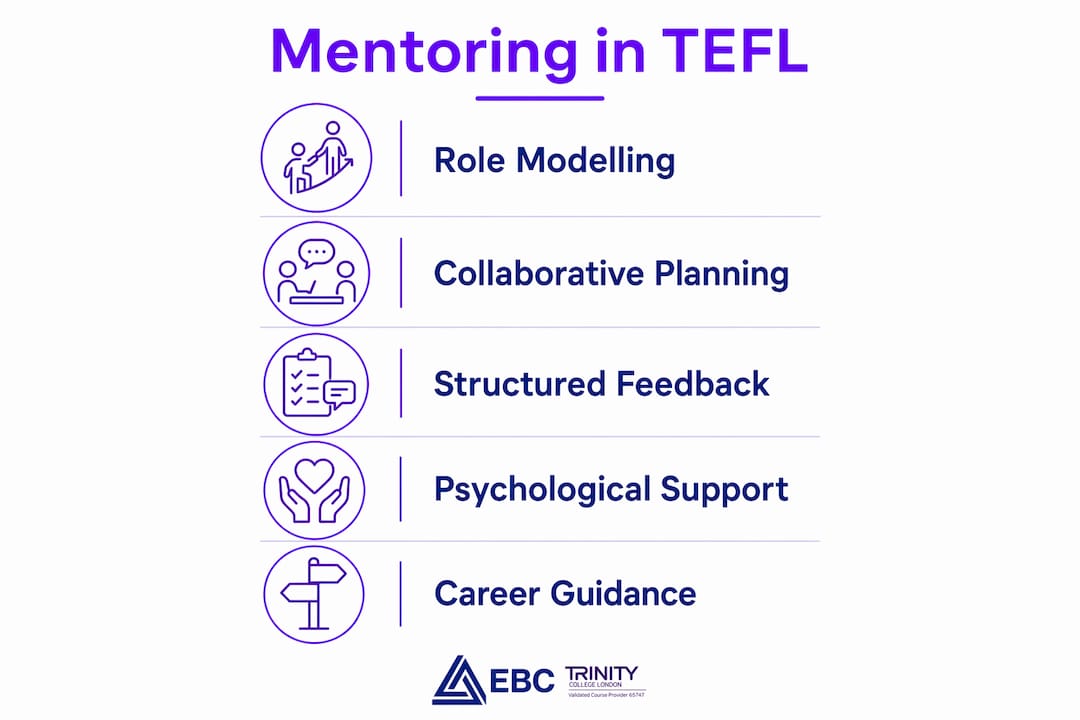
Mentors in TEFL serve three distinct functions, and each one addresses a different gap in a new teacher’s development. Understanding these roles helps you recognise what to look for and what to ask for when you begin your training.
Role modelling is the first and most visible function. When a mentor teaches a class while you observe, you are not just watching technique. You are absorbing professional dispositions: how to manage silence, how to correct errors without deflating a learner, and how to adapt mid-lesson when a plan stops working. This kind of learning cannot come from a course manual. Studies of overseas TEFL practicums show that modelling professional dispositions is one of the most effective ways to build a trainee’s sense of professional identity.
Collaborative lesson planning is the second function, and it is where mentoring becomes genuinely reciprocal. A good mentor does not hand you a lesson plan and walk away. They sit with you, question your assumptions, and help you design activities that match the specific learners in front of you. This co-planning process teaches you to think contextually rather than generically, which is the difference between a competent teacher and an excellent one.
Structured feedback and evaluation is the third function. Feedback after a lesson observation is only useful when it is specific, balanced, and tied to clear criteria. Mentors who provide balanced assessments after observed lessons give trainees a reliable map of their strengths and the areas that need attention. Vague praise or harsh criticism both stall development. Structured feedback accelerates it.
- Mentors model professional behaviour in real classroom settings
- Co-planning builds context-sensitive thinking, not just generic lesson design
- Structured feedback gives trainees a clear development roadmap
- All three roles together build pedagogical confidence and a stable teaching identity
Pro Tip: Ask your mentor to observe at least two contrasting lesson types early in your training. Seeing how an experienced teacher handles a grammar-focused lesson versus a communicative activity reveals far more than a single observation.
How does mentoring improve psychological well-being and career resilience?
New TEFL teachers face a specific kind of pressure that is rarely discussed openly. You are often teaching in a country where you do not speak the local language, managing classrooms of learners with very different needs, and doing so without the professional network you would have at home. That combination produces anxiety, self-doubt, and, in the worst cases, early exit from the profession.
Structured mentoring programmes strongly correlate with lower early-career teacher burnout and attrition. That finding matters because attrition is expensive for teachers and for schools. When a new teacher leaves within the first year, they lose the investment they made in training, and the school loses a resource it spent time and money to recruit. Mentoring reduces that risk by giving teachers a reliable source of professional support before problems become crises.
The psychosocial benefits of mentoring are just as significant as the pedagogical ones:
- Reduced isolation, particularly for teachers working abroad in unfamiliar cultural settings
- Increased confidence through regular, constructive feedback on real lessons
- A clearer sense of professional identity, which sustains commitment through difficult periods
- Emotional support that normalises the challenges of early-career teaching
Mentoring also fosters engagement with professional communities and peer collaboration. A mentor who introduces you to a wider network of teachers, whether through a local staffroom or an international online group, gives you access to collective knowledge that multiplies your own. That network becomes a long-term career asset, not just a short-term support mechanism.
Why is choosing the right TEFL mentor so important?
Mentorship quality is often overlooked by new teachers selecting TEFL courses. Most prospective teachers focus on price and accreditation, which are necessary but not sufficient criteria. A course can carry a respected qualification and still offer mentoring that amounts to little more than a weekly check-in email.
When you evaluate a TEFL programme, ask these questions about its mentoring provision:
- How many hours of one-to-one mentoring are included, and are they timetabled or ad hoc?
- Do mentors have active classroom experience in the regions where you plan to teach?
- Is the mentoring relationship structured around your specific development goals, or is it a generic process applied to all trainees?
- Does the programme build in time for reflective teaching practice, or does it treat observation as a one-way assessment?
- What happens to the mentoring relationship after you complete the course?
Research on effective TEFL mentoring shows that reciprocal, trust-based relationships produce better long-term outcomes than hierarchical expert-to-novice models. The shift matters because it changes what you are expected to bring to the relationship. You are not a passive recipient of wisdom. You are an active participant who brings observations, questions, and reflections to every session.
Pro Tip: Before your first mentoring session, write down three specific teaching moments from the previous week that you found difficult or confusing. Mentees who arrive with specific, evidence-based questions accelerate their growth far faster than those who wait to be told what to work on.
When you choose a TEFL course, treat the quality of its mentoring provision as a primary criterion, not an afterthought. The qualification gets you the interview. The mentoring determines how well you perform once you are in the classroom.
How does mentoring translate into practical skills and global job readiness?
Theory and practice are not the same thing, and the gap between them is where most new teachers struggle. A mentor’s most practical contribution is helping you close that gap in real time, with real learners, in a real classroom.

Mentoring helps teachers bridge pedagogical theory and classroom application. That means a mentor does not just tell you that communicative language teaching is effective. They watch you attempt it, identify where your execution breaks down, and give you specific adjustments to make before your next lesson. That cycle of attempt, observation, and feedback is how practical competence is built.
The practical skills that mentoring develops most effectively include:
- Classroom management strategies adapted to specific cultural contexts, whether you are teaching in South Korea, Italy, or Brazil
- Lesson planning that accounts for mixed-ability groups, a reality in almost every EFL classroom worldwide
- Error correction techniques that maintain learner confidence while building accuracy
- Cultural sensitivity in communication, which is non-negotiable when teaching across borders
Mentoring also extends directly into career support. Mentors aid career outcomes by providing guidance on international job placement, helping teachers understand which markets suit their skills and qualifications, and connecting them with professional networks in target countries. A mentor who has taught in Japan, Spain, or the UAE brings firsthand knowledge of hiring expectations, visa processes, and school cultures that no job board can replicate.
| Practical skill | How mentoring develops it |
|---|---|
| Classroom management | Observed lessons with targeted feedback on specific techniques |
| Lesson planning | Co-planning sessions that build contextual, learner-centred thinking |
| Error correction | Mentor modelling followed by trainee practice and review |
| Cultural adaptation | Mentor experience in target regions shared through guided reflection |
| Career navigation | Direct guidance on job markets, applications, and professional networks |
The lesson observation process is central to all of these outcomes. When observation is linked to structured feedback rather than simple pass-or-fail assessment, it becomes one of the most powerful development tools available to a new teacher. Teachers who receive this kind of mentoring arrive at their first international post with practical skills, not just a certificate.
EBC: mentoring built into every stage of your training
EBC integrates mentoring throughout its Trinity College London accredited programmes, including the Trinity CertTESOL, so that you receive structured support from your first observed lesson to your first international placement.

Whether you are preparing to teach English abroad or looking to build a long-term TEFL career across multiple countries, EBC pairs you with experienced trainers who provide the kind of reciprocal, trust-based mentoring that research identifies as most effective. The free lifetime job placement support means the mentoring relationship does not end when your course does. You can also begin with the TEFL introduction course to understand how mentoring fits into your broader professional development before committing to a full certification pathway. Book a free consultation to find out which programme suits your goals.
FAQ
What is the role of mentoring in TEFL?
Mentoring in TEFL guides new teachers through role modelling, collaborative lesson planning, and structured feedback, building both practical skills and professional identity. Research confirms it is one of the strongest predictors of early-career success and retention.
How does mentoring reduce burnout in new TEFL teachers?
Structured mentoring programmes correlate with lower burnout and attrition by providing consistent professional support, reducing isolation, and building the confidence teachers need to sustain their commitment through challenging early-career periods.
What should I look for when choosing a TEFL mentor?
Prioritise mentors with active classroom experience in your target region and programmes that build in reflective transformation rather than one-way assessment. Reciprocal, trust-based relationships produce better long-term outcomes than hierarchical models.
How does mentoring help with international job placement?
Mentors provide direct career guidance, including knowledge of specific job markets, hiring expectations, and professional networks in countries worldwide. This support aids smoother international placement beyond what a qualification alone can offer.
Can mentoring improve my classroom management skills?
Mentoring improves classroom management through observed lessons, targeted feedback, and co-planning sessions that build context-sensitive strategies. These skills are particularly valuable when teaching in culturally diverse settings across different countries.
Key takeaways
Mentoring is the single most effective driver of practical competence, psychological resilience, and career readiness for TEFL teachers working globally.
| Point | Details |
|---|---|
| Mentors serve three core roles | Role modelling, collaborative lesson planning, and structured feedback each build a different dimension of teaching competence. |
| Mentoring reduces burnout | Structured programmes lower early-career attrition by providing consistent professional and emotional support. |
| Mentorship quality is often overlooked | Prioritise mentoring provision when selecting a TEFL course, not just price and accreditation. |
| Reciprocal relationships work best | Trust-based mentoring outperforms hierarchical expert-to-novice models for long-term professional growth. |
| Mentoring extends into career support | Effective mentors guide job placement and professional networking, not just classroom practice. |