
The Trinity CertTESOL is an initial English language teaching qualification awarded by Trinity College London. It sits at Level 5 on the Regulated Qualifications Framework (RQF) in England and includes assessed teaching practice with real learners. It is built for people who want a professional teaching credential they can take to schools and language centres in many countries, not just a certificate to put on a CV. This guide explains what it is, how it is structured, who can take it, how it differs from generic online TEFL certificates and where it can take you.
Key Points
- The Trinity CertTESOL is a Level 5 initial teaching qualification awarded by Trinity College London and listed on the Ofqual register.
- It involves at least 130 guided learning hours within a 200-hour total, and at least six hours of assessed teaching with real English learners.
- Entry usually means being 18 or over, holding a qualification that allows access to higher education, and having a high standard of English.
- External moderation by Trinity College London is the main difference from many unmoderated online and face-to-face certificates.
- Trinity’s external moderation gives employers confidence in the qualification’s quality and standards.
- At EBC we run the Trinity CertTESOL as part of a global network of teacher training and work-abroad programmes.
Table of Contents
- What the Trinity CertTESOL is
- Who awards it: Trinity College London
- What Level 5 means
- How the course is structured
- Assessed teaching practice
- Entry requirements
- How it differs from generic online TEFL certificates
- International recognition
- Why it helps you find work and build teaching skills
- How EBC delivers the CertTESOL
- A practical way to decide
- FAQ
- Your next step
- Sources
What the Trinity CertTESOL is
TESOL stands for Teaching English to Speakers of Other Languages. The CertTESOL is Trinity’s Certificate in Teaching English to Speakers of Other Languages, described by Trinity as an internationally recognised qualification for people who want to start teaching English.
It is a pre-service course. Trinity’s own course guidance describes it as designed for people with little or no experience of teaching English, which makes it a sensible first step if you are changing career, finishing a degree or planning a gap year.
You will see “TEFL” and “TESOL” used almost interchangeably in job adverts. In practice, employers care less about the acronym and more about what stands behind the certificate: its level, its assessment and whether you have taught real learners. If the terminology is confusing, our article on TEFL or TESOL and why not both untangles it.
Who awards it: Trinity College London
Trinity College London is an international awarding organisation that develops and assesses qualifications in English language, teaching and the arts. It sets the syllabus, approves the centres that deliver the course and moderates the results. A centre such as EBC delivers the training and does the day-to-day assessment, and Trinity checks that the standard is consistent.
That split matters. When you hold a CertTESOL, the credential carries the awarding body’s name, not only the name of the training provider. An employer in Madrid, Seoul or Dubai can check what it means without knowing anything about the school where you studied.
What Level 5 means
The CertTESOL is entered on the Ofqual register as a Level 5 qualification, with 130 guided learning hours and a total qualification time of 200 hours. Trinity also confirms the level on its support page about the qualifications framework, where the CertTESOL is listed at Level 5 and the Diploma in TESOL (DipTESOL) at Level 7.
Two points are worth understanding:
- Level 5 is a position on a framework, not a guarantee of a job. Ofqual regulates qualifications in England. Other countries have their own systems, so outside the UK the level works as a recognisable benchmark rather than a legal entitlement.
- It is not a licence for state-school teaching. Trinity advises teachers who hope to work in mainstream education (primary, secondary, tertiary) to check local requirements first. Many countries ask for a degree, a national teaching licence or both for public schools. The CertTESOL is aimed mainly at teaching English as a foreign or additional language to learners in language schools, private institutes, companies and online.
How the course is structured
Trinity states that each course runs for a minimum of 130 hours and that every trainee completes all five units. Trinity’s qualifications overview sets them out, and the CertTESOL key features page breaks the 200 hours into 130 hours of guided learning and 70 hours of self-study. Delivery can be full-time, part-time, online, face-to-face or blended, depending on the provider.
The five units
- Unit 1: Teaching skills. Planning, delivering and reflecting on trainer observed lessons. This is where the reflective journal sits, and it is a real assessed component, not optional homework.
- Unit 2: Language awareness. Understanding the grammar, vocabulary and phonology you will be teaching, so you can explain it clearly and anticipate learner errors.
- Unit 3: Learner profile. Diagnosing what a particular learner or group needs, a skill that separates a teacher who follows a coursebook from one who adapts.
- Unit 4: Materials. Evaluating, adapting and creating classroom materials.
- Unit 5: Unknown language. You learn a language you have never studied, as a beginner, in a short series of lessons.
The unknown language unit surprises many trainees. Its purpose is empathy: you experience what it feels like to be confused, slow and dependent on your teacher’s technique. Most candidates say it changes how they give instructions, check understanding and pace a lesson.
All units are mandatory. Strong teaching practice does not cancel out a weak written assignment or journal, so treat the course as a whole rather than as a teaching test with some paperwork attached.
Assessed teaching practice
Teaching practice is the backbone of the CertTESOL. Trinity’s study skills guidance for trainees calls it the backbone of any course, given that the end goal is being ready to teach professionally.
The requirements, as set out in Trinity’s course regulations, include:
- at least six hours of observed and assessed teaching;
- real groups of English language learners, not classmates role-playing students;
- at least two different proficiency levels, so you are not only practising with one comfortable group.
You receive feedback from tutors and often from fellow trainees after each lesson. This loop of plan, teach, receive feedback and adjust is the part of the course that most changes how you teach. Trinity’s published guidance and the British Council’s teacher CPD framework both treat reflective practice as central to professional growth. For a closer look at why live practice matters, read our piece on the role of practical training in TEFL.
External moderation
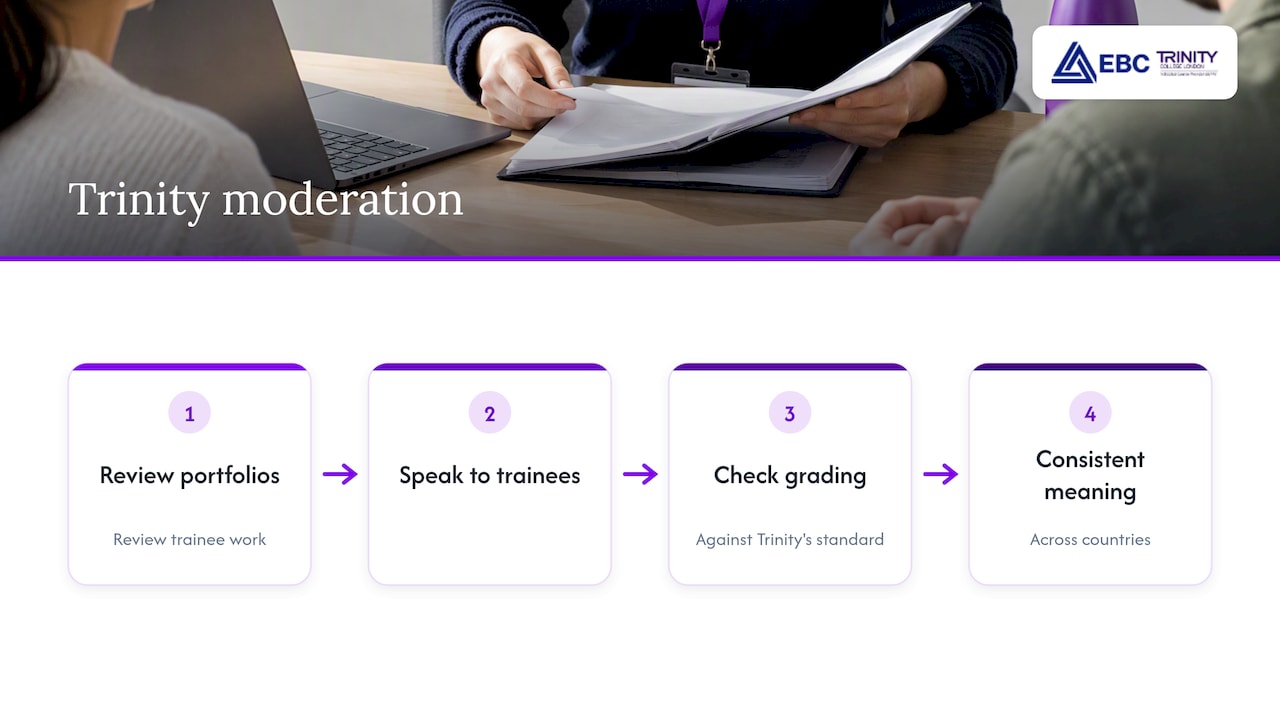
Trinity moderates each centre’s results. A moderator reviews trainee portfolios and speaks to trainees, to check that the centre’s internal grading meets Trinity’s standard. The effect is that a CertTESOL gained in one country means the same thing as one gained in another.
Entry requirements
The CertTESOL page on Trinity’s website sets out the typical entry profile. In summary:
- you are 18 or over;
- you hold a qualification that gives access to higher education in your home country (for example A levels or a Level 3 qualification in the UK);
- your written and spoken English is at a high level, with CEFR C1 the usual expectation for non-native speakers.
You do not need a degree or previous teaching experience. Individual centres may add their own interview or language check, so confirm details with the provider you choose. Our step-by-step guide to the CertTESOL walks through the application stages in order.
How it differs from generic online TEFL certificates
Many 120-hour online certificates are quick and inexpensive. Some are perfectly reasonable for personal interest or for employers who ask only for “a TEFL certificate”. The CertTESOL is a different kind of product. The comparison below describes types of course, not particular companies.
| Feature | Trinity CertTESOL | Typical self-paced online certificate |
|---|---|---|
| Regulated level | Level 5 on the RQF, entered on the Ofqual register | Often unregulated or with no stated framework level |
| Awarding body | Trinity College London | Frequently the training company itself |
| Observed teaching | At least six hours with real learners at two levels | Often none, or optional |
| External moderation | Yes, by Trinity-appointed independent external moderators | Usually none |
| Hours | 130 guided learning hours, 200 in total | Often 100 to 120 hours of self-study |
| Reflective journal and written work | Mandatory | Often multiple-choice quizzes |
The gap is practical as much as formal. A British Council-published review of changes in English language teaching reports that practical teaching practice is rated a fundamental part of initial teacher education by 98% of the experts consulted. A course with no teaching component simply cannot provide that.
That does not make every online option worthless. If you want to see how a flexible, tutor-supported online route compares, our EBC Online TEFL Certification Course costs €500. It is a different qualification with a different purpose, and our guide on how the CertTESOL compares with other TEFL certificates helps you decide which fits your goals. If you are weighing it against another Level 5 initial certificate from a different awarding body, we cover that in what separates the CertTESOL from its Cambridge counterpart.
International recognition
Trinity states that the CertTESOL is internationally recognised, and its support pages note that institutions including the British Council welcome it for teachers in their teaching centres worldwide. Because the qualification is regulated and externally moderated, employers in Europe, Asia, the Middle East and the Americas can read it as a clear statement of training.
Recognition has limits, and it is honest to say so. Each country and each employer sets its own requirements. Some ask for a degree as well as a teaching certificate. Visa rules vary by country and change often, and a qualification alone never guarantees a visa or a job. Check the current rules of the country you are aiming for through its official government sources before you commit to travel plans.
Why it helps you find work and build teaching skills
A qualification should do two jobs: get you hired and make you good once you are in the room. The CertTESOL is designed around both.
For finding work
- It gives employers a credential with a named awarding body, a framework level and verified teaching practice, which makes your application easier to assess.
- Your observed lessons give you real answers for interviews and demo lessons, because you have actually planned and taught to learners.
- The same credential travels. A teacher who moves from one country to another does not need to start from zero.
For teaching skills
- Learner diagnosis (Unit 3) and materials work (Unit 4) give you tools to adapt to a class instead of surviving it.
- The unknown language unit builds empathy for beginners and sharper classroom instructions.
- The reflective journal builds a habit you can carry through your career. The British Council’s CPD framework describes the move from awareness of a method to integrating it consistently into practice, and a structured, moderated course speeds up that move.
Career options include teaching in language schools, private institutes and summer schools, working with business clients, teaching young learners, tutoring privately and teaching online. Later, many teachers add specialisms such as Business English, CLIL or online teaching, or move towards academic management and teacher training. Our overview of certification to teach English abroad and the types of TESOL courses show how those paths connect.
How EBC delivers the CertTESOL
EBC is a global company. We promote teacher training and work opportunities around the world, and our graduates teach in countries across Europe, Asia and beyond. Our Trinity CertTESOL costs €1,450 and includes live, observed teaching practice. We also offer lifetime worldwide job placement support to our graduates.
If you want more than a course, our one-year programmes in Spain, France and Italy combine language or post-graduate study, teacher training and the chance to teach or work part-time. Prices are published on our site: Road2Spain Spanish + TEFL ranges from €5,900 to €6,700, Road2Spain Post-Graduate + TEFL is €5,400, Road2Italy is €7,700 and Road2France is €8,500. Visa support is part of the package, but visa decisions rest with the authorities of each country and we cannot guarantee any outcome.
You can see the course details on our Trinity CertTESOL page and our one-year programmes, or learn more about the main qualification page at our TESOL certification page. If you already teach and want to specialise, our CertPT courses cost €999 each.
A practical way to decide
Use these questions to check whether the CertTESOL fits you.
- Are you planning to teach in a virtual classroom or language school? If yes, observed practice will matter to employers.
- Do you want a credential that works in several countries? A regulated, moderated qualification is easier to explain across borders.
- Can you commit to 130 guided hours plus self-study? Full-time and part-time routes exist, so choose the pace that suits your life.
- Are your plans tied to one country? Check that country’s official requirements for teachers and visas first.
- Are you looking for a cheap certificate just to tick a box? That may be OK for some roles, but if you’re serious about a long-term teaching career, the CertTESOL provides a stronger foundation.
FAQ
Is the Trinity CertTESOL worth it?
If you plan to teach English for more than a few months, yes: the assessed teaching practice and external moderation give you practical skills and a credential employers can verify. If you need a basic certificate for one specific entry-level role, a shorter course may be enough. The right choice depends on your goals and the country where you plan to teach.
What level is the Trinity CertTESOL?
It is a Level 5 qualification on the Regulated Qualifications Framework in England, with 130 guided learning hours and 200 total qualification hours according to the Ofqual register. Level 5 is comparable in standard to the second year of an undergraduate degree. It is the initial teaching qualification, and Trinity’s Diploma in TESOL is the next step at Level 7.
Do I need a degree or teaching experience to take it?
No. Trinity’s typical requirements are being 18 or over, holding a qualification that allows entry to higher education, and having a high level of English. No previous teaching experience is needed. Some countries and employers ask for a degree separately, so check the rules where you want to work.
How long does the CertTESOL take?
The course has a minimum of 130 guided learning hours within a 200-hour total. Providers deliver it full-time, part-time, online or blended, so the calendar length varies. Ask your provider for exact dates and timetable. In EBC’s case, it is a 4-week course.
Will the CertTESOL guarantee me a visa or a job?
No qualification can promise that. It makes your application stronger and shows employers your training, but visas and hiring depend on each country’s rules and each employer’s needs. Always check official government guidance for the country you plan to work in.
Your next step
If the CertTESOL sounds like the right foundation, you are welcome to explore our course details, read about our graduates’ routes abroad or book a free consultation to talk through which option suits your plans. There is no pressure: our aim is that you choose a qualification you can use wherever you want to teach.
Sources
- Trinity College London: Certificate in Teaching English to Speakers of Other Languages (CertTESOL)
- Trinity College London: Aims of a CertTESOL course
- Ofqual Register: TCL Level 5 Certificate in Teaching English to Speakers of Other Languages
- Trinity College London support: CertTESOL and the qualifications framework
- Trinity College London: Qualifications in TESOL
- Trinity College London: CertTESOL key features
- Trinity College London: Study skills for the Trinity Certificate in TESOL
- Trinity College London: CertTESOL course regulations
- British Council TeachingEnglish: CPD Framework for teachers
- British Council TeachingEnglish: What’s changed in English Language Teaching?
Recommended
- Your complete guide to the Trinity CertTESOL course
- What is the Trinity CertTESOL? How do I pass the course?
- Step-by-Step Guide to Trinity CertTESOL Certification
- How to pass the Trinity CertTESOL – a step by step guide
This page provides commentary based on information, facts, and experiences available at the time of publication. It does not constitute legal advice, and EBC accepts no liability for decisions made based on the information provided. If you require legal advice, please consult a qualified lawyer.