

The Trinity CertTESOL is assessed through five units: observed teaching practice, a language awareness test, a learner profile, a materials assignment and an unknown language journal. You must pass every unit to be awarded the certificate. There is no single exam to cram for. You build evidence of your teaching across the course, and it is judged against a Level 5 standard. This guide explains what each unit asks of you, how the pass, refer and fail standards work, what happens if work needs improving, and how to plan your time. At EBC we train teachers for classrooms around the world, and the assessment is the same Trinity standard wherever you take it.
Key Points
- The CertTESOL has five units, and all five must reach the required standard before the certificate is awarded.
- Trinity requires at least six hours of observed, assessed teaching with real learners at two different levels.
- Trinity uses Pass, Refer and Fail standards. Certificates do not state a distinction or merit.
- A referred unit can normally be completed to standard within one month of the moderation visit, under your course provider’s procedures.
- Prepare for a steady workload across the whole course, not a final-week sprint.
Table of Contents
- What the assessment is designed to measure
- The five units at a glance
- Unit 1: observed teaching practice
- Unit 2: language awareness
- Unit 3: the learner profile
- Unit 4: the materials assignment
- Unit 5: the unknown language
- Pass, Refer and Fail: how results work
- If a unit is referred: resubmission and resits
- Is the CertTESOL hard to pass? Workload and preparation
- Why the assessment helps you get work
- Studying the CertTESOL with EBC
- FAQ
- Sources
What the assessment is designed to measure
Trinity describes the CertTESOL as a Level 5 initial qualification for people with little or no previous TESOL experience. It is delivered through a fully validated course of at least 130 hours, not by distance learning alone. The syllabus sets a minimum of 200 total qualification hours, including at least 130 guided learning hours.
The assessment looks at whether you can do three things:
- Plan lessons that suit a specific group of learners.
- Deliver those lessons in a real classroom and respond to what happens.
- Reflect on what worked, what did not, and what you would change.
Alongside this, you must show sound knowledge of English as a language and the potential to keep developing as a professional. Trinity also expects a high level of competence in spoken and written English from trainees, so your own written work is part of what is judged.
If you are still deciding whether the qualification is right for you, our Trinity CertTESOL course overview covers entry, format and recognition. This article stays with assessment.
The five units at a glance
Trinity’s CertTESOL page sets out the structure. Here it is in plain terms.
| Unit | Focus | What you produce |
|---|---|---|
| 1 | Teaching Skills | Observed teaching practice, with portfolios and journals |
| 2 | Language Awareness and Skills | A language awareness test |
| 3 | Learner Profile | A learner profile built around one-to-one teaching |
| 4 | Materials Assignment | A materials assignment with an external interview |
| 5 | Unknown Language | A reflective journal on learning a language you do not know |
Trinity requires all five units to be passed. Strength in one unit does not make up for a referral in another.
Unit 1: observed teaching practice
This is the part of the course most trainees think about first, and it carries real weight. Trinity’s validation requirements say teaching practice is assessed through at least six hours of observed teaching with real learners at two different levels. Trinity’s guidance also states that candidates must complete every assignment, including those six hours of observed and assessed practical teaching, to the required standard before the certificate can be awarded.
Observed teaching is more than the lesson itself. It covers the full cycle:
- Before the lesson: a written plan with clear aims, staging and an idea of what could go wrong.
- During the lesson: how you manage the group, give instructions, check understanding and adapt.
- After the lesson: a reflection on what happened, using evidence from the classroom.
The portfolio and journal records in Unit 1 show how you develop across the course. Tutors look for progress as well as individual performances, so a shaky first lesson that leads to clear improvement tells a good story.
What tutors typically look at
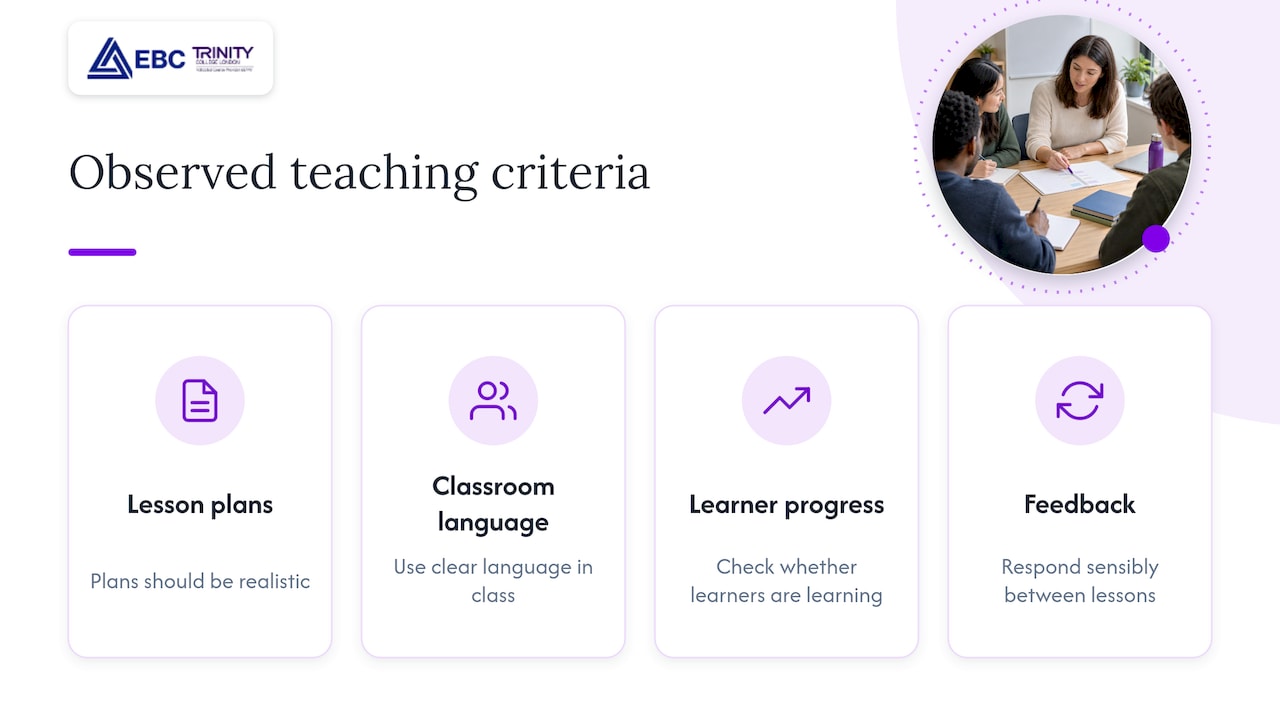
Exact criteria are set out in the Trinity syllabus and in your course provider’s approved marking scheme. Trinity says the scheme must reflect Level 5 expectations of Pass, Refer and Fail. In practice, you should expect observers to consider whether your plans are realistic, whether your language in class is clear, whether learners are actually learning, and whether you respond sensibly to feedback from one lesson to the next. Always read the criteria you are given at the start of your course, because they are what you will be measured against.
Our teaching practice guide explains how sessions are organised, which helps you picture what the six hours involve.
Unit 2: language awareness
Unit 2 checks that you understand English well enough to teach it. Many native speakers find this the surprise of the course: you use the language fluently, but explaining why we say “I’ve lived here for ten years” rather than “I live here for ten years” is a different skill.
The unit is assessed with a language awareness test. It draws on the grammar, vocabulary and phonology you meet in input sessions, and on your ability to analyse language from a learner’s point of view. Treat it as applied knowledge rather than memory: expect to identify the form, meaning and use of language, and to anticipate the problems learners have with it.
Good preparation looks like this:
- Revise a little every week rather than in a block before the test.
- Practise analysing example sentences aloud, as you would for a class.
- Use the terminology your course introduces, and be able to explain it simply.
- Keep a list of the errors you notice in learners’ speech during teaching practice, then work out the rule behind each one.
Unit 3: the learner profile
Unit 3 moves the focus from the language to the learner. Trinity’s unit list describes it as a learner profile with one-to-one teaching. You work closely with one learner, find out about their background, needs and difficulties, and use that to inform what you teach.
The written profile is where you show what you noticed and what you did about it. A strong submission usually has:
- A clear picture of the learner’s context, goals and previous learning.
- Specific evidence of their strengths and difficulties, such as examples of what they said or wrote, rather than general impressions.
- A link between the analysis and the teaching decisions you made.
- An honest reflection on what helped and what you would try next.
This unit rewards curiosity. Trainees who ask good questions of their learner, and listen to the answers, tend to find the writing comes more easily.
Unit 4: the materials assignment
Unit 4 asks you to work with teaching materials: choosing, adapting or creating resources for a particular group and explaining why. Trinity states that this unit includes an external interview, so you discuss your work with someone beyond your own tutors.
To prepare, be ready to explain every choice. Why this text, this task, this order? What would you change for a weaker or stronger group? An interview is far less daunting when your written assignment already contains clear reasoning. Reread your submission beforehand and note where you made trade-offs.
Unit 5: the unknown language
In Unit 5 you are placed in the position of a beginner learning a language you do not know, and you keep a reflective journal. The aim is to experience a classroom from the learner’s side. You notice what helps, what confuses, and how it feels to understand very little.
The journal is reflective, so honesty counts more than polish. Note specific moments: an instruction that did not land, a technique that made meaning clear, a point where you felt lost. Then connect these to how you will teach. Trainees often say this unit changes how they give instructions and use gesture, pictures and examples with lower-level learners.
Pass, Refer and Fail: how results work
Trinity uses three standards: Pass, Refer and Fail. Its validation requirements state plainly that certificates do not state a distinction, merit or other pass grade. Whatever your marks, the certificate says the same as every other successful candidate’s.
Some course providers add a locally decided mark or grade on their own report. Trinity allows this only if the criteria were approved in the provider’s proposal and explained to participants at the start. Ask your provider at enrolment whether this applies, so you know what any grade on a report means and what it does not.
Tutor feedback
Feedback runs through the whole course rather than arriving only at the end. After observed lessons you will normally discuss what you did, and written work comes back with comments. Use these comments as your syllabus for the next lesson or draft. Trainees who keep a short list of recurring points, such as “instructions too long” or “not checking understanding”, usually improve fastest.
External moderation
Trinity states that an independent moderator visits each course to moderate written and practical marks and to assess one programme component. This is a quality check on the course provider and gives the qualification its external credibility. You can read how it affects trainees in our guide to passing Trinity CertTESOL external moderation.
If a unit is referred: resubmission and resits
A Refer result means your work has not yet met the standard but can be improved. Trinity allows a candidate to pass all five units through referral and later completion of work, normally within one month of the moderation visit. The same document does not set out a general unlimited-resit entitlement, so what you can redo and how depends on your provider’s validated referral procedures. Every unit must finally reach the pass standard.
Three practical points follow:
- Ask at the start how referral works on your course, including who gives feedback on resubmitted work and how tight the timeline is.
- Act on feedback quickly. A one-month window is short if you are also working or travelling.
- Treat a referral as specific information. It usually points to one area to fix, not a verdict on whether you can teach.
No provider can promise that you will pass. What a good one can promise is clear criteria, honest feedback and support while you improve.
Is the CertTESOL hard to pass? Workload and preparation
It is demanding, but it is designed to be achievable for committed beginners. The course is intensive, with at least 130 guided hours, practical and written assignments and at least six hours of observed teaching. The challenge is less about any single task and more about managing several at once: planning tomorrow’s lesson, writing up yesterday’s, and studying for the language test.
Here is a realistic way to prepare.
Before the course
- Refresh your grammar knowledge, focusing on tenses, modal verbs and the basics of pronunciation.
- Read through the application and entry requirements in our step-by-step CertTESOL guide.
- Clear your calendar. Trainees on full-time courses should not plan a second commitment.
During the course
- Start each assignment early, even if only with notes.
- Keep a reflective journal from the first day. It feeds Units 1, 3 and 5.
- Observe other trainees’ lessons and write down one thing to borrow from each.
- Ask your tutor to explain any criterion you do not understand.
In the final week
- Check each unit against the criteria, not just against the task title.
- Allow time for proofreading. Your written English is part of the assessment.
- Rest before observed lessons and the language test. Tired trainees plan less carefully.
Why the assessment helps you get work
The assessment is not a hurdle separate from your career. Every unit produces something an employer values. After completing the CertTESOL, holders can apply for English teaching positions worldwide in a range of educational contexts, and the evidence you built shapes how you talk about your skills.
- Observed teaching means you can say you have taught real learners at two levels, and describe what you did. That answers the most common interview question from new teachers: “What experience do you have?”
- Language awareness lets you explain grammar clearly, which matters in any school, language centre or online platform.
- The learner profile shows you can diagnose needs and personalise lessons, a skill employers value in one-to-one and small-group settings.
- The materials assignment gives you a worked example of resource design you can discuss in interviews.
- The unknown language journal gives you a learner’s-eye view that helps with beginners everywhere.
Those skills travel. They are useful whether you plan to teach in Europe, Asia, the Americas or online. As a global organisation, EBC supports graduates with lifetime worldwide job placement assistance, and many go on to specialist CertPT courses such as Business English, CLIL, CLT and Teaching Online. If you are comparing qualifications, our CELTA vs Trinity CertTESOL guide sets out the differences.
Studying the CertTESOL with EBC
We run the Trinity CertTESOL for trainees around the world, with live teaching practice and tutor feedback built into the course. The fee is €1,450, as published on our Trinity CertTESOL page. If you would like to talk through how the assessment would fit your schedule, you can book a free consultation with our team, with no obligation.
FAQ
Is the Trinity CertTESOL hard to pass?
It is an intensive course, and the work is spread across five units rather than a single exam. Most of the difficulty comes from workload and from teaching real learners for the first time. Committed trainees who act on feedback have a good chance of reaching the standard, but nobody can guarantee a result.
Does the CertTESOL have grades such as merit or distinction?
No. Trinity uses Pass, Refer and Fail, and its certificates do not state a distinction or merit. A provider may record a local mark on its own report only if it explained the criteria at the start of the course.
How many hours of teaching practice do I need?
Trinity requires at least six hours of observed and assessed teaching with real learners. These must include learners at two different levels. You also plan each lesson and reflect on it afterwards.
Can I resubmit work if I am referred?
Usually, yes, within the provider’s validated referral procedures. Trinity’s syllabus says referred work is normally completed within one month of the moderation visit. Ask your provider how this works before you enrol.
Sources
- Trinity College London: Certificate in Teaching English to Speakers of Other Languages (CertTESOL)
- Trinity College London: CertTESOL syllabus from January 2016
- Trinity College London: CertTESOL validation requirements
- Trinity College London: TESOL qualifications and validated course
Recommended
- Trinity CertTESOL: Everything You Need to Know
- Step-by-Step Guide to Trinity CertTESOL Certification
- How to pass the Trinity CertTESOL – a step by step guide
- Trinity CertTESOL Step by Step Guide for Global Educators
This page provides commentary based on information, facts, and experiences available at the time of publication. It does not constitute legal advice, and EBC accepts no liability for decisions made based on the information provided. If you require legal advice, please consult a qualified lawyer.