

The best Trinity CertTESOL course is one Trinity College London has validated, includes assessed teaching practice with real learners, fits your schedule, and clearly states its total cost and support before you pay. Choosing the right qualification is also an important first step towards the teaching career you want to build, whether that means teaching abroad, working online or developing expertise in a specialist area. This guide gives you a practical checklist to use with any provider, including EBC, and shows you how to verify each answer for yourself. At EBC, we work with aspiring teachers from different backgrounds and countries, helping them prepare for teaching opportunities around the world.
Key Points
- Check the provider on Trinity’s course finder before you pay anything.
- Look for at least six hours of observed teaching practice with genuine English language learners, and a course of at least 130 hours.
- Compare format (full-time, part-time, online or blended), total fees and extra costs, not just the headline price.
- Ask what career support exists, what it covers and for how long, and get the answer in writing.
- Check the visa and qualification rules of the country where you want to teach, because no course can promise a visa or a job.
Table of Contents
- What a Trinity CertTESOL actually is
- The practical checklist
- Step 1: Confirm the provider is validated
- Step 2: Pick the format that fits your life
- Step 3: Check the entry requirements and interview
- Step 4: Look hard at the teaching practice
- Step 5: Understand assessment and moderation
- Step 6: Count the real cost
- Step 7: Ask about career support, and read the small print
- How to verify claims yourself
- Why a CertTESOL helps you find work and teach better
- Level 5 or a lower-level TEFL certificate?
- Where EBC fits
- FAQ
- Sources
What a Trinity CertTESOL actually is
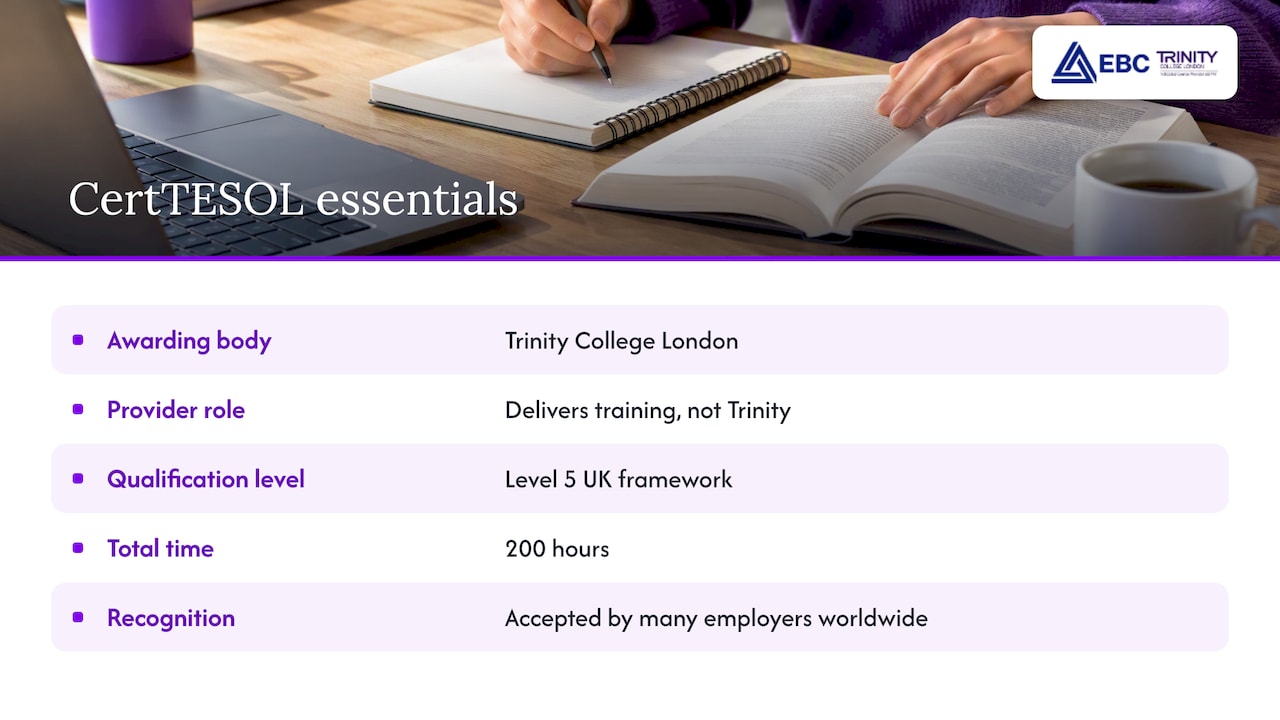
The Trinity CertTESOL is an initial teacher qualification for people who want to teach English to speakers of other languages. Trinity College London is the awarding body. It validates external course providers worldwide but does not deliver the training itself. That split matters: the name on your certificate is Trinity’s, but the quality of your experience depends on the centre you choose.
The qualification is Level 5 on the UK Qualifications and Credit Framework. According to Trinity, it is accepted by many employers worldwide and by the British Council for its teaching operations outside the UK. Trinity gives the total qualification time as 200 hours, which includes guided learning, observed practice and independent study.
If you are still deciding between types of qualification, our overview of types of TESOL courses explains where the CertTESOL sits.
The practical checklist
Work through these ten points with every provider you consider. A professional centre should be able to explain its course arrangements clearly, provide relevant details and give you the information you need to make a confident decision.
| Check | What good looks like | How to verify it |
|---|---|---|
| 1. Provider validation | The centre is listed as a validated CertTESOL provider | Search Trinity’s course finder and contact the centre through the details listed there |
| 2. Awarding-body status | Trinity College London is named as the awarding body, and the qualification is Level 5 | Read Trinity’s CertTESOL page and ask the centre for the exact qualification title on the certificate |
| 3. Delivery format | Full-time, part-time, online or blended, clearly described | Ask for a week-by-week timetable |
| 4. Assessed teaching practice | At least six hours of observed teaching with genuine learners | Ask who the learners are, where the lessons happen and who observes |
| 5. Trainer support | Named, qualified trainers and clear feedback after each lesson | Ask for trainer profiles and how quickly feedback arrives |
| 6. Assessment | Practical and written assignments, with external moderation | Ask when the Trinity moderator visits and how marks are confirmed |
| 7. Class size | A stated maximum group size, especially for teaching practice | Ask for the maximum number of trainees per group in writing |
| 8. Total fees | One clear figure, with what it includes | Request an itemised fee sheet |
| 9. Additional costs | Exam, registration, materials, travel, accommodation and visa costs listed | Ask what is not included |
| 10. Career support | A defined service, with its scope and duration stated | Ask what happens after you pass and for how long help continues |
The sections below explain each point, why it matters to your training and future career, and how to check the information independently.
Step 1: Confirm the provider is validated
Start by confirming the provider’s status. Trinity’s find a course page lets you search for validated providers and see their contact details. If a centre advertises a Trinity CertTESOL and you cannot find it there, contact Trinity and the provider to clarify the centre’s current validation status before making a commitment.
Trinity also moderates every validated CertTESOL course and conducts annual reviews of providers. In practice, this means an independent person from Trinity checks the course. It does not mean Trinity manages the day-to-day relationship between you and the provider. Trinity takes responsibility for the initial review of a course’s academic and practical management, not for interactions that go beyond validation requirements. That is why it is worth checking the practical arrangements and student support directly with the provider as well.
Use this straightforward check before you enrol:
- Search for the provider on Trinity’s finder.
- Contact them using the details Trinity lists, not only those on an advert.
- Ask them to confirm in an email that the exact course you are booking is the validated CertTESOL.
- Keep that email with your payment receipt.
Step 2: Pick the format that fits your life
Providers set their own schedules and fees. Trinity says the course can be taken full-time over a minimum of four weeks, or part-time, usually over three months to a year, and formats include face-to-face, online and blended learning, depending on the provider.
The right format depends on your current commitments, preferred learning environment and career plans. Consider how each option would fit your circumstances while giving you the practical training you need:
- Full-time and intensive: the fastest route, but also a demanding commitment. It may suit you if you can focus on training full-time and want to prepare for your next career step relatively quickly.
- Part-time: spreads the workload across several months and can be easier to combine with a job or other responsibilities. It calls for consistent study and planning over a longer period.
- Online or blended: offers flexibility over where you study. Check how teaching practice is organised, because you still need observed lessons with genuine learners as part of the qualification.
Our step-by-step CertTESOL guide walks through choosing a format and location.
Step 3: Check the entry requirements and interview
The minimum entry age is 18, although some providers ask for 20 or 21. You also need to demonstrate a high level of English in reading, writing, speaking and listening. Providers set their own application procedures, so expect a form, and often an interview or written task.
A considered application process helps establish whether the course is a good fit for your current English level, learning needs and professional goals. It also gives you an opportunity to understand the expectations before you commit. For a full walkthrough, see our guide on CertTESOL application steps.
Step 4: Understand the teaching practice
Teaching practice is where you begin to put your learning into action. It connects course concepts with the real decisions teachers make in the classroom and helps you develop confidence through feedback and reflection. Trinity requires at least 130 hours on the course, including six hours of observed practical teaching with genuine English language learners. The course also includes practical and written assignments, such as a language learning profile.
Questions to ask:
- Who are the learners, and are they real students rather than classmates role-playing?
- How many of the six hours will I teach in front of an observer?
- Do I teach different levels or age groups?
- How is feedback given, and is there time to act on it before the next lesson?
- If I teach online, how are the learners found and how is observation done?
Clear answers to these questions will help you understand the quality and structure of the practical experience you can expect. If any detail is unclear, ask the provider to explain it before you enrol.
Step 5: Understand assessment and moderation
Your work is assessed by the provider and moderated by Trinity. An independent moderator visits towards the end of the course to talk to tutors and trainees and moderate marks. In addition, every candidate is personally interviewed by Trinity about their coursework and experience before the qualification is granted.
This external layer is the reason employers value the certificate. Ask the centre how it prepares you for that interview and what the portfolio deadlines are. Understanding the assessment process early helps you plan your workload and approach the course with confidence. Our guide to passing assessments and submitting your final portfolio explains what to expect.
Step 6: Count the real cost
Validated providers set their own fees and course dates, so there is no single national price. For a realistic comparison, look at the full cost of completing the course rather than the headline fee alone.
Build a simple budget:
- Course fee, and exactly what it covers.
- Registration or Trinity-related fees, if charged separately.
- Books and materials.
- Travel and accommodation if the course is in person.
- Time off work, for full-time study.
- Visa or work permit costs for the country where you plan to teach.
Ask for the list in writing and ask what is excluded. Also ask about the refund and transfer policy if you cannot start on the agreed date.
EBC’s published prices as a transparent example
Transparency matters when you are comparing providers, so we apply the same principle to EBC. The following are our lastest published prices; check the course pages for the current fees, inclusions and terms.
- Trinity CertTESOL: €1,450.
- CertPT specialist courses (Business English, CLIL, CLT and Teaching Online): €999 each.
- EBC Online TEFL Certification Course: €500.
We want you to have the information you need to make the right decision, whether you choose EBC or another provider. For details not covered on our course pages, such as group size, timetable and exactly what the fee includes, ask us during a free consultation. We encourage you to put the same ten questions to every provider and compare the answers.
Step 7: Ask about career support, and read the small print
Many applicants choose a CertTESOL to teach abroad, so the qualification’s recognition matters. Trinity states that the British Council accepts the CertTESOL as an initial TESOL or TEFL qualification for teachers in its accredited organisations in the UK and its own teaching operations overseas. Trinity also advises you to check national or regional requirements before seeking primary or secondary school work abroad, because state schools often have their own rules.
When a provider offers career or job placement support, ask:
- What exactly does the support include: CV help, interview preparation, introductions to employers?
- Which countries and types of employer does it cover?
- Is there a time limit?
- Is it available to online students as well?
No provider can guarantee a job, and none can guarantee a visa. Visa decisions are made by the immigration authorities of each country, and rules change. Always check the official government page of the country you are heading to.
EBC’s international focus continues beyond the training itself. We support teachers as they explore opportunities in different markets, and our graduates look for work across Europe, Asia and beyond. Our worldwide job placement page describes the support we offer, and you can read about the TEFL job placement process before you decide.
How to verify claims yourself
An informed decision starts with evidence you can check for yourself. Use this routine to compare what providers tell you with independent information:
- Trinity’s finder: confirm the centre is validated.
- Trinity’s qualification page: confirm the level, hours and structure.
- The certificate wording: ask for a sample or the exact title.
- Past trainees: ask to speak to a graduate, or read independent feedback.
- Written answers: put your ten questions in an email and keep the reply.
- Employer requirements: look at three job adverts in your target country and see what qualification they ask for.
Third-party bodies such as TESOL International Association and IATEFL are also useful places to explore the wider profession and its standards.
Why a CertTESOL helps you find work and teach better
A CertTESOL can be an important foundation for your teaching career. It gives employers a recognised Level 5 credential and helps you develop practical skills you can draw on from your first teaching role. It can also open up directions for further professional development as your experience grows.
- Employability: recognition by the British Council for its teaching operations outside the UK, and acceptance by many employers worldwide, helps your application stand out.
- Classroom confidence: observed practice with genuine learners means your first paid class is not your first class.
- Transferable skills: lesson planning, language awareness, classroom management and giving feedback carry over to private tutoring, online teaching and corporate training.
- A path to specialising: once qualified, you can add focused study in areas such as Business English, CLIL, communicative teaching or online delivery.
If you want to keep building after your first certificate, see our guide to TESOL professional development steps.
Level 5 or a lower-level TEFL certificate?
People often ask whether a Level 5 qualification is the right investment compared with a shorter, lower-level certificate. The best choice depends on the kind of teaching you want to do and the requirements of the employers you hope to approach. A short online certificate can be a lower-cost introduction if you want to explore teaching informally. A Level 5 qualification with assessed teaching practice and external moderation provides a more substantial initial qualification for employers who specify that level of training. Look at job adverts in your intended market, consider the practical experience you want to gain and choose the route that supports your next step.
Where EBC fits
EBC brings together internationally recognised teacher training, professional development and opportunities to explore teaching careers in different parts of the world. Our programmes are designed for people who want to develop practical teaching skills, build their confidence and understand the opportunities available to them internationally.
Alongside the Trinity CertTESOL, we offer specialist professional development courses and international programmes such as Road2Spain programmes and Road2Italy and Road2France. These provide different pathways for teachers interested in combining professional development with an international experience.
Our role is to help you understand the training options and plan your next steps with realistic expectations. Rules on working during study differ by country and can change, so we do not promise visa outcomes. Compare EBC against the checklist above, then book a free consultation and put your questions to us directly.
FAQ
Is the Trinity CertTESOL recognised abroad?
Trinity states that it is accepted by many employers worldwide and by the British Council for its teaching operations outside the UK. Requirements differ by country and by school type, so check local rules before applying for state school work.
How long does a CertTESOL take?
Full-time courses take a minimum of four weeks. Part-time courses usually run from three months to a year. Your provider sets the exact schedule.
How much does a CertTESOL cost?
Validated providers set their own fees, so prices vary. Ask for an itemised total including any extra costs. Our own published price for the Trinity CertTESOL is €1,450.
Can I take a CertTESOL online?
Some providers offer online or blended formats. Check how the six hours of observed teaching practice with genuine learners are arranged.
Sources
- Find a TESOL Course, Trinity College London
- TESOL Qualifications and Validated Course, Trinity College London
- CertTESOL, other languages, Trinity College London
- Certificate in Teaching English to Speakers of Other Languages, Trinity College London
- Is the Trinity Certificate a recognised course?, Trinity support
- TESOL International Association
- IATEFL
Recommended
- Step-by-Step Guide to Trinity CertTESOL Certification
- Complete Guide to Trinity CertTESOL Certification
- CELTA vs Trinity CertTESOL: choose the best certification
This page provides commentary based on information, facts, and experiences available at the time of publication. It does not constitute legal advice, and EBC accepts no liability for decisions made based on the information provided. If you require legal advice, please consult a qualified lawyer.