

The Trinity CertTESOL is a Level 5 qualification on the UK’s Regulated Qualifications Framework (RQF), awarded by Trinity College London and listed on the official register kept by Ofqual, the regulator for qualifications in England. In plain terms, Level 5 describes the complexity of the knowledge and skills involved. It is not a mark of how hard the course feels, it is not a degree, and it does not transfer automatically into university credit. Regulation gives you something concrete: a public record you can check yourself before you enrol.
We train and place teachers worldwide, so this guide is written for readers in any country who want to understand what the label means and how far it travels.
Key Points
- The CertTESOL is listed on the Ofqual register as a Level 5 qualification, with qualification number 600/0192/6.
- Ofqual regulates awarding organisations and qualifications in England. Level on the RQF describes difficulty and complexity of content, and size describes study time.
- Level 5 does not mean “degree equivalent”, and it does not mean automatic university credit. Those are separate decisions made by each university.
- You can verify the qualification yourself on the official Ofqual register in a few minutes.
- Employers and authorities abroad set their own entry rules, so always check the requirements of the country or school you are aiming for.
Table of Contents
- What the Trinity CertTESOL is
- What Ofqual does
- How the Regulated Qualifications Framework works
- What Level 5 signifies
- How to verify the CertTESOL’s regulatory status
- Regulated CertTESOL or an unregulated TEFL certificate?
- What regulation tells employers, and what it does not
- Why a regulated Level 5 helps you get work and teach better
- What the CertTESOL costs
- Train with EBC and teach anywhere
- FAQ
- Sources
What the Trinity CertTESOL is
The CertTESOL is an initial teacher training qualification in teaching English to speakers of other languages. It is awarded by Trinity College London{target=“_blank”}, an international awarding organisation. It is designed for people starting out as English teachers, and it combines study of language and methodology with assessed, observed teaching practice with real learners.
Our own complete guide to the Trinity CertTESOL covers who it suits and how a course runs. Here we focus on the regulatory side, because “Level 5” and “Ofqual regulated” are the phrases that appear most often in course listings and are the least often explained.
What Ofqual does
Ofqual, the Office of Qualifications and Examinations Regulation, is the government regulator for qualifications, examinations and assessments in England. Its job is not to teach or to award qualifications. It regulates the organisations that do, called awarding organisations, and the qualifications they offer.
In practice that means:
- An awarding organisation must be recognised by Ofqual before it can offer regulated qualifications.
- Each regulated qualification is placed on a public register with a unique qualification number, a level, a size and its assessment methods.
- Ofqual sets rules the awarding organisation must follow, for example on how assessments are designed and quality assured.
Trinity College London is an awarding organisation. It designs the CertTESOL, sets the assessment standards and moderates the results. Ofqual oversees the awarding organisation and holds the qualification on its register. The training provider, such as us, delivers the course to Trinity’s requirements. Three separate roles, and it helps to keep them apart: regulator, awarding body, provider.
Ofqual’s remit covers England. The Ofqual register entry for the CertTESOL shows it available in England, Northern Ireland and internationally, which is why a teacher in Madrid, Seoul or Cape Town can hold the same qualification as one in Manchester.
How the Regulated Qualifications Framework works
The RQF is the system used in England, and for vocational qualifications in Northern Ireland, to organise qualifications. The UK government’s own guidance compares it to a bookcase in a library: each qualification is shelved according to two things, its level and its size.
Level: difficulty and complexity
The RQF has eight levels, supported by three entry levels. Level describes the difficulty and complexity of the knowledge and skills linked to a qualification. A higher level means the learner is expected to handle more complex ideas and more independent judgement.
Size: how long it takes
Size describes the estimated total time to study and be assessed, expressed as Total Qualification Time (TQT). Within TQT, Guided Learning Hours (GLH) are the hours of direct teaching, supervision and assessed contact. A big qualification and a small one can sit at the same level.
For the CertTESOL, the Ofqual register lists:
| Feature | Register entry |
|---|---|
| Level | 5 |
| Qualification number | 600/0192/6 |
| Guided learning hours | 130 |
| Total qualification time | 200 hours |
| Assessment methods | Coursework, oral examination, portfolio of evidence, practical examination |
The practical examination is the observed teaching component, which is why the CertTESOL is regarded as a practical, employer-facing credential rather than a purely written one. Our article on how CertTESOL assessment works walks through the units and pass criteria.
What Level 5 signifies
Level 5 sits in the middle of the upper half of the framework. It indicates that the qualification involves a substantial body of specialist knowledge and the ability to apply it in practice, in this case to plan, deliver and reflect on English language lessons.
The key is that the RQF framework itself says qualifications at the same level can differ widely in content and purpose. Level is a shelf position, not a verdict on quality, subject or career outcome. Two different Level 5 qualifications might have little in common beyond the number.
Level is not course difficulty
People often read Level 5 as “hard” or “easy”. It is neither. Level describes the complexity of the learning outcomes, not how stressful or intense a given course feels. A four-week intensive and a part-time course spread over several months can lead to the same qualification at the same level. The intensity depends on the format, your prior experience and your study habits. A new teacher may find the observed practice demanding whatever the number says.
Level 5 is not a degree
The RQF levels and the framework for higher education qualifications (FHEQ) are different frameworks that can be compared. UK ENIC, the national agency for international qualification recognition, lists the Higher National Diploma and the Diploma of Higher Education at FHEQ Level 5. These are sub-degree higher education awards, not bachelor’s degrees, which sit at Level 6.
So Level 5 should never be described as “degree level”. The CertTESOL is a professional teaching qualification. It does not replace a degree, and you do not need to claim it does. Where a country requires a degree for a work visa, that requirement stands separately.
Level 5 does not mean automatic university credit
A regulated level does not oblige any university to give credit. Universities decide for themselves whether to recognise prior learning, and they do so case by case, looking at content, size and relevance to the programme. If credit matters to you, ask the admissions office of the specific university, in writing, before you enrol on anything.
How to verify the CertTESOL’s regulatory status
You do not need to rely on a brochure, including ours. The register is public and free.
- Open the Ofqual “Find a Regulated Qualification” service, run by the UK government.
- Search for “CertTESOL” or the qualification number 600/0192/6.
- Open the entry titled TCL Level 5 Certificate in Teaching English to Speakers of Other Languages (Cert TESOL).
- Check the awarding organisation (Trinity College London), the level (5), the size (130 GLH, 200 TQT) and the assessment methods.
- Compare those details with what your course provider says. They should match.
Two practical tips. First, search by qualification number rather than by a provider’s marketing name. Second, remember the register lists qualifications, not training centres. To confirm that a centre is approved to deliver the course, ask the provider for confirmation of its Trinity centre status and the Trinity qualification you will receive on completion.
This is also how to read competing claims. A phrase such as “Level 5 TEFL” on its own is not proof of regulation. A regulated Level 5 qualification has a register entry and a number. If a certificate carries an internal “Level 5” label without a register entry, the label tells you the provider’s opinion, not the regulator’s record.
Regulated CertTESOL or an unregulated TEFL certificate?
Many TEFL certificates are legitimate, useful and widely accepted for entry-level jobs, but they are not all positioned in the same way. The differences worth comparing:
| Question | Regulated Level 5 qualification | Course certificate without a register entry |
|---|---|---|
| Public record | Yes, on the Ofqual register with a number | Provider’s own description |
| Defined size and level | Level and size stated in a national framework | Hours stated by the provider |
| Observed teaching with real learners | Part of the assessed practical examination | Varies by course |
| External moderation | Set by the awarding organisation | Varies by course |
If you are choosing between course types, our online TEFL course comparison explains how to weigh them against your goals and budget.
What regulation tells employers, and what it does not
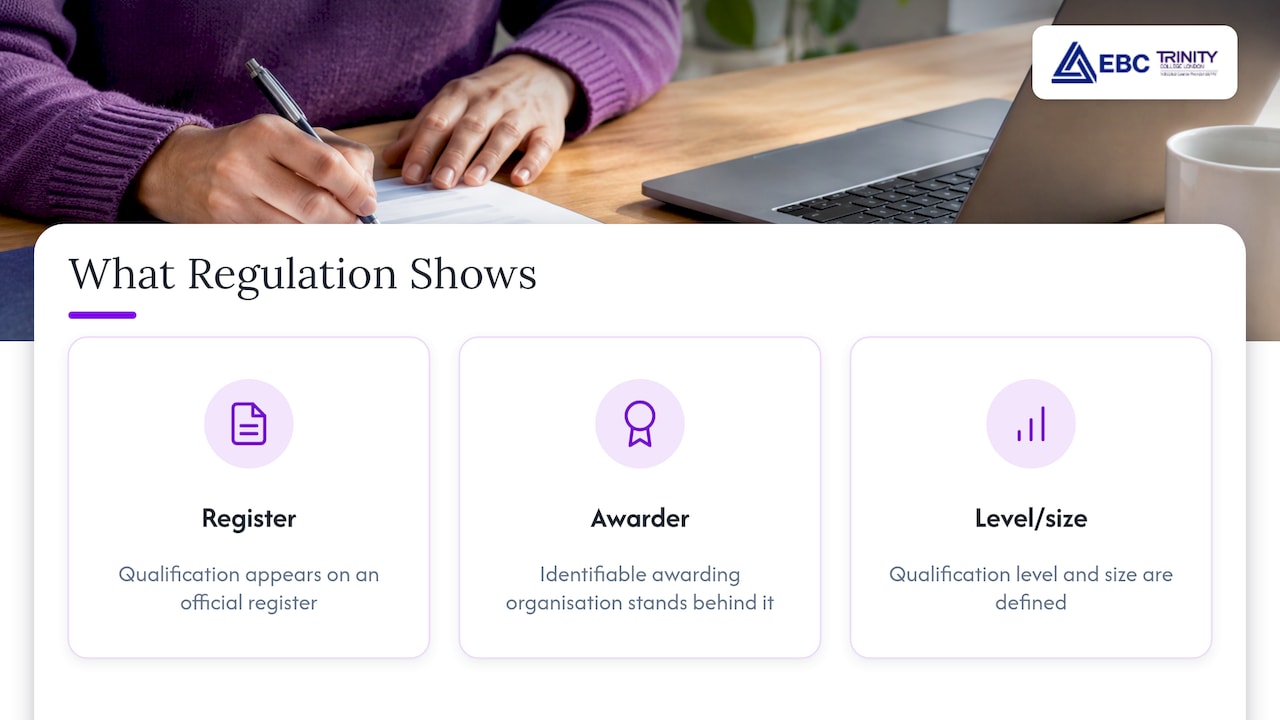
Regulation tells an employer, school or authority three useful things: the qualification exists on an official register, an identifiable awarding organisation stands behind it, and its level and size are defined. That is why school recruiters in many countries ask for a Trinity or similar regulated certificate.
It does not guarantee that every university, employer or government will accept it for every purpose. Recognition depends on the exact qualification, the destination country, the receiving organisation and any professional or immigration rules that apply. Visa rules in particular are set by each government and change over time, and no course can promise a visa or a job. Check the requirements of the school, ministry or embassy you will deal with, ideally before you pay for a course.
That is also how we treat it. Our global network supports graduates in finding teaching work around the world, but the final decision always rests with the employer and the authorities in the country concerned.
Why a regulated Level 5 helps you get work and teach better
The label matters less than what sits behind it. The CertTESOL’s design is what builds the skills schools hire for:
- Observed teaching practice. You teach real learners and receive feedback, so you walk into your first job having already planned, taught and reflected.
- Language awareness. You learn to explain grammar and pronunciation clearly, which is a daily classroom need.
- A verifiable credential. Recruiters can check it, which shortens screening in a competitive applicant pool.
- A route to specialisation. After initial training, practising teachers can add the Trinity CertPT in areas such as Business English, CLIL, CLT or Teaching Online. See our guide to the CertPT for how it builds on classroom experience.
- Portable training. Teachers who move between regions, for instance from Spain to Japan or South Korea, take a recognisable credential with them.
We also offer lifetime job placement support to our graduates, covering schools and programmes across Europe, Asia and beyond. For a step-by-step view of the path from enrolment to first job, read our step-by-step guide for global educators.
What the CertTESOL costs
Our Trinity CertTESOL is priced at €1,450 as a one-off fee. Prices for the same qualification differ between training centres because of format, location, class size, tutor time and what is bundled in, so compare what each fee includes rather than the headline number. The qualification number and assessment structure on the register are the same whichever centre delivers the course.
If you want a more flexible, lower-cost entry point, our online 200-hour TEFL course with trainer support is €500. If you want to combine training with a year abroad, our Road2Spain programmes start with Spanish plus TEFL at €5,900 to €6,700.
Train with EBC and teach anywhere
EBC is a global company that promotes teacher training and work opportunities around the world. You can take the Trinity CertTESOL with us for €1,450, and graduates receive free lifetime worldwide job placement support. If you want a year in Europe, our Road2Spain, Road2Italy and Road2France programmes combine language study, teacher training, visa support and the chance to teach or work part-time, subject always to the immigration rules of each country.

Book a free consultation and we will help you match the right course to your destination and goals.
FAQ
Is a Level 5 qualification equivalent to a degree?
No. Level 5 on the RQF is not a bachelor’s degree, which sits at Level 6. UK ENIC places sub-degree awards such as the HND and the Diploma of Higher Education at Level 5 of the higher education framework. The CertTESOL is a professional teaching qualification, and any credit towards a degree is for each university to decide.
Is the Trinity CertTESOL regulated by Ofqual?
Yes. It is listed on Ofqual’s register as a Level 5 qualification with qualification number 600/0192/6. You can check the entry yourself on the government’s Find a Regulated Qualification service, and confirm that your chosen centre delivers the Trinity qualification.
Does Ofqual regulation mean employers abroad will accept it?
It gives employers a verifiable record, which many value, but it cannot guarantee acceptance everywhere. Schools, ministries and visa authorities set their own rules. Check the requirements of the place you plan to work before you enrol.
How much does a Trinity CertTESOL cost?
Our Trinity CertTESOL costs €1,450. Fees at other centres differ with format, location and what is included, so compare inclusions as well as price.
Sources
- Trinity College London{target=“_blank”}
Recommended
- What is Ofqual level 5 and is it important for TESOL certification?
- What Is the Trinity CertTESOL? A Complete Guide
- Trinity CertTESOL Assessment Explained: Units, Criteria, Pass
- Trinity CertTESOL: Everything You Need to Know
This page provides commentary based on information, facts, and experiences available at the time of publication. It does not constitute legal advice, and EBC accepts no liability for decisions made based on the information provided. If you require legal advice, please consult a qualified lawyer.