

Yes, you can. The Trinity CertTESOL is an internationally recognised initial teaching qualification, and Trinity says it is accepted by the British Council as an initial qualification for its accredited UK teaching organisations and its overseas teaching operations. What it does not do is act as a work visa or promise a job. Those depend on the country, the employer, your nationality and, often, whether you hold a degree. This guide explains what the qualification covers, the jobs it supports, how requirements differ around the world and how to prepare an application that stands up.
At EBC we train and support teachers worldwide, so we see every day how much the picture changes from one destination to the next. The aim here is to help you choose your route with open eyes.
Ley Points
- A Trinity CertTESOL is a recognised, Level 5 qualification that can support work in private language schools, adult and further education, international education organisations and online teaching.
- It does not automatically grant a work visa or guarantee a job. Visa rules and hiring criteria are set by each country and employer.
- Many employers, and many visa routes, ask for a bachelor’s degree on top of your teaching certificate. Some destinations and online roles have fewer restrictions.
- Research each destination through official government and embassy pages before you apply, and never pay a recruiter for a visa promise.
- We offer the CertTESOL for €1,450, plus lifetime worldwide job placement support and 1-year study and work programmes in Spain, France and Italy.
Table of Contents
- What a Trinity CertTESOL actually qualifies you to do
- Entry requirements for the course itself
- The types of English-teaching roles a CertTESOL can support
- How hiring requirements differ
- Country by country: what to check
- Do you need a degree?
- Why the CertTESOL helps you get work and develop real skills
- Teaching children: a skill set of its own
- How to research and prepare your application
- Our courses and programmes
- FAQ
- Sources
What a Trinity CertTESOL actually qualifies you to do
The CertTESOL is designed for people who are new to teaching English to speakers of other languages. According to Trinity’s qualification page, it sits at Level 5 on the Ofqual Regulated Qualifications Framework, carries 200 total qualification hours, includes at least 130 guided-learning hours and requires at least six hours of supervised teaching practice with real learners.

That practice element matters. Employers reading your CV want evidence that you have stood in front of a class, planned lessons and received feedback, not only completed theory. Our course is built around hands-on teacher training for exactly that reason.
Trinity states that graduates may work in:
- private language schools;
- further and adult education;
- international education organisations;
- online English-teaching platforms.
Trinity also advises that teachers aiming at mainstream education should check the requirements of the relevant sector and country. State-school teaching in many places asks for a national teaching licence or equivalent, such as a PGCE in the UK. The CertTESOL is not a substitute for that, and it is better to know this at the start of your planning.
Entry requirements for the course itself
Before you worry about jobs, check that you can join the course. Trinity’s normal requirements, listed on its CertTESOL page, are:
- age 18 or over;
- educational qualifications sufficient for entry to higher education in your country;
- a high level of spoken and written English, normally CEFR C1 for speakers of English as a second or additional language;
- the ability to analyse and explain features of English, work with others, respond to feedback and manage both practical teaching and academic study.
A degree is not a formal entry requirement for the CertTESOL itself. Teaching experience is not required either. Course providers set their own entry procedures, and you can read how ours works in our guide to the Trinity CertTESOL entry requirements and the step-by-step application route.
Keep two questions separate, though. “Can I take the course?” is answered by Trinity and your course provider. “Can I get hired and legally work in a given country?” is answered by the employer and that country’s immigration rules.
The types of English-teaching roles a CertTESOL can support
The qualification is a passport to several kinds of work. Which one suits you depends on your goals, your degree status and where you want to live.
Private language schools and academies
This is the most common destination for newly certified teachers. Classes are often in the evenings and at weekends, with adults, teenagers and children. Schools usually set their own hiring standards, and a teaching certificate is a typical starting point.
Further, adult and higher education support
College and adult education settings can use the CertTESOL as an entry credential, sometimes alongside further study. Some university routes ask for a degree or postgraduate qualification as well.
Business and corporate English
Companies hire teachers to train staff in meetings, presentations and email. If you come from a professional background, this can be a natural fit. Our Trinity CertPT Business English pathway, at €999, is aimed at teachers who want to specialise in this area. See the professional development courses for the full list.
Online teaching
Online platforms and schools hire teachers for one-to-one and group lessons from almost anywhere with a reliable connection. Requirements still vary by platform, so read our overview of what teaching English online usually requires.
Language assistant and school-based programmes
Some countries run publicly funded programmes that place foreign speakers in classrooms as assistants. Eligibility is set by each country, often including age, nationality and language criteria, and is not always tied to a teaching certificate. We cover one route in our article on language assistants in Spain.
Higher-level posts
Employers at the top of the sector can ask for much more. A British Council teacher vacancy, for example, has listed a CertTESOL or equivalent together with a degree and several years of post-certificate experience. Treat the CertTESOL as the first rung of a ladder: Trinity’s Diploma, specialist certificates and experience are how many teachers climb.
How hiring requirements differ
There is no single rulebook. TESOL International Association states that no single degree, certificate or licence authorises teaching English in every field or country, and that requirements vary greatly by job and employer. It also notes that a common minimum for private language schools worldwide is a bachelor’s degree plus a TESOL certificate.
Five factors shape what applies to you:
| Factor | What it changes |
|---|---|
| Country | Visa categories, age limits, degree rules, and whether a teaching certificate is a legal or only a customary requirement |
| Employer type | Private schools, public programmes, universities and online platforms all set different standards |
| Nationality | Some visa routes and schemes are open only to certain passports, and some employers have their own preferences |
| Degree status | A degree widens your options in many destinations and is a visa condition in some |
| Visa eligibility | Employer sponsorship, student status and work permits are separate legal routes and cannot be swapped for one another |
Because of this, plan your visa strategy before you send applications, not after a job offer arrives.
Country by country: what to check
Immigration rules change, so we point you to the principles and tell you what to confirm on official pages. Always check the embassy or immigration authority of the country concerned, and the date the page was last updated.
Spain
Spain is a popular destination for newly certified teachers. For many non-EU nationals, the legal route is not simply “get a job and fly out”: study visas, language assistant schemes and employer-sponsored permits are different options with different conditions. Our Road2Spain programmes combine Spanish language study with TEFL training, and the post-graduate option adds a year of study. Visa decisions are made by the authorities, and we cannot guarantee any outcome.
France
France has a strong demand for English, from private institutes to corporate training. As in Spain, your right to work depends on your nationality and visa category. Student status can allow limited part-time work under the authorities’ rules, which you must confirm for your own case. Our Road2France programme is a 1-year route at €8,500 that combines study and teacher training.
Italy
Italy offers private language schools and business English opportunities. Italian employers and authorities set their own paperwork requirements, and these vary by nationality. Road2Italy is our 1-year programme at €7,700 for people who want to live and study there while building teaching skills.
South Korea
South Korea is widely known for structured teaching jobs, and employers there typically sponsor visas. Bachelor’s degree requirements are common for these roles, along with documents such as criminal record checks. Check the Korean embassy in your country and the employer’s visa conditions before accepting an offer.
China
China has strong demand for English teachers in schools, training centres and universities. Work permit rules for foreign teachers are set nationally and applied locally, and they often involve a degree and a teaching qualification. Because details differ by city and employer, confirm everything with the Chinese embassy or consulate and with the employer’s official documentation.
Japan
Japan’s teaching market includes private conversation schools, assistant teacher placements and international schools. Work visas are normally tied to an employer and to qualifications, with a degree frequently requested. Confirm the visa category with Japan’s official immigration information before you commit.
Across all six destinations, one point holds: the CertTESOL strengthens your application and your classroom skills, but your visa is a separate decision made by the immigration authority.
Do you need a degree?
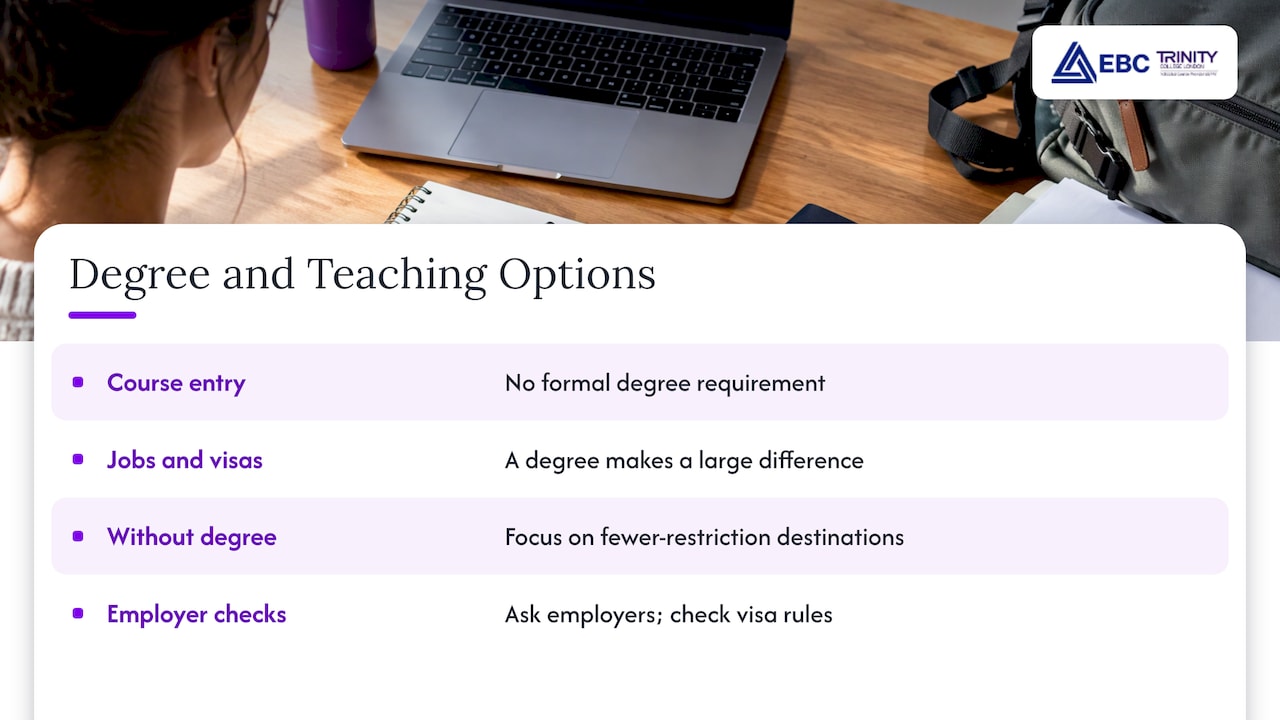
For the course, not as a formal rule, because Trinity asks for educational qualifications sufficient for entry to higher education. For many jobs and visas, yes, a degree makes a large difference. Graduate status widens the list of countries open to you. If you do not have a degree, focus on destinations and employers with fewer visa restrictions, online teaching, and roles where practical skills and your certificate carry more weight. Ask each employer directly what they need, and check the visa rules for your nationality.
Non-native speakers of English can also teach. The CertTESOL entry route expects a high level of English, normally C1, and employers will look at your language level, your accent clarity and your classroom skills. Some employers do state nationality preferences, so read job adverts carefully.
Why the CertTESOL helps you get work and develop real skills
A certificate is more than a line on a CV. Here is what it gives you in practice.
- A credential employers recognise. Trinity describes the CertTESOL as internationally recognised, which helps when a school abroad reads your application.
- Observed teaching practice. The supervised teaching with real learners means you can describe actual lessons in interviews and demo classes.
- Planning and assessment skills. You learn to analyse language, set aims, adapt materials and respond to feedback. These skills are useful in any classroom, in any country.
- Portable teaching skills. Methods you practise on the course transfer to private schools, business classes and online lessons alike.
- A route to specialisation. After the CertTESOL, you can add Business English, CLIL, CLT or Teaching Online through our CertPT courses, each priced at €999.
- Ongoing support. We offer free lifetime job placement assistance to our graduates, wherever in the world they choose to teach. Support helps you search and apply; it is not a promise of a particular post.
Teachers who add a specialism often find they can apply to a wider range of employers, from online platforms to corporate training departments. Read more in our overview of the advantages of Trinity CertTESOL certification.
Teaching children: a skill set of its own
Trinity makes the point that teaching young learners, especially ages 7 to 12, calls for more specialised methodology, materials and assessment. Many first jobs abroad involve children, so build these skills deliberately: learn classroom management for younger groups, activity-based lesson design and ways to give feedback to children.
Technology can lighten the planning load. AI tools for language teachers can help generate class activities, give personalised student feedback and track progress, which is handy when you are preparing varied lessons for different age groups. Combine this with training in child-focused methodology and you will be better prepared for the classroom.
How to research and prepare your application
Follow this sequence and you will avoid most of the common problems.
- Pick two or three destinations. Think about lifestyle, language, cost of living and the type of school you want.
- Check official rules first. Start with the destination’s embassy, ministry or education department. TESOL International Association also advises starting with the destination authorities, since rules are country and job specific.
- Match your profile to the visa route. Note whether your nationality, age and degree status fit employer sponsorship, a student route or a government programme.
- Use reputable job sources. Professional bodies such as TESOL International Association publish career resources, and our job placement team can help graduates find openings.
- Prepare your documents. Typically: CV, certificate, degree (if you have one), ID, reference letters and a criminal record check where required. Some countries ask for apostilled or legalised copies, so allow time.
- Practise a demo lesson. Many schools ask for one. Your observed teaching practice gives you material to draw on.
- Compare offers. Look at contract length, hours, pay, housing, visa support and holiday entitlement, and research the employer.
Warning signs of a bad job offer
Be cautious if an employer asks you to pay money for a job, has no credible online presence, writes poor English in official messages, promises to arrange your visa only after you arrive, or offers a post for which you lack the legal qualifications. Walk away if the paperwork does not match the official rules you have already checked.
Our courses and programmes
We are a global company that promotes teacher training and work opportunities around the world, and our courses are built to take you from first certificate to your first classroom.
- Trinity CertTESOL, €1,450, the internationally recognised qualification with live teaching practice. See the Trinity CertTESOL course.
- EBC Online TEFL Certification Course, €500, a 200-hour online option with trainer support.
- CertPT courses in Business English, CLIL, CLT and Teaching Online, €999 each, for teachers who want to specialise.
- Road2Spain, Road2France and Road2Italy, 1-year study and work abroad programmes that combine language or post-graduate study, teacher training, visa support and opportunities to teach or work part-time. Prices are published on each page, for example Road2Spain Spanish + TEFL at €5,900 to €6,700.
Visa support means we guide you through the process. It does not mean a visa is guaranteed, since decisions rest with the immigration authorities.
Ready to talk through your options? Book a free consultation and we will help you choose the course and destination that fit your goals.

Explore the Trinity CertTESOL page or our study and work abroad programmes to see what is included.
FAQ
Does a Trinity CertTESOL give me the right to work abroad?
No. The CertTESOL is a teaching qualification, not a work permit. Your right to work depends on the destination country’s immigration rules, your nationality and the employer. Check the official embassy or immigration pages for your destination before you apply.
Can I teach English abroad with a CertTESOL but no degree?
Yes, in some cases. A degree is not a formal entry requirement for the course, but many employers and visa routes do ask for one. Online teaching and destinations with fewer visa restrictions may be more open, so research each one carefully.
How long is the Trinity CertTESOL, and does it include teaching practice?
Trinity states the qualification has 200 total qualification hours, at least 130 guided-learning hours and at least six hours of supervised teaching practice with real learners. Our course includes live, observed teaching so you build classroom experience.
How much does the CertTESOL cost with EBC?
The Trinity CertTESOL with us costs €1,450. Our 200-hour online TEFL certification course costs €500, and our CertPT specialisations cost €999 each. Details are on each course page.
Is a CertTESOL enough for state-school teaching?
Usually not on its own. Trinity’s guidance says the CertTESOL may be sufficient for private schools, while state-school teaching may require a PGCE or equivalent. Check the sector rules for the country you want to work in.
Sources
- Trinity College London: Certificate in Teaching English to Speakers of Other Languages (CertTESOL)
- TESOL International Association: Frequently Asked Questions About Starting a Career in TESOL
Recommended
- How to become an English teacher abroad with Trinity
- How Do I Teach English Abroad: Accredited Programmes Guide
- How to Apply for TESOL: Secure Trinity CertTESOL and Work Abroad
- Certification to Teach English Abroad: International Careers Unlocked
This page provides commentary based on information, facts, and experiences available at the time of publication. It does not constitute legal advice, and EBC accepts no liability for decisions made based on the information provided. If you require legal advice, please consult a qualified lawyer.