

Yes. Trinity College London states that the British Council accepts the CertTESOL as an initial TESOL or TEFL qualification for teachers in its accredited teaching organisations in the UK and in its own teaching operations overseas. That is real weight behind a qualification you can take with EBC, a global company that trains and supports English teachers worldwide. Acceptance of the qualification is not the same as a job offer, though. Each employer sets its own requirements, and each country sets its own work-permit rules. This guide explains where the line falls.
Key Points
- Trinity says the British Council accepts CertTESOL as an initial TESOL or TEFL qualification, in the UK and in its own overseas teaching operations.
- The British Council does not award CertTESOL and does not accredit courses. Trinity awards it and Ofqual regulates it at Level 5.
- Acceptance does not guarantee recruitment. British Council posts we found also ask for around two years of teaching experience.
- Work permits and visas are decided by each country, and no course can guarantee them.
- EBC trains for Trinity CertTESOL and offers lifetime worldwide job placement support.
Table of Contents
- What the British Council accepts, and who awards the qualification
- Why the CertTESOL meets the Council’s standards
- What acceptance does not guarantee
- What British Council posts ask for besides CertTESOL
- Entry requirements for the CertTESOL
- Why this matters for finding work
- How to check a specific employer
- Taking the CertTESOL with EBC
- FAQ
- Sources
What the British Council accepts, and who awards the qualification
Three bodies are involved, and they do different jobs.
- Trinity College London awards the CertTESOL. It is regulated by Ofqual in the UK at Level 5 of the Regulated Qualifications Framework. Ofqual is the government regulator of qualifications in England.
- Course providers such as EBC run Trinity-validated courses. Trinity reports more than 100 validated CertTESOL providers worldwide.
- The British Council is the UK’s international organisation for cultural relations and English teaching. It employs teachers and runs an accreditation scheme for UK language schools. It does not award the CertTESOL.
Trinity’s resources say CertTESOL and DipTESOL are accepted by the British Council as appropriate certificate and diploma qualifications in its teaching operations outside the UK. They are also accepted by Accreditation UK, the scheme run jointly by the British Council and English UK. Trinity’s support page confirms the same recognition for the CertTESOL as an initial qualification, with the DipTESOL as the advanced one.
The British Council’s own guidance is careful about wording. Its accreditation guidelines say it does not validate or accredit teacher training qualifications. It assesses them only to decide whether a language school meets its teaching criteria. So the accurate wording is that the British Council accepts the CertTESOL. It does not accredit it, and it does not accredit EBC.
Why the CertTESOL meets the Council’s standards
The same guidelines set out what a valid certificate looks like. It must be externally validated by a reputable examination body or accredited by a national body such as Ofqual. It must include at least six hours of supervised teaching practice and at least 100 hours of ELT/TESOL input.
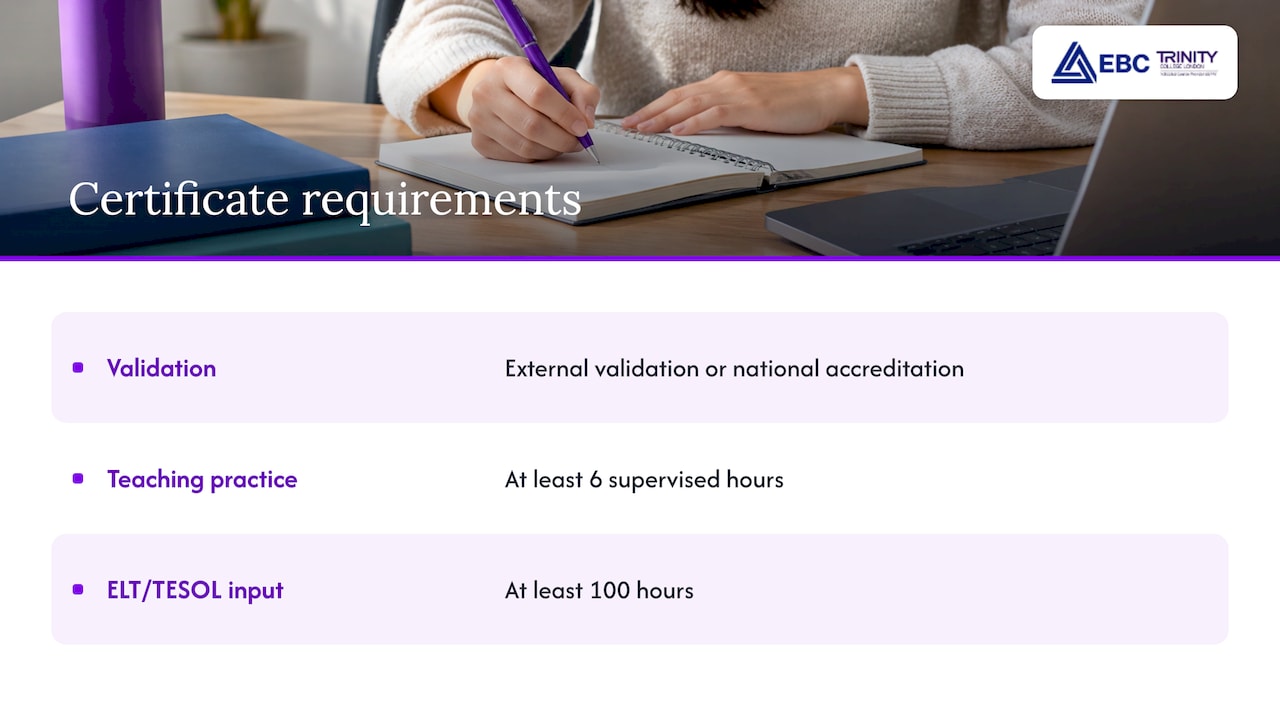
The CertTESOL is built around those features. Trinity says an independent moderator, appointed and trained by Trinity, visits every course. It also says the course cannot be completed by distance learning alone, because assessed teaching practice with real learners is part of it. The guidelines date from February 2018, so check the British Council’s current accreditation pages before relying on any detail.
If you are comparing it with the Cambridge CELTA, our CELTA and Trinity CertTESOL comparison sets out the differences in assessment and structure.
What acceptance does not guarantee
This is the part most pages skip. Trinity’s support page says British Council recognition means the CertTESOL counts as an initial English language teaching qualification. It does not guarantee eligibility to teach in every country. Requirements can vary by:
- country and local employment rules;
- the institution or employer;
- the age and level of the learners;
- regulatory requirements for the type of school.
Trinity also advises that anyone aiming at mainstream education (primary, secondary or university) should check the requirements of that sector in that country before starting a course. Teaching in a state school often involves a degree, a teaching licence or both, which is a different route from language-school teaching.
Three separate questions sit behind “is it accepted?”:
- Is the qualification recognised? For the British Council, yes, as above.
- Does this employer want it, with what else? That is the employer’s decision.
- Can you legally work there? That is decided by the government of the country concerned.
A recognised qualification answers only the first. EBC supports applicants with visa guidance on its study and work programmes, but visas are decided by the authorities, and no one can promise an outcome.
What British Council posts ask for besides CertTESOL
British Council recruitment varies by country, so read the post you want. Several official pages show a common pattern: a certificate such as the CertTESOL plus classroom experience.
| Where | What the page says |
|---|---|
| United Arab Emirates | CELTA or Trinity CertTESOL and at least two years’ post-qualification experience teaching adults and/or young learners |
| Qatar | Certificate-level TEFL qualification such as CELTA or CertTESOL, plus a minimum of two years’ training and teaching experience |
| Japan | Says its hiring criteria worldwide require CELTA or CertTESOL and at least two years’ teaching experience |
| Online teaching post, 2024 advert | Degree, a certificate such as CertTESOL, C2-level English and about two years’ post-certificate experience |
The pattern is clear. The CertTESOL gets you into the pool the British Council recruits from, and experience moves you to the front of it. These pages are examples that were live when we checked, so use each country’s British Council jobs page for current terms.
If you are starting from zero, this suggests a plan. Qualify, teach for two years at a language school or online, then apply. A CertTESOL is the first step in that sequence and it keeps those later doors open.
Entry requirements for the CertTESOL
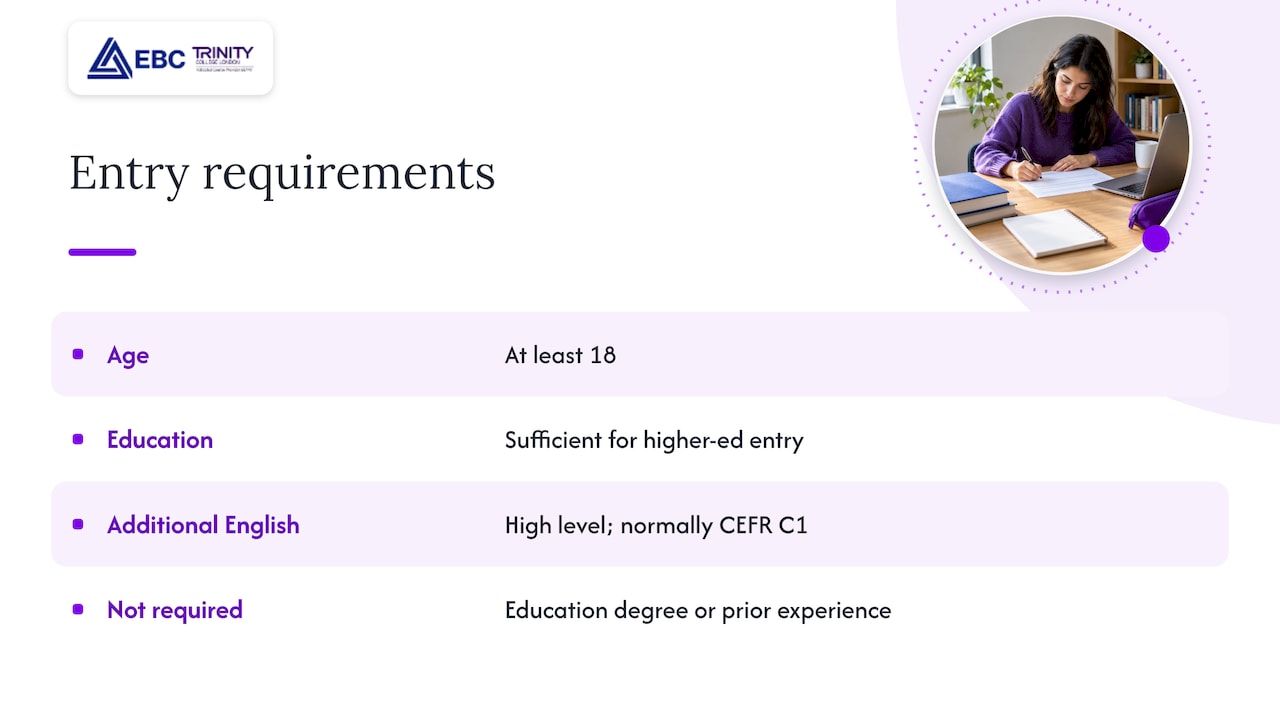
Trinity sets the entry bar. Trainees must be at least 18, hold qualifications sufficient for higher education entry in their own country, and show a high level of English. Speakers of English as an additional language should normally show CEFR C1, which is the advanced level on the European language scale. You do not need a degree in education or previous teaching experience.
Why this matters for finding work
For an aspiring teacher, a qualification the British Council accepts helps in three ways.
- It is recognised across borders. A certificate regulated at Level 5 in the UK and taken in more than 100 validated centres is easy for employers in different countries to read.
- It gives you assessed classroom skills. Teaching practice with real learners, observed and moderated, is what interviewers ask about. You can describe lessons you have actually taught.
- It is the base for specialising. Practising teachers can add Trinity CertPT courses in Business English, CLIL, CLT or Teaching Online, which build skills for specific kinds of classes. Our guide to the Trinity CertPT for practising teachers explains how they fit together.
EBC works on the same global scale as the jobs you will apply for. We train teachers for work in Europe, Asia and beyond, and our graduates get free lifetime job placement assistance. We cannot promise you a post, because employers and governments decide that. We can help you aim at the right ones.
How to check a specific employer
- Find the job advert or the employer’s careers page and note the stated qualification, hours and experience.
- Compare it with the CertTESOL: Level 5, six hours of assessed teaching practice, moderated by Trinity.
- Check the country’s visa and work-permit rules on the official government page. Age limits, degree requirements and sponsorship are common conditions.
- If you teach children or in a state school, check the sector’s extra requirements, such as a teaching licence or background checks.
- Ask the employer to confirm. Trinity says the employer you intend to apply to is best placed to confirm whether the qualification meets its needs.
Taking the CertTESOL with EBC
EBC’s Trinity CertTESOL costs 1450 EUR. It includes hands-on teaching practice, and free lifetime worldwide job placement support comes with it. If you want a year in Europe alongside it, our Road2Spain, Road2Italy and Road2France programmes combine accredited teacher training with a year of language or post-graduate study and visa support, with chances to teach or work part-time. You can compare them on the programmes page. A free consultation will help you choose the route that fits where you want to teach.

FAQ
Does the British Council accredit EBC or the CertTESOL?
No. The British Council says it does not validate or accredit teacher training qualifications. Trinity College London awards the CertTESOL, and Trinity validates the courses that deliver it. The British Council accepts the qualification as an initial TESOL or TEFL qualification.
Will a CertTESOL get me a British Council job?
It makes you eligible to apply, nothing more. The posts we reviewed also ask for about two years of post-qualification teaching experience. Each country’s British Council sets its own requirements, so read the advert you are interested in.
Does the CertTESOL let me work in any country?
No. Trinity says recognition does not guarantee eligibility to teach everywhere. Employers and national authorities set their own rules, and work permits are decided by governments. Check each country’s official requirements.
Can I take the CertTESOL fully online?
Trinity says the course cannot be followed by distance learning alone, although intensive and some part-time courses include a pre-course distance component. Assessed teaching practice is part of the qualification.
Sources
- Trinity College London: Certificate in Teaching English to Speakers of Other Languages
- Trinity College London: Are Trinity TESOL qualifications recognised internationally?
- Trinity College London: TESOL Qualifications and Validated Course
- British Council: Guidelines on assessing Teaching and learning
- British Council United Arab Emirates: Jobs
- British Council Qatar: Meet our training team
- British Council Japan: English teaching qualifications
- British Council: English Online Teacher job advert, February 2024
Recommended
- Your complete guide to the Trinity CertTESOL course
- Your complete guide to the Trinity CertTESOL course
- Your complete guide to the Trinity CertTESOL course
- Your complete guide to the Trinity CertTESOL course
This page provides commentary based on information, facts, and experiences available at the time of publication. It does not constitute legal advice, and EBC accepts no liability for decisions made based on the information provided. If you require legal advice, please consult a qualified lawyer.