

A TEFL or TESOL certification is worth a higher price when the extra money buys what employers and classrooms actually test: supervised teaching practice with real learners, expert feedback, formal assessment and a recognised awarding body. That is what a Trinity CertTESOL is built around, and it is why we think the €1,450 fee compares well with a $200 certificate. EBC is a global company, and our graduates take their qualification into classrooms and online teaching roles on every continent. Below, we show what you pay for, how to judge any course on its content rather than its price tag, and when a lower-cost route is the right first step.
Key Points
- A high price is only worth paying if it buys supervised teaching practice, trainer feedback and formal assessment by a recognised body.
- The Trinity CertTESOL is a Level 5 qualification with at least six hours of supervised teaching practice with real learners of English, according to Trinity College London.
- The EBC fee of €1,450 includes Trinity assessment and moderation fees, and instalment options are available.
- If you want a lower-cost start, the EBC Online TEFL Certification Course costs €500 and includes trainer support.
- Whichever course you choose, judge it by hours, practice, assessment and job support, not by the headline price.
Table of Contents
- What the price gap really measures
- What employers and standards look for
- What the €1,450 Trinity CertTESOL includes
- Cheap versus structured training: a side-by-side view
- A worked example: what the extra €950 buys
- Why it matters for getting work
- When a lower price is a sensible start
- Spending more can also mean a year abroad
- Questions to ask about any course
- Your next step
- FAQ
- Sources
What the price gap really measures
A $200 certificate and a €1,450 qualification share the word “TEFL” or “TESOL” and very little else. The difference is not decoration. It is the cost of the human work involved in training a new teacher.
A low-priced, self-paced certificate is usually a set of online modules you read, a quiz after each one, and a certificate at the end. It is cheap because it needs no trainer to watch you teach, no tutor to mark your lesson plans in detail and no external body to check that the standard has been met. You can finish it on a train. It has a place for people who simply want an introduction to the subject.
A structured professional course is priced for the things that cannot be automated:
- trainers who plan the programme and give feedback on your teaching
- real learners for you to teach, so that practice is more than a role-play
- assessment of your written work and your lessons against published criteria
- an awarding body that moderates the results, so a certificate from one centre means the same as one from another
The question is not “is €1,450 more than $200?” It obviously is. The question is whether the extra €1,000 or so buys a different product. In our view it does, and the rest of this article shows where.
What employers and standards look for
TEFL means teaching English as a foreign language, usually where English is not the main language of daily life. TESOL means teaching English to speakers of other languages, a wider label that also covers English-speaking countries. Employers mostly treat the two terms as interchangeable, according to Johns Hopkins School of Education. What they look at more closely is what sits behind the certificate. If you want the full comparison of the terms, our guide to TEFL vs TESOL covers it.
The same Johns Hopkins guide says reputable certificates commonly require at least 120 course hours and cover lesson planning, classroom management and teaching methodology. Requirements vary by country and employer, and many employers also expect a bachelor’s degree. Hours alone are not enough, though. Reading time and self-study do not equal instructor-led training or meaningful classroom practice, which is a point made in TEFL.net’s analysis of course claims. That article also cites introductory-level criteria that include observed and graded teaching practice and accreditation by a recognised exam board or university.
So a sensible buyer’s test has four questions:
- How many hours, and how many of them are taught by a trainer?
- Is there observed, assessed teaching practice with real learners?
- Who awards the qualification, and who checks the standard?
- What happens after the certificate: do you get help finding work?
A course that answers all four well costs more to run. That is the honest reason for the price.
What the €1,450 Trinity CertTESOL includes
The Trinity CertTESOL is an internationally recognised Level 5 qualification awarded by Trinity College London. Trinity states that every trainee completes at least six hours of supervised teaching practice with real learners of English, observes experienced teachers and receives structured feedback from tutors and peers (Trinity College London).
Here is what that means for you in practice, and what the EBC fee of €1,450 covers.
Supervised teaching practice
Teaching a real class is the part that most changes a new teacher. You plan a lesson, you teach learners who are not your classmates, and a trainer watches. You find out how long an activity really takes, how to give instructions that students follow and what to do when a task falls flat. EBC’s training is hands-on and includes live teaching experience, so you walk into your first paid classroom having already stood in front of one.
Trainer feedback
Feedback is where you improve. After each practice lesson a tutor tells you what worked and what to change, and you try again. A certificate with no feedback loop gives you information but not skill.
Formal assessment and moderation
Your work is assessed against Trinity’s criteria, and Trinity moderates the results. The EBC fee includes Trinity assessment and moderation fees, so there is no separate bill for the qualification itself. For you, that moderation is what lets an employer in Madrid, Seoul or Lima read your certificate and know roughly what standard stands behind it.
Instalment options
A fee of this size is easier to manage when it is spread out. Instalment payment options are available, and you can ask about them in a free consultation before you commit.
Lifetime job placement support
The fee also opens access to EBC’s free lifetime worldwide job placement support. Because EBC works globally, that help is not tied to one country or one season of hiring. The qualification is the key, and the placement support helps you find the door.
Cheap versus structured training: a side-by-side view
| What you get | Typical low-cost, self-paced certificate | EBC Trinity CertTESOL (€1,450) |
|---|---|---|
| Format | Online modules, studied alone | Structured professional training |
| Teaching practice | Often none | At least six hours supervised, with real learners |
| Trainer feedback | Limited or automated | Structured feedback from tutors and peers |
| Assessment | Quizzes | Formal assessment, moderated by Trinity |
| Awarding body | Varies by provider | Trinity College London, Level 5 |
| Job support | Varies | Free lifetime worldwide placement support |
The table is a guide to the type of product, not a claim about any one rival. When you compare courses yourself, put these same rows next to each one.
A worked example: what the extra €950 buys
Take two people, both aiming to teach adults in a language centre abroad.
The first completes a $200 self-paced certificate in a few weekends. She knows the vocabulary of lesson stages. She has never taught a class, so in interviews she is asked to describe a lesson she has delivered and has only theory to offer.
The second completes the Trinity CertTESOL. He has planned and taught lessons to real learners, has been observed, and can say in an interview what he changed after feedback. He can describe his approach to a mixed-ability group because he has met one.
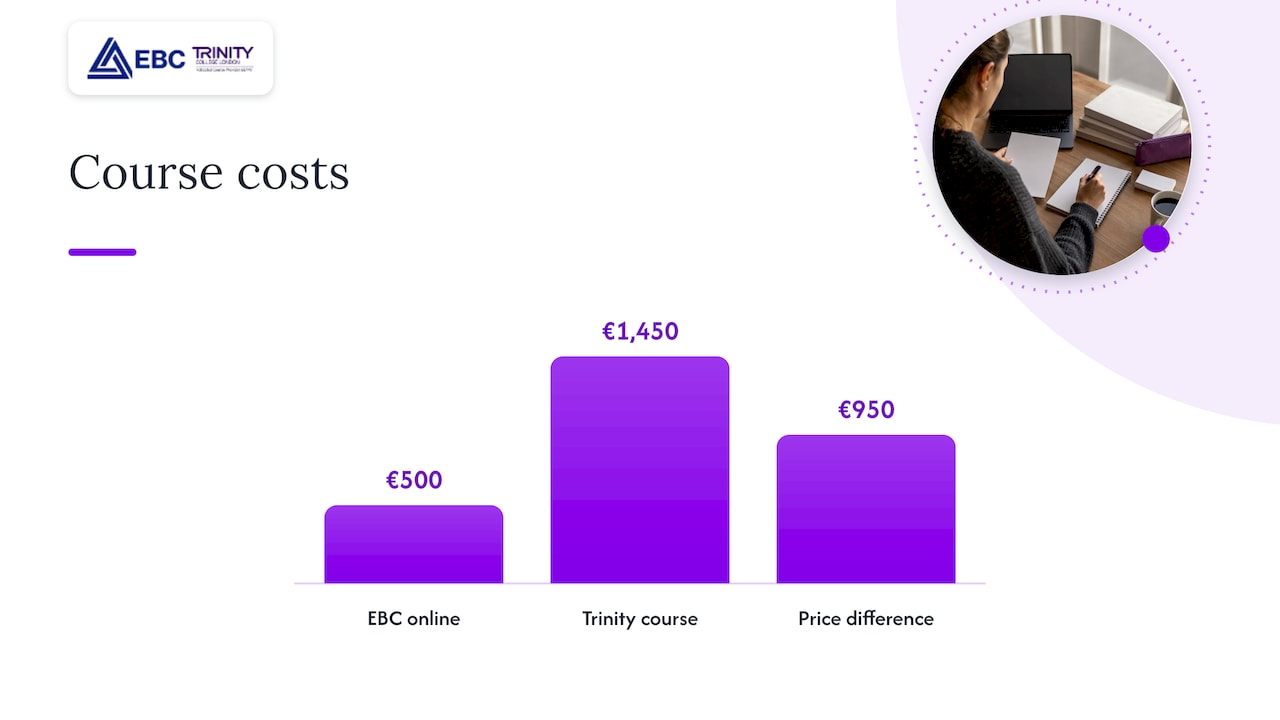
The price difference between the €500 EBC online course and the €1,450 CertTESOL is €950. Spread over a first year of teaching, or over the first few months of a contract, that is a small share of what a working teacher earns. The result is a stronger interview, a recognised qualification and more confidence on the first day. Pay rates vary widely by country and school type, so check the going rate where you want to work before you calculate your own payback.
Why it matters for getting work
A qualification is only worth what it does for your job search. Here is where a properly assessed course adds value.
It gets you through the screening. Many schools and online platforms filter on a recognised certificate, a minimum number of hours and, often, a degree. A Level 5 qualification from an established awarding body is easy for a recruiter to understand. Our guides on TEFL accreditation and which TEFL course is most recognised explain how to check this.
It gives you evidence to talk about. Interviewers like specifics: a lesson you taught, a problem you solved. Supervised practice gives you those stories.
It adds skills you use from day one. Lesson planning, classroom management, error correction and learner-focused teaching are what you are paid to do. They are also what make students stay and recommend you.
It travels. Visa and employment rules differ by country, and nothing in a certificate guarantees a visa or a job. But a qualification from an international awarding body is understood in many markets, from Spain, France and Italy to Japan, South Korea and China. EBC’s guide to teaching English in Italy shows how this plays out in one market.
It supports your application documents. Once you hold the qualification, make sure your CV shows it clearly. If you are applying in Canada, this guide on how to format a teacher resume for Canada shows what to include and how to lay it out.
It leads somewhere. The CertTESOL is an initial qualification. After some experience, teachers often move to specialist development such as the CertPT courses in Business English, CLIL, CLT or Teaching Online, each priced at €999. Those build on your classroom practice and open niches such as corporate training and online teaching. Our page on CPD for English teachers explains why ongoing development counts.

When a lower price is a sensible start
Not everyone needs the same course on the same day. If you are exploring the idea of teaching, or you want to teach online and prefer to study at your own pace, you can start with the EBC Online TEFL Certification Course. It costs €500 and includes trainer support, so you are not working alone.
If your plans firm up, or you want to teach in a classroom abroad, the Trinity CertTESOL is the next step to a fuller, assessed qualification. Talk through your goals in a free consultation and we will help you match the course to the job you want.
Spending more can also mean a year abroad
For some readers the question is bigger than a certificate. If you want to live in Europe for a year, EBC combines teacher training with language or post-graduate study and part-time work options in one package:
- Road2Spain Spanish + TEFL: €5,900 to €6,700
- Road2Spain Post-Graduate + TEFL: €5,400
- Road2Italy: €7,700
- Road2France: €8,500
These programmes include visa support and opportunities to teach or work part-time, with cultural immersion in the country. Visa outcomes depend on the authorities of each country and on your own circumstances, so no programme can guarantee a visa or a particular job. Read the programme pages for full details, including what each price covers.
Questions to ask about any course
You will make a better choice with a short checklist:
- Is the awarding body named and checkable? A recognised body such as Trinity publishes its qualification details, so you can confirm them.
- Is the practice supervised and with real learners? Peer role-play alone is not the same.
- Who marks your work? A named tutor, with moderation, is a good sign.
- What exactly is in the fee? Ask whether assessment and moderation are included, as they are in the EBC fee.
- What help do you get afterwards? Look for support that lasts beyond the last day of the course.
- Does it match where you want to teach? Employers in different countries weigh qualifications differently, so check the requirements for your target country.
Your next step
If you want a qualification that employers recognise and that has prepared you in a real classroom, the Trinity CertTESOL with EBC costs €1,450, includes Trinity assessment and moderation fees, and comes with free lifetime worldwide job placement support. Instalment options are available. To compare it with the online route or a year-abroad programme, book a free consultation and we will help you choose.

If you are still weighing up certificates, our guide Is a TEFL certificate worth it in 2026? and the comparison of CELTA vs Trinity CertTESOL are good places to continue.
FAQ
Is an expensive TEFL or TESOL certificate worth the money?
It is worth it when the price pays for supervised teaching practice, trainer feedback, formal assessment and a recognised awarding body. Those are the elements that prepare you for a real classroom and that employers can verify. The Trinity CertTESOL includes all of them.
How many hours should a good TEFL course have?
Reputable certificates commonly require at least 120 course hours, according to Johns Hopkins School of Education. Look beyond the number to how many hours are taught by a trainer and how much observed practice is included.
What is the difference between TEFL and TESOL?
TEFL usually refers to teaching English where it is not the main language, while TESOL is a wider term that also covers English-speaking countries. Employers often treat them as interchangeable, so the quality of the training matters more than the label.
Can I pay for the Trinity CertTESOL in instalments?
Yes, instalment payment options are available for the €1,450 fee. Book a free consultation to go through the options and choose a plan that suits you.
Does a certificate guarantee a job or a visa?
No. Visa rules are set by each country’s authorities and hiring decisions are made by employers. A recognised qualification and EBC’s free lifetime job placement support help you apply with confidence, but nothing is guaranteed.
Sources
- Trinity College London: Certificate in Teaching English to Speakers of Other Languages (CertTESOL)
- Johns Hopkins School of Education: TEFL vs. TESOL
- TEFL.net: 10 Misleading Claims By TEFL Course Providers
Recommended
- How Much Do TEFL Teachers Earn? The Reality Behind Global Teaching Salaries
- Are there any free TEFL courses for the unemployed?
This page provides commentary based on information, facts, and experiences available at the time of publication. It does not constitute legal advice, and EBC accepts no liability for decisions made based on the information provided. If you require legal advice, please consult a qualified lawyer.