
Choosing the right TEFL certification often feels overwhelming when you dream of teaching in Spain, France, or Italy. For recent graduates and career changers, the search for an internationally respected qualification with real classroom training can be confusing. This guide will clarify how accredited TEFL providers set the standard, what makes programmes like Trinity College London CertTESOL so valuable, and how trusted support and job assistance can open doors to rewarding teaching roles across Europe.
Table of Contents
- Defining Accredited TEFL Providers
- Trinity College London Accreditation Standards
- Types Of TEFL And TESOL Certifications Offered
- How Accredited TEFL Programmes Ensure Employability
- Comparing Accredited And Non-Accredited TEFL Courses
- Study And Work Abroad Programmes In Spain, France And Italy
Key Takeaways
| Point | Details |
|---|---|
| Accredited TEFL Providers | Ensure high-quality teacher training with standards recognised internationally, enhancing employability in global markets. |
| Trinity CertTESOL | Represents a prestigious qualification with comprehensive assessment and practical components, contributing to effective teaching preparedness. |
| Diverse Certification Options | Various TEFL/TESOL certifications cater to different teaching contexts, allowing educators to tailor their qualifications to career goals. |
| Importance of Practical Training | Accredited programmes emphasise real classroom experiences, making graduates more competitive candidates for teaching positions worldwide. |
Defining accredited TEFL providers
Accredited TEFL providers represent educational organisations that offer professionally recognised teacher training programmes specifically designed for teaching English to speakers of other languages. These providers undergo rigorous external assessment to ensure they meet comprehensive international standards for language instructor preparation. Accreditation standards establish a critical quality benchmark that separates professional certification from basic training programmes.
Key characteristics of accredited TEFL providers typically include comprehensive curriculum design, qualified instructor teams, practical teaching practice components, and recognition from respected international educational bodies. Unlike unaccredited courses, these programmes guarantee structured learning experiences that prepare teachers for real classroom challenges. The Trinity College London certification, for instance, represents one of the most respected global standards in English language teaching qualifications.
When evaluating potential TEFL providers, prospective teachers should examine several crucial factors. These include course duration, practical teaching hours, international recognition, trainer qualifications, and post-course support mechanisms. Essential features of accredited programmes often include structured lesson planning training, classroom management techniques, and comprehensive understanding of language acquisition theories.
Pro tip: Always verify an organisation’s accreditation status through official international teaching associations before committing to any TEFL certification programme.
Trinity College London accreditation standards
Trinity College London stands at the forefront of international English language teaching certification, offering rigorous accreditation standards that set global benchmarks for professional teacher training. Their CertTESOL qualification represents a pinnacle of excellence in language instructor preparation, meticulously designed to equip educators with comprehensive skills and knowledge for effective classroom delivery.

The organisation’s accreditation framework is distinguished by its comprehensive assessment criteria. Specifically, the Trinity CertTESOL is classified as a Level 5 qualification on the Ofqual Regulated Qualifications Framework, which corresponds to the academic complexity of second-year undergraduate study. This prestigious certification mandates a minimum of 130 guided learning hours, complemented by an additional 70 hours of independent study, ensuring thorough and rigorous professional development for aspiring English language teachers.
Key components of Trinity College London’s accreditation standards encompass multiple critical teaching competencies. These include advanced language awareness, sophisticated teaching methodology, learner profiling techniques, innovative materials development, and strategic approaches to managing unknown linguistic challenges. Advantages of Trinity certification extend beyond theoretical knowledge, with mandatory practical components like six hours of observed teaching practice that simulate authentic classroom environments and prepare instructors for real-world educational settings.
Pro tip: Research the specific recognition of Trinity CertTESOL in your target teaching destination to maximise your international employability.
Types of TEFL and TESOL certifications offered
The landscape of English language teaching certifications encompasses several distinct types of qualifications, each designed to prepare educators for specific teaching environments and career pathways. Types of TESOL certifications range from entry-level programmes to advanced professional credentials, offering aspiring teachers multiple routes into international education.
Primary certification categories include the Trinity CertTESOL, Cambridge CELTA, online TEFL certificates, and specialised professional diplomas. Entry-level certifications typically provide foundational teaching skills and are ideal for newcomers to the field, while advanced diplomas like the Diploma in TESOL offer more comprehensive training for experienced educators seeking career progression. These qualifications differ in duration, depth of study, practical teaching components, and international recognition, allowing teachers to select programmes aligned with their specific professional goals.
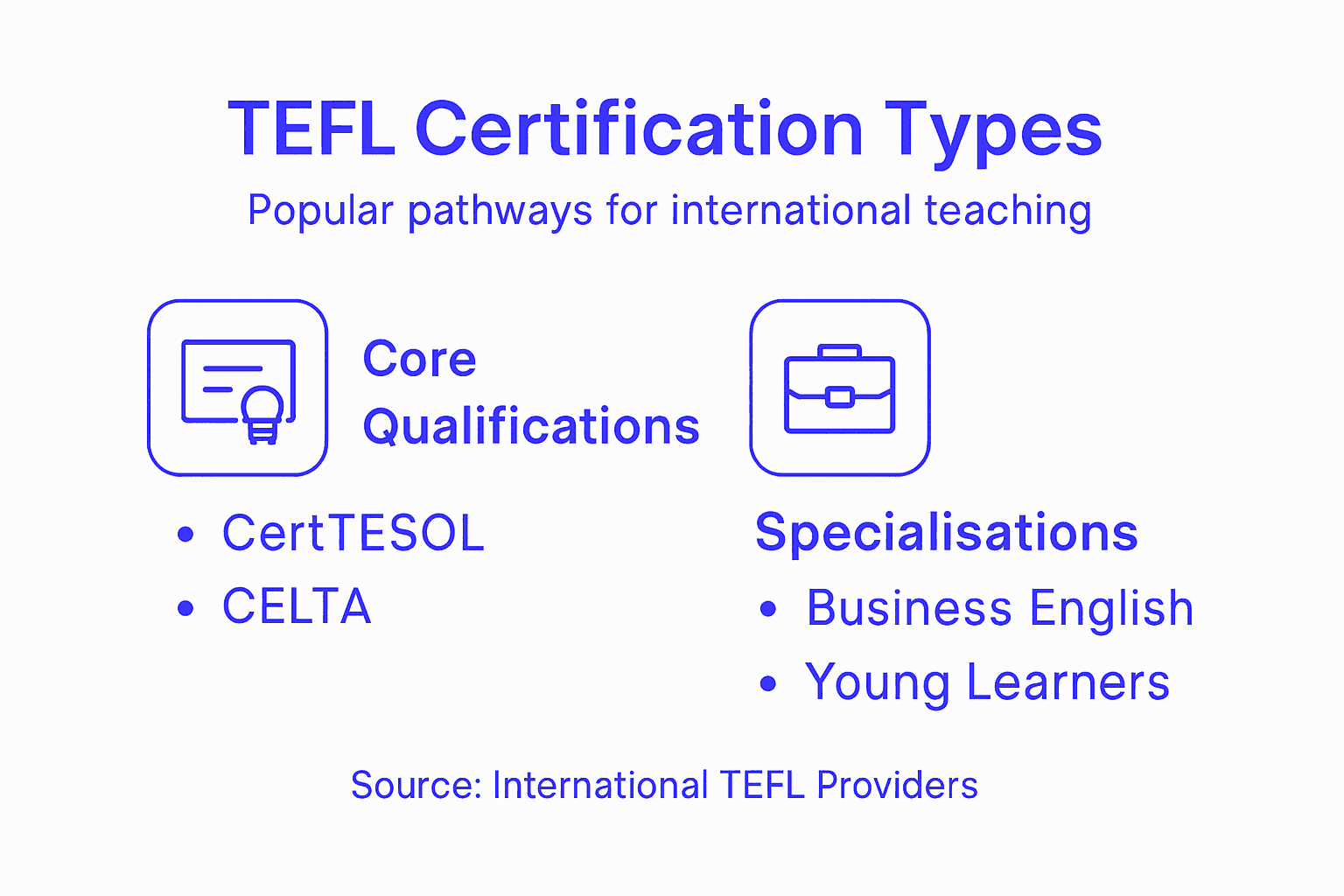
Specialised certifications have emerged to address unique teaching contexts, including Business English certification, Young Learners endorsements, Online Teaching credentials, and subject-specific qualifications like Content and Language Integrated Learning (CLIL). These targeted programmes enable teachers to develop niche expertise and enhance their employability in specific educational markets, providing opportunities for professional differentiation beyond standard language teaching credentials.
The following table highlights key differences between major TEFL/TESOL certifications commonly chosen by new and experienced teachers:
| Certification Type | Course Duration | Recognition |
|---|---|---|
| Trinity CertTESOL | 4-5 weeks full-time | International, highly valued |
| Cambridge CELTA | 4-5 weeks full-time | Global, widely accepted |
| Online TEFL Certificate | 2-12 weeks, flexible | Varies, less consistent |
| Advanced Diploma (TESOL) | 6 months or longer | Advanced, career-focused |
Pro tip: Always verify the international accreditation and recognition of your chosen TEFL or TESOL certification before investing time and resources.
How accredited TEFL programmes ensure employability
Accredited TEFL programmes play a crucial role in transforming aspiring teachers into globally competitive professionals by providing comprehensive training that directly addresses employer expectations. TESOL accreditation standards create a robust framework that validates a teacher’s professional capabilities, ensuring they possess the necessary skills to succeed in diverse international teaching environments.
The core mechanisms through which accredited programmes enhance employability include rigorous practical training, internationally recognised certification, and structured professional development pathways. These programmes typically incorporate extensive teaching practice, methodology workshops, language awareness modules, and real-world classroom management strategies. By developing a comprehensive skill set that goes beyond basic language instruction, graduates become attractive candidates for educational institutions worldwide, with certifications that serve as reliable indicators of professional competence.
Employers consistently prioritise candidates from accredited programmes due to their standardised training and demonstrated practical capabilities. Specialised modules such as Business English preparation, Young Learner teaching techniques, and Online Teaching methodologies further differentiate candidates in competitive job markets. Advanced programmes also provide additional career support mechanisms, including job placement assistance, professional networking opportunities, and guidance on international recruitment processes, which significantly enhance graduates’ prospects of securing meaningful teaching positions.
Below is a summary table showing how accredited TEFL programmes can improve a teacher’s international job prospects:
| Employability Factor | Benefit for Graduate | Employer Preference |
|---|---|---|
| Accredited Certification | Recognised qualification | Trusted by top schools |
| Practical Training | Experience in real classrooms | Essential for job offers |
| Professional Support | Ongoing career guidance | Favourable hiring outcome |
| International Recognition | Mobility across different countries | Greater job market access |
Pro tip: Select an accredited TEFL programme that offers comprehensive practical training and verified international recognition to maximise your global teaching opportunities.
Comparing accredited and non-accredited TEFL courses
The distinction between accredited and non-accredited TEFL courses represents a critical decision point for aspiring English language teachers seeking meaningful career opportunities. Accredited TEFL course types demonstrate substantial differences in quality, recognition, and professional value compared to unverified training programmes.
Accredited courses are characterised by rigorous external validation, comprehensive curriculum design, and recognition from respected international educational bodies. These programmes typically include structured practical teaching components, expert-led methodology training, and formal assessment processes that ensure high-quality instructor preparation. Non-accredited courses, by contrast, often lack standardised training frameworks, may offer minimal practical experience, and frequently provide certificates that hold little credibility with potential employers in competitive international teaching markets.
The key differentiators between accredited and non-accredited courses extend beyond theoretical knowledge into practical employability. Employers consistently prioritise candidates with Trinity College London or equivalent internationally recognised certifications, viewing these qualifications as reliable indicators of professional competence. Non-accredited courses frequently fail to provide the comprehensive skills development, professional networking opportunities, and job placement support that characterise high-quality teacher training programmes, potentially limiting graduates’ career prospects in global education environments.
Pro tip: Invest in an accredited TEFL course that offers comprehensive practical training, international recognition, and verifiable professional support to maximise your teaching career opportunities.
Study and work abroad programmes in Spain, France and Italy
Study and work abroad programmes in Spain, France, and Italy offer transformative experiences for aspiring English language teachers, combining professional development with cultural immersion. Study abroad opportunities provide comprehensive pathways for individuals seeking to enhance their teaching credentials while experiencing European educational and professional landscapes.
These innovative programmes typically integrate multiple components, including Trinity CertTESOL certification, language study, part-time teaching or work opportunities, and cultural integration experiences. Participants can expect structured support mechanisms that include visa assistance, accommodation guidance, professional networking opportunities, and continuous mentorship throughout their international journey. The programmes are meticulously designed to balance academic learning, practical teaching experience, and personal development, enabling participants to gain internationally recognised qualifications while immersing themselves in European cultural contexts.
Each destination offers unique advantages for international teachers. Spain provides vibrant urban environments and exceptional language learning opportunities, France delivers sophisticated cultural experiences with robust educational infrastructure, and Italy combines historic charm with dynamic professional networks. These programmes go beyond traditional teaching preparation by offering holistic experiences that develop linguistic skills, cross-cultural competencies, and professional adaptability, making graduates highly attractive to international educational institutions.
Pro tip: Research the specific visa requirements and work regulations for each country to ensure a smooth transition into your international teaching experience.
Unlock Your Global Teaching Career with Accredited TEFL Training and Unique Study Abroad Experiences
Navigating the world of TEFL certification can be challenging, especially when seeking accredited programmes that guarantee practical skills and international recognition. This article highlights the importance of Trinity College London accreditation and structured training for real-world classroom success. If your goal is to stand out as a confident, well-prepared English teacher with genuine global employability, our tailored courses and support are designed with you in mind.
At EBC TEFL, we offer professionally recognised Trinity CertTESOL and specialised certifications including Business English and Online Teaching. Our hands-on approach ensures you gain extensive practical experience combined with theoretical excellence. Plus, our exclusive 1-year study and work abroad programmes in Spain, France, and Italy provide a holistic pathway where you earn your accredited qualification while immersing yourself in vibrant cultures, enjoying language study, and gaining part-time teaching or work opportunities. Key features include visa assistance, ongoing professional development, and lifetime job placement support to maximise your career trajectory.
Take the first step towards becoming a globally competent English teacher who commands respect and opportunity worldwide. Explore detailed course options, cultural insights, and graduate success stories on our website. For personalised guidance and to discuss the best certification or study/work programme for your goals, book your free consultation today at EBC TEFL consultation. Your future classroom awaits.
Frequently Asked Questions
What are accredited TEFL providers?
Accredited TEFL providers are educational organisations that offer recognised teacher training programmes for teaching English to speakers of other languages, meeting international standards for language instructor preparation.
How does Trinity College London ensure high-quality teacher training?
Trinity College London’s accreditation framework includes rigorous assessment criteria, requiring a minimum of 130 guided learning hours and practical teaching components, ensuring comprehensive skills and knowledge for effective classroom delivery.
What are the different types of TEFL certifications available?
TEFL certifications include entry-level qualifications like the Trinity CertTESOL and Cambridge CELTA, along with online TEFL certificates and advanced diplomas, which vary in duration, depth of study, and international recognition.
How do accredited TEFL programmes enhance employability for teachers?
Accredited TEFL programmes provide rigorous practical training, internationally recognised certifications, and structured professional development pathways, equipping graduates with skills that meet employer expectations and improve job prospects.
