
Choosing the right path for teaching Business English can feel overwhelming, especially when you dream of practical experience and cultural immersion in Spain, France, or Italy. For aspiring English teachers, mastering professional communication skills is crucial to support learners’ real-world goals in today’s global market. This guide walks you through assessing learner needs, selecting accredited certifications, and developing lesson plans that set you apart in European classrooms.
Table of Contents
- Step 1: Assess Requirements For Business English Learners
- Step 2: Select Accredited Training And Certification Pathways
- Step 3: Develop Practical Business English Lesson Plans
- Step 4: Implement Effective Classroom Teaching Strategies
- Step 5: Verify Learner Progress And Job Placement Outcomes
Quick Summary
| Main Insight | Explanation |
|---|---|
| 1. Assess learners’ specific needs | Conduct thorough assessments to identify unique language and communication requirements of each business English learner. |
| 2. Select accredited certification pathways | Choose internationally recognised certifications to ensure robust training and enhance professional credibility. |
| 3. Develop practical lesson plans | Create lesson plans that align with real-world business communication scenarios to foster applicable skills. |
| 4. Implement engaging classroom strategies | Utilize interactive and task-based methods to enhance learner participation and practical language use. |
| 5. Monitor progress and outcomes | Establish systematic frameworks to assess learner advancement and connect language skills to career success. |
Step 1: Assess Requirements for Business English Learners
Successful business English instruction begins with a comprehensive understanding of each learner’s unique language and professional needs. The key objective is developing a targeted approach that addresses specific communication challenges within global business contexts.
To effectively assess business English learners’ requirements, educators must conduct a systematic comprehensive needs analysis. This process involves multiple strategic steps:
- Conduct initial proficiency assessments
- Interview learners about their professional backgrounds
- Analyse specific workplace communication demands
- Map individual language skill gaps
- Determine industry-specific terminology requirements
Understanding learner objectives requires deep investigation into their professional environments. Business English students typically need strong capabilities in:
- Professional presentation skills
- Email and written communication
- Negotiation language
- Technical vocabulary specific to their industry
- Intercultural communication strategies
The assessment process should focus on identifying precise language requirements that enable effective workplace interactions. Targeted language skill evaluation helps design personalised learning pathways aligned with individual career goals.
Successful business English instruction is not about generic language training, but creating customised learning experiences that directly support professional communication needs.
Professional communication skills form the core of business English learning. Instructors must remain flexible, adapting curriculum to match evolving global business communication trends.
Professional recommendation: Always conduct a detailed initial consultation with learners to understand their specific professional communication objectives and tailor your teaching approach accordingly.
Step 2: Select Accredited Training and Certification Pathways
Navigating the complex landscape of business English teaching certifications requires strategic planning and careful consideration of globally recognised qualifications. Your ultimate goal is selecting a certification pathway that provides robust training and international credibility.
When exploring certification options, focus on programmes offering comprehensive business English credentials. These internationally recognised qualifications should include:
- Practical business communication modules
- Industry-specific language training
- Professional teaching methodology
- Intercultural communication skills
- Assessment and evaluation techniques
Key certification pathways for aspiring business English instructors include:
- Cambridge Business English Certificates (BEC)
- Trinity College London certifications
- TEFL specialised business English programmes
- International professional language assessments
- Academic teaching diplomas with business focus
Carefully evaluate each certification based on three critical factors: global recognition, practical skill development, and alignment with your specific career objectives.
Selecting the right certification is not just about obtaining a credential, but strategically positioning yourself in the competitive global business English teaching market.
Professional credentials represent your gateway to international teaching opportunities. Research thoroughly, compare programmes, and choose a pathway that demonstrates both linguistic expertise and professional competence.
Here is a comparison of key business English teaching certifications and their professional advantages:
| Certification Pathway | Core Strength | International Recognition |
|---|---|---|
| Cambridge Business English Certificates | Widely accepted | High across Europe and Asia |
| Trinity College London Certifications | Strong methodology | Well regarded worldwide |
| Specialised TEFL Business Programmes | Practical focus | Varies by provider |
| International Professional Language Tests | Assess proficiency | Globally recognised |
| Academic Diplomas with Business Focus | In-depth study | Highly valued in academia |
Professional recommendation: Always verify the international accreditation and industry recognition of your chosen certification programme before making a final commitment.
Step 3: Develop Practical Business English Lesson Plans
Crafting effective business English lesson plans requires a strategic approach that bridges theoretical language learning with real-world professional communication needs. Your goal is to design lessons that transform classroom interactions into practical workplace skills.
When developing lesson plans, prioritise authentic business communication tasks. These should encompass critical professional scenarios such as:
- Conducting professional meetings
- Writing effective business emails
- Delivering persuasive presentations
- Negotiating business agreements
- Managing intercultural communication challenges
Successful lesson planning involves a structured methodology:
- Identify specific learner professional contexts
- Select relevant business communication scenarios
- Design targeted language skill development activities
- Integrate industry-specific terminology
- Create assessment mechanisms for skill progression
Practical lesson design requires understanding your learners’ specific professional environments. Each lesson should include clear learning objectives, engaging activities, and measurable skill development outcomes.
Effective business English lessons transform language learning from theoretical concepts into actionable workplace communication strategies.
Business communication modules must balance linguistic precision with practical application. Focus on creating lessons that simulate authentic professional interactions and challenges.

Professional recommendation: Always incorporate real-world business scenarios and materials that reflect current workplace communication trends and expectations.
Step 4: Implement Effective Classroom Teaching Strategies
Successful business English instruction goes beyond traditional language teaching, demanding innovative approaches that transform learners’ communication capabilities. Your mission is to create dynamic, engaging learning environments that bridge linguistic skills with professional communication expertise.
Embrace interactive teaching methodologies that promote active learner participation and real-world skill development:
- Utilise task-based learning techniques
- Encourage learner autonomy
- Integrate authentic business materials
- Leverage digital communication technologies
- Foster cross-cultural communication skills
Effective classroom strategies require a multifaceted approach:
- Design scenario-based learning activities
- Provide personalised feedback mechanisms
- Create collaborative communication exercises
- Develop adaptive teaching techniques
- Implement continuous skills assessment
Classroom engagement strategies must be flexible and responsive to diverse learner needs. Successful instructors balance structured learning with interactive, practical communication experiences.
Effective business English teaching transforms language instruction from passive learning to active professional communication skill development.
Professional communication training demands a holistic approach that connects linguistic precision with practical workplace communication skills.
The following table summarises effective classroom strategies for business English and their benefits:
| Strategy | Benefit for Learners | Real-World Application |
|---|---|---|
| Task-based learning | Promotes active usage of language | Mirrors workplace tasks |
| Authentic business materials | Increases relevance and motivation | Prepares learners for real work |
| Collaborative communication tasks | Develops teamwork and leadership | Reflects modern business practices |
| Continuous skills assessment | Tracks progress and adapts lessons | Ensures measurable improvement |
Professional recommendation: Continuously adapt your teaching strategies to reflect current global business communication trends and learner expectations.
Step 5: Verify Learner Progress and Job Placement Outcomes
Tracking and evaluating business English learners’ advancement requires a comprehensive approach that goes beyond traditional assessment methods. Your objective is to create a robust system that measures language proficiency, professional communication skills, and successful career progression.
Implement systematic assessment frameworks to monitor learner development and career outcomes:
- Conduct regular formative evaluations
- Track professional communication effectiveness
- Gather employer feedback
- Monitor job placement success rates
- Analyse long-term career progression
Comprehensive progress verification involves multiple strategic steps:
- Design multi-dimensional assessment tools
- Establish performance benchmarks
- Create individualised development plans
- Implement continuous feedback mechanisms
- Connect learning outcomes with career services
Performance tracking strategies must be dynamic and responsive to evolving business communication requirements. Successful verification goes beyond numeric scores, focusing on practical communication competence.
Effective learner assessment transforms educational metrics into meaningful professional development pathways.
Career progression monitoring requires a holistic approach that connects language learning with tangible professional opportunities.
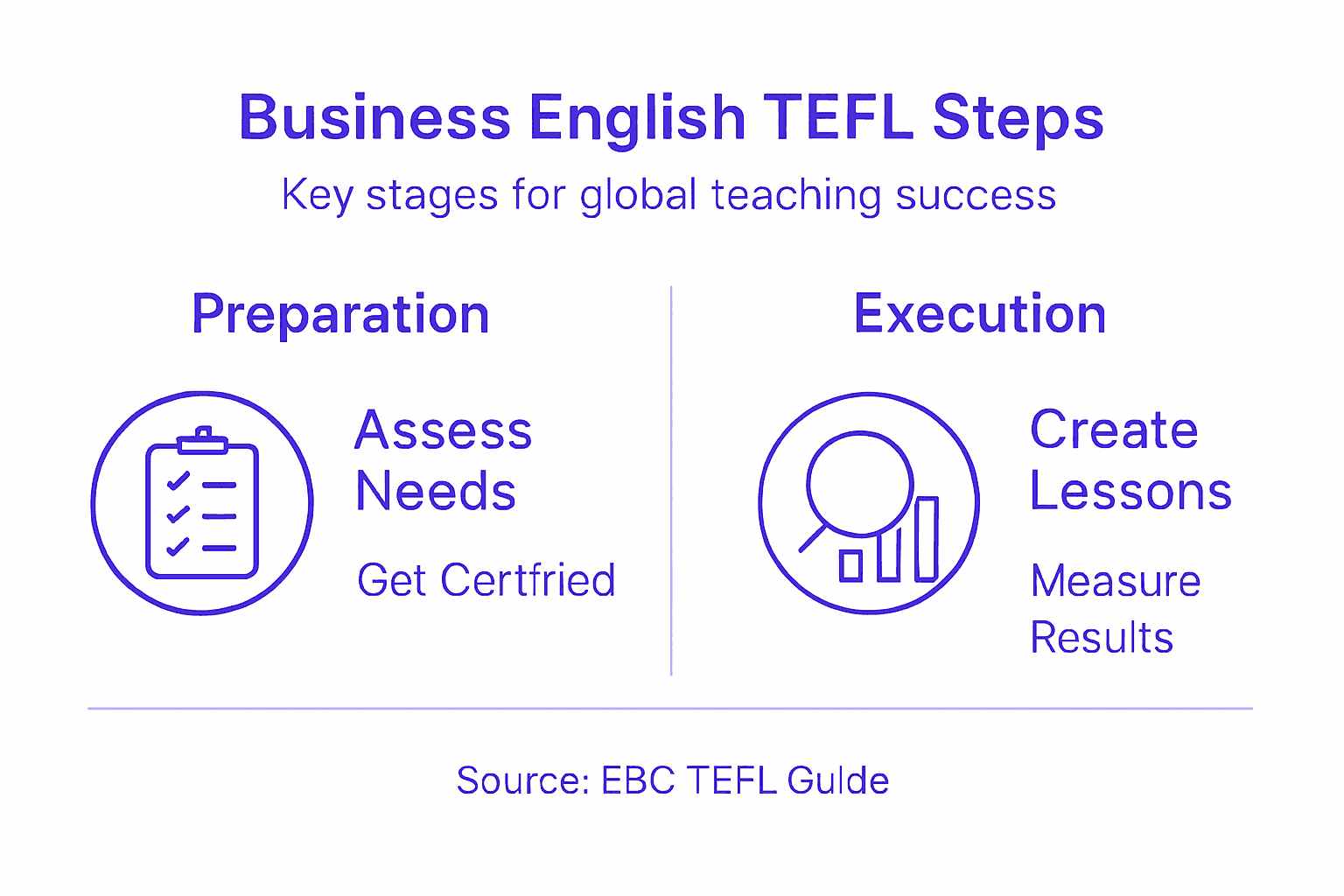
Professional recommendation: Develop a comprehensive tracking system that links language proficiency directly to professional communication success and career advancement.
Elevate Your Career with Expert Business English Teaching Training
The “Business English Teaching Guide for Global TEFL Success” highlights the challenge of mastering specialised communication skills alongside gaining accredited certification to thrive as a business English instructor. Key goals include understanding learner needs, selecting internationally recognised qualifications, and developing practical, real-world lesson plans. If you seek to stand out with Trinity College London accredited credentials while accessing global job placement support, you will find EBC TEFL perfectly aligned with your ambitions.
At EBC TEFL you can enrol in specialised Business English teaching courses designed to build both professional competence and teaching expertise. Our hands-on programmes offer Trinity College London internationally accredited certification, comprehensive training in teaching methodologies, and lifelong assistance connecting you to teaching opportunities worldwide. In addition, our unique one-year study and work abroad programmes in Spain, France, and Italy combine accredited teacher training with immersive language study and part-time work opportunities to accelerate your career development.
Experience tailored instructor training that transforms theoretical knowledge into practical communication skills that business English learners demand. Start your journey with EBC TEFL today and access the global network and expert guidance to achieve professional success in teaching Business English.
Explore our specialised courses including Business English and take advantage of comprehensive study/work options here: Specialised Courses.
Ready to transform your teaching career with Trinity College London accredited Business English training and global job placement support? Visit EBC TEFL now and take the first step towards high-impact, internationally recognised TEFL qualifications and life-changing global opportunities.
Frequently Asked Questions
What are the key steps to assess the requirements of business English learners?
To effectively assess business English learners’ requirements, conduct initial proficiency assessments, interview learners about their professional backgrounds, and analyse specific workplace communication demands. Begin with a comprehensive needs analysis to identify specific language requirements that enable effective interactions in the workplace.
How can I select the right accredited training and certification pathway for business English teaching?
Focus on programmes that offer comprehensive business English credentials, including practical communication modules and industry-specific terminology training. Evaluate options based on global recognition, practical skill development, and their alignment with your specific career objectives.
What should I include in practical business English lesson plans?
In your lesson plans, prioritise authentic business communication tasks such as conducting meetings, writing business emails, and delivering presentations. Design activities that integrate targeted language skill development and industry-specific vocabulary to ensure lessons reflect real-world business scenarios.
What effective teaching strategies should I adopt for business English classrooms?
Utilise interactive teaching methodologies like task-based learning and authentic business materials to enhance learner engagement. Implement collaborative exercises and continuous assessment processes to create a dynamic and practical learning environment for your students.
How can I verify learner progress and job placement outcomes in business English?
Develop a systematic assessment framework that tracks language proficiency, communication effectiveness, and job placement success rates. Conduct regular evaluations and gather feedback from both learners and employers to ensure that your teaching aligns with career advancement goals.
