
Choosing between CELTA and Trinity CertTESOL can feel overwhelming when you’re starting your English teaching journey. Both certifications open the most doors to international teaching careers, yet many aspiring teachers struggle to understand which suits their goals best. CELTA and Trinity CertTESOL are leading internationally recognised TEFL certifications issued by Cambridge and Trinity College London respectively. This guide cuts through the confusion, comparing course structures, global recognition, career prospects, and practical considerations to help you make an informed choice that aligns with your teaching ambitions and lifestyle preferences.
Table of Contents
Key takeaways
| Point | Details |
|---|---|
| Both globally recognised | CELTA and Trinity CertTESOL hold equal international standing for English teaching positions worldwide. |
| Different assessment styles | CELTA uses portfolio-based assessment whilst Trinity CertTESOL includes external moderation and oral exams. |
| Similar duration and intensity | Both typically require 4-5 weeks full-time or part-time equivalent with extensive teaching practice. |
| Personal goals matter most | Your choice depends on preferred learning style, budget, teaching destinations, and career trajectory. |
| Trinity offers flexibility | Trinity CertTESOL often provides more varied assessment formats and adaptable course structures. |
Overview of CELTA and Trinity CertTESOL certifications
Before diving into comparisons, understanding what each certification represents helps clarify your decision. Both qualifications prepare you to teach English to speakers of other languages, but they come from different accrediting bodies with distinct philosophies.
CELTA stands for Certificate in English Language Teaching to Adults. Cambridge Assessment English awards this qualification. It focuses heavily on practical teaching skills through observed lessons and reflective practice.
Trinity CertTESOL, the Certificate in Teaching English to Speakers of Other Languages, comes from Trinity College London. This qualification emphasises both practical teaching skills through observed lessons and reflective practice, and theoretical understanding through a balanced assessment approach. Trinity College London has offered teacher training since 1877, bringing extensive educational expertise to TESOL certification.
Both certifications require at least 120 hours of study, including observed teaching practice with real students. They’re designed for native and fluent English speakers who want to teach adults or young learners abroad. Entry requirements typically include being over 18 and holding qualifications equivalent to university entrance level.
Global recognition for both certificates remains strong. Schools, language centres, and universities worldwide accept either qualification for teaching positions. The British Council recognises both for teaching English internationally, which matters significantly for visa sponsorship and employment eligibility.
Key similarities include:
Minimum 120 hours of coursework and teaching practice
Internationally recognised by employers and governments
Focus on communicative language teaching methodology
Practical teaching experience with feedback from experienced trainers
No previous teaching experience required
The difference between Trinity CertTESOL and CELTA lies mainly in assessment methods, course structure, and institutional philosophy rather than quality or recognition. Understanding these distinctions helps you choose the certification that matches your learning preferences and career goals.
Comparing course content, assessment, and format
Course delivery and assessment approaches differ significantly between CELTA and Trinity CertTESOL, affecting your learning experience and how you demonstrate competence.
Both certifications offer multiple delivery modes. You can complete either qualification through intensive full-time courses (typically 4-5 weeks), part-time evening or weekend programmes (spanning several months), or blended formats combining online theory with in-person teaching practice. Some centres now offer fully online options with virtual teaching practice, though availability varies by location.
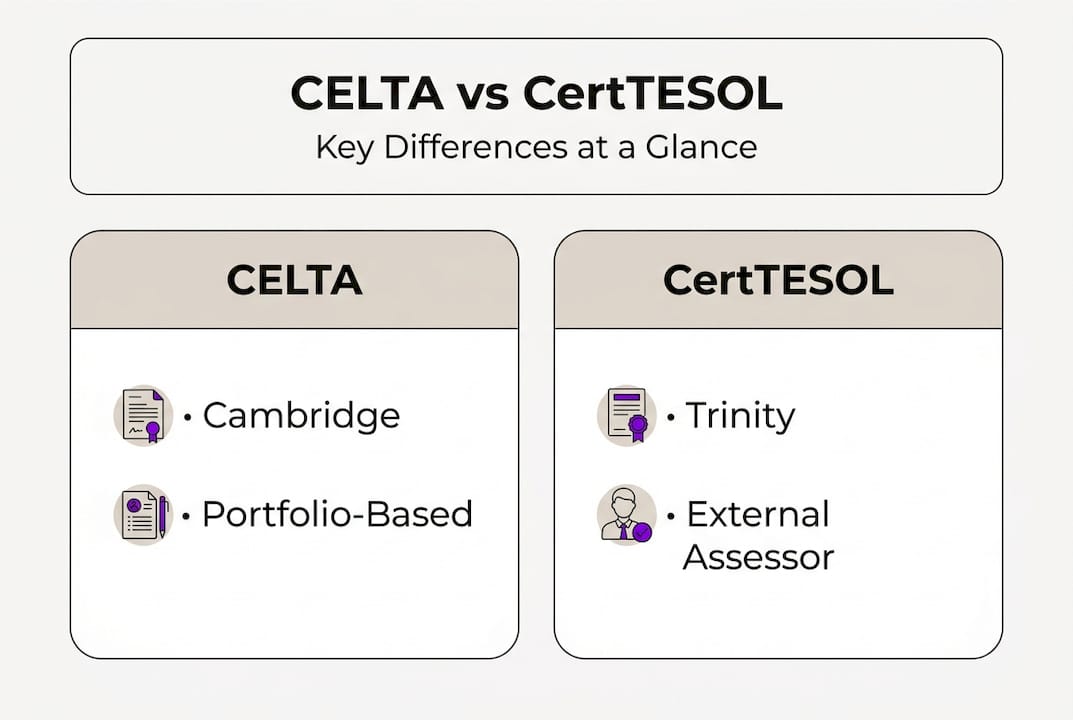
Assessment structures reveal the most notable differences. CELTA typically involves portfolio-based assessment with observed lessons, whilst Trinity CertTESOL includes external and internal assessments, observed lessons and a final oral exam. CELTA and Trinity CertTESOL candidates submit written assignments analysing language systems, lesson planning, and teaching reflection. Trainers assess teaching practice through direct observation, providing detailed feedback after each session.

Trinity CertTESOL takes a different approach. Candidates complete written assignments similar to CELTA but also face an external assessment component. An independent Trinity examiner conducts a final oral exam where you discuss your teaching philosophy, lesson planning decisions, use of teaching materials, and professional development. This external moderation ensures consistent standards across all Trinity centres globally.
| Assessment Component | CELTA | Trinity CertTESOL |
|---|---|---|
| Observed Teaching Practice Hours | 6 hours minimum | 6 hours minimum |
| Written Assignments | 4 assignments | 5 assignments plus journal |
| External Assessment | No | Yes (observed lesson and oral exam) |
| Grading System | Pass, Pass B, Pass A, Fail | Pass, Pass with Merit, Distinction, Fail |
| Portfolio Requirement | Yes | Yes |
Teaching practice requirements remain similar for both. You’ll teach real students at appropriate levels. You will be observed and receive constructive feedback from experienced trainers. CELTA requires six assessed teaching practice sessions totalling at least six hours. Trinity CertTESOL mandates the same minimum, though some centres offer additional practice opportunities.
Pro Tip: Consider your learning style when choosing between certifications. If you prefer internal assessment and portfolio development, CELTA suits you well. If you value external validation and enjoy discussing your teaching decisions verbally, Trinity CertTESOL’s oral exam component might appeal more.
Course intensity matches closely for both qualifications. Full-time courses demand 40-50 hours weekly including classroom time, teaching practice, lesson planning, and assignment completion. Part-time options spread this workload across several months, typically requiring 15-20 hours weekly. The complete CELTA vs Trinity CertTESOL comparison shows both certifications maintain rigorous standards regardless of delivery format.
Grading procedures differ slightly. CELTA awards Pass, Pass B (above standard), Pass A (well above standard), or Fail. Trinity CertTESOL uses Pass, Pass with Merit, Distinction, or Fail. Both grading systems recognise exceptional performance, which can enhance your CV when applying for competitive positions.
Recognition, career opportunities, and global acceptance
How employers view your certification directly impacts your teaching career trajectory and opportunities worldwide. Both CELTA and Trinity CertTESOL open similar doors, though regional preferences and specific contexts create subtle differences.
Both CELTA and Trinity CertTESOL are widely accepted globally. With roots in the 1960s and 1970s, CELTA and Trinity CertTESOL have each built 50+ years of global recognition—making them equally trusted choices for teaching English abroad.
Career opportunities accessible with either certificate include:
Language schools and private institutes worldwide
International schools requiring qualified English teachers
University language programmes and pathway courses
Corporate training and business English instruction
Online teaching platforms and remote positions
Volunteer programmes and educational charities
Regional familiarity can vary slightly between qualifications. In parts of Europe, Trinity CertTESOL is well known due to Trinity College London’s long-standing role in language assessment, while CELTA has historically been widely recognised in some Asian markets. In practice, however, employers across most regions—including the Middle East—generally view both qualifications as equivalent and focus more on teaching ability, experience, and interview performance.
Visa considerations matter significantly when teaching abroad. Both certifications meet visa requirements for teaching English in most countries. The British Council’s recognition of both qualifications strengthens visa applications, particularly in countries where British Council partnerships influence immigration policies.
Pro Tip: Research your target teaching destination before choosing a certification. Contact schools directly or join online teaching forums to learn which qualification employers in specific regions prefer. This due diligence prevents unnecessary complications during job applications.
The Trinity CertTESOL career impact extends beyond initial employment. The external assessment component demonstrates your ability to perform under observation and articulate teaching decisions, skills that translate well into senior teaching roles and teacher training positions.
Long-term career development benefits appear similar for both certifications. Either qualification provides a foundation for advanced diplomas like the Cambridge Delta or Trinity DipTESOL. Trinity also offers CertPT courses which provide Continuing Professional Development (CPD) in specialist areas such as teaching Business English, Communicative Language Teaching (CLT), Content and Language Integrated Learning (CLIL), and Online, Many teachers progress into academic management, curriculum development, or teacher training regardless of their initial certification choice.
Job placement success stories span both certifications. EBC TEFL Course graduates with Trinity CertTESOL secure positions in Spain, Italy, France, China, Thailand, Vietnam, and dozens of other countries. CELTA holders enjoy similar success rates. However, most CELTA courses only provide teacher training and do not include structured job placement services, Your teaching ability, cultural adaptability, and interview skills ultimately matter more than which certificate you hold.
Salary expectations remain comparable for both qualifications. Entry-level positions typically pay similarly whether you hold CELTA or Trinity CertTESOL. Experienced teachers with either certification command competitive salaries based on expertise rather than initial certification choice.
Choosing the right certification for you and practical next steps
Selecting between CELTA and Trinity CertTESOL requires honest reflection about your circumstances, preferences, and teaching goals. Neither certification is objectively better; the right choice depends entirely on your individual situation.
Consider these factors when deciding:
Learning style preferences: CELTA suits trainees who prefer clear, structured guidelines and want to follow the CELTA “playbook”, while Trinity CertTESOL appeals to those who enjoy flexibility and encourages tarinees to bring out and develop their “inner teacher” and adapt proven techniques to their teaching style.
Budget and location: Course fees vary by centre and location rather than certification type. Research local options for both qualifications, comparing costs, schedules, and centre reputations.
Teaching destinations: If you know where you want to teach, research employer preferences in that region. Some countries show slight preferences, though both certifications generally work equally well.
Course availability: Check which centres near you offer each qualification. Limited local options might make your decision easier.
Assessment comfort: Consider whether you prefer demonstrating competence through written portfolios or verbal discussion. Your comfort with different assessment formats affects your learning experience.
Timeline flexibility: Both certifications offer intensive and part-time options, but specific centres might have different schedule flexibility.
Budget considerations extend beyond course fees. Factor in accommodation during intensive courses, materials, travel to teaching practice locations, and potential income loss during full-time study. Part-time options allow continued employment but extend your certification timeline.
Time availability shapes your course format choice more than which certification you pursue. Full-time intensive courses suit career changers or recent graduates with dedicated time. Part-time programmes work better for employed individuals transitioning into teaching gradually.
Preferred teaching locations influence certification choice subtly. Choosing Trinity CertTESOL for career shift makes particular sense if you’re targeting European markets or value external assessment validation. CELTA might edge ahead slightly in Asian markets, though Trinity CertTESOL is equally recognised and accepted by most employers.
Course availability varies globally. Major cities typically offer both certifications through multiple centres. Smaller locations might only have one option, simplifying your decision. Online and blended courses expand access regardless of location.
Steps to apply and prepare:
Research accredited centres offering your preferred certification
Compare course dates, fees, and formats across multiple providers
Complete centre-specific application forms and language awareness tasks
Prepare for pre-course interviews assessing your suitability
Arrange accommodation and logistics for intensive courses
Complete any pre-course reading or tasks assigned by your centre
Clear your schedule to focus fully during the intensive training period
Pre-course preparation enhances your success. Most centres provide reading lists covering English grammar, teaching methodology, and language awareness. Familiarising yourself with these concepts before starting reduces stress during the intensive training period.
Application processes remain similar for both certifications. Centres assess your language awareness, motivation, and suitability through written tasks and interviews. They’re selecting candidates likely to complete the course successfully and become effective teachers.
Explore EBC TEFL courses and launch your teaching career
Ready to transform your teaching aspirations into reality? EBC TEFL Course offers comprehensive Trinity CertTESOL programmes designed to launch your international teaching career with confidence. Our Trinity College London accredited courses combine rigorous training with practical teaching experience, preparing you for classrooms worldwide.
Whether you’re considering certification to teach English abroad or exploring our TEFL introduction course, EBC provides expert guidance throughout your journey. We specialise in Trinity CertTESOL training with flexible delivery options and lifetime job placement support. Our TEFL study abroad programmes in Spain, France, and Italy combine accredited certification with cultural immersion and guaranteed teaching opportunities. Book a free consultation today to discuss which pathway suits your goals and start your global teaching adventure.
FAQ
Is the CELTA or Trinity CertTESOL better for teaching online?
Both certificates are widely accepted for online teaching positions, with most reputable platforms recognising either qualification equally. Your choice should be guided by personal learning preferences rather than job prospects, as CELTA and Trinity CertTESOL holders succeed just as reliably in securing online teaching roles. Check specific platform requirements for teaching English online before deciding.
Can I convert credits between CELTA and Trinity CertTESOL?
Credits generally cannot be transferred between CELTA and Trinity CertTESOL due to different accrediting bodies and assessment structures. Each qualification requires completing the full course independently. If you hold one certification and want the other, you must complete a separate full programme. However, both certifications provide equivalent standing for teaching positions, making dual certification unnecessary for most teaching careers.
How long does it typically take to complete each certification?
CELTA and Trinity CertTESOL usually take 4-5 weeks when completed full-time, with intensive daily sessions. Both certifications offer part-time options spanning 3-6 months, typically involving evening or weekend classes. The total instructional hours remain consistent regardless of delivery format, ensuring equivalent training depth. Your schedule flexibility and learning preferences should guide your format choice rather than the certification type.
Which certification is recognised by the British Council?
Both CELTA and Trinity CertTESOL are recognised by the British Council for TESOL teaching positions, providing eligibility for employment and support with visa applications in the many countries where the British Council operates. This global recognition reflects the rigorous training standards both certifications uphold and ensures that either qualification meets employment requirements at British Council teaching centres. With British Council schools in many countries, graduates of both courses have strong international job opportunities, removing concerns about choosing the “wrong” certification for British Council roles.
