
Many CELTA and Trinity CertTESOL training centers operate across numerous countries, attracting aspiring English teachers from all over the world. Choosing between the CELTA and Trinity CertTESOL certifications is a key decision for anyone pursuing an international teaching career. Both qualifications carry strong global recognition and prestige, yet each follows its own approach to teaching methodology, assessment, and practical classroom experience. Understanding these differences is essential for making an informed choice in a competitive teaching landscape.
Table of Contents
- Understanding CELTA and Trinity CertTESOL Certifications
- Entry Requirements and Core Course Structure
- Assessment Methods and Practical Teaching Elements
- Key Differences Between CELTA and Trinity CertTESOL
- Career Prospects and Global Recognition
Key Takeaways
| Point | Details |
|---|---|
| Certification Paths | CELTA and Trinity CertTESOL are leading qualifications for aspiring English teachers, each with unique features that cater to different professional goals. |
| Key Differences | CELTA offers a regimented approach to teaching methodology, while Trinity emphasizes personalized reflective practices and self-evaluation in its training. |
| Practical Experience | Both certifications require hands-on teaching practice, ensuring that candidates develop essential skills in real classroom settings. |
| Global Recognition | Graduates of both programmes gain access to diverse international teaching opportunities, with CELTA recognized for its regimented approach and Trinity for its reflective teaching philosophy. |
Understanding CELTA and Trinity CertTESOL Certifications
If you’re aspiring to teach English internationally, two prominent certification pathways stand out: CELTA and Trinity CertTESOL. These globally recognised qualifications serve as crucial entry points for educators seeking to launch their international teaching careers. While often mistaken as identical, these certifications have nuanced differences that can significantly impact your professional trajectory.
Both CELTA and Trinity CertTESOL are initial teaching qualifications accepted by the British Council, enabling graduates to teach English in accredited institutions worldwide. Understand the key differences between these certifications to make an informed decision about your professional development.
The Cambridge CELTA and Trinity CertTESOL have extensive global recognition, with approved centers worldwide offering hundreds of courses annually. They are validated by prestigious organisations including the UK Office of Qualifications and Examinations Regulation (Ofqual), IATEFL, and TESOL International Association. This widespread acceptance makes both certificates attractive options for many aspiring English language instructors.
Trinity CertTESOL distinguishes itself through a reflective and personalised approach. While similar in core content to the CELTA, Trinity places additional emphasis on:
- Professional self-evaluation
- Comprehensive reflective journal writing
- Detailed professional development tracking
- Personalized feedback mechanisms
Whether you choose CELTA or Trinity CertTESOL, both certifications represent robust pathways into international English language teaching, providing you with essential pedagogical skills, classroom management techniques, and globally transferable credentials. The right choice depends on your specific career goals, learning preferences, and desired teaching environments.
Entry Requirements and Core Course Structure
Navigating the entry requirements for CELTA and Trinity CertTESOL demands careful understanding of each programme’s unique prerequisites and structural expectations. While both certifications aim to prepare high-quality English language teachers, they maintain distinct entry criteria and course frameworks designed to ensure candidates are well-equipped for international teaching challenges.
Entry Requirements
Most candidates need a solid foundation in English language skills to be considered for these intensive teaching certification programmes. Typically, requirements include:
- Minimum age of 18 years
- Native or near-native English language proficiency
- Hold a high school/secondary school diploma
- Strong communication and interpersonal skills
- Demonstrable passion for language teaching
Learn more about preparing for your teaching certification to ensure you meet these foundational requirements.
Course Structure
Both CELTA and Trinity CertTESOL are intensive programmes requiring significant commitment. The typical course structure encompasses:
- Teaching Methodology: Input sessions on language teaching approaches
- Observed Teaching Practice: Real classroom experience with direct feedback
- Language Awareness: Deep exploration of English language systems
- Learner Analysis: Understanding student needs and learning contexts
- Assessment and Materials Development: Creating effective teaching resources
The Trinity CertTESOL typically requires a minimum of 130 contact hours over four weeks, with an additional expected 70 hours of independent study, totalling approximately 200 learning hours. The programme includes five core units: Teaching Skills, Language Awareness, Learner Profile, Materials Assignment, and an Unknown Language component.
Similarly, CELTA courses run intensively, usually spanning four weeks full-time or extending over several months in part-time formats. Both certifications culminate in observed teaching practice, written assignments, and a final assessment that evaluates a candidate’s comprehensive teaching capabilities.
Assessment Methods and Practical Teaching Elements
The assessment methods and practical teaching elements of CELTA and Trinity CertTESOL are crucial differentiators that transform theoretical knowledge into real-world teaching competence. These intensive certification programmes go far beyond traditional academic evaluations, focusing on practical skills, reflective practice, and authentic classroom performance.
Practical Teaching Components
Both certifications prioritise hands-on teaching experience through structured observed teaching practice. Candidates typically engage in:
- Micro-teaching sessions with peer groups
- Live classroom teaching with real student groups
- Detailed feedback and performance analysis
- Comprehensive lesson planning and execution
- Adaptive teaching technique demonstrations
Assessment Framework
The Trinity CertTESOL assessment is particularly comprehensive, incorporating six key evaluation elements:
- Six hours of observed teaching with authentic learner groups
- Reflective teaching journal documenting lesson plans and self-evaluations
- Final moderation interview with a Trinity-approved external assessor
- Language awareness assignments
- Learner profile research project
- Materials development task
Similarly, CELTA assessments involve multiple components designed to test practical teaching capabilities. Candidates are evaluated through written assignments, teaching practice portfolios, and live classroom performance assessments. The emphasis remains on demonstrating adaptable, student-centered teaching approaches that respond dynamically to diverse learning environments.
These rigorous assessment methods ensure that graduates are not just theoretically prepared, but practically equipped to deliver high-quality English language instruction across global educational contexts.
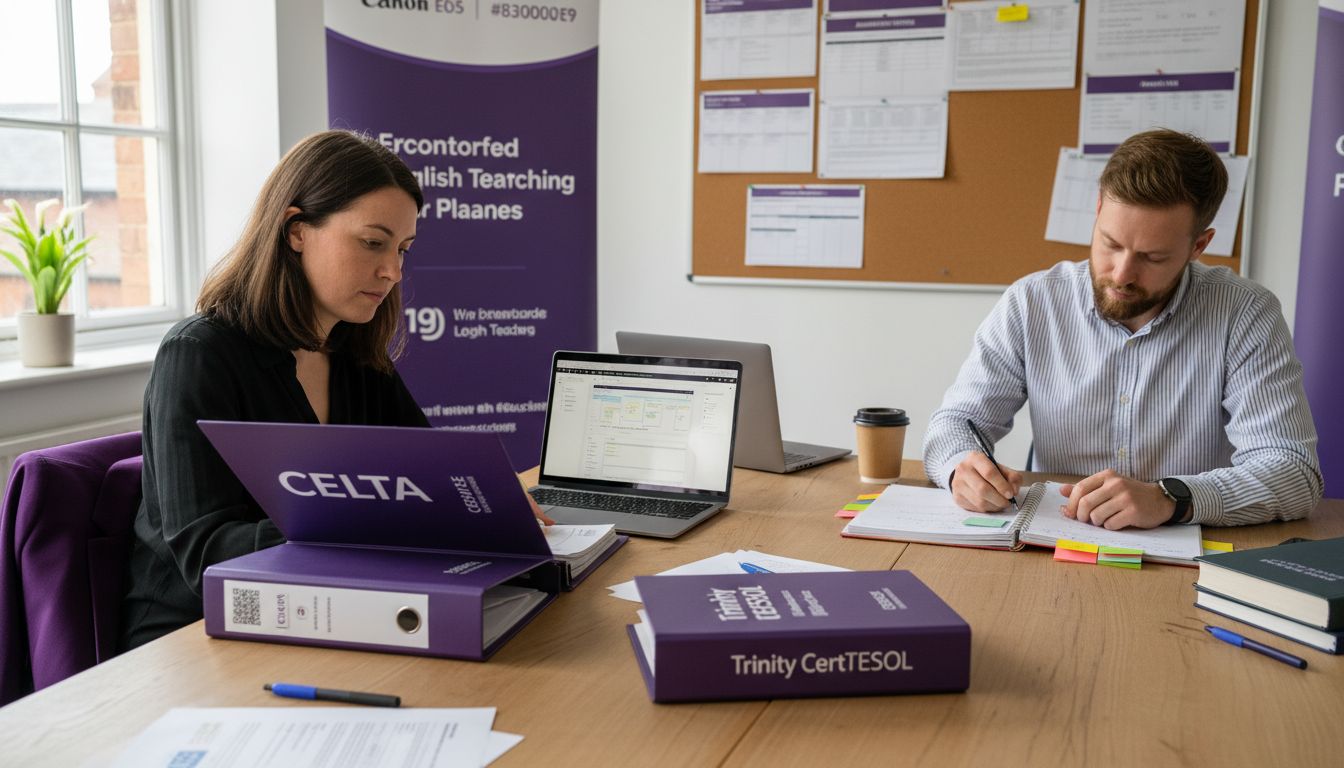
Key Differences Between CELTA and Trinity CertTESOL
While CELTA and Trinity CertTESOL might appear similar on the surface, they represent distinct approaches to initial English language teaching qualifications. These nuanced differences can impact a candidate’s professional development and teaching philosophy.
Assessment and Reflective Practice
The most pronounced distinction lies in their assessment methodologies and philosophical approach to teacher training. Explore the comprehensive guide to understanding these certification differences to appreciate the unique characteristics of each programme.
Key Distinguishing Elements
Trinity CertTESOL stands out through its distinctive features:
-
Enhanced Reflective Components
- Deeper emphasis on self-evaluation
- Comprehensive reflective journal writing
- More personalised professional development tracking
-
Unique Assessment Structure
- Greater focus on individual learning journey
- Detailed external moderation process
- More flexible approach to teaching methodology
This approach fosters independence and experimentation, giving teachers the tools to develop their own distinctive classroom style rather than strictly following a set formula.
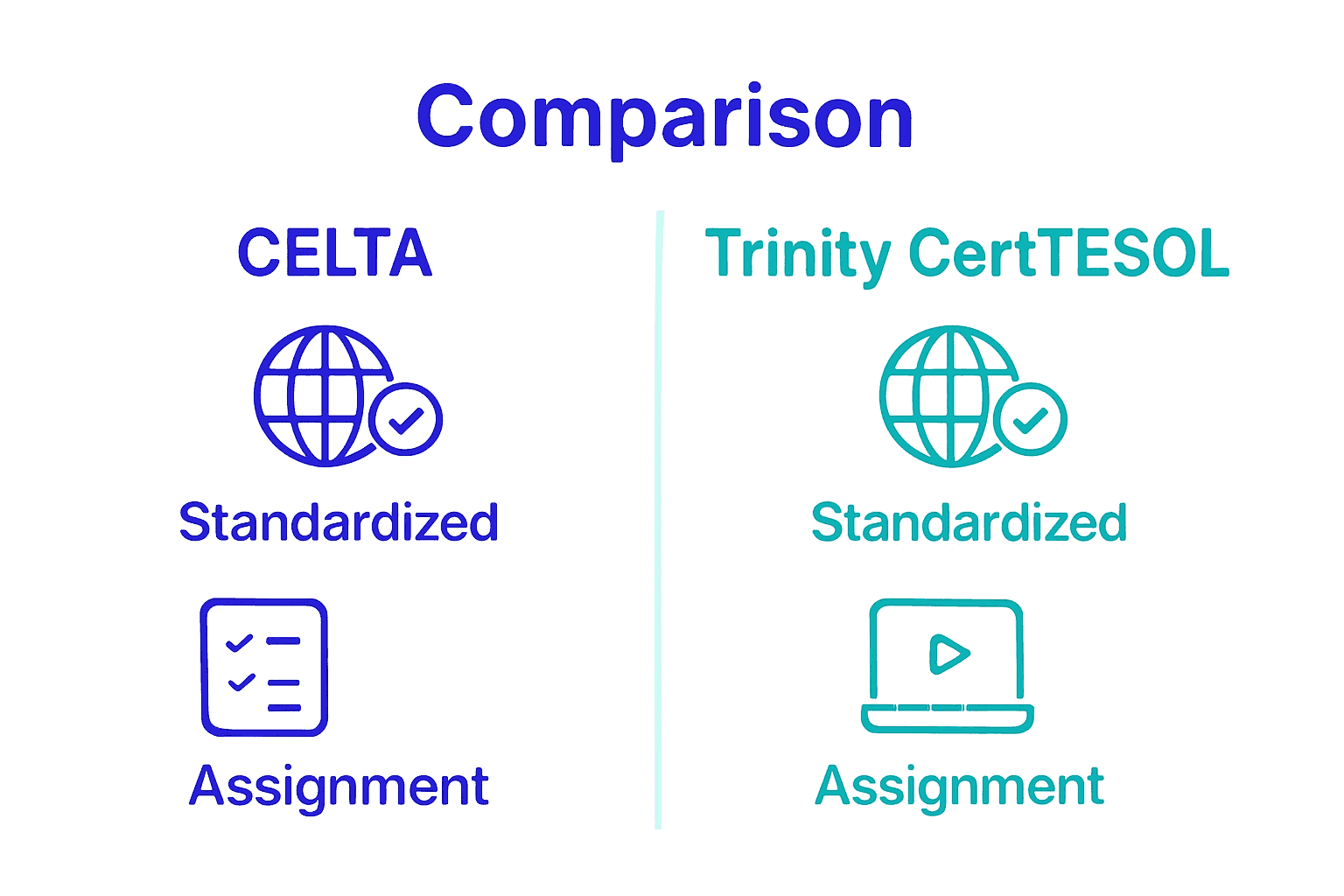
In contrast, CELTA takes a more formulaic, “painting-by-numbers” approach:
- Step-by-step teaching frameworks that leave little room for improvisation
- Prescribed assessment criteria applied uniformly to all trainees
- A prescribed methodology designed for consistency over creativity
This approach ensures reliability and standardization, but prioritises following the system over cultivating a self-directed, independent teaching style.
Practical Implications
These differences translate into practical teaching experiences. Trinity CertTESOL tends to produce teachers with stronger introspective skills and personalised teaching approaches, while CELTA graduates often demonstrate more consistent teaching techniques.
Ultimately, both certifications are internationally recognised and provide robust pathways into English language teaching. The choice depends on individual learning preferences, career goals, and personal teaching philosophy. Prospective teachers should carefully consider these nuanced differences to select the certification that best aligns with their professional aspirations.
Career Prospects and Global Recognition
The CELTA and Trinity CertTESOL certifications represent more than just academic credentials – they are passports to a dynamic, global teaching career that opens doors across continents. These internationally recognised qualifications transform passionate language enthusiasts into professional English language educators with genuine worldwide employability.
Global Teaching Opportunities
Both certifications provide graduates with a powerful professional toolkit that makes them attractive to employers in diverse educational settings. Discover comprehensive pathways to international teaching careers and understand how these certifications can shape your professional trajectory.
Employment Landscape
The career prospects for CELTA and Trinity CertTESOL holders are remarkably extensive:
International School Opportunities:
- Private language schools in Asia
- International schools worldwide
- Corporate language training programmes
- Online teaching platforms
- University language departments
Regional Employment Potential:
- Middle East language centres
- European language institutes
- Southeast Asian educational programmes
- International business communication training
- Government-sponsored language education projects
Competitive Advantages
While both certifications are globally respected, subtle differences emerge in their professional positioning. Trinity CertTESOL often appeals to educators seeking more personalised, reflective teaching approaches, whereas CELTA provides a more regimented qualification.
Remarkably, neither certification limits graduates to traditional classroom settings. Modern language professionals leverage these credentials for diverse roles including curriculum development, online teaching, educational consulting, and content creation. The key is understanding that these certifications are not just about teaching English – they’re about becoming a global communication professional with adaptable, transferable skills.
Choose the Right Path to Your Global Teaching Career
Deciding between CELTA and Trinity CertTESOL can feel overwhelming when you want to launch your international English teaching journey with confidence. Both certifications offer strong foundations but differ in teaching philosophy, assessment style, and reflective practice. If you are looking to align your training with your personal learning preferences and career goals, it is important to understand these differences and find the course that best fits your ambitions.
At EBC, we understand that making the right choice is key to your success abroad. Whether you are drawn to CELTA’s globally standardised approach or to Trinity CertTESOL’s personalised reflective methods, our expert team is here to guide you every step of the way. Benefit from accredited courses, practical teaching preparation, and lifelong job placement support.
Ready to take the next step and clarify which certification suits you best? Book your free consultation today and start your journey towards becoming a confident, qualified English teacher with global opportunities.
Frequently Asked Questions
What are the main differences between CELTA and Trinity CertTESOL?
Both CELTA and Trinity CertTESOL are recognised English teaching qualifications, but CELTA offers a more regimented approach while Trinity focuses on reflective practice and individual learning journeys.
What are the entry requirements for CELTA and Trinity CertTESOL?
Candidates typically need to be at least 18 years old, demonstrate native or near-native English proficiency, and possess a high school diploma. Strong communication skills and a passion for teaching are also essential.
How do the assessment methods differ between CELTA and Trinity CertTESOL?
CELTA assessments include written assignments and teaching practice portfolios, while Trinity CertTESOL assessments place greater emphasis on reflective teaching journals and individual learning experiences.
What career opportunities are available for holders of CELTA and Trinity CertTESOL?
Both certifications open doors to teaching roles in various settings, including private language schools, corporate training, and online teaching platforms, offering robust professional pathways in English language education.
Recommended
- What is the difference between the Trinity CertTESOL and CELTA?
- TESOL, TEFL, CELTA, DELTA, TESL – How Are They Different? – EBC Trinity CertTESOL and TEFL courses
- What is the Trinity CertTESOL? How do I pass the course?
- Complete Guide to Trinity CertTESOL Certification – EBC Trinity CertTESOL and TEFL courses
