
Key Points
- Effective CertTESOL preparation involves a structured plan covering language review, lesson planning, microteaching, and portfolio organization before training commences. Trainers evaluate practical skills like instruction clarity, adaptation, and reflection, emphasizing real-time responsiveness over perfection. Building a comprehensive portfolio and practicing regularly can improve employability worldwide and support a successful teaching career.
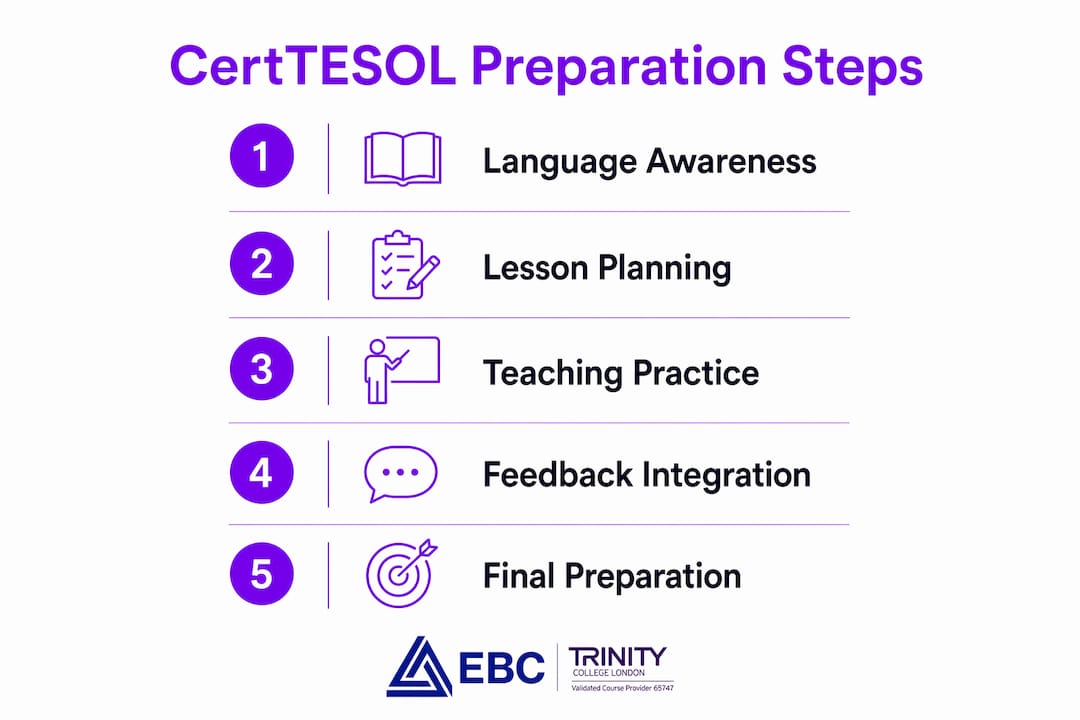
The six most effective CertTESOL preparation steps are: review the assessed components in your course handbook, build a language-awareness revision schedule, practise lesson planning with a timed template, arrange peer microteaching sessions, organise your portfolio folders before day one, and commit to a feedback-to-action routine from the very first observed lesson. Spread across several weeks, these steps give you a structured, course-ready foundation rather than a last-minute scramble.
- Review the CertTESOL course components and what each one requires.
- Build a language-awareness revision schedule covering grammar, lexis, and phonology.
- Practise lesson planning using a timed template with clear aims and staged activities.
- Arrange peer microteaching sessions to rehearse delivery before observed lessons begin.
- Organise your portfolio folders (teaching practice, guided observation journal, materials assignment, learner profile, unknown-language journal) before the course starts.
- Commit to a feedback-to-action routine from your very first teaching practice session.
A realistic timeline: complete steps 1–3 in the early weeks, steps 4–5 shortly after, and spend the remaining weeks rehearsing, refining, and building your portfolio materials.
Table of Contents
- What does the Trinity CertTESOL actually assess?
- Your practical 6–8 week CertTESOL preparation schedule
- Which language-awareness topics should you revise first?
- How to write a lesson plan that trainers respect
- How to get the most from teaching practice and feedback
- What do trainers actually look for?
- What resources should you use to prepare?
- How CertTESOL preparation improves your employability worldwide
- How EBC supports your CertTESOL preparation
- Key takeaways
- Your final seven days: a pre-course checklist
- Authoritative sources and further reading
- Ready to start your CertTESOL preparation with expert support?
What does the Trinity CertTESOL actually assess?
The Trinity CertTESOL is externally moderated by Trinity College London and assesses five core components: teaching practice, language awareness, a guided observation journal, a materials assignment, and an unknown-language journal. Each component tests a different dimension of your readiness to teach, and trainers look for specific behaviours in each one.
Understanding the assessment framework before you arrive is one of the sharpest advantages you can give yourself. Most trainees who struggle do so not because they lack ability, but because they are surprised by what is being measured. Your course handbook is the definitive reference: read it cover to cover in week one.
| Assessed component | What trainers look for |
|---|---|
| Teaching practice (TP) | Clear aims, staged activities, learner interaction, real-time adaptation |
| Language awareness exam | Accurate analysis of grammar, lexis, and phonology in context |
| Guided observation journal | Structured reflection on observed lessons with specific evidence |
| Materials assignment | Original, learner-appropriate resources with a written rationale |
| Unknown-language journal | Empathy with the learner experience; honest reflection on difficulty |
Course formats vary: intensive full-time programmes typically run for several weeks, while part-time and blended options spread the same content over several months. The assessment criteria remain identical regardless of format. Check your specific course handbook for submission deadlines and TP scheduling, as these differ between providers.
Your practical 6–8 week CertTESOL preparation schedule
A concrete week-by-week plan stops preparation from feeling abstract. The schedule below assumes an eight-week window; if you have six weeks, compress weeks one and two into a single intensive week.
Weeks 1–2: orientation and language review
- Read your course handbook and note every submission deadline and TP date.
- Create a provisional timetable, a weekly plan, and a daily task list. Trinity’s study skills guidance{target=‘_blank’} specifically recommends this three-level planning approach before the course begins.
- Begin grammar revision: tenses, modals, conditionals, and reported speech.
- Set up digital or physical folders labelled for each portfolio component: teaching practice, guided observation journal, materials assignment, language awareness, and unknown-language journal.
- Source a grammar reference book and a pronunciation guide (see the resources section below).
Daily micro-task: spend 20 minutes reading one grammar explanation and writing three example sentences in context.
Weeks 3–4: lesson planning and materials
- Write two complete lesson plans using the template in the lesson-planning section below.
- Collect a library of visual aids, images, realia, and short authentic texts. Trinity’s methods guidance{target=‘_blank’} recommends building this resource bank before training starts.
- Practise writing concept-checking questions (CCQs) for five different grammar or vocabulary items.
- Begin your unknown-language journal by studying a language you do not speak for 30 minutes per week.
Daily micro-task: write one lesson aim and three staged activities for a hypothetical learner group.
Weeks 5–6: microteaching and peer practice
- Run at least two timed microteaching sessions with a peer or in front of a mirror.
- Record one session and watch it back, noting teacher talk time (TTT), instruction clarity, and pacing.
- Draft your first guided observation journal entry based on a lesson you have watched online or in person.
- Begin the materials assignment: choose your learner group and draft a rationale.
Daily micro-task: practise giving instructions for one classroom activity in under 30 seconds, without reading from notes.
Weeks 7–8: consolidation and final preparation
- Proofread all written work. Trinity’s study skills advice{target=‘_blank’} flags inaccurate language in assignments as a common penalty point.
- Complete a full mock lesson plan for a 30–45 minute observed lesson.
- Review your portfolio folders and confirm every component has a draft or outline.
- Practise receiving feedback: ask a peer to critique your lesson plan and respond with a written action point.
Timing note: build in one rest day per week. Fatigue is the most underestimated factor in TP performance.
Which language-awareness topics should you revise first?
Language awareness is assessed both in a written exam and implicitly through your teaching practice. Trainers expect you to analyse language accurately and to teach it in context, not in isolation.
Grammar priorities
- Tenses: present simple vs present continuous (form, meaning, use); past simple vs present perfect; future forms (will, going to, present continuous for future).
- Modals: ability, permission, obligation, deduction. Know the difference between can and could, must and have to.
- Conditionals: zero, first, second, and third. Be able to explain the form and the concept without jargon.
- Reported speech: tense backshift, pronoun changes, and time expressions. Trainees frequently confuse direct and indirect speech in their language analysis.
Lexis and vocabulary
- Collocation: words that naturally go together (make a decision, do homework). Knowing common collocations helps you anticipate learner errors.
- Word formation: prefixes, suffixes, and compound nouns. Useful for teaching vocabulary in word families.
- Register: formal vs informal, spoken vs written. Trainers look for awareness of context when you select vocabulary for a lesson.
- Vocabulary clarification techniques: Trinity guidance{target=‘_blank’} recommends miming, drawing on the board, eliciting examples, and simple frequency charts rather than translation. Practise all four before your first TP.
Phonology basics
- Phonemic chart: learn the 44 phonemes of English. You do not need to be an expert, but you should be able to identify the sounds in a target language item.
- Word stress: know how to mark stress in a word and why it matters for intelligibility.
- Connected speech: weak forms, linking, and elision. These come up in listening lessons and pronunciation work.
Quick revision activity: take a grammar item from your lesson plan, write a full language analysis (form, meaning, pronunciation, common errors), and check it against a reference grammar. Do this for five items before the course starts.
How to write a lesson plan that trainers respect
A lesson plan is not a script. Trainers use it to understand your thinking, not to check that you followed instructions. The plan should show that you know your learners, have a clear language or skills aim, and have thought through each stage before you walk into the room.

Lesson-plan template
| Section | What to include |
|---|---|
| Lesson aim | One clear, measurable statement: what learners will be able to do by the end |
| Language/skills focus | Target language item or skill, with form, meaning, and pronunciation notes |
| Learner profile | Level, first language(s), known difficulties, prior knowledge of the target item |
| Assumptions | What you expect learners already know; what you anticipate they will find difficult |
| Staging and timings | Each activity in sequence with a time allocation and the interaction pattern (T–S, S–S, group) |
| Materials | List every handout, visual, or digital resource; attach copies |
| Anticipated problems | At least two learner difficulties and your planned response to each |
| Post-lesson reflection | Left blank before the lesson; completed immediately after |
Sample timings for a 30–45 minute observed lesson
- Lead-in / context setting: 3–5 minutes. Activate prior knowledge and create a reason to engage with the target language.
- Presentation or text work: 8–10 minutes. Introduce or elicit the target item in context.
- Controlled practice: 8–10 minutes. Structured activities where learners use the target item with support.
- Freer practice: 8–12 minutes. Communicative activity where learners use the language more independently.
- Feedback and error correction: 3–5 minutes. Whole-class feedback on accuracy and fluency.
Writing aims that work
A weak aim: “Students will learn about the past simple.”
A strong aim: “Students will be able to use regular and irregular past simple verbs to describe completed events in the past.”
The difference is specificity. A good aim names the form, the meaning, and the context. Write your aim first, then build every stage of the lesson around it.
Pro Tip: Write your CCQs before you write your activities. If you cannot check the concept in two or three simple questions, your understanding of the target language may need more work before the lesson.
How to get the most from teaching practice and feedback
Teaching practice is where the course is won or lost. The lesson plan gets you into the room; what you do when a learner gives an unexpected answer is what trainers actually assess.
Before the observed lesson
- Confirm the room layout, board space, and any technology you plan to use.
- Print or prepare all materials the evening before. Never rely on printing on the day.
- Run through your instructions aloud. If they take more than 30 seconds per activity, shorten them.
- Prepare a contingency: what will you do if the planned activity finishes five minutes early?
During others’ lessons: observation note-taking
- Note the lesson aim and whether it was achieved.
- Record specific moments of effective learner interaction (not general impressions).
- Write down one thing you would do differently and why.
- Use standard acronyms: TTT (teacher talk time), CCQ (concept-checking question), ICQ (instruction-checking question), L1 (learners’ first language).
The feedback-to-action (RAAA) plan
After every TP feedback session, complete this four-step record:
- Record: write down the trainer’s three main points, verbatim if possible.
- Reflect: note which point surprised you most and why.
- Aim: set one specific, observable aim for your next lesson (e.g. “reduce TTT in the presentation stage to under three minutes”).
- Adjust: write one concrete change to your next lesson plan that addresses the aim.
Trinity trainers report{target=‘_blank’} that the most successful trainees treat every critique as a development opportunity rather than a personal judgment. The RAAA plan makes that mindset concrete and measurable.
Pro Tip: Keep a single A5 notebook exclusively for TP feedback. Trainers notice when trainees reference previous feedback in their next lesson. It signals exactly the reflective practice they are looking for.
What do trainers actually look for?
The CertTESOL is designed to test practical competence{target=‘_blank’}: trainers prioritise adaptability and real-time responsiveness over polished delivery of a rigid plan. Knowing their priorities lets you direct your preparation energy where it counts.
Trainer priorities: a ranked checklist
- Clarity of instructions: learners should be able to start an activity without asking what to do.
- Learner interaction: are you talking to learners, or at them? S–S interaction should outweigh T–S in most stages.
- Adaptation: when something is not working, do you adjust? Trainers watch for this above almost everything else.
- Use of CCQs: do you check concept, not just comprehension? “Do you understand?” is not a CCQ.
- Time management: does the lesson finish with the aim achieved, or does it run out of time before freer practice?
- Feedback responsiveness: does your next lesson show evidence that you heard and acted on the previous session’s feedback?
The most common trainee mistakes
- Overlong teacher talk: the most frequently cited issue. Aim for learner talk to exceed teacher talk in every lesson after the presentation stage.
- Weak or absent CCQs: writing CCQs in the plan but not using them in the lesson, or using yes/no questions that do not check understanding.
- Ignoring the lesson aim: activities that are enjoyable but do not build towards the stated aim.
- Poor timing: spending too long on lead-in and running out of time for freer practice.
- Defensive response to feedback: arguing with trainer comments rather than recording and reflecting.
- Underusing peer learners: not setting up pair or group work effectively, defaulting to whole-class question-and-answer.
Demonstrating adaptability
When something unexpected happens in a lesson, pause, observe, and respond. If learners finish an activity early, have a follow-up question ready. If they struggle with a concept, use a different clarification technique: try miming if drawing did not work, or elicit an example from a stronger learner. Trainers are not looking for a perfect lesson. They are looking for a teacher who reads the room.
What resources should you use to prepare?
Build a focused resource folder rather than collecting everything you find. Quality and relevance beat volume.
- Grammar reference: a reliable, learner-friendly grammar reference such as English Grammar in Use (Raymond Murphy) gives you clear explanations and practice exercises for every item you will teach.
- Phonemic chart: the TeachingEnglish site hosted by the British Council offers free phonemic chart resources and pronunciation guidance suitable for CertTESOL level.
- Lesson-planning frameworks: Trinity College London’s official CertTESOL qualification page{target=‘_blank’} outlines the assessed components and links to candidate guidance documents.
- Professional reading: IATEFL publishes accessible articles on classroom methodology, feedback, and language teaching that support both language awareness and teaching practice preparation.
- TESOL research and standards: TESOL International Association provides standards documents and professional development resources that broaden your understanding of the field beyond the course itself.
- Peer practice groups: form a study group with two or three other candidates. Take turns delivering five-minute microteaching slots and giving structured feedback using the RAAA framework above.
- Personal resource folder: create subfolders for grammar notes, lesson plans, CCQ banks, visual aids, and reflection logs. File everything under the relevant portfolio component from day one.
Pro Tip: Do not wait until the course starts to read about methodology. Spend one hour per week in the preparation period reading a short article on a teaching technique. By week eight you will have a working knowledge of eight or nine approaches that you can reference in your lesson plans and TP feedback.
How CertTESOL preparation improves your employability worldwide
The skills you build during CertTESOL preparation are not just course requirements. They are the evidence base for your teaching career, and employers across the globe look for exactly this kind of documented readiness.
What employers notice in newly qualified teachers
- A polished lesson plan portfolio: schools and language institutes in the UK, Europe, Asia, Latin America, and the Middle East ask to see sample lesson plans at interview. A portfolio of five to ten varied, well-structured plans signals that you can hit the ground running.
- Observed lesson recordings: where consent allows, a short recording of a microteaching session demonstrates confidence and classroom presence in a way that a CV cannot.
- A reflective journal: entries that show you received feedback and changed your practice are compelling evidence of professional maturity. Many hiring managers in competitive markets cite this as a differentiator.
- Materials assignment: an original, learner-appropriate resource with a written rationale shows creativity and the ability to adapt published materials, a skill valued in every teaching context from private language schools to corporate English programmes.
Portfolio checklist for job applications
- Five to ten lesson plans covering different levels, skills, and language items.
- Two to three completed observation journal entries with specific, referenced evidence.
- At least one original teaching material with a written rationale.
- A one-page reflective summary of your TP development across the course.
- Your Trinity CertTESOL certificate (digital and printed copies).
The CertTESOL certification pathway opens doors in markets that require internationally recognised qualifications: South Korea, Japan, the UAE, Saudi Arabia, and across Europe all list Trinity accreditation as a preferred or required credential. Demonstrating feedback responsiveness and classroom management in your portfolio gives you a concrete edge over candidates who hold the same certificate but cannot show the evidence behind it.
How EBC supports your CertTESOL preparation
EBC offers Trinity CertTESOL programmes with trainer-led preparation built into the course structure, so you are not preparing alone. The practical offerings include handbook walkthroughs before your first session, mock teaching practice slots with structured feedback, portfolio guidance across all five assignment areas, and free lifetime job placement support once you qualify.

For candidates who want to combine certification with international experience, EBC runs one-year study and work abroad programmes in Spain, France, Italy, and beyond, pairing Trinity CertTESOL training with language study, cultural immersion, and part-time teaching opportunities. Visa support is available, though eligibility and outcomes depend on individual circumstances and cannot be guaranteed.
Pro Tip: Book a free consultation before you commit to a course date. A 20-minute call with an EBC adviser will clarify which course format fits your timeline, budget, and career goals, and you will leave with a personalised preparation checklist.
The EBC Trinity CertTESOL course is the natural next step for candidates who want accredited training, practical classroom hours, and a clear path to global teaching roles. Book a free consultation at ebcteflcourse.com to get your personalised preparation plan.
Key takeaways
Effective CertTESOL preparation requires a structured, week-by-week plan that covers language awareness, lesson planning, microteaching practice, and portfolio organisation before the course begins.
| Point | Details |
|---|---|
| Start with the handbook | Read your course handbook in week one to map every deadline and assessed component. |
| Language awareness is assessed twice | Grammar, lexis, and phonology appear in the written exam and in every observed lesson. |
| Use the RAAA feedback routine | Record, reflect, aim, and adjust after every TP session to show trainers measurable growth. |
| Portfolio preparation begins before day one | Set up folders for all assessed components and begin drafts early to avoid last-minute penalties. |
| EBC provides trainer-led support | Mock TPs, portfolio guidance, and free lifetime job placement are included in EBC’s CertTESOL programmes. |
Your final seven days: a pre-course checklist
The week before your course starts is best used to consolidate knowledge, organise materials, and arrive calm.
- Print or download your course handbook and tab the key sections: TP schedule, submission deadlines, assessment criteria.
- Confirm your portfolio folders are labelled and contain at least a draft outline for each of the assessed components.
- Run one final timed microteaching session of 10–15 minutes and complete a RAAA record immediately afterwards.
- Review your CCQ bank: check that you have concept-checking questions ready for at least five grammar and five vocabulary items.
- Prepare your materials kit: visual aids, printed handouts, board markers, and any realia you plan to use in early TPs.
- Set a consistent sleep schedule for the week ahead. Fatigue affects instruction clarity and feedback retention more than most trainees expect.
- Write one sentence about what you want to achieve by the end of the course. Read it on day one. Trainers consistently find that candidates with a clear personal aim engage more productively with feedback from the outset.
Authoritative sources and further reading
The resources below are official or peer-recognised authorities. All links open in a new tab.
- Trinity College London: CertTESOL qualification page — the definitive source for assessed components, candidate guidance, and external moderation information. Read this before any other preparation resource.
- Trinity College London: Study Skills for the CertTESOL — official candidate guidance on timetabling, note-taking, assignment writing, and portfolio organisation. Directly relevant to every section of this article.
- Trinity College London: Methods and Techniques — practical classroom guidance on clarifying meaning, using visual aids and realia, and managing learner interaction. Essential reading for lesson planning and TP preparation.
- Teaching English (British Council) — free lesson plans, methodology articles, phonemic chart resources, and professional development reading suitable for CertTESOL candidates at all stages of preparation.
- IATEFL — the International Association of Teachers of English as a Foreign Language. Publishes accessible articles on classroom practice, feedback, and language teaching methodology.
- TESOL International Association — professional standards, research summaries, and development resources for English language teachers worldwide.
- The College of Teachers / Chartered College of Teaching — UK-based professional body offering research-informed resources on reflective practice and teacher development relevant to CertTESOL portfolio work.
Note: visa and immigration information referenced anywhere in your preparation research is indicative only. Requirements vary by nationality, destination country, and individual circumstances. Always verify current requirements directly with the relevant embassy or immigration authority.
Ready to start your CertTESOL preparation with expert support?
Preparing for the Trinity CertTESOL on your own is entirely possible, and this guide gives you the framework to do it. But the candidates who arrive most confident are those who have had real trainer input before day one: structured feedback on a practice lesson plan, a clear explanation of the portfolio requirements, and a preparation checklist built around their specific timeline.
EBC delivers exactly that. As a Trinity College London accredited provider with a global network of graduates teaching in the UK, Europe, Asia, Latin America, the Middle East, and beyond, EBC combines rigorous CertTESOL training with free lifetime job placement support. Whether you are planning to teach locally or want to build an international career, the EBC CertTESOL programme gives you the accreditation, the practical hours, and the career infrastructure to get there.
Book a free consultation with EBC and leave with a personalised preparation plan built around your start date.