
Key Points
- Digital tools are transforming TEFL by supporting personalized and engaging language learning experiences.
- Effective technology integration depends on clear goals, proper training, and understanding teaching methodologies.
- Teachers should focus on human connection and purpose-driven use rather than just the latest gadgets.
Many people assume that screens and apps in the language classroom are little more than distractions dressed up as innovation. The reality is quite different. Digital tools are reshaping how English is taught and learned across the globe, and teachers who understand how to use them purposefully hold a genuine advantage. This article covers the main types of classroom technology used in TEFL, the methodologies that bring them to life, an honest look at what works and what does not, and practical steps to help you integrate technology with confidence from day one.
Table of Contents
- What is classroom technology in TEFL?
- Key TEFL methodologies using classroom technology
- Advantages and pitfalls of technology in the EFL classroom
- How to integrate technology effectively: tips for new TEFL teachers
- Why classroom technology in TEFL is about people, not hardware
- Take your TEFL journey further with expert support
- Frequently asked questions
Key Takeaways
| Point | Details |
|---|---|
| Definition clarified | Classroom technology in TEFL includes digital tools that enhance English language teaching. |
| Methods compared | Blended, flipped, gamified, and AI-driven lessons each offer unique advantages in the classroom. |
| Balanced view | While technology personalises learning, it also poses risks like distraction if misused. |
| Practical integration | Success with technology relies on starting simple, clear goals, and ongoing professional training. |
What is classroom technology in TEFL?
Classroom technology in TEFL refers to any digital or electronic tool used to support the teaching and learning of English as a foreign language. The scope is broad. It ranges from a basic projector displaying vocabulary slides to sophisticated AI platforms that adapt exercises to each learner’s level in real time.
The journey began modestly. Tape recorders were once considered cutting edge, giving learners access to native speaker audio for the first time. Then came language laboratories, CD-ROMs, and interactive whiteboards. Today, mobile apps, video conferencing tools, and AI-driven platforms sit at the centre of many lessons. Each generation of technology has shifted what is possible inside and outside the classroom.
The main categories teachers work with today include:
- Interactive whiteboards for visual, whole-class activities
- Presentation software such as Google Slides and Canva for structured input
- Learning management platforms like Moodle and Google Classroom for organising courses
- Language apps including Quizlet and Duolingo for independent practice
- Online resources such as YouTube, news sites, and authentic audio libraries
These tools underpin a range of modern TEFL approaches. Key methodologies include blended learning, flipped classrooms, mobile-assisted language learning, gamification, and AI-driven personalisation, all supporting learner-centred practice. Developing the essential TEFL teacher skills to evaluate and select tools wisely is just as important as knowing how to operate them.
Here is a quick overview of common classroom technology and its typical use:
| Tool | Primary use | Level suitability |
|---|---|---|
| Interactive whiteboard | Whole-class visual activities | All levels |
| Language apps | Vocabulary and grammar drill | Beginner to intermediate |
| Learning platforms | Course management and homework | All levels |
| Video conferencing | Online and hybrid lessons | All levels |
| AI adaptive tools | Personalised practice | Intermediate to advanced |
Pro Tip: Before adopting any new tool, ask yourself one question: does this help my students reach a specific learning goal, or does it simply look impressive? Matching technology to teaching goals rather than trends will save you time and produce better results. You can see this principle in action when teaching the present perfect with targeted digital activities that reinforce form and meaning together.
Key TEFL methodologies using classroom technology
Understanding which tools exist is only part of the picture. What matters equally is how they connect to teaching approaches that are grounded in evidence and classroom experience.
Blended learning combines face-to-face instruction with online components. Students might complete vocabulary exercises on a learning platform at home and then discuss findings in class the next day. This approach suits learners with busy schedules and allows teachers to personalise the independent study phase.

The flipped classroom reverses traditional delivery. Learners watch a short video or complete a reading task before the lesson, freeing up class time for speaking, discussion, and feedback. This works particularly well for grammar explanation, where students arrive already familiar with the rule and ready to practise.
Mobile-assisted language learning (MALL) uses smartphones and tablets to extend learning beyond the classroom. Apps that focus on vocabulary building, listening practice, and pronunciation are especially popular here.
Gamification brings game mechanics such as points, leaderboards, and rewards into language tasks. Platforms like Kahoot and Gimkit make grammar revision engaging. Exploring gamification in TEFL in more depth reveals how it boosts participation and reduces anxiety around error-making.
Task-based learning with technology asks students to complete a real-world digital task, such as producing a podcast episode or writing an email for a simulated business context. More ideas are available through task-based language teaching approaches.
AI-driven personalisation uses algorithms to adjust difficulty and content to individual learners, a method shown to support learner-centred approaches effectively.
To integrate a new methodology, follow these steps:
- Identify a clear learning objective for the lesson
- Choose a methodology that suits your students’ age and level
- Select one or two tools that serve the methodology
- Pilot with a single class before rolling out widely
- Gather student feedback and adjust accordingly
| Methodology | Key strength | Common challenge |
|---|---|---|
| Blended learning | Flexibility and personalisation | Requires learner self-discipline |
| Flipped classroom | More speaking time in class | Students may skip pre-class tasks |
| MALL | Accessible anywhere | Screen time and distraction risk |
| Gamification | High engagement | Can overshadow learning content |
| AI personalisation | Tailored feedback | Demands teacher training |
When working with teaching multilingual classes, technology can help you differentiate tasks without creating separate lesson plans for every learner.
Advantages and pitfalls of technology in the EFL classroom
Now that we have reviewed the key methods, it is worth asking whether technology in the EFL classroom truly lives up to its promise and where it can fall short.
The benefits are real and well-documented. Technology allows for personalisation at scale. An adaptive platform can present a lower-level learner with simpler grammar exercises while simultaneously offering a more advanced student authentic text analysis. Real-time feedback tools mean learners no longer wait until the following week to find out whether their answer was correct. Engaging formats, from interactive videos to collaborative online documents, capture attention in a way that a static textbook page rarely can.
Yet the pitfalls are equally real. Consider what the research shows:
29% of educators say technology improves learning through personalisation and real-time feedback, while 36% say it harms learning through distractions, cheating, and shallow engagement.
That gap tells an important story. Technology is not neutral. Its impact depends almost entirely on how it is used.
Top practical advantages:
- Immediate, automated feedback on written and grammar tasks
- Access to authentic, up-to-date English language materials
- Differentiation for mixed-ability groups without extra planning time
- Higher student engagement, particularly among younger learners
- Wider range of skills practice outside the classroom
Key pitfalls to manage:
- Off-task browsing and social media use during lessons
- Over-reliance on auto-correction, which can reduce genuine learning
- Academic dishonesty when AI tools complete tasks on behalf of students
- Risk of shallow learning when students skim content rather than process it
- Technical failures disrupting lesson flow
Reading more about AI in English teaching helps you stay informed about the specific opportunities and risks AI tools bring to your lessons. Building solid language teaching skills gives you the judgement to manage these tensions well.
Pro Tip: The most effective classrooms do not go all-in on technology or reject it outright. Blending digital tools with discussion, writing by hand, and face-to-face communication consistently produces better learning outcomes than either approach alone.
How to integrate technology effectively: tips for new TEFL teachers
Recognising both the benefits and pitfalls, the most useful question becomes: how do you actually make technology work in your lessons?
Start with your learning objective, not the tool. Every tech-enhanced activity should answer one question clearly: what will students be able to do better at the end of this lesson? If you cannot answer that question, the technology is not ready to go into the lesson.
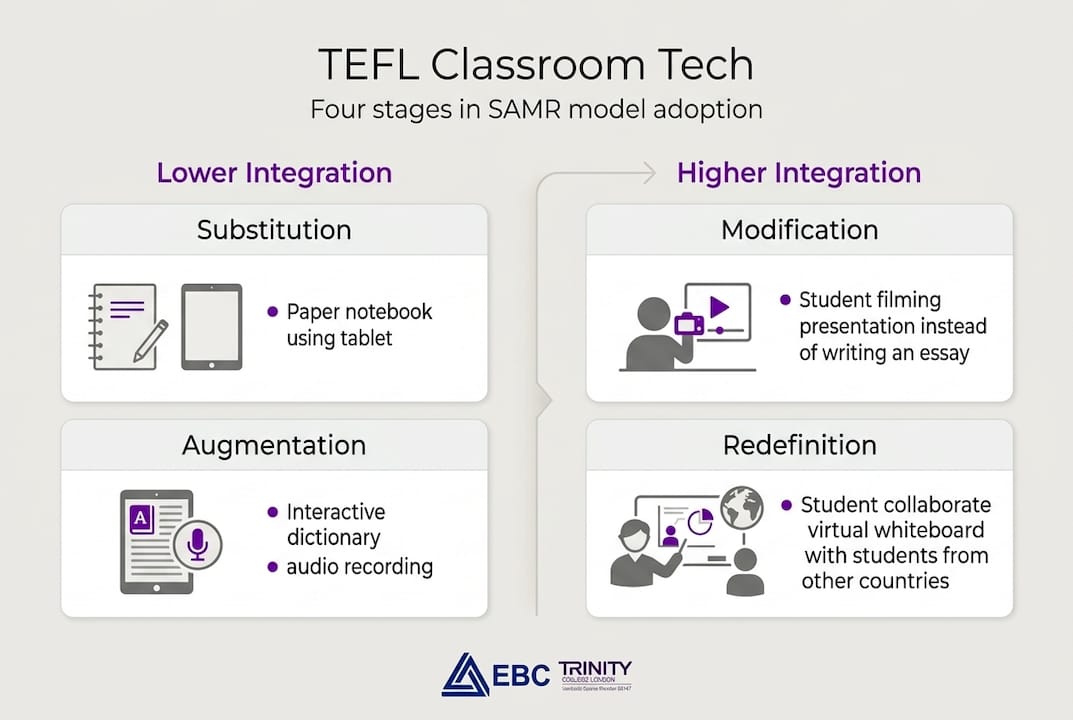
The SAMR model offers a useful framework for measuring how deeply technology is integrated. SAMR stands for Substitution, Augmentation, Modification, and Redefinition. Substitution simply replaces a paper task with a digital one. Redefinition creates entirely new learning experiences that would be impossible without technology, such as a live video exchange with students in another country. Aiming beyond substitution is where real learning gains appear.
For new teachers especially, starting simple is the soundest approach. Trying to use five different platforms in your first term will overwhelm both you and your students. Master one tool well before adding another.
Here is a step-by-step guide to planning a technology-enhanced lesson:
- Write your learning objective first, in plain language
- Choose one technology tool that directly serves that objective
- Prepare a backup plan in case of technical difficulties
- Introduce the tool to students before expecting them to use it independently
- Set clear boundaries for device use during the lesson
- Assess whether the tool helped students meet the objective after the lesson
Strengthening your TEFL teacher skills through formal training gives you the pedagogical grounding to make these decisions with confidence rather than guesswork.
Pro Tip: Invest time in learning one tool properly before your course begins. Teachers who understand the pedagogical purpose of a tool, not just its features, use it far more effectively in the classroom.
Why classroom technology in TEFL is about people, not hardware
Most conversations about technology in TEFL focus on the tools: which app is best, which platform has the most features, which AI gives the most accurate feedback. We think this framing misses the point entirely.
The teachers who use technology most effectively are not those with the newest gadgets. They are the ones with the clearest sense of what their students need and the skill to create conditions where real communication happens. A high-quality lesson can be built around a single YouTube clip and a well-crafted discussion task. A poorly designed lesson can deploy five cutting-edge platforms and still leave students disengaged.
Training, context, and clear objectives matter far more than the technology itself. That is why developing strong essential teaching skills through an accredited TEFL programme is the foundation everything else rests on. The best classrooms use technology to build human connection, not replace it.
Take your TEFL journey further with expert support
Understanding how technology fits into modern language teaching is a strong first step. The next step is building the skills and credentials to put it all into practice in real classrooms around the world.
At EBC TEFL, we offer Trinity College London accredited certification programmes designed to prepare you for the realities of teaching English globally. From an introduction to TEFL to full international TEFL certification, our courses cover methodology, classroom technology, and real teaching practice. We also support graduates with free lifetime job placement assistance across our global network. Ready to take the next step? Discuss your study options with one of our advisers today.
Frequently asked questions
What are the main types of classroom technology used in TEFL today?
The main types include interactive whiteboards, educational apps, online learning platforms, gamification tools, and AI-driven systems. Key methodologies built around these tools include blended learning, mobile-assisted language learning, and task-based approaches.
Does technology improve or hinder language learning in TEFL?
Research shows a divided picture: 29% of educators report improvement through personalisation, while 36% cite distractions and shallow learning. The outcome depends almost entirely on how the technology is used rather than the technology itself.
How can new TEFL teachers start using technology effectively?
Begin with one tool aligned to a clear lesson objective, follow the SAMR model to deepen integration over time, and invest in proper training before introducing new platforms to your students.