
When setting out to teach English, many aspiring educators quickly discover that traditional grammar drills rarely prepare students for real conversations. This is why understanding the core principles of Communicative Language Teaching matters. If you plan to earn a Trinity College London accredited TEFL certificate and thrive abroad, mastering CLT will help you inspire learners through interactive, real-life scenarios instead of dry, textbook readings.
Table of Contents
- What Is CLT Method? Core Principles Explained
- Major Variations of the CLT Approach
- How Communicative Teaching Works in Practice
- CLT in Accredited TEFL Programmes
- Benefits and Job Impact for Teachers
Key Takeaways
| Point | Details |
|---|---|
| CLT Prioritises Communication | Communicative Language Teaching focuses on developing practical language skills through real-world communication and learner interaction. |
| Teacher’s Role as Facilitator | In CLT, teachers act as facilitators rather than knowledge transmitters, fostering interactive and engaging learning environments. |
| Variety of Approaches | CLT includes several variations like Task-Based Language Teaching and Content-Based Instruction, each tailored to enhance communicative competence. |
| Enhanced Employability | Teachers trained in CLT methodologies gain versatile skills that significantly improve their job prospects in global educational markets. |
What Is CLT Method? Core Principles Explained
Communicative Language Teaching (CLT) represents a revolutionary approach to language instruction that fundamentally transforms how educators teach English. Unlike traditional grammar-focused methods, CLT prioritises real-world communication skills and learner interaction. Communicative language approaches emerged as a response to earlier rigid teaching techniques that often left students unable to effectively communicate in authentic contexts.
At its core, CLT centres on developing communicative competence, where students learn not just linguistic structures but how to use language meaningfully. The method shifts the teacher’s role from a strict knowledge transmitter to a facilitator who creates engaging, interactive learning environments. Learners are encouraged to negotiate meaning, express themselves spontaneously, and practise language in scenarios that mirror real-life communication challenges.
The key principles of CLT include active student participation, task-based learning, and contextual language use. Classroom activities typically involve group discussions, role-playing, problem-solving tasks, and interactive exercises that compel students to communicate authentically. By simulating genuine communication scenarios, CLT helps learners develop practical language skills that extend beyond grammatical precision into genuine linguistic fluency.
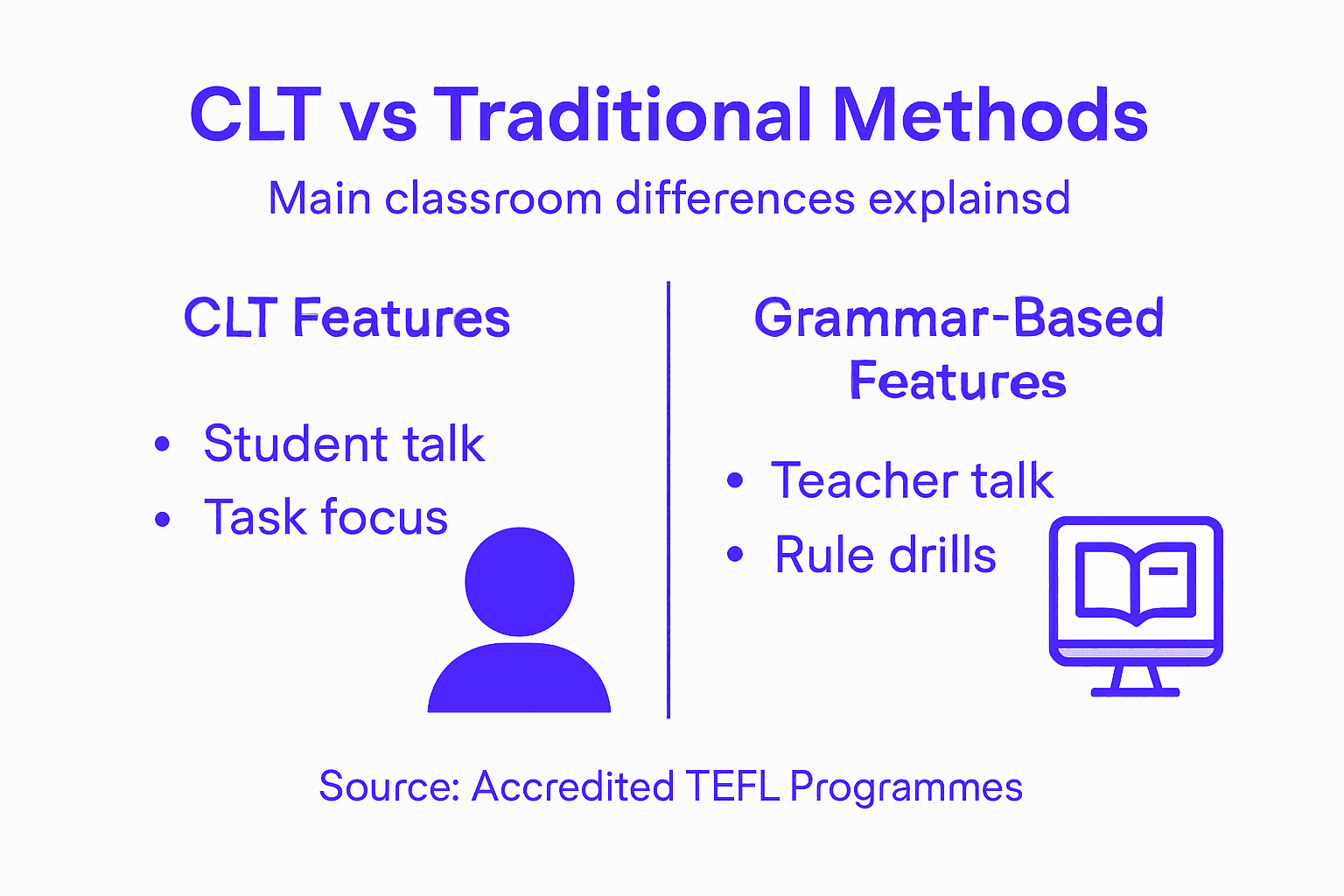
Here is a comparison of CLT and traditional grammar-focused teaching methods:
| Aspect | Communicative Language Teaching (CLT) | Traditional Grammar-Based Methods |
|---|---|---|
| Lesson Focus | Real-world communication tasks | Grammatical structures |
| Teacher Role | Facilitator of interaction | Knowledge transmitter |
| Student Participation | High, interactive and collaborative | Mostly passive, individual tasks |
| Error Correction Approach | Encourages risk-taking, selective | Immediate, frequent corrections |
| Contextual Relevance | High, uses authentic scenarios | Often limited, abstract contexts |
Pro tip: When implementing CLT, focus on creating communicative tasks that are genuinely interesting and relevant to your students’ lives and interests.
Major Variations of the CLT Approach
Communicative Language Teaching (CLT) encompasses several nuanced approaches that adapt core communicative principles to diverse educational contexts. Communicative language variations range from task-based language teaching to content-based instruction, each offering unique strategies for developing language skills while maintaining the fundamental goal of meaningful communication.
The primary variations include Task-Based Language Teaching (TBLT), which structures learning around completing specific communicative tasks, and Content-Based Instruction (CBI), where language learning occurs through studying subject matter in the target language. Another significant approach is the Competency-Based Method, which focuses on developing specific language abilities that students can demonstrate in real-world contexts. These variations share a common thread of prioritising practical communication over rote grammatical memorisation, but differ in their specific implementation strategies.

Each CLT variation addresses unique educational challenges, considering factors such as learner proficiency, classroom dynamics, and cultural contexts. Some approaches lean towards a stronger communicative focus, emphasising spontaneous interaction, while others provide more structured guidance with explicit grammatical input. The key is maintaining a balance between communicative fluency and linguistic accuracy, ensuring that students develop both the confidence to use language and the precision to use it effectively.
The table below outlines the main CLT variations and their distinctive features:
| CLT Variation | Key Feature | Typical Use Case |
|---|---|---|
| Task-Based Language Teaching | Learning through goal-driven tasks | Everyday communication practice |
| Content-Based Instruction | Language learnt via subject matter content | Academic or professional contexts |
| Competency-Based Method | Focus on demonstrable language abilities | Workplace or vocational training |
Pro tip: Select a CLT variation that best matches your students’ specific language learning needs and cultural background to maximise engagement and learning outcomes.
How Communicative Teaching Works in Practice
In the practical implementation of Communicative Language Teaching, classrooms transform into dynamic learning environments that prioritise authentic communication. Communicative teaching techniques revolve around interactive activities designed to simulate real-world language use, moving far beyond traditional grammar-focused instruction. Teachers become facilitators who craft scenarios that encourage students to negotiate meaning, express ideas spontaneously, and develop genuine linguistic confidence.
Typical CLT classroom activities are carefully structured to promote meaningful interaction. These might include role-playing exercises where students simulate professional conversations, information-gap tasks requiring collaborative problem-solving, and group discussions that demand active verbal participation. Such activities integrate multiple language skills simultaneously – listening, speaking, reading, and writing – while providing contextualised opportunities for linguistic practice. The goal is not perfection, but progressive communication ability that prioritises fluency and comprehension over grammatical precision.
The teacher’s role in CLT is fundamentally different from traditional instructional models. Instead of lecturing and correcting every minor error, educators create supportive environments that encourage risk-taking and natural language acquisition. They strategically intervene to guide communication, offer constructive feedback, and help students develop communicative strategies. This approach recognises that language learning is a complex, dynamic process where learners construct meaning through interaction, negotiation, and contextual understanding.
Pro tip: Design classroom activities that mirror authentic communication scenarios, ensuring they are engaging, challenging, and directly relevant to your students’ real-world language needs.
CLT in Accredited TEFL Programmes
Accredited TEFL programmes increasingly recognise Communicative Language Teaching as a fundamental pedagogical approach for preparing effective English language instructors. Accredited TEFL programme methodologies now integrate CLT principles as a core component of teacher training, ensuring that new educators understand how to create dynamic, interactive learning environments that prioritise practical communication skills.
The integration of CLT into professional teacher training involves comprehensive preparation across multiple dimensions. Lesson planning becomes a critical skill, with trainees learning to design activities that promote genuine language interaction rather than rote grammatical exercises. Programmes typically include practical components where prospective teachers develop and demonstrate their ability to create communicative tasks, manage classroom dynamics, and support learner autonomy. This approach ensures that new teachers can adapt CLT principles to diverse classroom contexts, from young learners to professional language environments.
Assessment in accredited TEFL programmes reflects the communicative approach, moving beyond traditional grammar-focused testing to evaluate students’ actual communicative competence. Trainees learn to design assessment strategies that measure language use in realistic contexts, considering factors such as fluency, contextual appropriateness, and strategic communication skills. This holistic approach prepares teachers to view language learning as a complex, interactive process that goes far beyond memorising grammatical rules and vocabulary lists.
Pro tip: During your TEFL training, focus on developing practical communication skills and creating authentic learning scenarios that will truly engage your future students.
Benefits and Job Impact for Teachers
Communicative Language Teaching (CLT) offers transformative professional opportunities for English language educators, significantly enhancing their career prospects and teaching effectiveness. Professional teaching competencies developed through CLT methodologies equip teachers with versatile skills that dramatically improve employability in global educational markets.
The professional impact of CLT extends far beyond traditional teaching approaches. Classroom innovation becomes a core professional attribute, with teachers developing advanced skills in learner engagement, interactive communication, and adaptive instruction. These competencies make CLT-trained educators highly sought after in international schools, language institutes, and corporate training environments. The approach cultivates teachers’ ability to create dynamic learning experiences that go beyond rote instruction, positioning them as strategic educational professionals who can navigate complex multicultural communication contexts.
Career advancement for CLT-trained teachers is particularly promising in global education markets. The methodology’s emphasis on practical communication skills prepares educators to work effectively across diverse cultural and linguistic settings. Teachers gain not just linguistic expertise, but also critical interpersonal skills such as facilitating complex group interactions, designing learner-centred curricula, and supporting individual student communication development. These advanced pedagogical skills translate into enhanced professional credibility and increased opportunities for leadership roles in language education.
Pro tip: Continuously develop your communicative teaching skills by reflecting on classroom interactions and seeking opportunities to innovate your instructional approaches.
Transform Your Teaching with the CLT Method and Trinity College London Accreditation
Unlock the power of Communicative Language Teaching to become a confident, effective English teacher worldwide. As the article highlights, mastering CLT means focusing on real-world communication skills, interactive learning, and practical fluency — exactly the competencies that top employers seek. At EBC TEFL, we offer Trinity College London accredited courses including specialised CLT training to equip you with hands-on techniques that bring language learning to life.
Ready to step into a rewarding global teaching career with expert support? Explore our Trinity CertTESOL and specialised CLT courses designed to prepare you for real classroom success. Plus, our unique one-year study and work abroad programmes in Spain, France, and Italy combine accredited teacher training, immersive language study, and practical teaching experience. Benefit from free lifetime job placement assistance and join a vibrant international community. Take the first step today by booking a free consultation at EBC TEFL and transform your passion for English teaching into a global profession.
Frequently Asked Questions
What is the Communicative Language Teaching (CLT) method?
Communicative Language Teaching (CLT) is a language instruction approach that focuses on developing learners’ communicative competence through real-world communication skills and learner interaction, rather than merely teaching grammatical structures.
How does CLT differ from traditional grammar-based teaching methods?
CLT prioritises interactive, communicative tasks and involves students actively, while traditional methods tend to focus on grammatical accuracy and often place students in passive roles. CLT promotes fluency and comprehension over strict adherence to grammatical rules.
What are some common activities used in a CLT classroom?
Typical activities in a CLT classroom include role-playing exercises, group discussions, information-gap tasks, and collaborative problem-solving. These tasks encourage students to engage in authentic language use and develop multiple language skills simultaneously.
How can teachers implement CLT principles in their teaching?
Teachers can implement CLT by creating engaging and relevant communicative tasks, facilitating interactive discussions, and encouraging students to take risks in their language use. They should also provide opportunities for spontaneous communication that mirrors real-life scenarios.
