
Fluency in English unlocks far more than just travel perks—it fuels real job opportunities. As demand grows, employers increasingly favour teachers with a british certification or similar internationally recognised credentials. Mastering communicative language teaching techniques puts you ahead in a field where over 80 percent of hiring managers rank practical classroom skills above textbook knowledge. This guide unpacks the key principles that make you a confident, job-ready candidate for European classrooms.
Table of Contents
- Core Principles Of Communicative Language Teaching
- Historical Shifts In TEFL And CLT
- Essential CLT Classroom Techniques And Activities
- CLT’s Integration In Trinity College London Courses
- Qualifications, Job Prospects, And Global Mobility
- Common Misconceptions And Pitfalls To Avoid
Key Takeaways
| Point | Details |
|---|---|
| Communicative Language Teaching (CLT) Focus | CLT shifts from grammar-based instruction to interactive communication, prioritising authentic language use in learners’ social contexts. |
| Teacher and Student Roles | Teachers act as facilitators in a learner-centred environment, encouraging active participation and practical language skills development. |
| Importance of Contextual Learning | Effective language acquisition occurs through engaging, context-rich activities that mirror real-world communication scenarios. |
| Addressing Misconceptions | Educators must challenge common myths about CLT to implement its principles effectively, recognising its balance of fluency, accuracy, and structured learning. |
Core principles of communicative language teaching
Communicative Language Teaching (CLT) represents a transformative approach to language education that fundamentally shifts focus from rigid grammatical structures to dynamic, interactive communication. Unlike traditional methods that prioritised memorisation and translation, CLT emphasises authentic language use and meaningful interaction between learners.
The core principles of this methodology revolve around creating genuine communicative contexts where language becomes a practical tool for real-world expression. Communicative competence development stands at the heart of this approach, which means students learn not just linguistic rules, but how to effectively communicate in diverse social situations. Key features include:
- Learner-centred classroom dynamics
- Task-based interactive activities
- Prioritising fluency over perfect grammatical accuracy
- Integrating speaking, listening, reading, and writing skills
- Encouraging spontaneous language production
Successful implementation of CLT requires teachers to design activities that mirror authentic communication scenarios. This might involve role-playing exercises, group discussions, problem-solving tasks, and interactive projects that compel students to negotiate meaning actively. The instructor becomes a facilitator rather than a strict instructor, guiding learners towards more natural and confident language use.
Pro tip: Design classroom activities that simulate real-world communication scenarios to help students develop practical language skills beyond traditional textbook learning.
Historical shifts in TEFL and CLT
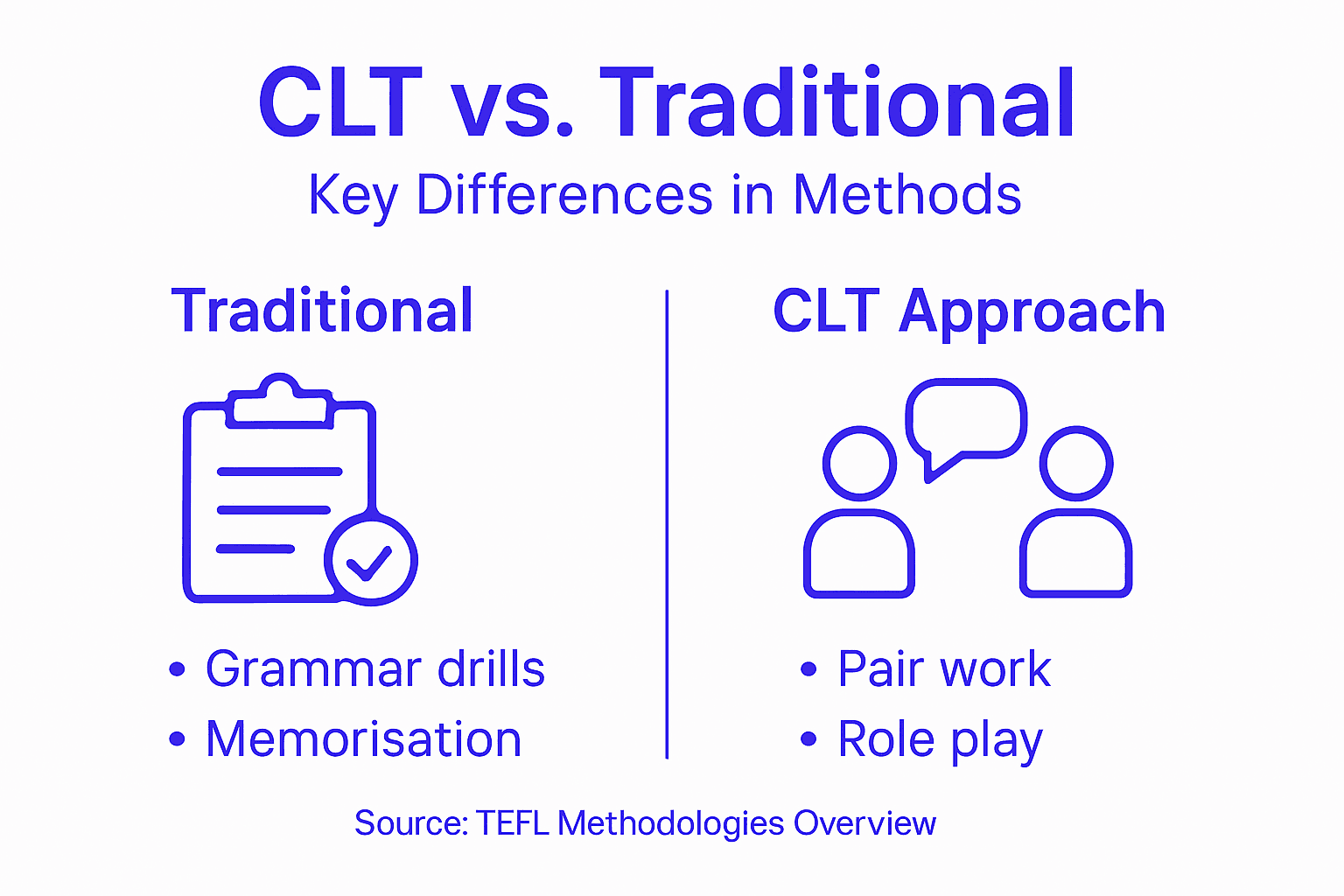
The evolution of English language teaching methodologies represents a fascinating journey of pedagogical transformation. Traditional language teaching approaches were predominantly grammar-focused, characterised by rigid translation methods and extensive memorisation of linguistic rules. Teachers acted as strict controllers of language learning, with students passively receiving grammatical instruction and repeating prescribed linguistic patterns.
The emergence of Communicative Language Teaching (CLT) marked a revolutionary shift in language education. Specialised TEFL courses began emphasising interactive and contextual learning strategies that prioritised practical communication skills over mechanical grammatical precision. This paradigm shift recognised that language acquisition is fundamentally about meaningful interaction, not just understanding abstract linguistic structures.
Key historical transitions in language teaching methodology included moving from grammar-translation approaches to audio-lingual methods, and subsequently to communicative frameworks. These changes reflected broader educational psychology insights about how humans actually learn languages – through engagement, context, and meaningful communication. Modern language teaching now understands that learners acquire language most effectively when they are actively participating, negotiating meaning, and using language in realistic, purposeful scenarios.
The contemporary TEFL landscape continues to evolve, incorporating technology, cultural understanding, and learner-centred approaches that recognise the complex, dynamic nature of language acquisition. Teachers are now viewed as facilitators who create communicative environments rather than strict instructors delivering prescriptive language rules.
The following table summarises how contemporary and traditional English teaching methodologies differ in classroom dynamics, teacher roles, and student experiences:
| Aspect | Traditional Methods | Communicative Approach |
|---|---|---|
| Classroom dynamic | Teacher-centred, rigid | Learner-centred, flexible |
| Teacher’s role | Controller, authority | Facilitator, guide |
| Student activity | Passive, repetitive practice | Active participation, negotiation |
| Focus of learning | Grammar and translation | Practical communication skills |
| Error correction | Immediate and explicit | Strategic, context-driven |
Pro tip: Continuously update your teaching methodology by attending professional development workshops and staying connected with current language teaching research trends.
Essential CLT classroom techniques and activities
Communicative Language Teaching demands dynamic, interactive classroom strategies that transform language learning from passive reception to active participation. Task-based language activities represent the cornerstone of engaging language instruction, designed to simulate real-world communication scenarios and encourage spontaneous linguistic production.
Effective CLT classroom techniques typically incorporate multiple interactive approaches:
- Role-playing scenarios that mirror authentic social interactions
- Problem-solving group activities requiring collaborative communication
- Discussion-based learning that promotes critical thinking
- Peer dialogue and interaction exercises
- Technology-enhanced communication tasks
- Authentic material integration from real-world sources
Successful implementation involves carefully structured activities progressing through pre-task, during-task, and post-task phases. This approach allows learners to gradually build confidence, negotiate meaning, and develop communicative competence. Teachers act as facilitators, creating environments that encourage students to take linguistic risks, experiment with language, and learn through meaningful interaction rather than mechanical repetition.

Modern CLT classrooms leverage technology and diverse communication tools to create immersive learning experiences. Digital platforms, multimedia resources, and collaborative online tools provide additional channels for students to engage in authentic language practice, breaking down traditional classroom barriers and connecting learners with global communication contexts.
Here is a comparison of major classroom activities and their specific contribution to communicative competence development:
| Activity Type | Key Benefit | Sample Outcome |
|---|---|---|
| Role play | Real life scenario practice | Improved conversational fluency |
| Group problem-solving | Collaboration and negotiation | Enhanced critical thinking skills |
| Technology-mediated tasks | Diverse communication context | Increased digital literacy |
| Authentic material use | Exposure to real language | Stronger cultural awareness |
Pro tip: Design classroom activities that progressively increase in complexity, allowing students to build communicative confidence through structured yet flexible learning experiences.
CLT’s integration in Trinity College London courses
Trinity College London has been at the forefront of integrating Communicative Language Teaching (CLT) principles into its professional teaching qualifications, recognising the critical importance of interactive and meaningful language learning approaches. Professional teaching credentials are meticulously designed to equip educators with sophisticated skills that go beyond traditional language instruction methodologies.
The Trinity CertPT course exemplifies this commitment to CLT by focusing on several key development areas:
- Evaluating and adapting existing teaching materials
- Creating learner-centred instructional resources
- Developing strategies for authentic communication
- Understanding diverse classroom communication dynamics
- Implementing interactive teaching techniques
- Promoting student engagement through communicative approaches
Central to Trinity’s approach is the recognition that language teaching is not about rigid grammatical instruction, but about creating meaningful communicative experiences. Teachers are trained to design learning environments that encourage spontaneous language use, negotiate meaning, and develop genuine communicative competence. This involves understanding nuanced approaches to language instruction that prioritise practical communication skills over mechanical linguistic reproduction.
Moreover, Trinity College London’s qualifications integrate theoretical understanding with practical application, ensuring that teachers can translate CLT principles into real-world classroom strategies. By emphasising adaptable teaching techniques, cultural sensitivity, and interactive learning models, these courses prepare educators to meet the complex communication needs of modern language learners across global contexts.
Pro tip: Continuously reflect on your teaching practice by recording and analysing classroom interactions to identify opportunities for more effective communicative language strategies.
Qualifications, job prospects, and global mobility
Navigating the global English language teaching landscape requires strategic qualifications that open doors to international career opportunities. International teaching credentials represent more than just academic certifications – they are passports to worldwide professional mobility, enabling educators to transform their careers across diverse cultural contexts.
The modern TEFL professional’s career trajectory depends on several critical factors:
- Internationally recognized qualifications
- Proven communicative language teaching skills
- Adaptability to different educational environments
- Cultural competence and linguistic flexibility
- Specialised teaching endorsements
- Professional networking capabilities
Teaching qualifications like the Trinity CertTESOL are strategically designed to meet global employment standards. These credentials are particularly valued by prestigious institutions such as the British Council, international schools, and language centres worldwide. Employers seek teachers who can demonstrate not just linguistic knowledge, but the ability to create engaging, interactive learning experiences that transcend traditional classroom boundaries.
Global mobility in TEFL is increasingly driven by technological capabilities, cultural understanding, and specialized skill sets. Teachers with comprehensive training in Communicative Language Teaching methodologies are particularly attractive to international employers, as they bring sophisticated pedagogical approaches that align with contemporary language learning requirements. This means developing a portfolio that showcases adaptability, technological proficiency, and a nuanced understanding of cross-cultural communication dynamics.
Pro tip: Continuously expand your professional credentials and maintain an updated digital portfolio highlighting your international teaching experiences and specialised skills.
Common misconceptions and pitfalls to avoid
Communicative Language Teaching (CLT) has been surrounded by numerous misunderstandings that can potentially derail effective language instruction. CLT misconceptions persist due to incomplete or oversimplified interpretations of this dynamic teaching methodology, creating significant challenges for educators seeking to implement authentic communicative approaches.
Key misconceptions about CLT include:
- Believing CLT completely eliminates grammar instruction
- Assuming CLT only focuses on spoken communication
- Thinking error correction is entirely discouraged
- Perceiving CLT as prioritising fluency over linguistic accuracy
- Viewing communicative approaches as lacking structured learning
- Considering CLT incompatible with traditional teaching methods
Successful CLT implementation requires a nuanced understanding that challenges these widespread myths. Contrary to popular belief, communicative approaches actually integrate grammatical structures, value all language skills, and employ strategic error correction. The fundamental goal is developing comprehensive communicative competence that balances fluency, accuracy, and meaningful interaction. Educators must recognise that CLT is not about abandoning traditional language teaching elements, but transforming them into more engaging, interactive learning experiences.
Navigating these misconceptions demands professional development, critical reflection, and a willingness to challenge ingrained teaching paradigms. Language teachers must continually educate themselves about the sophisticated, multifaceted nature of communicative language teaching, understanding that it represents a sophisticated approach to language learning rather than a simplistic methodology.
Pro tip: Regularly document and reflect on your classroom interactions to distinguish between authentic CLT principles and potential misinterpretations of communicative language teaching.
Transform Your TEFL Career with Communicative Language Teaching and Trinity Accreditation
If you are inspired by the power of Communicative Language Teaching to build real-world language skills and boost global employment prospects this is your next step. EBC TEFL offers Trinity College London accredited courses including the renowned Trinity CertTESOL and CertPT that equip you with practical, hands-on training designed to develop authentic communicative competence. Our specialised CLT-focused programmes ensure you learn how to facilitate learner-centred, interactive classrooms just as the latest research advocates.
Unlock international teaching opportunities with free lifetime job placement support and career guidance tailored for TEFL professionals committed to delivering engaging communicative learning experiences worldwide. Explore our comprehensive 1-year study and work abroad programmes in Spain, France, and Italy combining accredited teacher training, language study, visa assistance, and part-time teaching roles. Take the leap now and join a global community of educators advancing their careers with EBC TEFL. Book your free consultation to get started today at EBC TEFL and discover how our Trinity College London courses and study/work options can shape your teaching journey.
Learn more about our Trinity CertPT and specialised courses focused on Communicative Language Teaching. Begin your pathway to confident, skilled teaching with EBC TEFL.
Frequently Asked Questions
What is Communicative Language Teaching (CLT)?
CLT is an approach to language education focused on enhancing students’ ability to communicate effectively in real-world situations, emphasising authentic language use over rigid grammar rules.
How does CLT differ from traditional language teaching methods?
Unlike traditional methods that primarily focus on grammar and memorisation, CLT prioritises interactive and meaningful communication, encouraging learners to engage actively in the language.
What are some effective techniques used in CLT classrooms?
Effective techniques include role-playing scenarios, problem-solving group activities, discussion-based learning, and technology-enhanced tasks, all aimed at fostering real-world communication skills.
How can qualifications in CLT improve job prospects in teaching English?
Qualifications in CLT enhance employability by demonstrating to employers that teachers possess the skills to create engaging, communicative learning environments, which are increasingly valued in international teaching settings.
