
Over half of multilingual employers now actively seek teachers with specialist skills in English for Specific Purposes training. For aspiring teachers aiming to stand out in Spain, France, or Italy, understanding this tailored approach can set you apart in a crowded field. Discover why building expertise in ESP gives you a critical edge for gaining Trinity College London certification and seizing 1-year international study and work opportunities that elevate your global credentials.
Table of Contents
- Defining English For Specific Purposes Today
- Major Types And Real-World Applications
- Esp In Accredited TEFL/TESOL Training
- Teacher And Learner Roles In Esp Classes
- Esp, Career Growth, And Global Opportunities
- 1-Year Study And Work Abroad Pathways
Key Takeaways
| Point | Details |
| Focus on Specific Needs | English for Specific Purposes (ESP) tailors language education to the precise communication demands of various professional and academic contexts. |
| Diverse Applications | ESP encompasses several categories, including English for Academic Purposes, Business, Science, and Social Studies, each targeting unique professional requirements. |
| Teacher and Learner Dynamics | ESP promotes a collaborative learning environment where teachers design contextualised curricula and learners actively engage in their professional contexts. |
| Career Advancement | Proficiency in ESP enhances professional adaptability and international career opportunities by developing specialised communication skills. |
Defining English for Specific Purposes Today
English for Specific Purposes (ESP) represents a strategic approach to language learning that transcends traditional English instruction by tailoring language education to precise professional and academic contexts. Unlike generic English language training, ESP focuses on developing communication skills directly aligned with learners’ specific career or academic requirements. Researchers have defined ESP as a distinctive subfield that prioritises targeted linguistic competencies across diverse domains.
At its core, ESP operates through a sophisticated framework of needs analysis, examining the precise communication demands within specialised fields such as medicine, business, engineering, and scientific research. The methodology involves comprehensive genre analysis and an understanding of discourse communities, enabling language educators to craft highly contextualised learning experiences. By drawing on education, linguistics, and communication theories, ESP programmes simulate authentic professional tasks that prepare learners for real-world communication challenges.
The global significance of ESP has grown exponentially with increasing international professional mobility. Modern ESP approaches recognise that effective communication extends beyond grammatical accuracy, encompassing sociocultural competence, professional terminology, and genre-specific communication strategies. Whether preparing medical professionals to discuss complex treatments, business executives to negotiate international contracts, or researchers to publish academic papers, ESP provides targeted linguistic tools that directly enhance professional capabilities.
Pro tip: When exploring ESP programmes, prioritise those offering sector-specific curriculum and opportunities for authentic language practice within your professional domain.
Major Types and Real-World Applications
English for Specific Purposes encompasses diverse specialised language learning approaches tailored to specific professional and academic domains. ESP has significantly evolved from its initial focus on scientific and technological communication to include a comprehensive range of professional linguistic training programmes.
The major types of ESP include several distinctive categories that address unique communication requirements across different sectors. These primary classifications are:
- English for Academic Purposes (EAP): Designed for students preparing for university-level studies, focusing on research writing, academic presentation skills, and scholarly communication
- English for Business and Economics (EBE): Targeting professionals in corporate environments, emphasising negotiation skills, report writing, and international business communication
- English for Science and Technology (EST): Concentrating on technical vocabulary, research paper composition, and professional scientific discourse
- English for Social Studies (ESS): Supporting researchers and professionals in humanities and social science disciplines
Comprehensive ESP programmes strategically identify learners’ specific communication needs through detailed needs analysis, ensuring that language training directly addresses the unique linguistic challenges within each professional domain. These approaches go beyond traditional language instruction by simulating authentic workplace communication scenarios, helping learners develop nuanced linguistic competencies specific to their professional contexts.
Pro tip: When selecting an ESP programme, carefully assess how closely the curriculum matches your specific professional or academic communication requirements.
To clarify the main branches of ESP and their distinct characteristics, see the comparison below:
| ESP Category | Target Learners | Core Focus | Typical Contexts |
| Academic Purposes (EAP) | University students | Research writing, academic skills | Universities, research |
| Business & Economics (EBE) | Business professionals | Negotiation, report writing | Corporate settings |
| Science & Technology (EST) | Scientists, engineers | Technical vocabulary, scientific text | Labs, industry sectors |
| Social Studies (ESS) | Social scientists, analysts | Humanities and social sciences usage | NGOs, policy institutes |
ESP in Accredited TEFL/TESOL Training
Accredited TEFL and TESOL programmes have undergone a significant transformation, recognising the critical importance of English for Specific Purposes in contemporary language education. The integration of ESP represents a strategic shift towards meeting learners’ precise educational and occupational needs, moving beyond traditional one-size-fits-all language instruction.
In the realm of professional teacher training, ESP has become a fundamental component of specialised TEFL accreditation. This approach equips language educators with sophisticated skills to design targeted curricula that address specific professional and academic communication requirements. The training encompasses several critical dimensions:
- Conducting comprehensive needs analysis
- Developing specialised instructional materials
- Understanding sector-specific communication dynamics
- Implementing context-driven pedagogical strategies
Modern accredited TEFL and TESOL programmes recognise that effective language instruction extends far beyond grammatical proficiency. These programmes train teachers to become linguistic architects, capable of crafting learning experiences that precisely match the communicative demands of various professional domains. Whether preparing students for international business negotiations, academic research, or technical communications, ESP-focused training ensures educators can deliver highly targeted and relevant language learning experiences.
Pro tip: When selecting a TEFL certification, prioritise programmes that demonstrate a robust approach to ESP and provide practical training in needs analysis and specialised curriculum design.
Teacher and Learner Roles in ESP Classes
English for Specific Purposes fundamentally reimagines traditional language learning by establishing dynamic, collaborative relationships between teachers and learners. ESP practitioners hold multifaceted roles that extend far beyond conventional teaching approaches, functioning simultaneously as curriculum designers, researchers, and communication facilitators.
Teachers in ESP classrooms adopt several sophisticated professional responsibilities:
- Conducting comprehensive needs analysis
- Developing sector-specific instructional materials
- Creating authentic communication scenarios
- Guiding learners towards professional linguistic competence
- Facilitating learner autonomy and self-directed learning
Effective ESP instruction requires teachers to integrate subject-specific content with targeted language training, transforming the traditional classroom dynamic. Learners are no longer passive recipients of language instruction but active participants who bring their professional contexts and experiences directly into the learning environment. This approach demands that students critically engage with specialised terminology, professional communication strategies, and contextually relevant linguistic skills.

The learner’s role in ESP is fundamentally proactive and collaborative. Students are expected to contribute their professional insights, participate actively in task-based learning, and develop specialised communication competencies that directly translate to their specific academic or occupational domains. By bridging theoretical language instruction with practical, context-driven learning, ESP creates a unique educational ecosystem where language acquisition is intrinsically linked to professional development.
Pro tip: Approach ESP learning as a collaborative journey, actively bringing your professional context and communication goals into every learning interaction.
ESP, Career Growth, and Global Opportunities
English for Specific Purposes has emerged as a powerful catalyst for professional advancement in an increasingly interconnected global marketplace. Career growth is now intrinsically linked with specialised language competencies that enable professionals to navigate complex international working environments with confidence and skill.
ESP training offers professionals a strategic advantage through targeted linguistic development:
- Enhancing communication skills in specific professional domains
- Building sector-specific technical vocabulary
- Developing cross-cultural communication capabilities
- Improving professional adaptability and employability
- Expanding international career opportunities
Global labour markets increasingly demand professionals who can communicate precisely within their specialised fields, making ESP an essential investment in career development. Professionals with refined linguistic capabilities can differentiate themselves by demonstrating nuanced communication skills that transcend traditional language proficiency. This approach enables individuals to become more competitive candidates, facilitating career progression and international mobility across diverse professional landscapes.
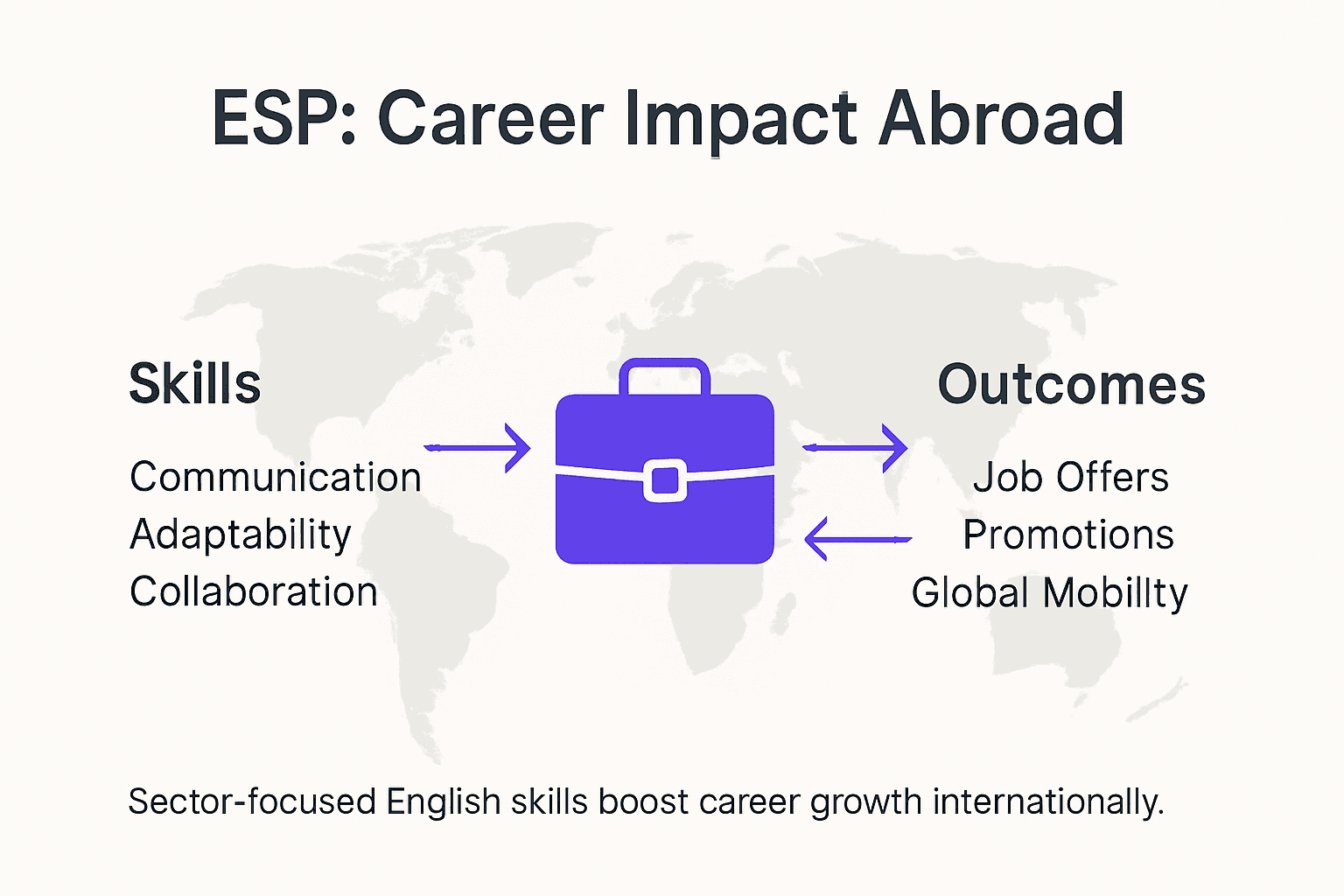
The strategic value of ESP extends beyond immediate communication needs, providing professionals with a robust framework for continuous learning and adaptation. By developing sector-specific language skills, individuals can position themselves as valuable assets in multinational organisations, research institutions, and global industries that prioritise sophisticated communication capabilities.
Pro tip: Actively seek opportunities to apply your specialised language skills in real-world professional contexts to maximise the practical impact of your ESP training.
Below is a summary of how ESP participation contributes to global career advancement:
| ESP Benefit | Professional Advantage | Long-Term Outcome |
| Technical communication | Clearer sector-specific interaction | Higher employability |
| Cross-cultural skills | Competence in multicultural work environments | Broader career prospects |
| Industry terminology | Mastery of specialist vocabulary | Leadership role readiness |
| Authentic scenarios | Preparedness for real workplace situations | Smoother global adaptation |
1-Year Study and Work Abroad Pathways
International education pathways have evolved dramatically, offering unprecedented opportunities for comprehensive personal and professional development through structured one-year programmes. Specialised study abroad initiatives now provide frameworks that integrate academic learning, cultural immersion, and professional experiences, transforming traditional educational approaches.
These transformative pathways typically encompass multiple strategic dimensions:
- Academic credit acquisition
- Language proficiency enhancement
- Professional skill development
- Cultural integration experiences
- Networking opportunities in international contexts
Structured international programmes like Erasmus+ offer comprehensive support for students seeking structured year-long educational experiences, enabling participants to expand their global competencies systematically. These programmes are meticulously designed to align academic objectives with practical skill development, ensuring participants gain meaningful international exposure while maintaining educational progression.
The one-year study and work abroad pathway represents more than an educational experience; it is a strategic career investment. By combining academic learning with professional exposure, participants develop multifaceted skills that significantly enhance their global employability. The immersive nature of these programmes facilitates deep cultural understanding, language mastery, and professional adaptability that traditional educational models cannot replicate.
Pro tip: Research programme-specific visa regulations and support services thoroughly before committing to an international study and work pathway.
Unlock Your Career Potential with Trinity-Accredited ESP Training and Study Abroad
Navigating the specialised demands of English for Specific Purposes can be challenging without the right guidance and credentials. If you want to develop professional communication skills tailored to your career goals while gaining invaluable international experience, our Trinity College London accredited TEFL and TESOL courses offer the perfect solution. With targeted training in Business English, technical language, and real-world teaching practice, combined with our unique one-year study and work abroad programmes in Spain, France, and Italy, you can enhance your language expertise and gain global work experience simultaneously.
Why choose EBC TEFL?
- Internationally recognised certification through Trinity College London
- Practical, hands-on teaching preparation that links theory with industry-specific language needs
- Lifetime job placement support to boost your global employment opportunities
- Comprehensive one-year programmes integrating accredited teacher training, immersive language study, visa support, and part-time work opportunities
Take the next step in your professional journey by exploring our specialised TEFL courses or discover how our study and work abroad programmes can transform your career and personal growth. For tailored advice and personalised guidance, book a free consultation today at EBC TEFL and begin achieving your global career ambitions now.
Frequently Asked Questions
What is English for Specific Purposes (ESP)?
English for Specific Purposes (ESP) is a tailored approach to language learning that focuses on developing communication skills specifically aligned with professional or academic contexts rather than generic language instruction.
How can ESP training impact my career abroad?
ESP training enhances sector-specific language skills, improves professional adaptability, and fosters cross-cultural communication capabilities, all of which significantly boost employability and career progression in international markets.
What are the main types of ESP programmes available?
The main types of ESP programmes include English for Academic Purposes (EAP), English for Business and Economics (EBE), English for Science and Technology (EST), and English for Social Studies (ESS), each targeting different professional or academic fields.
How do I choose the right ESP programme for my needs?
When choosing an ESP programme, assess how well the curriculum matches your specific communication requirements and the opportunities for authentic language practice within your professional context.
Recommended
- 11 good reasons to take a TEFL course – EBC Trinity CertTESOL
- Find English teaching jobs abroad – 12 top quality job sites – EBC Trinity CertTESOL and TEFL courses
- How to Succeed in Online TEFL and Launch a Global Teaching Career – EBC TEFL courses
- International TEFL Career Steps: Your Path to Global Teaching – EBC TEFL courses
