
Nearly 80 percent of international schools now require teachers to demonstrate advanced English language proficiency before hiring. For anyone with british qualifications, mastering these standards opens doors to sought-after teaching roles in Spain and France. Understanding frameworks like CEFR and major global tests helps you stand out among candidates. This guide delivers practical clarity on how proficiency benchmarks shape your professional journey and how to apply them while building your TEFL career abroad.
Table of Contents
- Defining English Language Proficiency Standards
- CEFR Levels Explained for Learners and Teachers
- Alternative Frameworks and Global Benchmarks
- Why Proficiency Matters for TEFL Careers Abroad
- Recognised Tests, Accreditation, and Common Pitfalls
- Proficiency Pathways in Study and Work Abroad Programmes
Key Takeaways
| Point | Details |
|---|---|
| Importance of English Language Proficiency Standards | ELP standards provide a framework for assessing language skills across speaking, listening, reading, and writing, ensuring learners develop essential communication capabilities. |
| Significance of CEFR Levels | The CEFR offers a structured system for measuring language proficiency from beginner to advanced, helping educators design targeted learning experiences. |
| Diverse Language Proficiency Frameworks | Familiarity with various language assessment frameworks, such as IELTS and TOEFL, aids educators in tailoring instruction to meet regional and professional language needs. |
| Critical Role of Proficiency in TEFL Careers | High English language proficiency is essential for effective communication in multicultural environments and enhances employability in international teaching roles. |
Defining English Language Proficiency Standards
English Language Proficiency (ELP) standards represent a critical framework for assessing and developing language skills across multiple communication domains. These comprehensive standards define the precise linguistic knowledge and capabilities English language learners must acquire to succeed academically and professionally.
The standards systematically evaluate language competence through four primary domains: speaking, listening, reading, and writing. Each domain requires specific skill development and progression, enabling educators and institutions to track learner advancement with precision. Language proficiency frameworks like WIDA connect social and academic language contexts by providing structured assessment methods that align linguistic capabilities with academic content requirements.
Key characteristics of robust English Language Proficiency standards include:
- Clearly defined progressive levels of language competence
- Alignment with academic content and curriculum standards
- Comprehensive assessment across multiple communication domains
- Adaptability to different educational and professional contexts
- Measurable benchmarks for language skill development
Understanding these standards helps aspiring English teachers recognise the nuanced approach required when supporting language learners. Proficiency is not merely about vocabulary or grammar, but about developing holistic communication skills that enable meaningful interaction across diverse settings.
Pro tip: When preparing for TEFL certification, focus on understanding how language proficiency standards translate into practical teaching strategies that support learners at different linguistic levels.
CEFR Levels Explained for Learners and Teachers
The Common European Framework of Reference for Languages (CEFR) provides a globally recognised system for measuring and describing language proficiency across six progressive levels. This comprehensive framework enables standardised language assessment from beginner to advanced stages, offering clear benchmarks for learners and educators worldwide.
The CEFR levels are structured as follows:
- A1 (Beginner): Basic communication in simple, everyday situations
- A2 (Elementary): Ability to handle straightforward social interactions
- B1 (Intermediate): Competence in managing most travel and work scenarios
- B2 (Upper Intermediate): Sophisticated communication with native speakers
- C1 (Advanced): Complex language use with nuanced understanding
- C2 (Proficiency): Near-native fluency and sophisticated language manipulation
The framework’s structured ‘can-do’ descriptors provide precise insights into communicative competencies at each level. These detailed descriptors help teachers design targeted learning experiences and enable learners to understand their current capabilities and future language learning goals. By offering a transparent, internationally recognised system, CEFR transforms language learning from an abstract process to a measurable, strategic journey.
The following table compares CEFR levels and their expected communicative abilities:
| CEFR Level | General Skill Description | Example Ability |
|---|---|---|
| A1 | Understand basic phrases | Introduce oneself, answer simple questions |
| B1 | Manage practical situations | Handle travel interactions, write short texts |
| C1 | Use language with flexibility | Discuss abstract topics, write reports |
| C2 | Near-native command | Understand nuanced meaning, mediate complex discussion |
For TEFL professionals, understanding CEFR levels is crucial. These standards not only guide curriculum development but also provide a universal language for discussing student progress across different educational and cultural contexts. Systematic language teaching approaches like our TEFL course levels align closely with these international proficiency benchmarks.
Pro tip: When preparing for international teaching roles, familiarise yourself with CEFR descriptors to effectively assess and support students’ language development across different proficiency levels.
Alternative Frameworks and Global Benchmarks
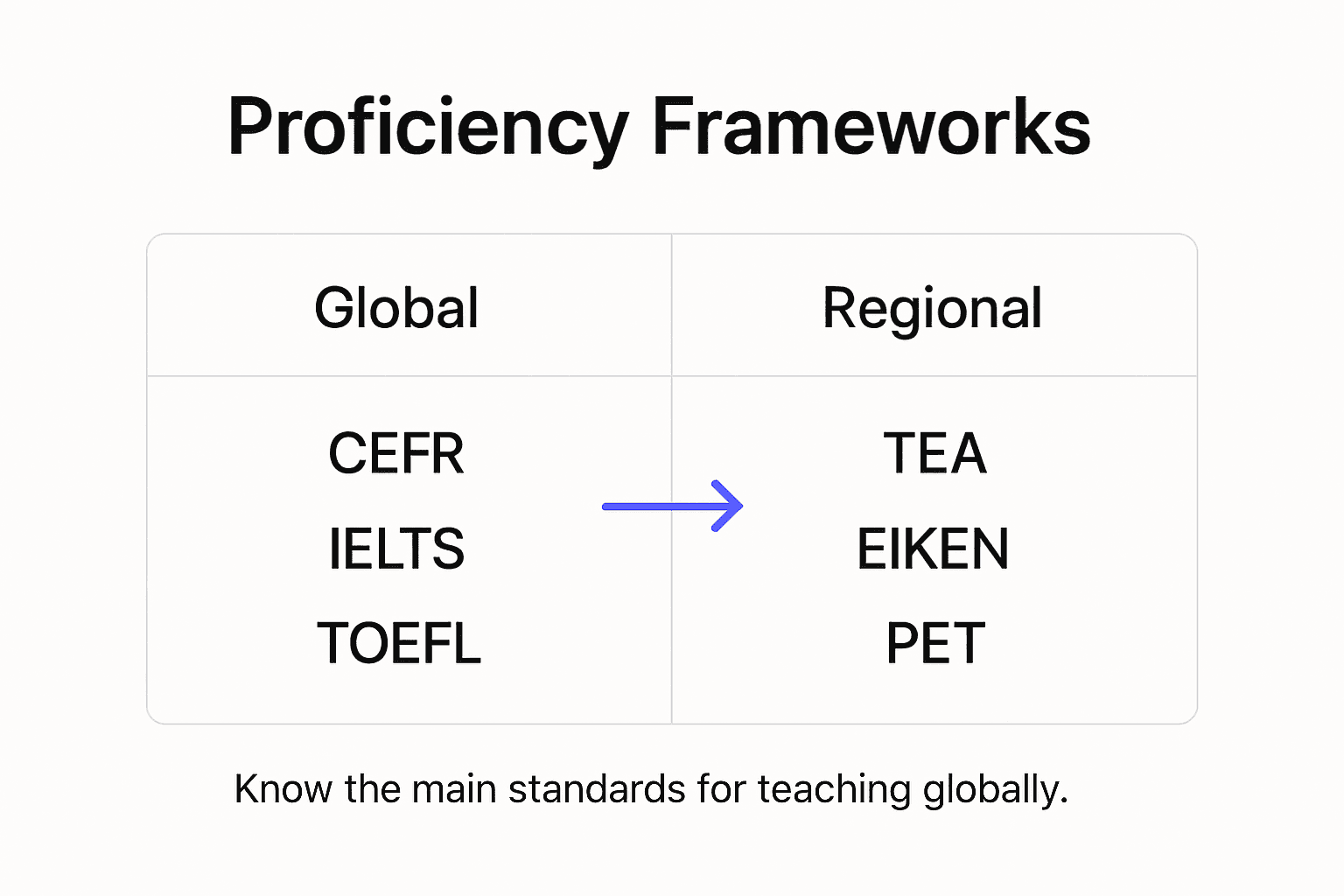
Language proficiency assessment extends far beyond the CEFR, with numerous regional and national frameworks offering unique approaches to measuring linguistic capabilities. Canada’s comprehensive language benchmarking system demonstrates the diversity of global proficiency evaluation methods, providing alternative standards for immigration, professional certification, and academic progression.
Key alternative language proficiency frameworks include:
- Canadian Language Benchmarks (CLB): Comprehensive assessment across four language domains
- Test of English for International Communication (TOEIC): Business and workplace communication focus
- International English Language Testing System (IELTS): Academic and migration language assessment
- Pearson Test of English (PTE): Computer-based language proficiency evaluation
- Test of English as a Foreign Language (TOEFL): Academic English language competence
Regional education agencies like the Texas Education Agency develop customised proficiency standards that reflect local educational requirements while maintaining global comparability. These frameworks illustrate how language assessment adapts to specific contextual needs, providing nuanced approaches to measuring linguistic competence beyond standardised international benchmarks.
Here is a summary of key international English proficiency frameworks and their primary uses:
| Framework/Test | Main Purpose | Typical Application |
|---|---|---|
| CEFR | Academic and general proficiency | Course alignment and learner benchmarking |
| IELTS | Migration and academic admission | University entry, immigration |
| TOEFL | Academic English assessment | University admission worldwide |
| CLB | Canadian immigration and settlement | Immigration, workforce qualification |
| PTE | Computer-based language testing | Fast results for study and migration |
| TOEIC | Business English proficiency | Workplace recruitment and promotions |
For TEFL professionals, understanding these diverse frameworks is crucial. Each system offers unique insights into language assessment, helping educators design targeted learning experiences that address specific regional and professional language requirements. Exploring systematic language teaching approaches enables teachers to navigate the complex landscape of global language proficiency evaluation.
Pro tip: Develop a comprehensive understanding of multiple language assessment frameworks to enhance your adaptability and effectiveness as an international English language instructor.
Why Proficiency Matters for TEFL Careers Abroad
English language proficiency is the fundamental cornerstone of successful international teaching careers, determining an educator’s ability to communicate effectively and navigate complex multicultural learning environments. Beyond mere linguistic competence, proficiency represents the gateway to global professional opportunities, enabling teachers to transform classroom interactions and support students’ comprehensive language development.
Key professional advantages of high English language proficiency include:
- Enhanced communication with students, colleagues, and administrators
- Greater credibility in international educational settings
- Improved ability to explain complex linguistic concepts
- More nuanced cultural understanding and adaptability
- Increased employability across diverse international markets
Professional registration standards increasingly emphasise verified language skills as a critical benchmark for international educators. These rigorous requirements ensure that teachers not only possess linguistic knowledge but can effectively communicate, manage classroom dynamics, and support learners’ academic progression across varied cultural contexts.

International TEFL career pathways demand sophisticated language competencies that extend beyond traditional teaching skills. Proficient educators can design innovative learning experiences, navigate complex communication scenarios, and serve as linguistic and cultural bridges between students and global educational frameworks.
Pro tip: Continuously develop your linguistic skills by immersing yourself in authentic language environments and seeking opportunities for advanced communication practice.
Recognised Tests, Accreditation, and Common Pitfalls
Navigating the landscape of internationally recognised English language proficiency tests requires strategic understanding and meticulous preparation, particularly for aspiring TEFL professionals seeking global teaching opportunities.
Recognised international English language tests include:
- IELTS (International English Language Testing System)
- TOEFL (Test of English as a Foreign Language)
- CELPIP (Canadian English Language Proficiency Index Programme)
- PTE Academic (Pearson Test of English)
- Cambridge English Language Assessment
Proficiency assessment standards require comprehensive evaluation across multiple linguistic domains, encompassing speaking, listening, reading, and writing skills. Professional educators must understand that these tests are not merely academic exercises but critical gateways to international teaching careers.
Common pitfalls in language proficiency testing include:
- Failing to verify test validity periods
- Submitting incorrect test versions
- Misunderstanding score requirements
- Neglecting specific institutional or regional assessment criteria
- Overlooking domain-specific performance expectations
Systematic preparation through recognised TEFL training programmes can help aspiring teachers navigate these complex assessment landscapes, ensuring comprehensive readiness for international teaching opportunities.
Pro tip: Always maintain current, validated language proficiency documentation and research specific institutional requirements before submitting professional applications.
Proficiency Pathways in Study and Work Abroad Programmes
Proficiency pathways represent strategic frameworks that transform language learning into transformative international experiences, enabling aspiring educators to systematically develop linguistic skills essential for global teaching careers.
Comprehensive proficiency pathways typically encompass:
- Initial Assessment: Comprehensive language skill evaluation
- Targeted Training: Customised language development programmes
- Practical Immersion: Real-world communication experiences
- Progressive Skill Building: Incremental linguistic competence development
- Professional Certification: Internationally recognised qualifications
Structured language development frameworks provide scaffolded learning experiences that support learners’ transition between different proficiency levels. These frameworks emphasise contextual language use, ensuring participants develop nuanced communication skills relevant to professional and academic environments.
Study abroad programmes offer unique opportunities for holistic language skill development, integrating linguistic training with cultural immersion and professional preparation. By combining structured learning with authentic communication experiences, participants can rapidly advance their English language capabilities while exploring global career opportunities.
Pro tip: Select study and work abroad programmes that provide comprehensive language support, combining structured training with authentic communication experiences to maximise your professional development.
Unlock Your Global TEFL Career with Trinity College London Accreditation
Mastering English language proficiency is essential for becoming a confident and effective TEFL teacher internationally. If you are inspired by the standards and frameworks like CEFR and want to transform your language skills into a recognized teaching qualification, EBC TEFL offers accredited training that meets these high global benchmarks. Our Trinity College London courses provide practical, hands-on teacher training designed to develop your expertise across all language domains while boosting your employability worldwide.
Begin your journey with our comprehensive 1-year study and work abroad programmes in Spain, France, and Italy that combine specialised Trinity CertTESOL certification with immersive language study, visa support, and real-world teaching or work opportunities. Benefit from free lifetime global job placement assistance and join a supportive community committed to your professional success. Take the next step now by booking a free consultation here and discover how to turn your English proficiency into a life-changing international teaching career.
Frequently Asked Questions
What are the four primary domains of English language proficiency?
The four primary domains of English language proficiency are speaking, listening, reading, and writing. Each domain requires specific skill development to ensure comprehensive language competence.
How does the Common European Framework of Reference (CEFR) classify language proficiency?
The CEFR classifies language proficiency into six levels: A1 (Beginner), A2 (Elementary), B1 (Intermediate), B2 (Upper Intermediate), C1 (Advanced), and C2 (Proficiency), each level indicating a specific set of communicative abilities.
Why is proficiency in English important for TEFL careers?
Proficiency in English is crucial for TEFL careers as it enhances communication with students and colleagues, increases employability, and allows educators to effectively teach complex linguistic concepts while navigating multicultural classroom dynamics.
What are some recognised English language proficiency tests for TEFL professionals?
Recognised English language proficiency tests include IELTS, TOEFL, PTE Academic, CELPIP, and Cambridge English Language Assessment. These tests assess speaking, listening, reading, and writing skills critical for teaching positions.