
A usable lesson plan example gives you a measurable objective, a timed sequence of activities, a formative check, differentiation options, and a short reflection prompt at the end. Below you’ll find two complete lesson plans you can copy or adapt for your own classroom, plus a fillable template and guidance on writing objectives that hold up in an observation. You’ll also see why the habits behind good planning make you a stronger candidate wherever you choose to teach.
Key Points
- Effective lesson plans specify clear, observable objectives and success criteria that directly reflect student behaviors during activities.
- Using scaffolds such as modelling, sentence starters, and differentiated tasks reduces lesson overrun and increases activity effectiveness.
- Incorporating formative checks that mirror lesson objectives helps identify student understanding and guide immediate instructional adjustments.
- Proper planning of transitions, seating arrangements, and timing prevents disruptions and keeps students engaged throughout each stage.
- Rotating delivery methods to include visual, auditory, and kinesthetic elements broadens lesson reach without requiring separate lessons.
Table of Contents
- Two full lesson plan examples you can use today
- What should a lesson plan template include?
- How do you prepare and adapt a lesson plan quickly?
- Choosing formative checks and building a reflection habit
- How does careful lesson planning help you get hired?
- Adapting the same lesson for primary, secondary, and adult learners
- Sample lesson plans for speaking, listening, reading, and writing
- Using technology and multimedia without losing the lesson’s shape
- Classroom management strategies that make a plan actually work
- Engaging visual, auditory, and kinesthetic learners in one lesson
- Turn these planning habits into an accredited qualification
- Sources
Two full lesson plan examples you can use today
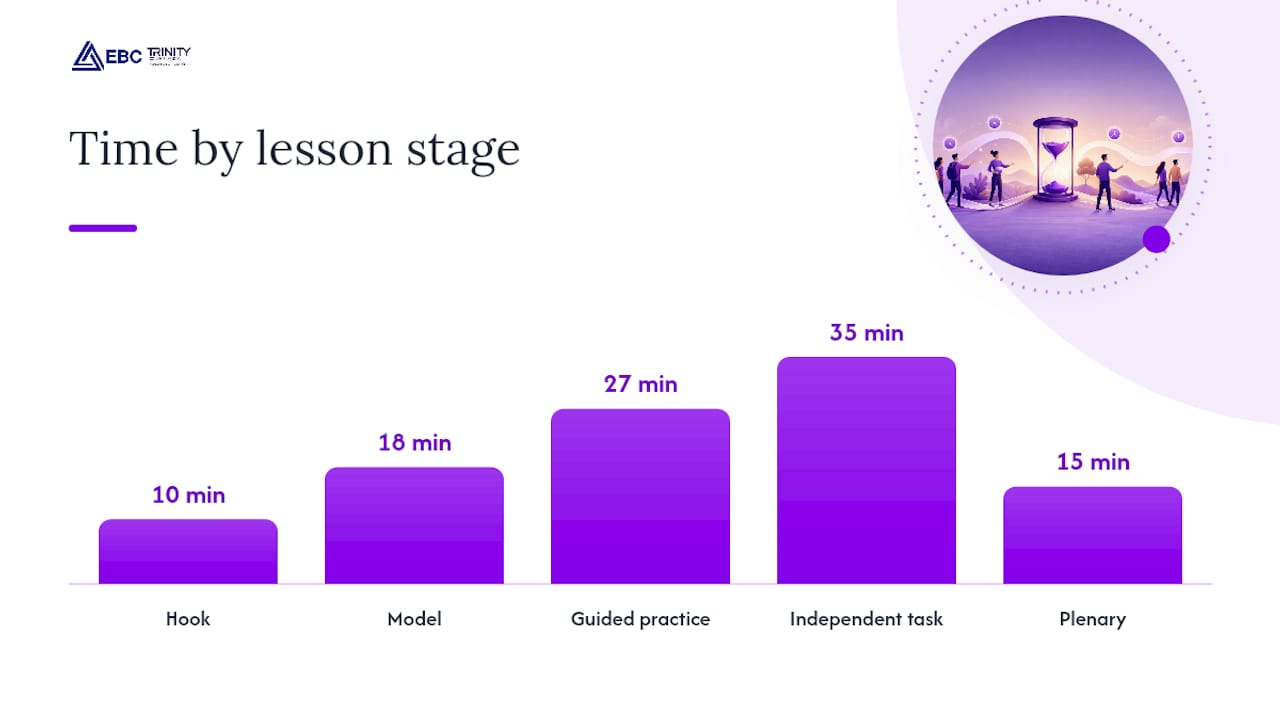
Here are two complete plans built around a common structure: hook, model, guided practice, independent task, plenary. Both follow the sequencing recommended in Writing aligned lesson plans can help new teachers, which favours explicit success criteria and a closing check over loosely connected activities.
Lesson 1: Past simple storytelling (pre-intermediate, 45 minutes)
Objective: Students will narrate a personal anecdote using at least five past simple verbs, three of them irregular.
Success criteria: A partner can retell the story back correctly using the same verb forms.
- Hook (5 mins): Show three photos of an obviously chaotic holiday. Ask “What happened?”
- Model (8 mins): Tell your own short anecdote, underlining past simple verbs on the board as you go.
- Guided practice (12 mins): Students fill gaps in a printed anecdote with correct past forms, checking in pairs.
- Independent task (15 mins): Students write and rehearse their own 60 second anecdote.
- Plenary/exit ticket (5 mins): Students tell their anecdote to a new partner, who writes down three verbs they heard.
Materials: photos (printed or projected), gap-fill handout, mini-whiteboards. Low-resource swap: sketch the photos on the board instead of printing them.
Differentiation: weaker students get a verb bank; stronger students add a second time marker (“before that”, “after a while”).
Lesson 2: Persuasive email writing (upper-intermediate, 60 minutes)
Objective: Students will draft a persuasive email requesting a refund, using two modal verbs and one conditional structure.
Success criteria: The email includes a clear request, a justification, and a polite closing line.
- Hook (5 mins): Read a badly written complaint email aloud; ask what’s wrong with it.
- Model (10 mins): Annotate a strong sample email, highlighting the modal verbs and conditional clause.
- Guided practice (15 mins): Students reorder a jumbled email into the correct structure.
- Independent task (20 mins): Students write their own email from a given scenario card.
- Plenary/exit ticket (10 mins): Swap emails; peers tick off the success criteria on a checklist.
Pro Tip: Keep a spare five-minute filler activity in your back pocket, such as a “find someone who used a modal verb today” mingle. Lessons rarely finish exactly on time, and having a buffer stops the plenary from feeling rushed.
Both plans borrow their sequencing logic from annotated examples like the Year 6 English lesson plan from Ochre Education, which shows how scaffolds and checks for understanding sit inside a single coherent flow rather than as separate bolt-ons.
What should a lesson plan template include?
A lesson plan works as your roadmap for the hour: objectives come first, activities and checks for understanding come second, and everything else supports that alignment, according to the CRLT’s lesson planning framework. Once you’ve internalised that order, the template writes itself.
A workable one-page template includes:
- Title and level: the class group and approximate proficiency band.
- Time and materials: total duration and everything you’ll physically need.
- Learning objective: one sentence, one observable outcome.
- Success criteria: how you and the students will know the objective was met.
- Sequence: hook, model, guided practice, independent task, plenary, each with a timing.
- Differentiation: one adjustment up, one adjustment down.
- Assessment: the specific check you’ll use to close the lesson.
- Reflection: a line left blank until after the lesson.
For the objective line, favour observable verbs over vague ones. “Improve speaking” tells nobody anything. “Order a meal in a restaurant role play using three polite request forms” tells you exactly what to look for. This distinction is one that the CRLT framework returns to repeatedly: success criteria should describe a behaviour you can actually watch happen in the room.
Keep this template to one page. A compact structure with objective, assessment, sequence and differentiation is generally enough for confident teaching, and Education Copilot’s guide to lesson writing makes the same case against over-scripting every line of dialogue. For a fuller walk-through of how the fields connect, see EBC’s guide to lesson planning for TEFL success. If an observer asks to see your plan, a one-pager with clear evidence beats a ten-page document nobody has time to read.
Pro Tip: Write your success criteria before you write the activities. If you can’t picture a student demonstrating it, the activity you’re about to plan probably won’t get them there.
How do you prepare and adapt a lesson plan quickly?
Good planning starts with the big picture, not the first activity that comes to mind, as explained in this Chinese Mandarin Language Course Design that illustrates practical course design principles. The NEA’s lesson planning advice warns against “fluff”: activities that feel busy but don’t move students towards the objective.
Before you teach, run through this checklist:
- Confirm materials are printed, charged, or otherwise ready the night before.
- Check your seating plan matches the activity (pairs for role play, groups of four for discussion).
- Time-test your own instructions by reading them aloud once.
- Prepare one sentence starter or worked example per activity, in case students freeze.
- Have a low-resource backup (whiteboard sketch, oral drill) for every activity that depends on printing or tech.
Scaffolds matter more than most new teachers expect. Modelling the task yourself, showing a worked example, and giving sentence starters (“I think… because…”) all reduce the blank-page panic that derails independent tasks.
Around one in three new teachers report that unclear or missing scaffolds are what most often causes activities to run over time or fall flat, based on classroom planning research cited by the NEA. If half the class is stuck five minutes into independent work, pause, re-model on the board, and shorten the task rather than pushing through.
Choosing formative checks and building a reflection habit
A formative check should mirror your objective exactly, not just test general knowledge. Oak National Academy’s lesson planning guide recommends checking understanding during and immediately after explanation, then confirming it again with a short exit task.
Quick, low-prep options include:
- Thumbs up/down/sideways on a projected statement.
- A one-question exit ticket tied directly to the success criteria.
- Mini-whiteboards held up simultaneously so you can scan the whole room.
After class, spend five minutes writing three things: who struggled, whether pacing worked, and one change for next time. This habit, described in Edutopia’s teacher reflection tips, turns a single lesson into a reusable asset rather than a one-off.
Pro Tip: Keep these notes in one running document. After a term, patterns jump out. You’ll notice, say, that pair work always overruns by five minutes, and you can build that buffer into every future plan.
How does careful lesson planning help you get hired?
Interviewers and mentors observing a trial lesson look for the same things: a clear objective, activities that visibly build towards it, and a specific way you checked whether students actually learned it. A plan padded with generic activities and no success criteria signals inexperience faster than almost anything else.
When you build a teaching portfolio, include two or three annotated plans with your reflection notes attached. Employers value concise, objective-linked plans and evidence that you improve between lessons over long, decorative templates, a point Edutopia’s research on lesson writing makes directly. Being able to talk through why you placed an activity where you did, in an interview, demonstrates the exact professional judgement a hands-on practicum is designed to build.
Adapting the same lesson for primary, secondary, and adult learners
The five-part sequence (hook, model, guided practice, independent task, plenary) holds across age groups. What changes is pacing, instruction language, and how much independence you expect.
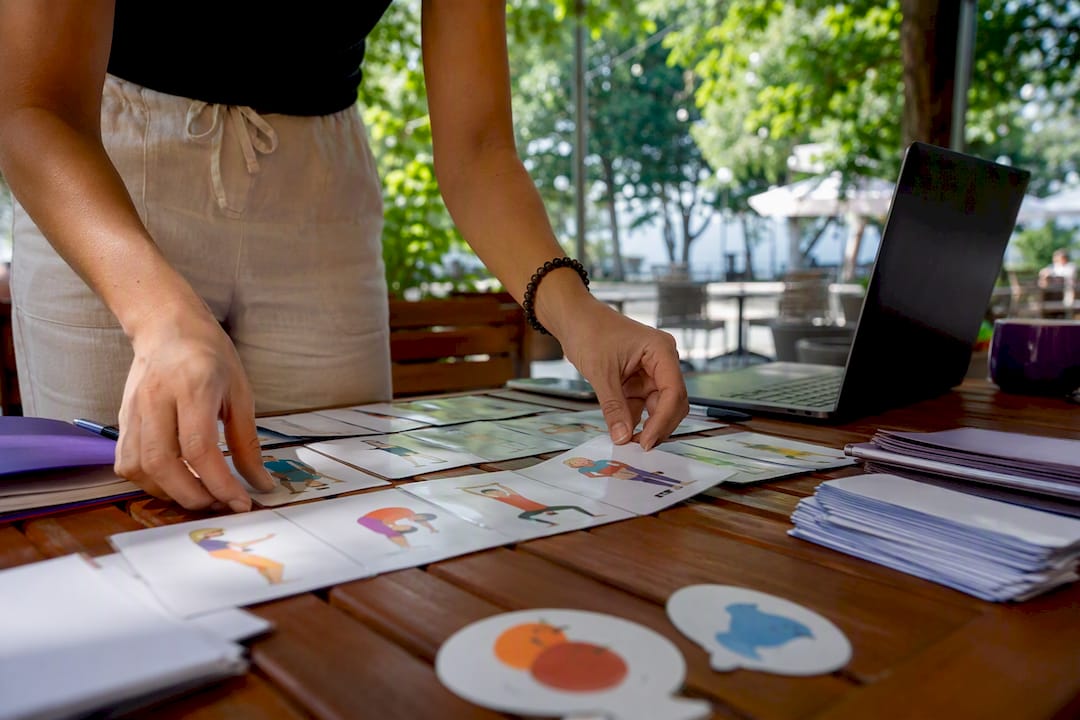
With primary learners, shorten each stage to five or six minutes, use physical movement in the hook (a mime, a quick song), and rely on visuals rather than written instructions. Success criteria should be demonstrable, not written: “point to the correct picture” rather than “explain your reasoning”.
With secondary learners, you can extend independent tasks to fifteen or twenty minutes and introduce peer assessment against the success criteria, since teenagers generally respond well to structured autonomy. Behavioural scaffolding matters more here: give explicit transition instructions between stages to avoid drift.
With adult and general ESL learners, connect the objective to a real-world task they’ll actually use (booking a hotel room, writing a work email) and be explicit about why the lesson matters to them. Adults tolerate less busywork and respond better when you name the objective aloud at the start rather than letting them infer it.
Across all three groups, the objective and success criteria should stay specific and observable. Only the vehicle changes.
Sample lesson plans for speaking, listening, reading, and writing
Each of the four skills needs a slightly different backbone inside the same five-stage sequence.
For speaking, build the hook around a provocative question, model the target language yourself, then move straight into paired practice; the exit ticket is often a recorded thirty-second monologue, using the language taught.
For listening, front-load vocabulary before playing any audio, use a first listen for gist and a second for detail, and check comprehension with true/false statements rather than open questions, which slow the pace unnecessarily.
For reading, pre-teach two or three key words, set a purpose question before students read (never after), and follow with a task that requires them to use the text rather than just answer about it.
For writing, spend more time than usual on the model stage. Show a strong sample, annotate its structure, and give sentence starters before independent writing begins; the exit ticket becomes a peer checklist against your success criteria rather than a new activity.
Using technology and multimedia without losing the lesson’s shape
Video clips, quiz apps, and interactive slides can sharpen a hook or speed up a formative check, but they should serve the objective, not replace it. A five-minute video clip works well as a hook if it’s followed by a specific question, not just “what did you think?”
AI tools can now draft a lesson structure in seconds, but that draft still needs a teacher’s eye. Oak National Academy notes that AI-generated plans require editing for alignment with your actual objective, differentiation for the students in front of you, and local classroom context an algorithm has no way of knowing. Treat any AI draft as a first pass, not a finished plan.
For low-connectivity classrooms, keep a non-digital version of every multimedia activity ready. A printed transcript can substitute for an audio file; a photocopied slide can replace a projector that won’t switch on. EBC’s round-up of free digital resources is a useful place to find tools that work even with patchy internet access.
Classroom management strategies that make a plan actually work
The best plan on paper still fails if transitions between activities aren’t managed. Build transition cues into the plan itself: a countdown, a hand signal, or a fixed phrase (“pens down, eyes here”) that students learn to respond to automatically.
Seating arrangements should be decided at the planning stage, not improvised on the day. If guided practice needs pairs and independent work needs individual focus, note the switch in your plan so you’re not rearranging the room mid-lesson while attention drains away.
Behaviour tends to slip during the gaps between stages, not during the stages themselves. Timing each section tightly, and telling students how long they have, reduces the drift that causes most low-level disruption. A stopwatch visible to the class works better than a private mental countdown.
Engaging visual, auditory, and kinesthetic learners in one lesson
You don’t need three separate lessons to reach different learner types. You need one lesson that rotates its delivery method across the five stages. A visual learner benefits from the photos or diagrams in your hook; an auditory learner gets more from your spoken model and the class discussion; a kinesthetic learner needs the guided practice stage to involve movement, manipulation of cards, or physical role play rather than sitting still filling in a worksheet.
Building in at least one moment of movement, one moment of listening, and one visual anchor per lesson costs you almost nothing in planning time but broadens who the lesson actually reaches. The Year 6 English example from Ochre Education demonstrates this well, layering a visual prompt, a spoken model, and a hands-on sorting task inside a single 45 minute sequence rather than treating each learner type as a separate lesson.
Turn these planning habits into an accredited qualification
Every technique above, backward design, success criteria, formative checks, reflection, is exactly what EBC builds into its Trinity CertTESOL and CertPT training. The course is internationally accredited through Trinity College London, and the practical, hands-on practicum gives you supervised classroom time to actually run plans like these in front of real students before you’re marked on them.

Beyond the qualification itself, EBC offers lifetime worldwide job placement support, plus comprehensive one-year study and work abroad programmes in Spain, France, and Italy that combine language study, postgraduate study, visa support, and part-time teaching opportunities. Visa outcomes depend on individual circumstances and the rules of the country involved, so no guarantee can be made there, but the guidance and paperwork support are built into the programme from day one. If you’re weighing up where formal accreditation and a structured practicum could take your planning skills next, explore certification to teach English abroad and book a free consultation to talk through which pathway fits your situation.
Sources
For deeper reading on planning methodology, see teachingenglish.org.uk. For lesson structure and template background, revisit EBC’s guide to what lesson planning means in TEFL.
- Strategies for Effective Lesson Planning | CRLT
- Writing aligned lesson plans can help new teachers | Edutopia
- Year 6 English lesson plan example – Ochre Education / AERO
- How to plan a lesson: a helpful guide for teachers | Oak National Academy