
Use these low-prep setup tweaks and ready-to-run activities to increase student talk time and engagement in your ESL lessons. The ideas below draw on evidence-based instructional practices and classroom-tested techniques from organisations such as the British Council and TESOL, and every one works whether you teach in a language school in Bangkok, a state classroom in Poland or an online session with students spread across three continents. Training in practical, hands-on techniques like these builds classroom competence valuable when job hunting.
TL;DR:
- Seating in clusters or a horseshoe improves eye contact and partner work, facilitating more student interaction and quick transitions.
- Activities like Board Race and Two Truths and a Lie provide quick, adaptable ways to maximize speaking time and assess fluency informally.
- Using timers, role cards, and clear routines ensures efficient activity flow and evenly distributed speaking responsibilities.
- AI tools support differentiation through captions, glossaries, and simplified texts but require manual verification for accuracy and relevance.
- Incorporating students’ cultural backgrounds and first languages into activities enhances engagement, inclusivity, and meaningful language practice.
Table of Contents
- Classroom setup ideas that boost interaction
- Ten ready-to-run activities for maximum speaking time
- Routines that keep every activity productive
- Using tech and AI as a scaffold, not a shortcut
- Scaffolding and assessment built into the activity
- Why these skills matter for your next job application
- Where this training comes from
- Ideas for developing listening and reading skills
- Techniques for encouraging vocabulary acquisition and retention
- Integrating writing practice into classroom activities
- Incorporating cultural awareness and inclusivity in activities
- Classroom management strategies specific to ESL learners
- Useful sources for templates and further reading
- FAQ
Classroom setup ideas that boost interaction
Small changes to your room layout do more for participation than most teachers expect, and none of them cost much. Seating arranged in clusters or a horseshoe, rather than rows, lets students make eye contact and turn to a partner without shuffling furniture. Good natural or warm artificial lighting near the speaking area keeps energy up during longer sessions, particularly in late afternoon classes.
A vocabulary wall that changes with each unit gives students a visual anchor when they forget a word mid-sentence, and a word mat left on every desk saves you from repeating the same vocabulary five times per lesson. Marking out a small speaking zone (even just a rug or a taped square) signals to students that this is where fluency work happens, separate from quiet reading or test corners. A simple materials station, a box or shelf near the door, stops lesson time disappearing into hunting for pens and flashcards.
Where you use tablets, phones or a classroom laptop, keep charging points near the tech corner rather than scattered around the room, and set a routine for handing devices out and back in under a minute.
- Cluster or horseshoe seating for constant eye contact and quick pairing.
- A rotating vocabulary wall tied to the current unit, not left static all term.
- A taped-off speaking zone that cues students into talk mode.
- A materials station near the door to cut transition time.
- A fixed spot for charging and storing shared devices.
Pro Tip: Label your speaking zone with a simple sign like “English Only Here” so students self-regulate without you repeating the rule.
Ten ready-to-run activities for maximum speaking time
Each of these needs little preparation and can be adapted up or down in level. Several also work as informal assessment, letting you note fluency and accuracy while students think they are just playing a game.
- Board Race: Split the class into teams, call out a topic (“food”, “jobs”), and have one student per team run to the board and write a related word before tagging a teammate. Runs 5 to 8 minutes and works for vocabulary review at any level.
- Two Truths and a Lie: Students write three statements about themselves, two true and one false, then share in pairs or small groups while others guess. Takes 10 minutes and builds question formation and listening for detail.
- Simon Says: Best with younger learners, this classic listening game reinforces instructions and body vocabulary in short, high-energy bursts of 5 minutes.
- Pictionary: One student draws a word or phrase while their team guesses within a time limit, reinforcing vocabulary through visual memory. Adapt difficulty by controlling the word list.
- Hot Seat: A student sits facing the class while a word appears behind them; classmates give clues until the student guesses. Strong for vocabulary recall under light pressure.
- Change place, change face: Students stand, ask a question, then physically swap seats with whoever answers, keeping the room moving and talk time high. The British Council notes it works particularly well with shy students since the movement lowers pressure, and it needs only 8 to 10 prepared questions.
- Interview the expert: One student role-plays an expert on a topic while classmates prepare and ask questions, pushing both question formation and listening comprehension.
- Mini escape room: Students solve a sequence of language puzzles to “unlock” a final answer. TESOL recommends designing puzzles around your target grammar or vocabulary and testing the sequence yourself before running it live, since a broken clue can stall the whole activity.
- Presentations project: Over two lessons, teach structure and useful phrases first, then have students present with peer questions and feedback focused on communication rather than correcting every error.
- Role play: Assign short scenarios (ordering food, a job interview) with simple prompt cards, ideal for practising functional language in a low-stakes format.
Information-gap tasks, where each student holds half the information needed to complete a task, and Board Race both double neatly as formative assessment: you can circulate and note who initiates language versus who only responds.
Routines that keep every activity productive
A clear signal, whether a raised hand, a bell or a countdown on the board, tells students when talk time starts and stops, cutting the dead minutes between activities. Giving each group member a role card (timekeeper, reporter, vocabulary checker) spreads responsibility and stops stronger students dominating.
- Use a visible countdown timer so transitions happen without verbal reminders.
- Assign role cards for group tasks to distribute speaking and listening duties evenly.
- Drop in quick, whispered feedback while circulating rather than halting the activity.
- End with a one-line exit ticket: one thing learned, one question remaining.
A short peer report, where one student from each group summarises their conversation to another group, adds a listening check without extra planning.
Using tech and AI as a scaffold, not a shortcut
Used carefully, AI tools support rather than replace language development. Live captions or subtitles help students follow fast spoken input, and AI-generated glossaries or simplified texts let you differentiate reading material in minutes rather than hours, a use the University of Rochester highlights as effective when the outputs are checked for accuracy and matched to proficiency level. Chatbots can give shy students low-pressure practice asking and answering questions outside class, and short AI-generated audio clips work well for pre-lesson warm-ups or post-lesson review.
- Check any AI-generated text or glossary for accuracy before handing it to students.
- Keep translation tools for occasional support, not as a substitute for English practice.
- Use captions or subtitles for listening tasks rather than full transcripts.
- Favour free or low-cost tools so device access does not become a barrier.
Pro Tip: Ask an AI tool to generate three versions of the same text at different reading levels, then let students choose which one to work from.
Scaffolding and assessment built into the activity
Learner packs, laminated word mats, phrase banks and sentence starters, let students manage their own cognitive load rather than waiting on you for every phrase. Pairing a stronger speaker with a developing one, or offering voice-to-text support for lower-proficiency students, keeps everyone producing language during the same task.
- Provide sentence frames (“I think… because…”) for open discussion tasks.
- Use visual role cards for students who need a concrete anchor.
- Pair strategically rather than alphabetically or by friendship group.
- Note fluency, accuracy and interaction on a simple three-column rubric as you circulate.
Rosenshine’s principles, including small steps, modelling and frequent checks for understanding, are associated with higher student success rates during instruction, which is the reasoning behind breaking any new activity into a modelled example before students attempt it alone.
Why these skills matter for your next job application
Interviewers for teaching posts consistently look for evidence of differentiation, classroom management and comfort with technology, not just a certificate. Running the activities above gives you concrete material to describe: how you scaffolded a mixed-ability group, how you used a quick rubric to track participation, how you adapted a text with an AI tool.
- Keep short, anonymised snapshots of lesson activities and outcomes to reference at interview.
- Write brief reflective notes after trying a new technique, what worked and what you would change.
- Mention specific tools and routines by name rather than describing teaching in general terms.
Practical training that emphasizes hands-on classroom skills supports building a strong portfolio for international teaching applications.
Where this training comes from
The course delivers Trinity College London accredited training, combining accreditation with hands-on teaching practice and offers job placement support to graduates seeking work worldwide.
- Trinity College London accreditation underpins the certification pathways provided.
- Training emphasises live, practical teaching experience over classroom theory alone.
- Job placement support is offered for graduates, with no guarantee of specific outcomes or visas.
- The provider operates globally, supporting placement across multiple regions.
Ideas for developing listening and reading skills
Listening improves fastest when students hear language in short, purposeful bursts rather than long unbroken audio. Play a clip twice, once for gist and once for detail, and ask a different question each time so students have a clear listening purpose. Podcasts, short news clips or even a two-minute AI-generated summary work well for this, provided the language matches your group’s level.
For reading, graded texts paired with a pre-teaching stage, where you introduce five or six keywords before students open the text, reduce the frustration of hitting unknown vocabulary mid-sentence. Jigsaw reading, where each student reads a different section of a text and then reports back to their group, forces both careful reading and clear speaking in the same task. Short, frequent reading with comprehension questions beats occasional long passages for building both confidence and speed.
Encourage students to predict content from a title or image before reading or listening begins, a small step that primes attention and gives weaker students a foothold before the language starts.
Techniques for encouraging vocabulary acquisition and retention
Vocabulary sticks best when students meet a word several times in different contexts rather than once on a list. Rotate new words through a speaking activity, a reading text and a quick game across the same week rather than teaching them once and moving on.
Word mats and a visible vocabulary wall, updated each unit, give students a constant point of reference during speaking tasks, reducing the temptation to switch to their first language when they forget a term. Categorising new words by theme or by grammatical function, rather than presenting them alphabetically, also helps students build mental links between related terms.

Short, low-stakes recall games such as Hot Seat or Pictionary, described above, work well as five-minute retrieval practice at the start of a lesson, reinforcing words from the previous session before moving on to new material.
Integrating writing practice into classroom activities
Writing does not need a separate lesson to happen well. A short written reflection after a speaking activity, two or three sentences on what a partner said, ties writing directly to the language just produced aloud. Exit tickets, mentioned earlier as a routine, double as light writing practice when you ask for a full sentence rather than a single word.
Collaborative writing tasks, where pairs build a short story or dialogue together on one shared sheet, encourage students to negotiate language choices out loud before committing them to paper, blending speaking and writing naturally. For presentation projects, a written outline or script draft before the spoken delivery gives you an additional artefact to assess and gives students a chance to plan their language rather than improvising under pressure.
Short, frequent writing tasks tied to something students have just said or heard tend to feel less daunting than a blank page and a generic essay title.
Incorporating cultural awareness and inclusivity in activities
Activities land better when students see their own backgrounds reflected in the material, not just the target culture. Letting students bring examples from their own countries into topics like food, festivals or family customs turns a generic vocabulary lesson into a genuine exchange, and it works whether your class is entirely one nationality or a mix of a dozen.
Multilingual classrooms benefit from treating students’ first languages as a resource rather than a problem: a quick comparison of an idiom or proverb across languages can open a vocabulary lesson and validate what students already know. Presentation and interview-style activities are a natural fit for this, since students choose their own content and often default to something personally meaningful.
Avoid assuming a single cultural reference point works for the whole room, holidays, sports and food customs vary widely, and a quick check before building a lesson around one avoids leaving some students without anything to contribute.
Classroom management strategies specific to ESL learners
Language barriers make standard management techniques land differently. Instructions given in short, simple sentences, backed by a gesture or visual, reduce the confusion that often triggers off-task behaviour in lower-proficiency classes. Repeating a key instruction in two different ways, once verbally and once written on the board, catches students who missed it the first time without singling anyone out.
Clear, consistent routines matter more in ESL classrooms than in first-language settings, since students cannot always rely on incidental language to work out what is expected. A visible daily structure, a warm-up, a main activity, a wrap-up, in the same order each lesson, reduces anxiety for students still building their confidence with English.
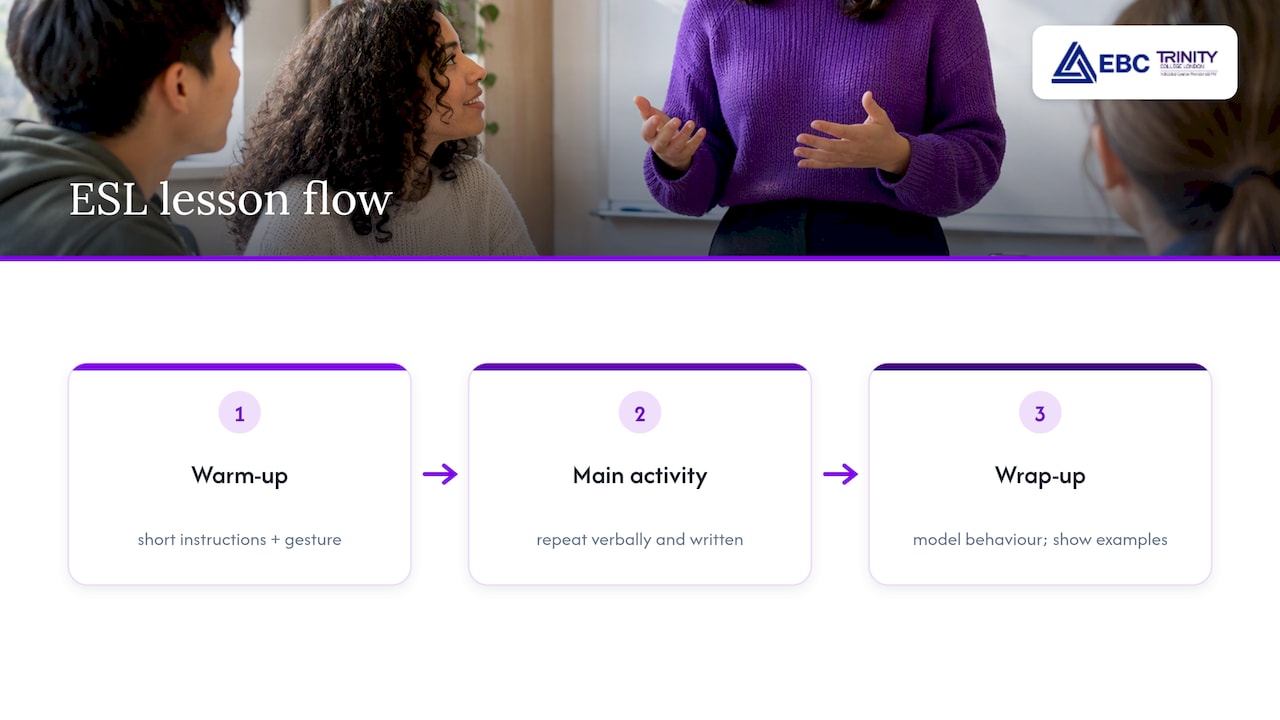
Behaviour expectations work best when modelled rather than only explained: showing what “working quietly” or “taking turns” looks like removes the vocabulary gap that written rules can create.
Useful sources for templates and further reading
- TeachingEnglish for ready-made, classroom-tested activity templates
- TESOL for gamification and escape-room design guidance
FAQ
What are some fun activities for an ESL classroom?
Board Race, Two Truths and a Lie, Pictionary and Change place, change face are all low-prep, high-engagement options covered above. Each takes about 5 to 10 minutes and adapts to almost any proficiency level with small tweaks to vocabulary difficulty.
What are some good topics for ESL lessons?
Topics that connect to students’ own lives, food, travel, family customs and everyday routines, tend to generate the most natural conversation. Letting students bring their own cultural examples into these topics also supports the inclusivity goals covered earlier in this article.
What are some good project ideas for ESL students?
Presentation projects, scaffolded over two lessons with structure taught first and peer questions second, work well across mixed-ability groups. Interview-style role plays and short collaborative writing projects, such as a shared short story, also give students a clear, achievable goal to work towards.
What are some good ESL lesson plan ideas for beginners?
Beginners benefit from short, repetitive routines: a visual vocabulary warm-up, a simple listening task with a clear gist question, then a guided speaking activity using sentence frames. Simon Says and Board Race both work well at this level since they rely on recognition rather than free production.
Recommended
- Top ESL classroom activities to engage your students
- Free digital resources to make your English classes more efficient
- Games for Writing to Speaking
- English teaching warm-up activities for online teaching
This page provides commentary based on information, facts, and experiences available at the time of publication. It does not constitute legal advice, and EBC accepts no liability for decisions made based on the information provided. If you require legal advice, please consult a qualified lawyer.