
Here is a ready-to-teach TEFL lesson plan you can copy now: by the end of the lesson, learners can order food at a café using polite request forms, built across a warm-up, presentation, controlled practice, freer production and review, each timed to fit a 45 to 60 minute slot. That single can-do objective, labelled to CEFR A2, is the model used by trainers when teaching new teachers. The full template and two worked examples sit below, ready to copy.
Key Points
- A clear header with measurable objectives, class profile, materials, and timings is essential for demonstrating proper lesson planning.
- Most TEFL lessons follow a consistent five-stage structure, from warm-up to review, with each stage sized proportionally to the total duration.
- Online and large classes require adapted approaches, such as shorter presentation segments, group responses, and visual aids for young learners.
- Formative assessment during freer tasks and simple exit tickets are crucial for capturing immediate progress and informing future lessons.
- Using a standardized lesson plan template and reflecting post-lesson improves employability and demonstrates understanding of CEFR levels and effective teaching practices.
Table of Contents
- What goes in the header of a TEFL lesson plan?
- How do you structure a TEFL lesson in five stages?
- Two worked example TEFL lesson plans you can copy
- A fillable TEFL lesson plan template for 30 to 90 minutes
- How do you adapt a lesson plan for online classes and mixed levels?
- How do you assess learning within a single lesson?
- Why do these lesson-planning skills make you more hireable?
- Trusted resources and downloadable templates
- How EBC’s accredited training helps you plan and teach with confidence
- Sources
What goes in the header of a TEFL lesson plan?
Every usable lesson plan opens with the same block of information, whatever the level or setting. Recruiters and course assessors look for this structure first, because it tells them, in seconds, whether a lesson has been properly thought through.
A strong header answers four questions before the teaching even starts: what will students be able to do, who exactly are they, what do you need in the room, and how long does each part take. Standard headers frame the aim as a measurable statement and tie it to a recognised level such as CEFR A1 to C1, rather than a vague topic name like “food vocabulary.”
Fill in these fields at the top of every plan:
- Objective: a measurable can-do statement (e.g. “students can ask for and give directions using imperatives”).
- Class profile: age range, CEFR level, class size and any assumed prior knowledge.
- Materials and tech: handouts, flashcards, audio, whiteboard, or an app if teaching online.
- Timings summary: total lesson length and a rough split across stages.
- Metadata: your name, the date, a version number, and any source materials referenced.
That last field matters more than it looks. A dated, versioned plan shows an employer you revise your work, which is exactly the kind of evidence EBC’s guide to accredited lesson planning points new teachers towards during interviews.
How do you structure a TEFL lesson in five stages?
Most 45 to 90 minute TEFL lessons follow the same five-stage skeleton, and it works because each stage hands off cleanly to the next. A five-stage template covering warm-up through to review is one of the most widely used formats in TEFL training worldwide, and it scales up or down depending on how much time you have.
- Warm-up (5% to 15% of the lesson). Wake the class up and activate what they already know. Three reliable options: a quick “guess the word” mime, a one-minute pair chat on a related topic, or a picture prediction task. Warm-ups that recycle target vocabulary through a short game tend to boost retention once you reach the presentation stage.
- Presentation (10% to 25%). Model the target language clearly, with a simple board plan and visual support, so students see the form before they try to use it.
- Controlled practice (20% to 40%). Run accuracy-focused drills, gap fills, or matching tasks. Monitor closely and correct as you go.
- Freer production (20% to 40%). Set a communicative task, ideally in pairs or small groups, where fluency matters more than perfect grammar. Give feedback after, not during.
- Review or exit ticket (5% to 10%). Check learning fast, note what needs revisiting, and close the lesson.
Interaction patterns should shift with the stage: whole-class for presentation, pairs for controlled practice, and small groups for freer production, since that mix keeps quieter students from disappearing into the background.
Pro Tip: If you’re short on planning time, stick to the same five-stage skeleton every lesson. Some trainers use PPP (Presentation, Practice, Production) instead of ESA (Engage, Study, Activate); both map onto this structure, so pick one and stay consistent rather than switching formats mid-course.

Two worked example TEFL lesson plans you can copy
These two plans show the structure in action. Copy the shape, then swap in your own topic and level.
Plan A: A1 young learners, animals vocabulary (45 minutes)
- Objective: students can name and describe six animals using “It’s a…” and “It has…”.
- Profile: ages 7 to 9, CEFR A1, 15 students, no prior animal vocabulary assumed.
- Materials: flashcards, a simple worksheet, a bag of toy animals.
- Warm-up (5 min, whole class): animal sounds guessing game.
- Presentation (10 min, whole class): flashcard drilling with gestures.
- Controlled practice (15 min, pairs): matching worksheet.
- Freer production (10 min, groups): describe-and-guess game.
- Review (5 min, whole class): quick show-and-tell with toy animals.
- Online adaptation: replace toy animals with a shared screen gallery and use breakout pairs for the matching task.
Plan B: B1 teens/adults, making complaints politely (60 minutes)
- Objective: students can make a polite complaint using “I’m afraid there’s a problem with…”
- Profile: ages 16+, CEFR B1, 12 students, basic present tense assumed.
- Materials: role-play cards, a short listening clip, handout.
- Warm-up (5 min, pairs): share a bad customer service story.
- Presentation (15 min, whole class): listening clip plus board plan of the target phrase.
- Controlled practice (20 min, pairs): scripted role-play cards.
- Freer production (15 min, groups): unscripted complaint role-play with feedback.
- Review (5 min, whole class): exit ticket, one sentence each.
- Online adaptation: send role-play cards via chat and run freer production in breakout rooms with a two-minute time limit.
A fillable TEFL lesson plan template for 30 to 90 minutes
Paste this block into a document and fill in the gaps:
- Objective: Students can ___
- CEFR level / age / class size: ___
- Materials: ___
- Total time: ___
Timing splits scale predictably once you know the total length. A useful free fillable ESL template with stage-by-stage prompts follows roughly this pattern:
| Lesson length | Warm-up | Presentation | Controlled practice | Freer production | Review |
|---|---|---|---|---|---|
| 30 min | 3 min | 5 min | 10 min | 5 to 10 min | 4 min |
| 45 min | 5 min | 5 to 10 min | 15 min | 12 min | 5 min |
| 60 min | 7 min | 12 min | 15 min | 15 min | 5 min |
| 90 min | 10 min | 15 min | 20 to 40 min | 20 to 40 min | 5 min |
No printer? Swap flashcards for objects in the room, use the whiteboard instead of handouts, and read out gap-fill sentences rather than copying them. Another free downloadable template offers a printable version if you want a paper backup.
How do you adapt a lesson plan for online classes and mixed levels?
The five-stage skeleton holds worldwide; only the delivery changes.
- Online: keep teacher-facing activities brief, set breakout tasks with a visible timer, and shorten the presentation window since screen attention drops faster than in a classroom.
- Large classes: rely on choral response for controlled practice and nominate two or three “monitors” to report back from groups you can’t reach individually.
- Young learners: lean on visuals, short bursts of movement, and tasks that last no more than five minutes each.
For more on cutting prep time without losing quality, EBC’s list of free digital classroom resources is worth bookmarking before your next online lesson.
How do you assess learning within a single lesson?
Formative checks during freer production catch problems before they harden into habits. Ask students to model a sentence themselves (“show me one example”), then compare against two or three sample prompts you prepared in advance.
Exit tickets work best kept simple:
- A one-sentence task using the target language, submitted on paper or in chat.
- A three-question quick quiz for higher-stakes lessons.
Write your lesson note in one line: what worked, what you’d change, and why. That single sentence, repeated across a teaching portfolio, becomes evidence of reflective practice.
Why do these lesson-planning skills make you more hireable?
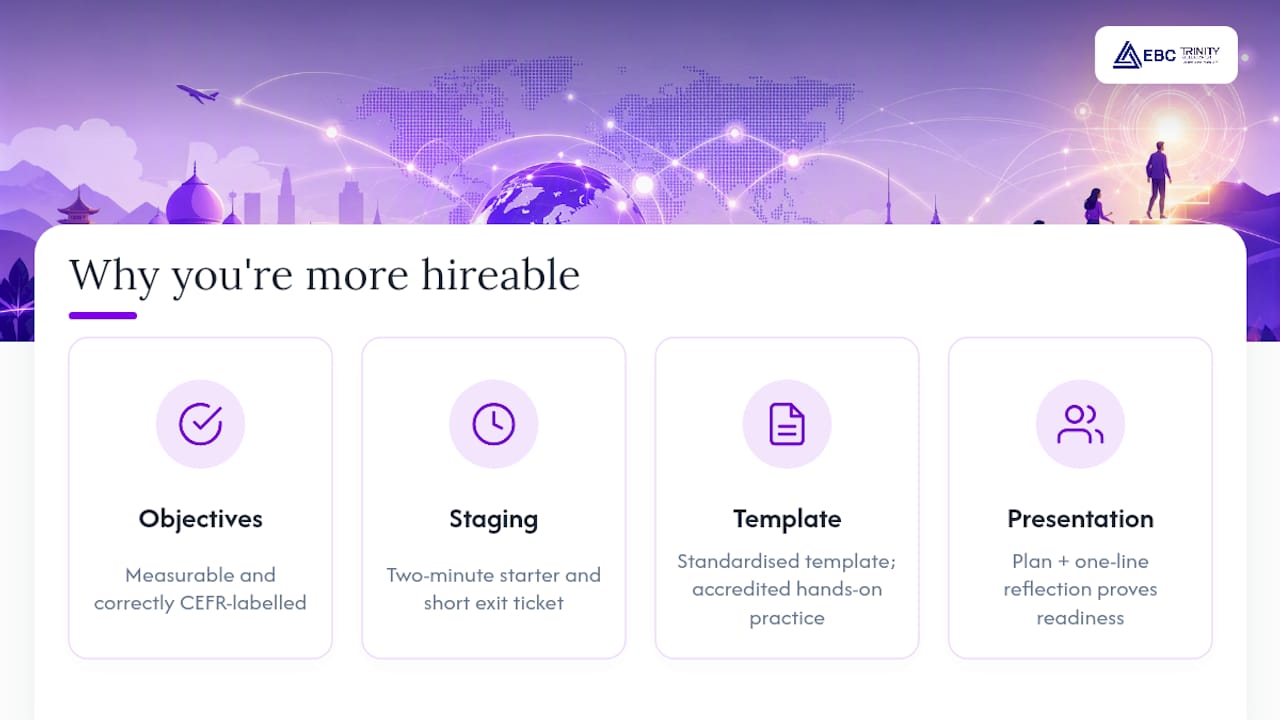
Interviewers and recruiters check whether your objective is measurable and correctly labelled to CEFR, because it signals you understand levels, not just topics. A clear staging plan with a two-minute starter and a short exit ticket reduces uncertainty for anyone observing your demonstration lesson.
Experienced TEFL content creators build this structure into every training session using a standardised template, backed by accredited, hands-on practice. Presenting a plan like this in interviews, alongside a one-line reflection note, is strong proof of readiness employers see.
Trusted resources and downloadable templates
For further reading, a large lesson plan library organised by CEFR level offers models across every stage of learning. External links here open in a new tab and carry no guarantee about employment or visa outcomes.
How EBC’s accredited training helps you plan and teach with confidence
Lesson planning like this isn’t a side skill on an EBC course. It’s built into every Trinity-accredited session, alongside classroom practice that mirrors real interview and observation conditions worldwide.

Where other short courses hand you a template and leave you to work it out, EBC pairs the planning framework with hands-on teaching practice and lifetime job placement support, at no extra cost once you’ve qualified. That combination matters more than the template itself: employers want to see that you’ve actually delivered lessons like the ones above, not just written them. If you’re weighing up whether a certification pathway is worth it, the TESOL certification steps guide walks through exactly how accreditation and job support fit together. When you’re ready to talk it through, book a free consultation and ask how EBC’s training turns a plan like this into a teaching career, wherever in the world you want to work.
Sources
- ESL lesson plan template: 5 stages + examples – Tahric Teaches
- Template for ESL/TEFL Lesson Plans – Class-Templates