
Designing effective CLIL lessons that simultaneously teach subject content and develop language skills challenges even experienced educators. Many aspiring English teachers struggle to balance content knowledge with language objectives whilst maintaining learner engagement. This article provides practical CLIL lesson examples grounded in the 4Cs framework, offering concrete strategies to help you implement this powerful methodology in diverse teaching contexts.
Table of Contents
- How To Evaluate And Design Effective CLIL Lessons
- Examples Of CLIL Lessons Across Different Subjects
- Comparing CLIL Lesson Approaches: Collaboration, Cognition And Culture
- Choosing The Right CLIL Lesson Approach For Your Teaching Context
- Explore Accredited CLIL And TEFL Courses With EBC
- Frequently Asked Questions
Key takeaways
| Point | Details |
|---|---|
| CLIL integrates content and language | The 4Cs framework (Content, Communication, Cognition, Culture) guides effective lesson design. |
| Language needs must be explicit | Lessons should address both content-obligatory and content-compatible language requirements. |
| Multiple approaches exist | Collaboration, cognition, and cultural integration offer different pathways to CLIL success. |
| Context shapes lesson choice | Learner levels, subject matter, and teaching environment determine the most effective approach. |
| Training enhances outcomes | Professional CLIL certification significantly improves teacher confidence and student engagement. |
How to evaluate and design effective CLIL lessons
Successful CLIL teaching requires understanding what distinguishes it from traditional language instruction. The 4Cs framework provides the foundation: Content (subject matter knowledge), Communication (language skills), Cognition (thinking processes), and Culture (intercultural awareness). Each element must be deliberately planned and balanced to create meaningful learning experiences.
When designing lessons, you need to identify specific language needs related to your subject. Content-obligatory language includes essential vocabulary and structures students must learn to understand the topic, such as photosynthesis, carbon cycle, or decimal fractions. Content-compatible language offers opportunities to develop broader skills whilst studying content, like comparative adjectives when discussing climate zones or past tense when exploring historical events.
Effective CLIL lessons incorporate several key criteria. Language objectives should be as explicit as content goals, clearly stating what linguistic skills students will develop. Cognitive challenge engages learners in higher-order thinking through analysis, evaluation, and creation rather than mere recall. Cultural relevance connects content to students’ lives and broadens their intercultural understanding. Communicative activities provide authentic opportunities for meaningful language use in context.
Pro Tip: Prioritise scaffolding techniques like visual supports, sentence frames, and collaborative tasks to ensure all learners can access challenging content regardless of current language proficiency.
Balancing these elements requires careful planning. You might teach a science concept using diagrams and demonstrations whilst simultaneously developing descriptive language. A history lesson could explore past events through storytelling whilst practising narrative structures. The key is making both content and language learning visible and intentional.
Examples of CLIL lessons across different subjects
Practical examples illustrate how CLIL methodology works across curriculum areas. These lessons demonstrate the integration of subject content with language development, showing you concrete applications of the framework.
A geography lesson on climate zones combines map reading with descriptive language. Students locate different zones on world maps, then describe characteristics using comparative adjectives and weather vocabulary. They might work in pairs to compare tropical and temperate climates, explaining differences using because and whereas. The lesson develops geographical knowledge whilst building academic language for descriptions and comparisons.
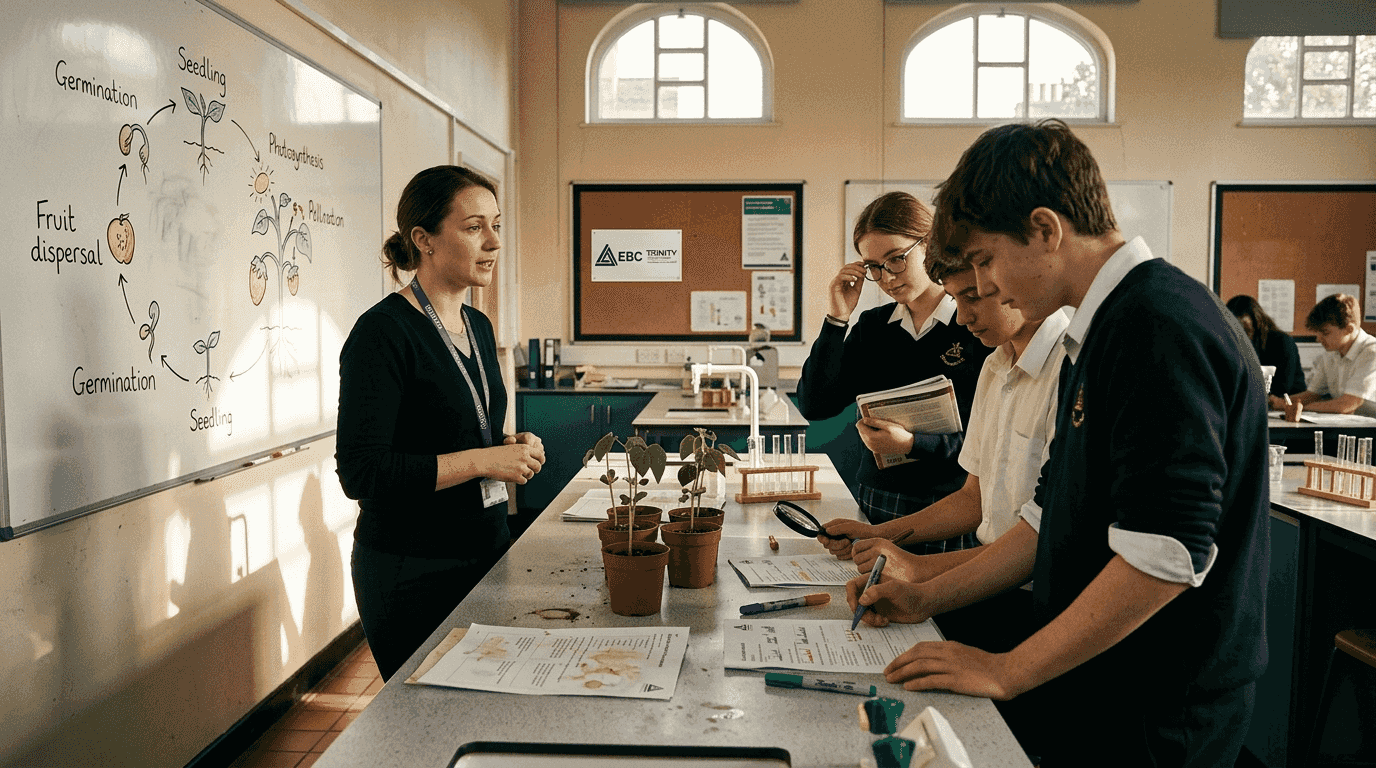
Science lessons lend themselves naturally to CLIL approaches. When teaching plant life cycles, students label diagrams using scientific terminology, then role-play different stages explaining transformations. They might create posters showing seed to flower development, writing explanatory captions using sequence markers like first, then, finally. This builds both botanical understanding and procedural language skills.
History lessons offer rich opportunities for language development through content. Exploring historical events, students create timelines whilst practising past tenses and time expressions. They might research key figures, then present findings using biographical language. Discussing causes and consequences develops critical thinking alongside conjunctions and cohesive devices. Storytelling activities make historical content memorable whilst building narrative skills.
Mathematics in CLIL focuses on problem-solving language and mathematical discourse. Lessons on measurements involve practical activities like calculating classroom dimensions, developing vocabulary for units, operations, and comparisons. Data interpretation tasks combine chart reading with language for describing trends, making predictions, and justifying conclusions. Students explain their reasoning using because, therefore, and if…then structures.
Art lessons integrate visual literacy with descriptive and evaluative language. Students analyse artworks, developing vocabulary for colours, shapes, techniques, and emotions. They might compare different styles or periods, using comparative language and opinion expressions. Creating their own pieces provides opportunities to explain choices and processes, building both artistic and linguistic competence.
These examples show CLIL’s versatility across subjects. Enhanced language acquisition and content understanding occur simultaneously, with measurable gains in both areas. The key is selecting content-appropriate language objectives that genuinely support subject learning rather than feeling artificially imposed.
Comparing CLIL lesson approaches: collaboration, cognition and culture
Different CLIL approaches emphasise various aspects of the 4Cs framework, each offering distinct benefits for learners. Understanding these variations helps you select strategies matching your teaching context and student needs.
Collaborative learning places social interaction and communication at the centre. Pair and group work encourages students to negotiate meaning, explain concepts to peers, and solve problems together. This approach develops interpersonal skills alongside language fluency. Tasks might include jigsaw activities where students become experts on different aspects of a topic, then teach their knowledge to classmates. Collaborative approaches work particularly well with mixed-ability groups, as peer scaffolding supports struggling learners.
Cognition-focused lessons prioritise higher-order thinking skills. Students engage in analysis, evaluation, synthesis, and creativity rather than memorisation. They might compare alternative solutions to environmental problems, evaluate historical decisions, or design experiments testing hypotheses. These lessons develop academic language for reasoning, justification, and critique. Cognitive challenge engages learners intellectually whilst building sophisticated linguistic competence.
Culture-rich approaches embed cultural content throughout lessons, increasing relevance and motivation. Students explore how different cultures approach mathematical problems, examine art from various traditions, or compare geographical features across countries. Cultural integration helps learners see themselves in the curriculum whilst developing intercultural awareness. This approach particularly engages students from diverse backgrounds, validating their experiences and knowledge.
| Approach | Primary Focus | Best For | Language Development |
|---|---|---|---|
| Collaboration-centred | Social interaction and peer learning | Mixed-ability groups, communication skills | Conversational fluency, negotiation language |
| Cognition-focused | Critical thinking and problem-solving | Advanced learners, academic preparation | Academic discourse, reasoning language |
| Culture-rich | Intercultural awareness and relevance | Diverse classrooms, motivation building | Descriptive and comparative language |
| Mixed methods | Balanced integration of all 4Cs | Most contexts, comprehensive development | Full range of language skills |
Pro Tip: Blend approaches within units or lessons to address diverse learner needs. Start with collaborative activities to activate prior knowledge, move to cognition-focused tasks for deep learning, then incorporate cultural connections for relevance and reflection.
The 4Cs framework ensures balanced lesson design regardless of which element you emphasise. Even collaboration-centred lessons should include cognitive challenge and cultural awareness. The difference lies in which aspect drives your planning and provides the lesson’s organisational structure.
Choosing the right CLIL lesson approach for your teaching context
Selecting appropriate CLIL strategies requires analysing your specific teaching situation. Follow these steps to match approaches with your context and learners.
- Assess learner language levels and subject knowledge to define scaffolding requirements. Beginners need more visual support, simplified language, and structured interaction patterns. Advanced students can handle complex texts, abstract concepts, and open-ended tasks. Understanding your starting point determines how much support to build into lessons.
- Select lesson designs balancing content and language objectives explicitly. Write both types of learning outcomes clearly. For example, a science lesson might aim for students to understand photosynthesis (content) whilst using present simple to describe processes (language). Making objectives visible helps you plan activities serving both purposes.
- Incorporate collaborative activities and cultural elements fitting learner backgrounds. Choose grouping strategies matching your students’ collaborative skills. Include cultural content they can relate to whilst introducing new perspectives. Tasks should feel relevant to their lives and experiences.
- Plan metacognitive tasks developing cognition and critical thinking. Include opportunities for students to reflect on their learning, explain their reasoning, and evaluate their understanding. Ask them to compare, analyse, justify, and create rather than simply recall. These higher-order tasks develop both thinking skills and academic language.
- Seek professional CLIL training for confidence and competence. Teacher training proves crucial for effective implementation. Certified programmes provide theoretical grounding, practical techniques, and ongoing support that dramatically improve lesson quality and student outcomes.
Research demonstrates that teachers receiving CLIL training report significantly higher student engagement, improved learning outcomes, and greater confidence in balancing content and language objectives compared to untrained colleagues.
Your teaching context, including class size, available resources, curriculum requirements, and institutional support, shapes which approaches work best. Be prepared to adapt and experiment. What succeeds in one setting may need modification elsewhere. Regular reflection on what works helps you refine your practice over time.
Explore accredited CLIL and TEFL courses with EBC
Developing expertise in CLIL methodology transforms your teaching effectiveness and career opportunities. EBC offers globally recognised programmes combining accredited CLIL training with comprehensive certification to teach English abroad.
Our Trinity College London accredited courses provide the practical skills and theoretical knowledge you need to design and deliver outstanding CLIL lessons. You’ll learn from experienced trainers, gain hands-on teaching practice, and join a global network of certified educators. With specialised pathways including CLIL, Business English, and Online Teaching, EBC prepares you for diverse teaching contexts worldwide. Our lifetime job placement support ensures you find rewarding opportunities matching your qualifications and aspirations. Whether you’re starting your teaching journey or advancing your expertise, EBC’s TEFL programmes offer the professional development you need to succeed in international education.
Frequently asked questions
What exactly are CLIL lessons?
CLIL lessons integrate subject content teaching with foreign language learning, using the target language as the medium of instruction for non-language subjects. Students simultaneously develop content knowledge in areas like science, history, or geography whilst improving language skills naturally through meaningful context.
Which subjects work best for CLIL approaches?
Almost any subject suits CLIL methodology, though science, geography, history, and mathematics prove particularly effective. These subjects offer rich vocabulary, clear concepts, and authentic language use opportunities. The key is selecting content appropriate for learners’ cognitive development and language levels.
How do you balance language and content objectives in lessons?
Effective CLIL requires explicitly planning both types of objectives before designing activities. Identify essential content-obligatory language students must learn, then add content-compatible language offering broader development opportunities. Design tasks serving both purposes simultaneously, like describing experimental results or comparing historical periods.
What challenges do teachers face with CLIL and how does training help?
Teachers often struggle balancing content depth with language accessibility, assessing both dimensions, and managing diverse proficiency levels. Professional training provides practical strategies for scaffolding, explicit language instruction within content lessons, and assessment techniques measuring integrated learning. Trained teachers report greater confidence and more successful student outcomes.
How does CLIL impact learner outcomes and engagement?
Research shows CLIL students demonstrate enhanced language proficiency, deeper content understanding, and improved critical thinking skills compared to traditional instruction. The meaningful context increases motivation, as learners see immediate purpose for language development. Cultural integration and collaborative activities further boost engagement and intercultural competence.
