
Key Points
- Business English TEFL focuses on professional communication skills for corporate learners worldwide.
- Certified courses and real-world teaching practice are essential to start and succeed.
- Building trust and understanding learners’ goals lead to effective, engaging lessons and career growth.
Teaching English to professionals around the world is one of the most rewarding career paths available to TEFL-qualified teachers today. Yet many aspiring teachers feel uncertain about where to begin, particularly when it comes to specialising in Business English. This guide walks you through everything you need to know: what Business English TEFL actually involves, the qualifications and materials you will need, the steps to launch your career, and the common mistakes to avoid. Whether you are just starting out or ready to take your next professional step, this is your practical starting point.
Table of Contents
- Understanding Business English TEFL and why it’s in demand
- What you need before you start: certifications, skills, and materials
- Step-by-step: how to start teaching Business English with TEFL
- Common pitfalls and tips for new Business English TEFL teachers
- What success looks like: measuring progress and professional opportunities
- What most new TEFL teachers miss about Business English success
- Advance your Business English TEFL journey with accredited support
- Frequently asked questions
Key Takeaways
| Point | Details |
|---|---|
| Global demand | Business English TEFL is in high demand and unlocks international teaching careers. |
| Right certification | Earning an accredited TEFL or TESOL certificate is essential for job prospects. |
| Clear preparation | Having the right skills and materials sets you up for successful lessons. |
| Practical steps | Following structured steps from training to job applications streamlines your start. |
| Ongoing development | Continuous learning and using diverse resources strengthen your effectiveness as a teacher. |
Understanding Business English TEFL and why it’s in demand
Business English TEFL is the practice of teaching English specifically for professional and corporate settings. Unlike general English, which covers everyday communication, Business English focuses on the language skills that working professionals need: writing formal emails, presenting data, negotiating contracts, participating in meetings, and building cross-cultural professional relationships.
The learners you will teach in this specialism are not schoolchildren. They are corporate employees, senior managers, human resources professionals, engineers, and executives. Many of them already speak English at an intermediate level but need targeted support to perform confidently in global business environments. This creates a very specific teaching challenge and a very specific opportunity.
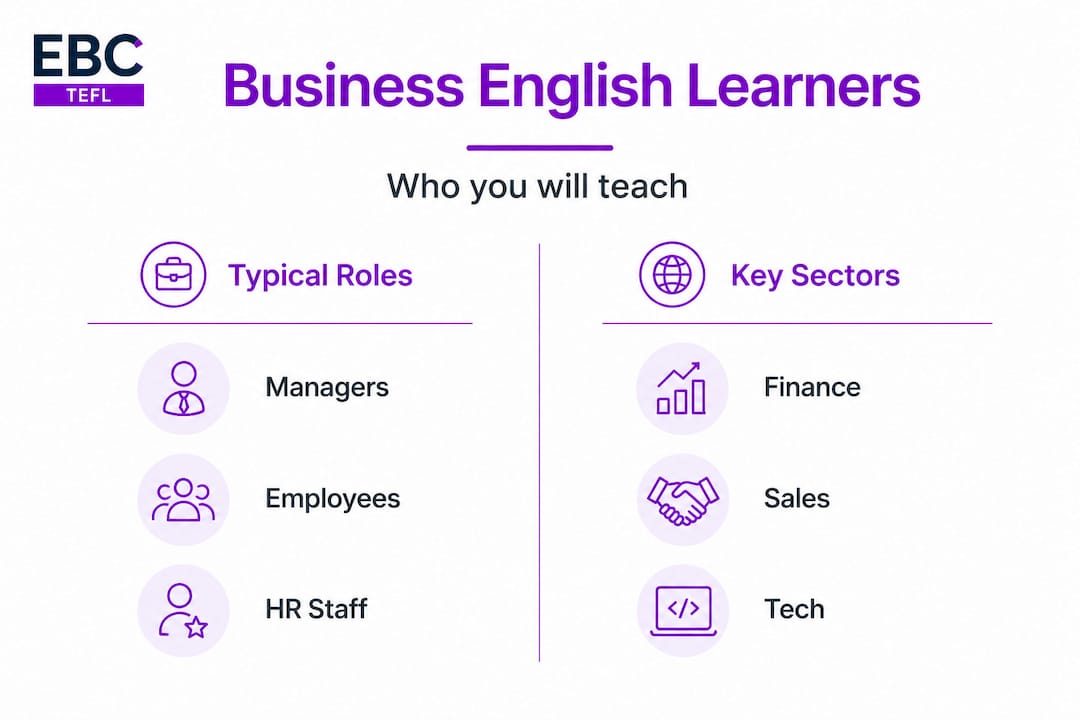
As a global TEFL guide from EBC TEFL notes, Business English is a rapidly growing niche within TEFL, opening more job opportunities worldwide. That growth is being driven by globalisation, international trade, and the increasing demand for English as the language of business across Europe, Asia, Latin America, and beyond.
Why does this matter for you as a teacher? Several reasons:
- Higher earning potential: Business English teachers typically command better hourly rates than general English teachers because their learners are often funded by employers.
- Greater job security: Corporate clients tend to book consistent, long-term training programmes rather than occasional lessons.
- Professional relevance: Working with adult professionals keeps your teaching grounded in real-world outcomes.
- Global reach: Business English teaching roles exist in virtually every country with a growing economy.
“Business English is not just about vocabulary lists. It’s about helping professionals think, communicate, and lead in a second language — that’s a genuinely skilled role.”
This is a specialism that respects both your skills and your time. It is also one that rewards preparation and ongoing professional development, which we will address in the sections that follow.
What you need before you start: certifications, skills, and materials
Before you teach your first Business English lesson, there are several things you need to have in place. Skipping these steps can cost you opportunities and undermine your confidence in the classroom.
Certifications
Internationally recognised TEFL or TESOL certificates are favoured by employers across the globe. At a minimum, you will need a foundational TEFL or TESOL qualification. For Business English specifically, a specialist certification is a significant advantage. EBC TEFL offers a dedicated Business English teaching course as part of its suite of Trinity College London accredited programmes, giving you credibility with corporate clients from day one.
| Requirement | What it involves | Where to obtain it |
|---|---|---|
| TEFL or TESOL certificate | Core teaching methodology and practice | EBC TEFL, Trinity CertTESOL |
| Business English specialisation | Corporate language, needs analysis, ESP | EBC TEFL Business English course |
| Intercultural communication skills | Understanding cultural business norms | TEFL training and self-study |
| Lesson planning ability | Structuring lessons for adult learners | Training course + practice |
| Business vocabulary knowledge | Industry-specific terms and registers | Reference books, online platforms |
Core skills you need to develop
You do not need to be a business expert to teach Business English. However, you do need to understand how businesses operate and what your learners actually need. These are the key skills to build:
- Conducting a needs analysis: identifying what your student wants to achieve
- Adapting lessons to specific industries, such as finance, law, or technology
- Teaching professional communication: presentations, reports, meetings, negotiations
- Managing adult learners who may have busy schedules and high expectations
- Being confident using digital tools and online teaching platforms
Recommended materials
Building a solid library of teaching resources from the start will save you considerable time. Look for materials that reflect real business situations rather than generic English exercises. The expert tips for teaching Business English on the EBC TEFL website are a strong starting point, and you can also access a wide range of free TEFL resources to supplement your paid materials.

Pro Tip: Applying early for an accredited Business English TEFL course gives you access to teaching materials, mentor feedback, and job placement support that significantly fast-tracks your hiring options. Many top corporate clients only work with teachers from recognised training providers.
Step-by-step: how to start teaching Business English with TEFL
Now that you understand the requirements, here is the practical sequence for launching your Business English TEFL career. As EBC TEFL highlights, enrolling in an accredited course and building practical experience are key to landing Business English teaching jobs.
Choose an accredited TEFL or TESOL programme. Your first step is selecting a course that is internationally recognised. Trinity College London accreditation, offered through EBC TEFL, is highly respected by employers globally. This is your professional foundation.
Add a Business English specialisation. Once you have your core certification, enrol in a dedicated Business English module or course. This will teach you how to deliver needs-based lessons, use authentic business materials, and assess professional language skills.
Practise your teaching in realistic contexts. Many training programmes include observed teaching practice. Take this seriously. The more time you spend teaching real learners under expert supervision, the more confident and effective you will become.
Build a portfolio of lesson plans. Employers and corporate clients want evidence of your teaching approach. Create a folder of well-structured Business English lesson plans covering meetings, presentations, email writing, and negotiations.
Apply for roles strategically. Look for positions with language schools that serve corporate clients, in-house language training departments at international companies, and online teaching platforms that focus on professionals. The step-by-step Business English TEFL guidance on the EBC TEFL website gives you a detailed breakdown of this process.
Leverage job placement support. EBC TEFL offers free lifetime job placement assistance to graduates. Use this from the moment you complete your course. Connecting with the EBC network gives you access to opportunities across Europe, Asia, and beyond.
Online vs. in-person Business English teaching
| Factor | Online teaching | In-person teaching |
|---|---|---|
| Flexibility | High: set your own schedule | Lower: tied to client location |
| Earning potential | Moderate to high | High, especially in major cities |
| Professional development | Requires self-discipline | Natural mentoring opportunities |
| Equipment needed | Computer, headset, stable internet | Minimal |
| Student base | Global | Local or regional |
| Suitability for beginners | Yes, with the right platform | Yes, with institutional support |
Both paths are genuinely viable. Many experienced Business English teachers do both. Starting online is often easier for new teachers because it reduces logistical pressure and lets you focus on developing your teaching examples and classroom presence.
Pro Tip: Record one of your early online lessons with your student’s permission. Watching it back is one of the fastest ways to spot what you are doing well and where you can improve. It builds classroom confidence far more quickly than reading about teaching theory.
Common pitfalls and tips for new Business English TEFL teachers
Even well-prepared teachers make avoidable mistakes in their first Business English roles. Knowing what to watch out for gives you a head start.
Mistakes that hold new teachers back
- Underpreparing for the business context. Walking into a lesson about negotiation without understanding how negotiations actually work in business is immediately noticeable to professional learners. Do your research before each lesson.
- Treating it like general English teaching. Business English learners have specific goals and limited time. A lesson on past tense grammar is rarely what they need. Every lesson should connect directly to a professional outcome.
- Ignoring individual learning goals. Not every business professional needs the same skills. A marketing manager needs very different English from an accountant. Conduct a needs analysis before you plan a single lesson.
- Neglecting professional rapport. Your learners are adults with careers and expertise. Treat them as partners in the learning process, not students in a traditional classroom sense. Mutual respect drives engagement.
- Failing to adapt when lessons go off-track. Adult learners often raise unexpected topics or questions. Rigid adherence to a plan can frustrate them. Build flexibility into every session.
Practical tips for building engagement
- Use authentic business materials: real emails, news articles, company reports, and video presentations
- Incorporate role play for meetings, calls, and negotiations
- Set clear lesson objectives at the start of every class
- Invite learners to bring their own workplace challenges to the lesson
- Consistently check understanding without making learners feel embarrassed
“Don’t hesitate to learn from peers and make use of reputable tools — ongoing development is not optional in Business English TEFL, it’s the mark of a serious professional.”
As EBC TEFL confirms, accessing free resources and learning from experienced teachers accelerates professional growth significantly. Read the essential tips for aspiring tutors and explore digital resources that make your classes more efficient and engaging. Seek out a mentor, join TEFL communities online, and never stop refining your craft.
What success looks like: measuring progress and professional opportunities
How do you know your Business English teaching is working? And what does the road ahead look like once you gain experience? These are important questions to consider early in your career.
Early markers of progress
- Positive learner feedback: your students tell you they are more confident in meetings or emails
- Improved engagement: learners arrive prepared and participate actively
- Repeat bookings: corporate clients re-engage you for further courses
- Growing referrals: satisfied learners recommend you to colleagues
- Stronger lesson plans: your preparation time decreases as your experience increases
Where Business English TEFL can take you
The career trajectory for a skilled Business English teacher is genuinely impressive. International teaching credentials open opportunities for higher-salary, in-demand positions in a market that spans every continent. Consider these directions:
- Corporate training contracts: Long-term, well-paid agreements with multinational companies
- Language school management: Moving into director of studies or curriculum development roles
- Online platform teaching: Building a student base on professional English platforms
- Freelance consulting: Developing bespoke training programmes for industries such as finance or law
- Working abroad programmes: EBC TEFL’s one-year programmes in Spain, France, and Italy combine teaching with language study and cultural immersion, offering a genuinely enriching professional pathway
You can explore the full scope of what this specialism offers through the business teaching guide on the EBC TEFL website. The global demand for English in professional settings shows no sign of slowing. With over 1 billion people learning English worldwide, the need for qualified, specialist Business English teachers is genuinely vast.
What most new TEFL teachers miss about Business English success
Most new Business English TEFL teachers focus heavily on grammar delivery. They plan lessons around tense structures, vocabulary lists, and textbook exercises. That is understandable, particularly when you are just starting out and looking for something concrete to anchor your lessons.
But here is the honest truth: grammar is rarely the obstacle for your typical Business English learner. They already know the grammar. What they struggle with is confidence, register, and context. They cannot hold their own in a boardroom discussion. They freeze when asked to chair a meeting in English. They write emails that come across as blunt or overly formal because they do not understand the subtle conventions of professional English communication.
The teachers who succeed in this specialism are those who listen first. They use needs analysis not as a tick-box exercise but as a genuine conversation about what the learner is trying to achieve in their career. They adapt their teaching to the learner’s industry, their workplace culture, and their specific communication gaps.
Building authentic professional relationships with your students is, in our view, as important as any lesson plan you will ever write. When a learner trusts you as a professional ally rather than just a teacher, they open up about their real challenges. That transparency transforms your lessons from generic to genuinely useful.
The TEFL certificate guide for Business English covers the foundational skills in depth, but the real differentiator is the human quality you bring to each session. Curiosity about your learner’s world, patience with their progress, and a genuine interest in their professional success will set you apart far more reliably than any particular teaching technique.
Advance your Business English TEFL journey with accredited support
Starting a Business English TEFL career is achievable, genuinely rewarding, and globally in demand. The key is taking the right steps from the beginning, with accredited qualifications and practical experience that employers actually respect.
At EBC TEFL, we support teachers at every stage of this journey. From your introduction to TEFL through to Trinity College London international certification courses and specialist Business English training, our globally recognised programmes are designed to get you into the classroom with confidence. We also offer free lifetime job placement support, one-year study and work abroad programmes in Spain, France, and Italy, and a network of teachers working across the world. Explore our TESOL certification steps or book a free consultation with our team today to discuss your next step.
Frequently asked questions
What is Business English TEFL and who should take it?
Business English TEFL trains teachers to help professionals communicate in corporate settings. It is ideal for those targeting business learners globally in companies, international organisations, or online professional platforms.
Do I need prior teaching experience for Business English TEFL?
No prior experience is required, but having an internationally recognised TEFL or TESOL certificate and a genuine interest in business communication will significantly strengthen your prospects with employers.
What kind of jobs can I get after Business English TEFL?
Graduates can teach corporate clients directly, work for international language training providers, or teach online to professionals worldwide. International teaching credentials open access to higher-salary roles across many sectors.
Are there resources for lesson planning and teaching Business English?
Yes. Many training providers and TEFL platforms offer free materials, example lessons, and digital tools. Accessing free resources early in your career and learning from experienced mentors significantly accelerates your professional development.
How can I make my Business English classes engaging for adults?
Focus every lesson on real business scenarios that are directly relevant to your learner’s workplace. Encourage participation through role play, discussion of authentic materials, and regular goal-setting aligned to their professional objectives.