
Key Points
- Becoming an English teacher in Spain requires a recognized qualification, a valid visa, and financial preparation of at least €1,500 before arrival.
- Certifications like Trinity CertTESOL and TEFL open doors at language schools and international institutions, and visa options depend on nationality and program type.
Becoming an English teacher in Spain requires a recognised qualification, a clear understanding of your visa options, and practical preparation for daily life in a country where culture shapes your working routine as much as any contract does. Whether you are a recent graduate, a career changer, or someone looking to build a global teaching career across Spain, France, Italy, or beyond, this guide covers every step you need to take.
How to be an English teacher in Spain: qualifications and certifications
Spain does not impose a single mandatory teaching licence on all English teachers, but the qualifications you hold determine which doors open and which stay closed.
Private language academies and international schools operate under different expectations. Most language centres prefer candidates who hold a TEFL, TESOL, or Trinity CertTESOL qualification alongside their degree. International schools typically require a full teaching licence from your home country, plus relevant classroom experience. The gap between “technically allowed” and “genuinely competitive” is where certification earns its value.
The table below summarises the main certification routes and their practical weight in the Spanish job market.
| Certification | Awarding body | Recognition in Spain | Best suited for |
|---|---|---|---|
| Trinity CertTESOL | Trinity College London | High, internationally recognised | Language academies, global teaching careers |
| TEFL (120-hour) | Various providers | Moderate, widely accepted | Entry-level roles, language centres |
| CELTA | Cambridge Assessment English | High, widely recognised | Academies, international schools |
| Bachelor’s degree only | University | Limited academy acceptance | Academies that are less choosy |
| Trinity CertPT | Trinity College London | High, specialist recognition | Primary and young learner teaching |
The Trinity CertTESOL, accredited by Trinity College London, carries particular weight because it is recognised by employers across Europe, Latin America, Asia, and beyond. This matters if Spain is your first posting rather than your only one. A qualification that travels with you is worth more than one that works only in a single market.
Pro Tip: Choose a certification accredited by an internationally recognised body such as Trinity College London. Employers in Spain and globally can verify the credential independently, which accelerates hiring decisions.
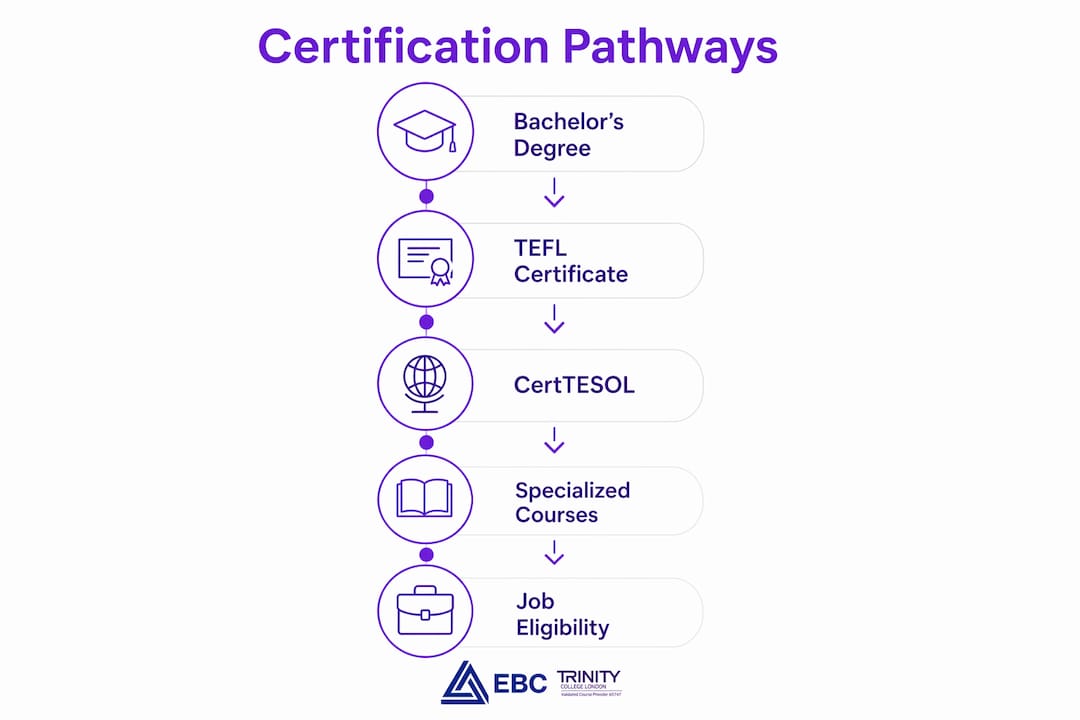
You can explore the basics of teaching in Spain to understand which certifications align best with specific roles before you apply.
What visa and work permit options exist for English teachers in Spain?
Legal permission to work in Spain is non-negotiable, and the route you take depends on your nationality, your programme type, and your long-term plans. EU and EEA citizens have the right to live and work in Spain without a separate visa. Non-EU citizens face a more structured process, and the options vary significantly.

The EBC Road2Spain programme allows non-EU participants to live and work on a student visa. Visa sponsorship is rare among private language centres, which means most non-EU teachers either enter through a programme like EBC’s Road2Spain or arrange their own visa before seeking private work.
Key documents typically required for a Spanish student or work visa application include:
- Valid passport with at least six months’ remaining validity
- Proof of enrolment in an approved programme or a signed employment contract
- Criminal background check from your home country, apostilled
- Medical certificate confirming good health
- Proof of sufficient funds to support yourself on arrival
- Completed visa application form and passport photographs
Timelines vary by consulate and nationality, but applications commonly take between four and twelve weeks. Start the process early. Delays at the consulate stage are common, and missing a programme start date due to late paperwork is an avoidable setback.
Pro Tip: Never pay a deposit on a flat or commit to a lease start date until your visa is confirmed. Visa processing timelines are unpredictable, and financial commitments made too early create unnecessary pressure.
Where and how can you find English teaching jobs in Spain?
The Spanish English teaching job market divides into three broad sectors: government language assistant programmes, private language academies, and international schools. Each offers a different balance of stability, income, and professional development.
Private language academies are the largest employer of English teachers in Spain. That concentration is heaviest in the capital, and our guide to teaching English in Madrid specifically breaks down academy salaries, visa routes, and hiring timelines for the city. They typically require an EU work permit or visa and prefer native or near-native speakers with a teaching licence or TEFL qualification. Contracts range from full-time salaried positions to hourly arrangements, and the quality of academies varies considerably. Research individual schools before signing anything.
For private tutoring, platforms like Lingobongo and TusClasesParticulares are the most widely used tools for connecting with individual students. Tutoring income helps offset the modest stipends from school-based roles and gives you direct control over your schedule and rates.
| Teaching setting | Typical hours | Income range | Key requirement |
|---|---|---|---|
| Semi-private “Concertado” school | 20–25 hrs/week | €1,500–€2,000/month | TEFL/TESOL + student visa |
| Private language academy | 20–25 hrs/week | €1,200–€2,000/month | TEFL/TESOL + student visa |
| International school | Full-time | €1,500–€2,500/month | Teaching licence + degree + visa or degree + TEFL/TESOL + student visa |
| Private tutoring | Flexible | €15–€40/hour | TEFL/TESOL + student visa |
If you are considering international schools specifically, the application process for international schools in Spain involves submitting credentials well in advance of the academic year, often by February or March for September starts.
Pro Tip: Cluster your private tutoring clients geographically. Travelling across a city between lessons wastes time and money. Targeting one neighbourhood or district makes your schedule far more manageable.
Practical relocation: living costs, housing, and daily life in Spain
Life as an English teacher in Spain is genuinely rewarding, but financial planning before you arrive is what separates a smooth transition from a stressful one. Rent in shared flats averages €250 to €350 per month outside city centres, but central apartments in Madrid or Barcelona cost considerably more and can consume half a teacher’s monthly stipend without supplementary income.
Arriving with at least €1,500 in reserve is strongly recommended to cover deposits, first and last month’s rent, and initial living expenses before your first stipend arrives. This is not a luxury buffer. It is a practical minimum for avoiding financial stress in your first weeks.
Spanish cultural rhythms shape your working day in ways that surprise most new arrivals. Lunch often runs for two hours, socialising after meals (known as sobremesa) is a genuine social institution, and the working day often extends into the evening as a result. Long-term expats consistently report that embracing these social habits improves both job satisfaction and professional networking. Treating the siesta hour as dead time is a missed opportunity.
Practical tips for your first weeks in Spain:
- Join local Facebook groups for expat teachers in your city to find flat shares and social events
- Never pay a deposit without receiving keys and a signed contract
- For stays over one year, always sign a formal rental contract regardless of what a landlord suggests
- Use mid-day breaks for lesson planning, professional development, or building local connections
- Register with your local town hall (empadronamiento) as soon as possible, as this is required for many administrative processes
Pro Tip: Facebook groups featuring city pages are among the fastest ways to find flat shares and connect with other teachers before you even land. Many teachers secure housing before arrival this way.
How to build your employability and thrive as a teacher in Spain
Certification gets you through the door. What keeps you employed and opens better opportunities is a combination of professional development, cultural intelligence, and flexibility. Teachers with fragmented schedules who plan their days deliberately, clustering tutoring sessions and using mid-day breaks productively, consistently report better work-life balance and higher overall income.
Specialised qualifications add measurable value to your profile. Courses in Business English, CLIL (Content and Language Integrated Learning), and online teaching are in growing demand across Spain and globally. These are not just additions to a CV. They signal to employers that you can serve specific learner groups and adapt to different teaching contexts.
The skills that make you a stronger candidate in Spain also transfer directly to teaching markets in France, Italy, Latin America, Asia, and beyond. Ebcteflcourse operates globally, and the teachers who build the broadest skill sets are the ones who access the widest range of opportunities. A Trinity CertTESOL combined with a CLIL or Business English specialisation positions you for roles that a standard TEFL certificate alone cannot reach.
Key areas to develop for long-term teaching success:
- Continuous professional development through bodies such as IATEFL{target=“_blank”} or TESOL International{target=“_blank”}
- Understanding of different learner needs, from young learners to adult business professionals
- Flexibility in contract types, including part-time, freelance, and online teaching
- Cultural sensitivity and genuine engagement with the local community
- Networking with other teachers through professional associations and local groups
You can find detailed professional advice in Ebcteflcourse’s three tips for teaching in Spain to sharpen your approach before your first placement.
Start your teaching career with internationally recognised certification
Ebcteflcourse offers Trinity College London accredited TEFL and TESOL certification programmes designed for teachers who want to work in Spain and across the globe. The Trinity CertTESOL certification is recognised by employers in Europe, Asia, Latin America, and beyond, giving you a credential that works wherever your career takes you.
Ebcteflcourse also offers one-year study and work abroad programmes in Spain, France, and Italy, combining accredited teacher training, language study, visa support, and part-time teaching opportunities in a single structured programme. Free lifetime job placement support is included with every course, meaning the relationship does not end when you qualify. Whether you are ready to apply or still weighing your options, book a free consultation with the Ebcteflcourse team to discuss the right certification pathway for your goals. You can also explore the TEFL job placement process to understand exactly how support works after you certify.
Key takeaways
Teaching English in Spain requires a recognised qualification, a valid visa route, and financial preparation of at least €1,500 before arrival to cover housing deposits and initial costs.
| Point | Details |
|---|---|
| Certification matters | Trinity CertTESOL and TEFL qualifications open doors at language academies and international schools. |
| Visa route depends on nationality | Non-EU teachers use a programme like EBC’s Road2Spain to get a student visa. |
| Get TEFL Certified before you arrive | Take your Trinity CertTESOL before you arrive so you can immediately start looking for work when you get here. |
| Financial preparation is non-negotiable | Arrive with at least €2,000 in reserve to cover initial expenses. |
| Cultural integration improves outcomes | Embracing Spanish social rhythms such as sobremesa and extended lunches strengthens professional networks. |
FAQ
What qualifications do I need to teach English in Spain?
Private language academies and international schools, a TEFL, TESOL, or Trinity CertTESOL qualification is expected alongside your degree.
Can non-EU citizens teach English in Spain legally?
Yes if they use a one-year study programme like EBC’s Road2Spain.
How much do English teachers earn in Spain?
You can earn between €1,200 and €2,000 working 20 to 30 hours a week.
How do I find housing as a new teacher in Spain?
Joining expat teacher Facebook groups before arrival is one of the most reliable ways to find flat shares. Always sign a formal rental contract and never pay a deposit without receiving keys.
Is a TEFL qualification recognised outside Spain?
A Trinity CertTESOL or accredited TEFL qualification is recognised by employers across Europe, Latin America, Asia, and beyond. Choosing an internationally accredited certification from the outset means your qualification supports your career wherever you choose to teach next.