
Key Points
- Choosing a recognized accreditation like Trinity CertTESOL or CELTA ensures global recognition for your qualification. Practical, assessed teaching hours are crucial as they demonstrate real classroom experience that employers value highly. Carefully select a course with the right format and specialisation aligned with your career goals to maximize employability worldwide.
Choosing a TESOL qualification is one of the most consequential decisions you will make before teaching English abroad. The market is crowded with options ranging from weekend certificates to internationally accredited programmes, and the differences between them are not always obvious. Knowing how to choose the right TESOL course before you commit your time and money can be the difference between walking confidently into a classroom in Tokyo, Madrid, or Nairobi and struggling to get an interview. This guide covers accreditation, course formats, specialisations, and career impact so you have everything you need to decide with clarity.
Table of Contents
- Key takeaways
- How to choose the right TESOL course: formats and duration
- Why accreditation defines your career ceiling
- How to choose a TESOL specialisation for your career goals
- TESOL courses and global employability
- My honest take on choosing a TESOL course
- Start your TESOL career with the right foundation
- FAQ
Key takeaways
| Point | Details |
|---|---|
| Accreditation is non-negotiable | Courses accredited by Trinity College London or Cambridge Assessment English carry genuine global recognition. |
| Practical teaching hours matter most | Employers prioritise candidates who have completed assessed, observed teaching practice during their training. |
| Specialisation sharpens your prospects | Selecting a TESOL specialisation aligned with your target context, such as Business English or Young Learners, strengthens your job applications. |
| Course format affects readiness | Blended and in-person courses with live teaching components prepare you more thoroughly than purely theoretical online programmes. |
| Career support extends your investment | Job placement assistance and global networks compound the value of your certification long after you graduate. |
How to choose the right TESOL course: formats and duration
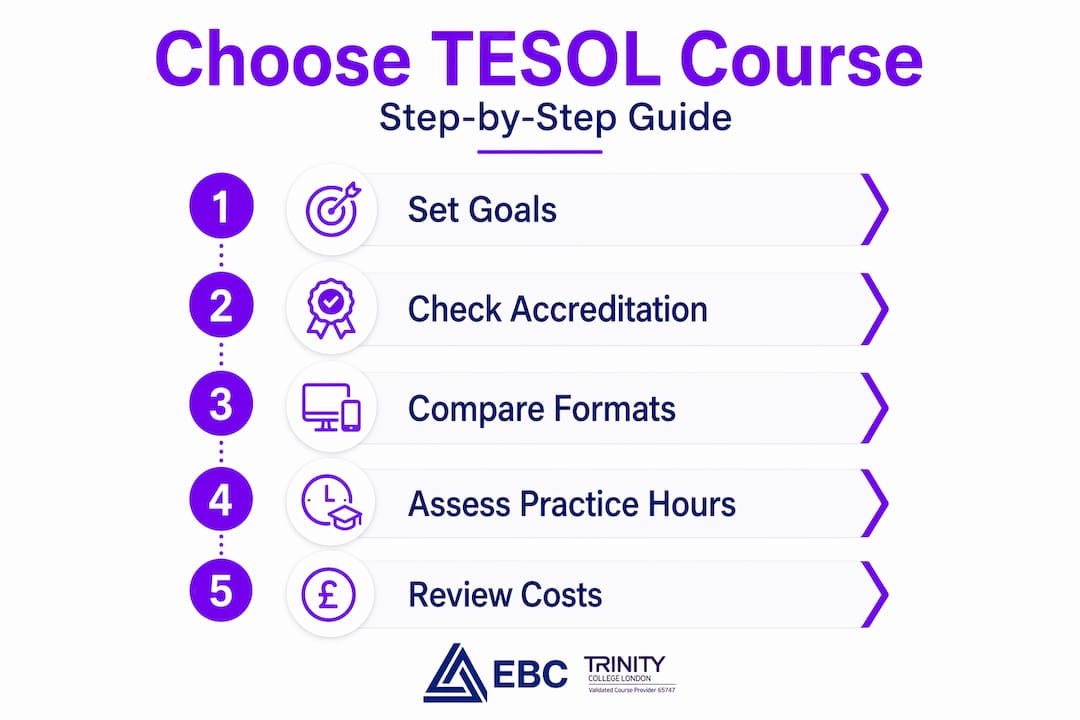
Before you compare prices or destinations, you need to understand what the different course formats actually deliver. Not all TESOL courses are built the same way, and the structure you choose will shape both your learning experience and how employers perceive your qualification.
Full-time intensive courses are typically delivered over four to five weeks and require your complete focus. They are demanding but highly efficient. You build skills rapidly, receive consistent feedback, and complete your teaching practice in a concentrated block. These courses suit candidates who want to qualify quickly and move into work without delay.
Part-time courses spread the same content over several months, usually through evening or weekend sessions. They work well if you are currently employed and cannot take time away. The trade-off is pace. Progress feels slower, and maintaining momentum over months requires genuine commitment.
When it comes to delivery mode, you have three main options:
- In-person: You attend a physical training centre, teach real students under trainer observation, and receive immediate, face-to-face feedback. This format produces the strongest foundation for new teachers.
- Online with live teaching practice: Since 2020, many courses deliver online teaching practice through video conferencing, maintaining the assessed component that quality demands.
- Blended: A combination of online study and in-person or observed teaching sessions. This format offers flexibility without sacrificing the practical component.
What you should never accept is a course that is purely self-paced with no assessed teaching whatsoever. Non-accredited theoretical courses consistently show weaker outcomes in teacher confidence and classroom readiness.
Pro Tip: Ask any course provider directly how many hours of observed, assessed teaching practice are included. If they cannot give you a clear number, treat that as a warning sign.
Most quality TESOL programmes require a minimum of 120 contact hours. Within that, the assessed teaching practice component is what separates a credential that opens doors from one that simply fills space on a CV.
Why accreditation defines your career ceiling
Accreditation is the single most important factor in a TESOL course comparison, yet it is also the most misunderstood. Many providers use phrases like “internationally recognised” or “globally accepted” without any third-party body backing those claims. You need to look past marketing language and identify the actual accrediting organisation.

The two most widely respected bodies in the industry are Trinity College London and Cambridge Assessment English. Courses accredited by these bodies maintain standards that align with what international schools, language academies, and government programmes actually expect from qualified teachers.
Here is how the main qualifications compare at entry level:
| Qualification | Awarding body | Teaching practice | Global recognition |
|---|---|---|---|
| Trinity CertTESOL | Trinity College London | Minimum 6 assessed hours | High, recognised worldwide |
| CELTA | Cambridge Assessment English | Minimum 6 assessed hours | High, recognised worldwide |
| Generic TESOL certificate | Varies or none | Often none or unassessed | Limited, employer-dependent |
Both the Trinity CertTESOL and CELTA sit at the same level and carry comparable weight with employers. The practical teaching component is what they share, and it is what makes them stand apart from generic certificates. You can explore the specific differences between them to decide which programme structure suits you better.
For candidates with existing teaching experience, more advanced qualifications such as the Delta become relevant. Matching your qualification level to your experience is sound practice and supports proper career progression rather than repeating ground you have already covered.
Pro Tip: Check whether the accrediting body is the same one issuing your certificate or simply “approving” the course. Trinity College London and Cambridge Assessment English issue the certificate directly. That distinction matters to employers.
Candidates entering these programmes typically need English language skills at CEFR C1 level or equivalent. If you are uncertain about your level, most accredited providers offer a pre-course assessment to help you prepare.
How to choose a TESOL specialisation for your career goals
Once you understand the core qualification landscape, the next question is whether to pursue a specialisation. Knowing how to choose a TESOL specialisation well can directly expand the range of roles available to you in specific teaching markets around the world.
Different TESOL specialisations cater to distinct teaching contexts, and each one draws a different kind of employer. The most common specialisations include:
- Business English: Prepares you to teach corporate clients, professionals, and executives. Strong demand in Europe, Latin America, and East Asia. Suits candidates with a professional or business background.
- Young Learners (CLIL or general): Focuses on age-appropriate methodology for children and teenagers. Content and Language Integrated Learning (CLIL) is particularly valued in European bilingual school programmes.
- Online Teaching: Equips you to design and deliver lessons in virtual environments. Demand has grown substantially and continues to expand globally.
- Communicative Language Teaching (CLT): A methodology-focused specialisation that deepens your understanding of how learners acquire language through communication. Useful across nearly every teaching context.
The most important question to ask yourself when deciding how to select a TESOL specialisation is: who do you want to teach, and where? If you are planning to work in a primary school in Spain or Italy on a one-year work programme, a Young Learners or CLIL qualification is directly relevant. If you intend to teach professionals in an Asian city, Business English training gives you a clear edge.
Consider also the curriculum structure of each specialisation. Look for courses that balance theory with practical application, include peer feedback, and provide assessed tasks tied to real teaching scenarios. A specialisation that only adds theory without changing how you teach is of limited value to a future employer.
TESOL courses and global employability
Choosing the right course is not just an academic decision. It has a direct and measurable impact on your career trajectory. Here is how to think about it systematically:
Accredited qualifications open international doors. Schools and language institutes in over 100 countries specifically request Trinity CertTESOL or CELTA-level qualifications. Without one, you are competing for a much smaller pool of positions, often with lower salaries and fewer protections.
Assessed teaching practice is what employers actually check. Practical teaching experience during training is what hiring managers ask about in interviews. They want to know how many hours you taught, what feedback you received, and how you responded to it. A certificate without that story is difficult to sell.
Specialisations align you with specific markets. If you add a Business English or CLIL specialisation to your core certificate, you become a credible candidate for roles that generalists cannot fill. That translates into better salaries and more stable contracts.
Continuous professional development compounds your value. The teachers who build lasting international careers do not stop learning after their initial certificate. Exploring the advantages of ongoing TESOL development gives you a clear view of why this matters at every career stage.
“The teachers who thrive long-term are not necessarily the most naturally gifted. They are the ones who invested in the right qualification first and kept developing from there.”
On the topic of visas and work permits: requirements vary significantly between countries and change regularly. Some destinations have formal pathways for English teachers, while others require additional documentation. Research the specific requirements for your target country thoroughly, and seek professional guidance where needed.
Affordable TESOL certification does not have to mean compromising on quality. Some of the most respected programmes are also accessible in terms of cost, particularly when you factor in lifetime job placement support and access to a global alumni network.
My honest take on choosing a TESOL course
I have seen hundreds of people go through this decision, and the pattern of mistakes is remarkably consistent.
The biggest one is treating price as the primary filter. I understand the logic. Affordable TESOL certification matters, and budgets are real constraints. But I have watched candidates spend a fraction of the cost on an unaccredited online certificate, only to spend double the time and money later trying to upgrade when they could not get hired in the schools they wanted. The maths rarely works out in favour of the cheap option.
The second mistake is undervaluing the teaching practice component. People read the hours and think, “six hours does not sound like much.” What they miss is that six hours of assessed, observed teaching with real students and qualified trainer feedback is genuinely transformative. It forces you to confront your assumptions about teaching, receive criticism in real time, and improve under pressure. That process builds confidence that theory alone simply cannot.
My third observation is that people pick specialisations based on what sounds interesting rather than what their target market actually needs. Interest matters, but it should be the second filter, not the first. Research the job boards for your target destination before you decide on a specialisation. What are schools asking for? That answer should shape your choice more than anything else.
What I find genuinely exciting about the current TESOL market is how global it has become. Strong accreditation paired with a well-chosen specialisation now gives you real mobility across continents. That is not marketing language. It is what the data from placement outcomes consistently shows.
Start your TESOL career with the right foundation
If you are ready to move from research to action, Ebcteflcourse offers Trinity CertTESOL certification programmes that meet the highest international standards, with practical teaching components and global job placement support included. Whether you are looking to teach in Europe, Asia, Latin America, or beyond, the pathways are there. Ebcteflcourse also offers one-year study and work programmes in Spain, France, and Italy, combining accredited teacher training with language study, cultural immersion, and part-time teaching experience. Free lifetime job placement assistance is available to all graduates. To explore which certification suits your goals and get personalised guidance, book a free consultation with the team today.
FAQ
What should I look for in a TESOL course?
Prioritise accreditation by a recognised body such as Trinity College London or Cambridge Assessment English, and confirm the course includes a minimum of six hours of assessed, observed teaching practice. These two factors are the strongest indicators of quality and employer recognition.
Is an accredited TESOL certificate really necessary?
Yes. Schools and language institutes worldwide, particularly in competitive markets, specifically request accredited qualifications. Generic or unaccredited certificates significantly limit the roles and salary levels available to you internationally.
How do I choose between the Trinity CertTESOL and CELTA?
Both are globally recognised entry-level qualifications with equivalent standing. The main differences lie in course structure, assessment style, and provider network. Reviewing a detailed qualification comparison will help you identify which format suits your learning style and schedule.
What TESOL specialisation should I choose?
Match your specialisation to your target teaching context. Business English suits corporate and professional settings; Young Learners or CLIL is valuable for school environments; Online Teaching is relevant for remote and digital platforms. Research job listings in your target destination before deciding.
Can I find affordable TESOL certification without sacrificing quality?
Yes, but you need to look carefully. Some accredited programmes are priced accessibly, especially when you account for lifetime job placement support and alumni networks. Avoid purely theoretical courses with no teaching practice, regardless of their price point, as the long-term career cost is higher.