
Key Points
- Trinity CertTESOL Accreditation ensures your TEFL qualification is recognised by employers worldwide.
- Most accredited courses require applicants to be 18 or older and demonstrate English proficiency.
- Enrolling in an approved study/work program includes visa support, teaching practice, and legal work rights.
Countless aspiring teachers dream of living and workimg abroad in Spain, France, Italy, and Asian countries, yet many stall at the very first hurdle: understanding which TEFL qualification actually counts. The market is flooded with cheap online certificates that look convincing but carry little weight with employers or immigration authorities. Choosing the wrong course can cost you months of effort and real money. This guide walks you through everything you need to know, from understanding accreditation to selecting the right course, meeting entry requirements, and navigating the enrolment process so you can launch a genuine teaching career in Europe.
Table of Contents
- Understanding accreditation and why it matters
- Requirements and prerequisites for enrolling in accredited TEFL courses
- Step-by-step guide to enrolling in an accredited TEFL course
- Top accredited TEFL courses for studying and working in Spain, France, and Italy
- What to expect after enrolment: jobs, study, and making the most of your accredited TEFL course
- Why getting an accredited TEFL isn’t just a box to tick
- Start your accredited TEFL journey with EBC
- Frequently asked questions
Key Takeaways
| Point | Details |
|---|---|
| Accreditation is vital | Only accredited TEFL courses guarantee job and visa recognition across Europe. |
| Courses suit diverse backgrounds | Both CELTA and Trinity CertTESOL accept a range of applicants, with or without teaching experience. |
| Student visas enhance flexibility | Enrolling through study/work packages allows up to 30 hours of work weekly in Spain, France, or Italy. |
| Compare before enrolling | Key differences like cost and teaching style can make one course a better fit for your goals. |
Understanding accreditation and why it matters
Accreditation is the formal process by which an independent body verifies that a course meets defined quality standards. In TEFL, this matters enormously. Not all certificates are equal, and the difference between an accredited and a non-accredited course can determine whether you get a job offer or a rejection, and whether your visa application succeeds or fails.
When employers in Spain, France, or Italy review your application, they look for qualifications from recognised awarding bodies. Immigration authorities do the same. A certificate from an unverified online provider rarely satisfies either requirement. You may complete the course, pay the fees, and still find yourself unable to work legally or secure a position at a reputable school.
So how do you spot a legitimate provider? Look for these markers:
- Awarding body: The qualification should be issued by a recognised institution such as Trinity College London or Cambridge Assessment English.
- Level of qualification: Reputable courses sit at Level 5 on the Regulated Qualifications Framework (RQF), equivalent to the first year of a university degree.
- Teaching practice hours: Accredited courses include observed teaching practice with real learners, not just theory modules.
- Employer recognition: Check that schools and language academies in your target country explicitly accept the qualification.
- Transparent assessment: Look for external moderation and standardised grading, not just internal marking.
The two gold standards in Europe are CELTA (Certificate in English Language Teaching to Adults) and Trinity CertTESOL (Certificate in Teaching English to Speakers of Other Languages). Both are Level 5 qualifications that are globally recognised and valued by employers across the continent.
“Choosing an accredited course is not simply about ticking a box. It is the foundation upon which your entire teaching career is built. Employers and visa officers see your qualification before they see you.”
Understanding the differences between TEFL certificates is an essential early step. You should also review what TESOL accreditation involves before committing to a provider, as the terminology can be confusing for first-time applicants.
Requirements and prerequisites for enrolling in accredited TEFL courses
Choosing an accredited course is only the first step. Understanding entry requirements ensures you approach the process fully prepared, without surprises that delay your application.
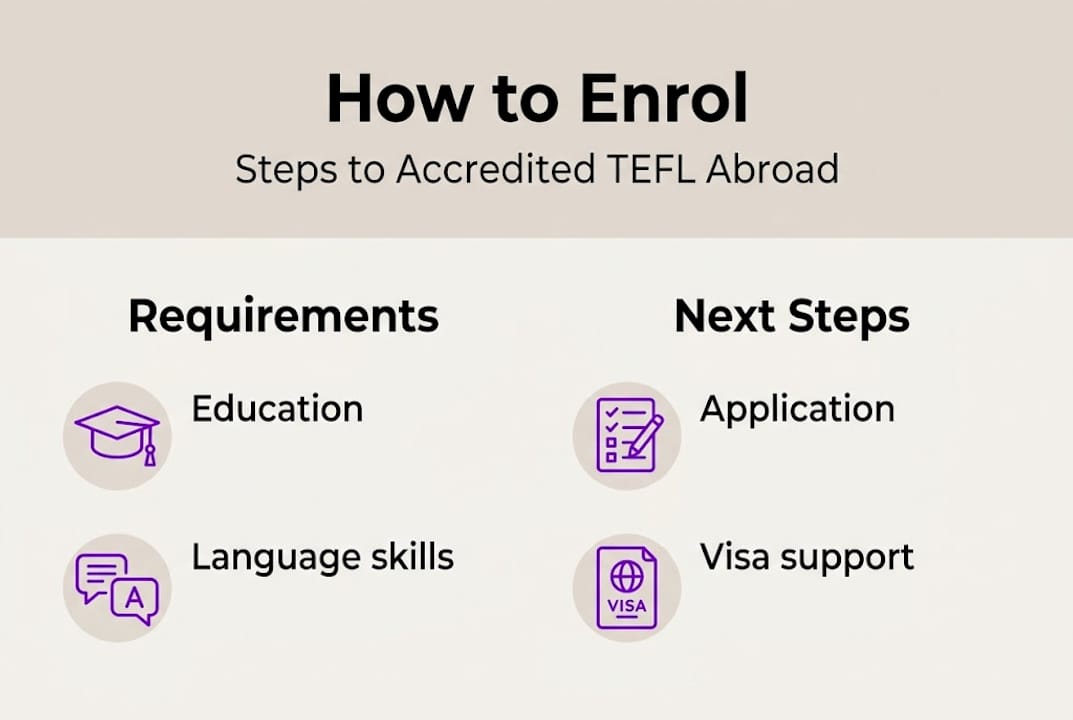
Most accredited TEFL courses share a core set of prerequisites. Here is what you typically need:
- Age: You must be at least 18 years old. There is no upper age limit.
- English proficiency: Native-level or near-native fluency is expected. Non-native speakers may need to demonstrate proficiency through a recognised test such as IELTS (International English Language Testing System) or equivalent.
- Educational background: A university degree is preferred by most providers, though it is not always a strict requirement. Some programmes accept candidates with strong professional experience instead.
- No prior teaching experience required: Both CELTA and Trinity CertTESOL are designed for people entering the profession for the first time.
- Documentation: You will typically need a copy of your highest academic qualification, a valid passport or national identity document, and sometimes a personal statement or motivation letter.
One important distinction to understand early on is that CELTA is more structured and formulaic in its approach, whereas Trinity CertTESOL is known for being more reflective and personalised. This affects not only the learning experience but also how you prepare your application.
For non-native English speakers, the key is demonstrating that your language skills are at the level required to teach effectively. Many providers ask for a short written task or an informal interview to assess this before offering a place.

Pro Tip: Write your motivation letter in clear, formal English and tailor it to the specific programme. Mention your reasons for choosing that provider, your target country, and any relevant experience, even if it is outside teaching.
If you are unsure whether you meet the requirements, review the TEFL training requirements in detail before applying. Many providers also offer pre-enrolment consultations where you can ask questions directly.
Step-by-step guide to enrolling in an accredited TEFL course
Armed with the right prerequisites, you can now move on to the critical task of actually enrolling in the course. The process is more straightforward than many people expect, provided you follow a clear sequence.
- Research accredited providers: Use official awarding body directories to find approved centres. Read reviews, speak to alumni, and check whether the provider has experience placing graduates in your target country.
- Compare course formats: Decide between in-person, blended, or fully online delivery. For European work visas, in-person or blended courses with observed teaching practice carry more weight.
- Check programme inclusions: Some providers, such as EBC, offer study and work programmes in Europe that bundle a 1-year student visa, a language course, Trinity CertTESOL training, and post-arrival work authorisation into a single package.
- Prepare your documents: Gather your academic certificates, passport copy, and motivation letter before starting the application.
- Submit your application: Complete the online form, upload your documents, and pay any application or deposit fees.
- Attend the interview or pre-course task: Most accredited providers include a brief interview or written task to confirm your suitability.
- Receive your offer and confirm your place: Once accepted, you will receive a formal offer. Confirm your enrolment and begin preparing for your visa application if you are joining a European study/work programme.
| Step | In-person course | Study/work programme |
|---|---|---|
| Visa support | Not included | Included |
| Language course | Not included | Included |
| Work authorisation | Self-arranged | Up to 30 hrs/week |
| Duration | 4 weeks (intensive) | 1 year |
| Ideal for | Quick qualification | Full immersion |
Pro Tip: When choosing your TEFL certification, factor in your timeline. If you want to be teaching in Madrid by autumn, begin your application at least four months in advance to allow time for visa processing.
For those serious about becoming an English teacher abroad, the study/work route offers a structured, legally supported pathway that removes much of the guesswork.
Top accredited TEFL courses for studying and working in Spain, France, and Italy
Having discussed the process of enrolling, it is vital to choose the right course that aligns with your career and study goals. Here is a practical comparison of the leading options available for European placements.
Both CELTA and Trinity CertTESOL are widely accepted across Spain, France, and Italy. However, there are meaningful differences in cost, style, and flexibility. Trinity CertTESOL is often more affordable than CELTA, with typical costs around €1,450 compared to €1,500 to €2,500 for CELTA, while offering equivalent employer value in Europe.
| Course | Cost (approx.) | Format | European recognition | Reflective approach |
|---|---|---|---|---|
| CELTA | €1,500 to €2,500 | In-person/blended | High | Moderate |
| Trinity CertTESOL | From €1,450 | In-person/blended | High | Strong |
| EBC Road2Spain/France/Italy | Varies by package | In-person + 1 year | High | Strong |
EBC’s study/work programmes stand apart from standalone courses. The Road2Spain, Road2France, and Road2Italy packages include a language course, a 1-year student visa, Trinity CertTESOL training, and a work allowance of up to 30 hours per week. This means you are not simply earning a certificate. You are building a life in your chosen country from day one.
Key advantages of EBC’s European programmes include:
- Visa support: Full guidance through the student visa application process for Spain, France, or Italy.
- Language immersion: A structured language course in Spanish, French, or Italian runs alongside your TEFL training.
- Work rights: Legal authorisation to work up to 30 hours per week post-arrival.
- Post-graduate study: Access to a one-year post-graduate programme for further professional development.
- Lifetime job placement support: EBC provides free, ongoing assistance with job applications throughout your career.
“The combination of accredited teacher training, legal work rights, and language study in one package is genuinely rare. It removes the barriers that stop most people from making the move.”
For a detailed TEFL course comparison, reviewing the specific content, assessment criteria, and provider reputation will help you make a confident, informed decision.
What to expect after enrolment: jobs, study, and making the most of your accredited TEFL course
After completing your enrolment, the adventure is only just beginning. Here is what comes next and how to make the most of it.
Once your place is confirmed, your immediate priorities are practical. Update your CV to reflect your incoming qualification, and begin researching language schools, academies, and private tutoring opportunities in your destination city. Many EBC graduates secure part-time teaching work within weeks of arriving, thanks to the work authorisation built into their student visa.
Work rights under approved study/work programmes typically allow 20 to 30 hours of paid employment per week after arrival in Spain, France, or Italy. This gives you real income while you study, rather than depleting your savings.
Here are the steps that set successful graduates apart:
- Activate your job placement support early: EBC’s lifetime job placement assistance means you have access to a global network from the moment you enrol, not just after graduation.
- Learn the local language: Even basic conversational ability in Spanish, French, or Italian dramatically improves your employability and your daily life.
- Build your professional network: Connect with other teachers, school directors, and EBC alumni in your city. Referrals remain one of the most reliable routes to teaching work.
- Pursue continuous development: Consider adding specialised qualifications such as Business English or CLIL (Content and Language Integrated Learning) to increase your hourly rate and broaden your client base.
- Document your teaching hours: Keep a record of all observed and independent teaching practice. This is valuable evidence for future employers and for progression to higher-level qualifications.
Pro Tip: Review the advantages of Trinity CertTESOL certification before your course begins. Understanding what assessors look for will help you perform more confidently during observed teaching practice.
The post-enrolment phase is where your investment truly pays off. Stay proactive, stay connected, and use every resource available to you.
Why getting an accredited TEFL isn’t just a box to tick
There is a temptation, particularly when budgets are tight, to opt for the cheapest available certificate and assume it will do the job. We have seen this pattern many times, and the outcome is almost always the same: short-term savings followed by long-term frustration.
Employers at reputable language schools check qualifications carefully. Immigration officers in Spain, France, and Italy are equally thorough. A certificate that does not meet their standards does not simply limit your options. It can close doors entirely, leaving you unable to work legally or progress professionally.
Seasoned teachers consistently say the same thing: invest in a qualification from a recognised body. The accreditation comparison between leading courses makes it clear that the gap in employer recognition between accredited and non-accredited qualifications is significant and lasting. Your certification follows you throughout your career. Choose one that opens real doors, not one that requires constant explanation or apology.
Start your accredited TEFL journey with EBC
If you are ready to move from research to action, the right support can make all the difference. EBC operates globally, connecting aspiring teachers with internationally recognised, accredited TEFL and TESOL courses that are respected by employers and immigration authorities worldwide.
Whether you are drawn to the study/work programmes in Spain, France, or Italy, or you want to explore standalone international TEFL certification options, EBC provides expert guidance at every stage. Our TEFL and TESOL courses are designed to give you the credentials, confidence, and career support you need to succeed. With lifetime job placement assistance included, you are never navigating the market alone. Book a call with EBC today and take your first concrete step towards teaching abroad.
Frequently asked questions
What is the difference between an accredited and a non-accredited TEFL course?
Accredited courses meet international quality standards and are recognised by employers and immigration authorities, while non-accredited courses may not be accepted for jobs or visas. Both CELTA and Trinity CertTESOL are globally recognised Level 5 qualifications that carry genuine weight with European employers.
Can I work while studying for a TEFL certification in Spain, France, or Italy?
Yes, approved study/work programmes provide a student visa that allows 20 to 30 hours of paid work per week after arrival. This makes it possible to earn an income while completing your language and teacher training courses.
Is CELTA or Trinity CertTESOL better for jobs in Europe?
Both qualifications carry equivalent employer value across Europe, so neither has a clear advantage in terms of job prospects. Trinity CertTESOL is often the more affordable option, making it a popular choice for candidates on a budget.
What documents do I need to enrol in an accredited TEFL course?
You will typically need proof of your highest level of education, a valid passport or identity document, and in some cases a motivation letter or the result of a language proficiency test.
Are there age or degree requirements for enrolling in accredited TEFL courses?
Most accredited programmes require applicants to be at least 18 years old and to demonstrate fluency in English. A university degree is preferred but is not always a strict requirement for every provider.
Recommended
- How Do I Teach English Abroad: Accredited Programmes Guide – EBC TEFL courses
- Accredited TEFL Course Process for Global Teaching Success – EBC TEFL courses
- How to Succeed in Online TEFL and Launch a Global Teaching Career – EBC TEFL courses
- ESL Teaching Qualification: Accredited Routes Abroad – EBC TEFL courses