
Stepping into the world of Business English teaching opens exciting doors for career-oriented educators. Many learners face distinct challenges when adapting their communication skills to global business contexts. Understanding each student’s unique needs allows you to design engaging lessons that bridge academic knowledge with real professional scenarios. This guide shows you how to combine research-driven strategies and authentic materials to deliver effective Business English instruction and maximise global career potential.
Table of Contents
- Step 1: Assess Business English Learner Needs
- Step 2: Develop A Professional, Real-World Curriculum
- Step 3: Deliver Practical Business English Lessons
- Step 4: Incorporate Authentic Materials And Scenarios
- Step 5: Evaluate Progress And Adapt Your Approach
Quick Summary
| Key Insight | Explanation |
|---|---|
| 1. Conduct thorough needs analysis | Tailor learning experiences by understanding each learner’s communication requirements and professional context. |
| 2. Develop a flexible curriculum | Create a curriculum that adapts to different professional backgrounds and focuses on practical communication skills. |
| 3. Use authentic materials | Integrate real-world business resources to enhance learning and simulate actual professional communication scenarios. |
| 4. Implement interactive teaching | Focus on experiential learning techniques like role play and simulations to boost communication confidence. |
| 5. Regularly evaluate and adapt | Continuously track learner progress and refine teaching strategies to meet evolving communication needs. |
Step 1: Assess business English learner needs
Assessing business English learner needs requires a strategic approach that goes beyond basic language evaluation. Your goal is to understand each student’s unique professional communication requirements and design targeted learning experiences that enhance their global career potential.
Start by conducting a comprehensive needs analysis through targeted surveys. This process involves gathering detailed information about the learner’s current language proficiency, specific industry context, and professional communication goals. Develop a questionnaire that explores their current job role, anticipated career trajectory, and the specific business communication scenarios they encounter. Key areas to investigate include negotiation skills, presentation capabilities, email correspondence, telephonic communication, and cross cultural interaction strategies.
The assessment should incorporate both self evaluation techniques and objective language proficiency measurements. Request learners to provide examples of challenging communication scenarios they have experienced in their professional environments. This approach helps you understand the practical gaps in their business English skills and design a curriculum that addresses real world communication challenges.
Pro tip: Create a personalised communication skills matrix that tracks the learner’s progress across different business English competencies, allowing for targeted and adaptive learning interventions.
Here’s a summary of business English assessment techniques and their impact on learner outcomes:
| Assessment Technique | Main Focus | Typical Business Benefit |
|---|---|---|
| Needs analysis surveys | Identify learner goals | Tailored lesson planning |
| Self-evaluation tasks | Reflect on skills gaps | Increased learner engagement |
| Objective proficiency testing | Measure language levels | Accurate progress tracking |
| Scenario-based feedback | Assess real situations | Improved workplace readiness |
Step 2: Develop a professional, real-world curriculum
Developing a professional business English curriculum requires a strategic approach that transforms language learning into practical career preparation. Your goal is to create an engaging learning experience that directly bridges academic knowledge with professional communication skills.

Start by integrating research-driven curriculum design that balances theoretical understanding with applied business communication techniques. This means constructing learning modules that simulate authentic workplace scenarios such as international negotiations, cross cultural presentations, professional email correspondence, and virtual meeting interactions. Incorporate diverse industry specific contexts that reflect the complex communication demands professionals encounter in global business environments.
Ensure your curriculum includes adaptive learning pathways that accommodate different professional backgrounds and language proficiency levels. Design assessment strategies that measure not just linguistic accuracy but also communication effectiveness and contextual appropriateness. Include practical components like role play simulations, case study analyses, and collaborative project work that mirror real world business challenges.
Pro tip: Develop a flexible curriculum framework that allows personalised learning trajectories, enabling students to focus on industry specific communication skills relevant to their individual career aspirations.
Compare key components of a professional business English curriculum framework:
| Component | Purpose | Example Activity |
|---|---|---|
| Workplace simulations | Practise professional scenarios | Role play negotiation |
| Industry context | Address sector-specific language | Case study in marketing field |
| Communication pathways | Support diverse learner needs | Group project for mixed levels |
| Effectiveness metrics | Evaluate real communication skills | Email review and peer feedback |
Step 3: Deliver practical business English lessons
Delivering practical business English lessons requires a sophisticated approach that transforms language instruction into meaningful professional communication training. Your objective is to create immersive learning experiences that prepare students for real world international business interactions.
Business English teaching strategies must transcend traditional language instruction by focusing on linguistic competence and cultural adaptability. Design lessons that incorporate authentic scenarios like multinational conference calls, cross cultural negotiation simulations, and professional correspondence exercises. Integrate contextual learning modules that reflect the dynamic communication demands of global business environments, emphasising practical language use over mechanical grammatical exercises.
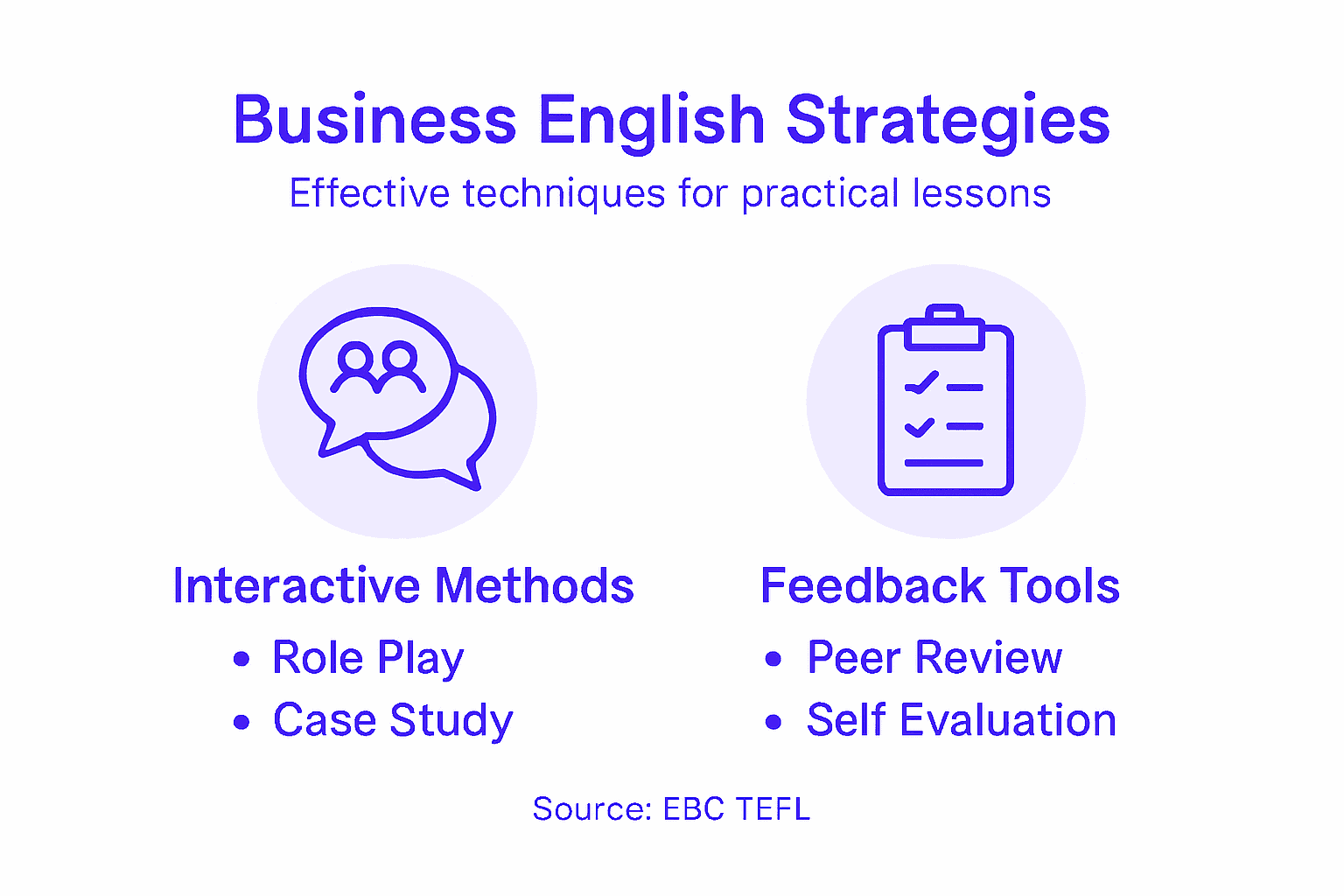
Emphasise interactive and experiential learning techniques that develop students communication confidence. Implement role play scenarios that mirror actual workplace challenges, utilise case studies from diverse international business contexts, and create opportunities for learners to develop adaptive communication skills. Your lessons should focus on developing linguistic flexibility, professional vocabulary, and the ability to navigate complex intercultural communication contexts effectively.
Pro tip: Design lesson plans with modular components that allow real time adaptation based on learner feedback and specific professional communication requirements.
Step 4: Incorporate authentic materials and scenarios
Incorporating authentic materials into business English lessons transforms theoretical language learning into dynamic, real world communication training. Your primary objective is to bridge the gap between classroom instruction and professional communication contexts.
Teaching approaches with authentic materials require strategic selection and integration of genuine business resources. Curate a diverse collection of materials including corporate reports, professional email exchanges, video conference recordings, business news broadcasts, and industry specific podcasts. These resources should represent varied communication contexts such as international negotiations, marketing presentations, client interactions, and cross cultural business meetings.
Carefully analyse and adapt these authentic materials to match your learners professional development goals. Create scaffolded learning activities that progressively challenge students communication skills. Develop comprehension exercises that require critical analysis of linguistic nuances, professional communication strategies, and cultural communication subtleties. Encourage students to deconstruct these materials examining language structures, professional vocabulary usage, tone, and contextual communication approaches.
Pro tip: Develop a rotating library of contemporary authentic materials that reflect current global business trends and communication practices.
Step 5: Evaluate progress and adapt your approach
Evaluating progress in business English teaching requires a strategic and dynamic approach that goes beyond traditional assessment methods. Your goal is to continuously refine your teaching techniques to maximise student learning outcomes and professional communication skills.
Decision tree-based evaluation strategies provide sophisticated mechanisms for tracking learner development. Implement a comprehensive assessment framework that includes diagnostic pre tests, periodic skill assessments, and reflective performance analyses. Design evaluation tools that measure not just linguistic accuracy but also communication effectiveness, professional vocabulary acquisition, and intercultural communication competence.
Create personalised feedback mechanisms that allow individual learners to understand their progression and identify specific areas for improvement. Utilise a combination of quantitative metrics and qualitative observations to build a holistic view of student development. Regularly review and adjust your teaching strategies based on learner performance data, emerging business communication trends, and individual student needs. This adaptive approach ensures your business English curriculum remains relevant, engaging, and aligned with real world professional communication requirements.
Pro tip: Develop a flexible assessment system that captures nuanced communication skills beyond traditional language proficiency metrics.
Unlock Global Career Success by Teaching Business English
Mastering the art of teaching Business English is key to opening doors in international career opportunities. If you aim to develop engaging, real-world lessons and assess learner progress effectively as described in the article “How to Teach Business English for Global Career Success,” you need accredited training that equips you with practical, hands-on teaching skills. EBC TEFL offers Trinity College London accredited courses like the specialised Business English CertTESOL and CertPT programmes. These cultivate your ability to deliver professional communication training tailored to diverse learners.
Take the next step towards empowering your future students and yourself by enrolling in our internationally recognised teacher training. Our 1-year study and work abroad programmes in Spain, France, and Italy combine accredited certification, language study, and invaluable teaching experience abroad with visa support and lifetime job placement assistance. Explore how our practical, career-focused approach aligns perfectly with mastering business English teaching at Discover Our Courses. Begin your journey to become a confident, globally equipped English teacher today and transform your passion into worldwide career opportunities.
Find out more and book your free consultation now at EBC TEFL.
Frequently Asked Questions
What is the best way to assess business English learner needs?
Assessing business English learner needs involves conducting a comprehensive needs analysis through targeted surveys. Create a questionnaire that explores each learner’s current job role, professional communication goals, and specific challenges they face in business scenarios.
How can I develop a curriculum that prepares learners for real-world business communication?
Develop a professional business English curriculum by integrating research-driven design that simulates authentic workplace scenarios. Incorporate modules that include international negotiations and cross-cultural presentations to ensure learners engage with relevant communication contexts.
What teaching strategies can enhance practical business English lessons?
To enhance practical business English lessons, focus on interactive and experiential learning techniques like role play and case studies. Design your lessons to mirror actual workplace challenges, fostering students’ communication confidence and adaptability.
How should I incorporate authentic materials into my teaching?
Incorporate authentic materials by curating genuine business resources such as corporate reports and industry-specific podcasts. Develop scaffolded learning activities that challenge students progressively and encourage critical analysis of these materials.
How can I effectively evaluate learner progress in business English?
Evaluate learner progress in business English by implementing a comprehensive assessment framework that includes diagnostic tests and reflective performance analyses. Create personalised feedback mechanisms to help learners identify areas for improvement and ensure ongoing development of their communication skills.
Recommended
- What Is Teaching Business English Online? Complete Guide – EBC TEFL courses
- What Is Business English? Skills for Global Careers
- 7 Essential Business English Teaching Tips for Aspiring Tutors – EBC TEFL courses
- Teaching business English in Madrid Spain – EBC Trinity CertTESOL and TEFL courses
- Entendiendo las habilidades del siglo XXI – Rescrito
