
Teaching English in Italy attracts thousands of aspiring educators each year, yet many struggle to navigate certification requirements, visa complexities, and the competitive job market. Without proper Trinity College London accreditation and understanding of local teaching demands, even qualified candidates face rejection. This comprehensive guide walks you through exactly how to qualify, secure work, and excel as an English teacher in Italy in 2026, focusing on Trinity-accredited pathways and practical strategies for success.
Table of Contents
- Understanding Requirements For Teaching English In Italy
- Preparing To Teach: Certification, Visa, And Language Skills
- Teaching Methodologies And Classroom Tips For Italian Learners
- Work Opportunities And Programmes For English Teachers In Italy
- Train For Your English Teaching Career With Trinity Certification
- How To Teach English In Italy: Frequently Asked Questions
Key takeaways
| Point | Details |
|---|---|
| Certification matters | Trinity College London accredited TEFL with 120+ hours and a degree are essential for competitive positions in Italy. |
| Visa planning is critical | EU citizens face fewer barriers whilst non-EU teachers must secure student or work visas through sponsorship or programmes. |
| Communicative methods work best | Italian learners benefit from speaking-focused lessons that address pronunciation challenges and false friends. |
| Multiple pathways exist | Paid assistantships, freelance teaching, and language school positions each offer distinct advantages and challenges. |
| Location affects opportunity | Milan, Rome, and Florence provide the highest demand for English teachers, especially in business English sectors. |
Understanding requirements for teaching English in Italy
Before packing your bags for Rome or Milan, you need to understand what makes you eligible and competitive in Italy’s English teaching market. The Italian education sector values proper accreditation and legal documentation above all else.
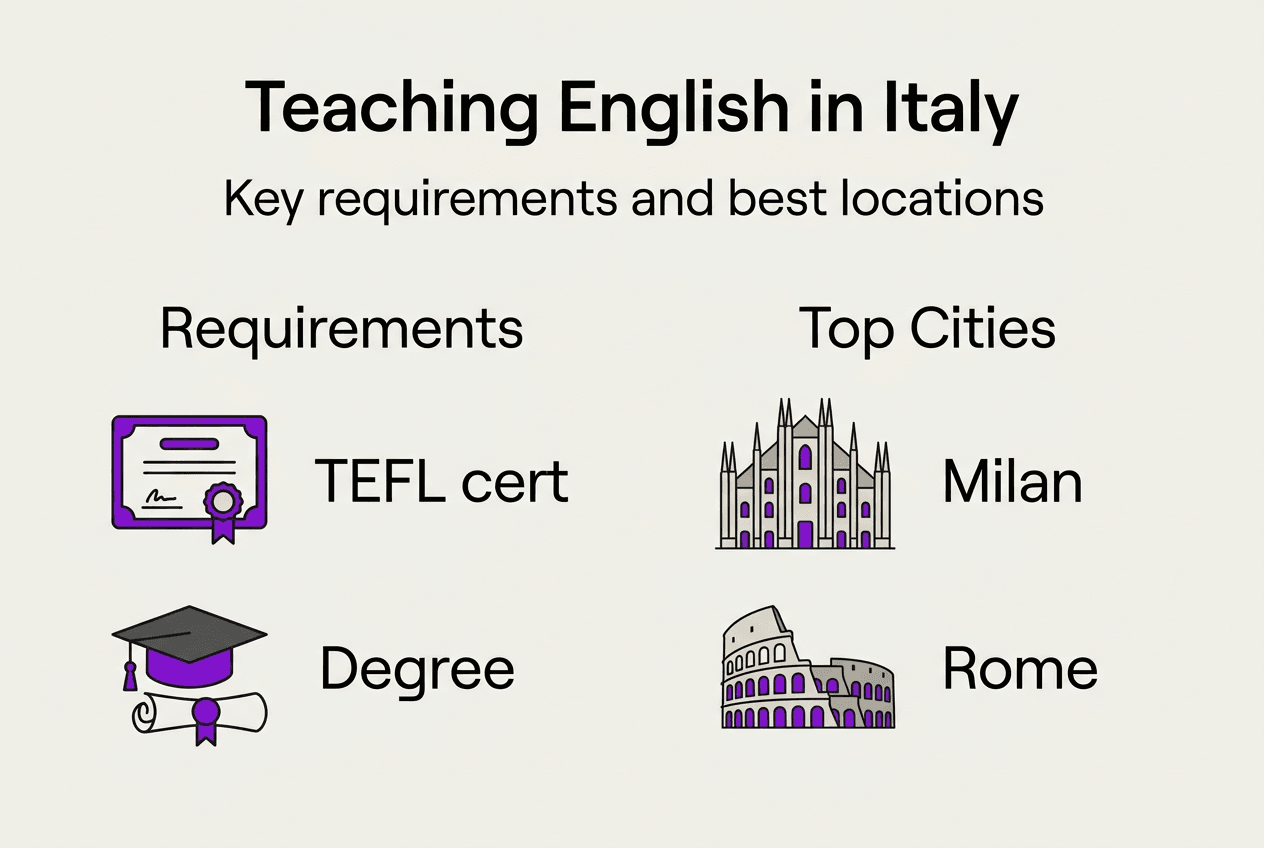
To teach English in Italy, you must hold a 120+ hour accredited TEFL certification and preferably a university degree. Trinity College London certification stands as the gold standard, recognised by language schools and educational institutions throughout Italy. Schools prioritise Trinity-accredited teachers because the qualification demonstrates practical teaching competency through assessed teaching practice, not just theoretical knowledge.
Your nationality significantly impacts your pathway. EU citizens enjoy freedom of movement and can work legally without sponsorship, making job hunting straightforward. Non-EU teachers face stricter requirements and must secure either a student visa through a study programme or a work visa sponsored by an employer. The latter proves challenging as Italian schools rarely sponsor foreign teachers unless you possess exceptional qualifications or fill a specialised niche.
Geographic demand varies dramatically across Italy. Major cities like Milan, Rome, and Florence host the highest concentration of language schools, international companies requiring business English training, and private students willing to pay premium rates. Smaller cities and rural areas offer fewer opportunities but potentially lower living costs and more authentic cultural immersion.
Pro Tip: Research specific neighbourhoods within major cities where expatriate communities and international businesses cluster, as these areas generate consistent demand for English instruction and business English courses.
Freelance teaching represents a common pathway but requires navigating Italian bureaucracy. You’ll need to obtain a Partita IVA (tax identification number) and understand the complexities of self-employment taxation. Basic Italian language skills become invaluable here, facilitating communication with tax advisors, landlords, and potential students whilst demonstrating cultural commitment to employers.
Essential qualifications checklist
- Trinity College London accredited TEFL/TESOL (minimum 120 hours)
- Bachelor’s degree (any field, though education or English preferred)
- Native or near-native English proficiency
- Basic Italian language skills (A2-B1 level recommended)
- Clean criminal background check
- Valid passport with appropriate visa status
| Requirement | EU Citizens | Non-EU Citizens |
|---|---|---|
| Work authorisation | Automatic right to work | Student or sponsored work visa required |
| TEFL certification | 120+ hours Trinity preferred | 120+ hours Trinity preferred |
| University degree | Strongly recommended | Essential for visa applications |
| Italian language | Helpful but optional | Often required for visa approval |
Preparing to teach: certification, visa, and language skills
Proper preparation separates successful teachers from those who struggle or abandon their Italian teaching dreams. Your certification choice, visa strategy, and language development form the foundation of a sustainable teaching career in Italy.
Choose your TEFL certification carefully. Whilst many providers offer 120-hour courses, Trinity College London accredited programmes carry significantly more weight with Italian employers. The Trinity CertTESOL includes assessed teaching practice with real students, providing practical classroom experience that online-only certificates lack. This hands-on training prepares you for the realities of managing Italian learners’ specific challenges.

Non-EU citizens must approach visa planning strategically and early. Student visas through language or university programmes offer the most accessible entry point, allowing you to live legally in Italy whilst building local connections and teaching experience through private tutoring. Some teachers combine a master’s programme with part-time teaching to establish themselves before seeking full-time positions. Work visas require employer sponsorship, which few schools provide for entry-level teachers without existing legal status.
Pro Tip: Apply for your student visa at least four months before your intended start date, as Italian consulates often experience processing delays and may request additional documentation.
Develop functional Italian language skills before arrival. You don’t need fluency, but reaching A2-B1 level demonstrates commitment and facilitates daily life. Many visa applications require proof of Italian language study. Beyond bureaucratic requirements, speaking Italian helps you understand your students’ linguistic challenges, communicate with school administrators, and build rapport with colleagues. It also opens doors to teaching opportunities in smaller cities where English proficiency is lower.
Organise your documentation meticulously. Italian bureaucracy demands precision and patience. Ensure your degree certificates are officially translated and apostilled, keep multiple copies of your TEFL certification, and maintain digital backups of all documents. Schools and visa offices frequently request the same paperwork multiple times.
Timeline planning prevents last-minute stress. Complete your Trinity certification at least three months before your target start date. Begin visa applications four to six months in advance for student visas, longer for work visas. Research potential employers and programmes six months out, as many schools hire for September starts during the preceding spring.
Preparation timeline
- 6 months before: Research schools, complete Trinity TEFL certification, begin Italian language study
- 4 months before: Submit visa applications, gather and translate all required documents
- 2 months before: Secure accommodation, finalise employment or study programme details
- 1 month before: Arrange health insurance, open Italian bank account if possible, prepare teaching materials
Teaching methodologies and classroom tips for Italian learners
Understanding how Italian students learn English transforms good teachers into exceptional ones. Italian learners face specific linguistic challenges rooted in the structural differences between Italian and English, requiring targeted teaching strategies.
Adopt a communicative teaching approach that prioritises students producing full English phrases rather than translating word-by-word from Italian. Italian students often default to mental translation, which slows fluency and produces unnatural sentence structures. Design activities that require spontaneous English responses, such as information gap exercises, role-plays, and discussions where translation proves impractical.
Pronunciation challenges require focused attention. Italian phonology lacks several English sounds, causing persistent difficulties. The ‘th’ sounds (both voiced and unvoiced) don’t exist in Italian, leading students to substitute ‘t’ or ‘d’ sounds. Similarly, the distinction between short and long vowels often eludes Italian learners, producing confusion between words like ‘ship’ and ‘sheep’. Dedicate regular practice time to these problematic sounds through minimal pair drills and pronunciation games.
“Focus on communicative methods that encourage speaking in full phrases, address common pronunciation challenges like ‘th’ and vowel length, and tackle false friends that confuse Italian learners.”
False friends create vocabulary confusion. Words that look similar in Italian and English but carry different meanings trip up learners at all levels. ‘Burro’ means butter in Italian, not a donkey. ‘Camera’ means room, not a photographic device. Explicitly teach these deceptive cognates and create memorable contexts to prevent errors.
Pro Tip: Create a classroom “false friends wall” where students add confusing word pairs they discover, turning potential embarrassment into collaborative learning.
Balance all four skills but emphasise listening and speaking. Italian students typically receive grammar-heavy instruction in school, producing learners who can analyse sentence structures but struggle with spontaneous conversation. Structure lessons around communicative tasks that integrate listening and speaking naturally. Use authentic materials like podcasts, news clips, and songs to expose students to varied accents and natural speech patterns.
Foster a supportive classroom environment where mistakes become learning opportunities. Italian culture values eloquence and correctness, making some students reluctant to speak until they feel certain of accuracy. This perfectionism inhibits fluency development. Model acceptance of errors, praise attempts, and frame mistakes as valuable feedback rather than failures.
Common Italian learner challenges
- Pronunciation: Difficulty with ‘th’, ‘h’ sounds, and vowel length distinctions
- Grammar: Confusion with present perfect vs past simple usage
- Vocabulary: False friends and phrasal verb comprehension
- Fluency: Over-reliance on mental translation slowing speech production
- Confidence: Reluctance to speak before achieving perceived perfection
Effective activity types for Italian students
- Information gap pair work: Forces communication without translation
- Pronunciation drilling: Targets specific problematic sounds systematically
- Authentic listening: Exposes students to natural speech patterns and vocabulary
- Role-play scenarios: Builds confidence through structured speaking practice
- Error correction games: Makes mistake identification collaborative and non-threatening
Work opportunities and programmes for English teachers in Italy
Navigating Italy’s English teaching job market requires understanding the distinct pathways available and their respective advantages and challenges. Your choice between structured programmes, freelance work, or language school employment shapes your entire Italian experience.
Paid assistantship programmes provide structured entry for recent graduates. The SITE programme offers eight-month paid positions in Lombardy schools for American graduates with a bachelor’s degree, basic Italian skills, and visa support included. These programmes handle bureaucratic complexities whilst providing guaranteed income and cultural immersion. However, positions are competitive and typically require applications six to nine months in advance.
Major cities concentrate teaching opportunities. Milan hosts numerous international corporations requiring business English training, whilst Rome and Florence attract language schools catering to tourists and professionals. Business English positions typically pay better than general English instruction and value teachers with corporate experience or specialised knowledge. Competition is fierce in these cities, but the volume of opportunities means persistent, qualified teachers find work.
Freelance teaching with Partita IVA represents the most common pathway for established teachers. You set your rates, choose your students, and control your schedule. However, this independence comes with bureaucratic complexity and income instability. You’ll navigate Italian tax requirements, build your client base through networking and referrals, and manage administrative tasks without institutional support. Many successful freelancers combine private students with part-time language school contracts to balance flexibility and stability.
Pro Tip: Join local expatriate groups and teaching networks on social media before arrival to discover unadvertised opportunities and receive practical advice from experienced teachers in your target city.
Language school employment offers stability but lower pay. Schools provide visa sponsorship (for EU citizens) or employment letters (supporting visa applications), consistent schedules, and teaching resources. However, hourly rates typically fall below freelance rates, and contracts may include unpaid preparation time. Many teachers start with schools to gain experience and local connections before transitioning to freelance work.
Full-time positions remain rare. Most English teachers in Italy piece together income from multiple sources: language school hours, private students, online teaching, and corporate contracts. This portfolio approach provides resilience against seasonal fluctuations but requires entrepreneurial energy and excellent organisation.
| Pathway | Advantages | Disadvantages | Best For |
|---|---|---|---|
| Paid assistantship | Visa support, structured entry, guaranteed income, cultural immersion | Competitive, limited locations, fixed duration, lower pay | Recent graduates, first-time teachers, non-EU citizens |
| Freelance teaching | High hourly rates, schedule flexibility, client choice, entrepreneurial control | Bureaucratic complexity, income instability, self-marketing required, no benefits | Experienced teachers, EU citizens, entrepreneurial personalities |
| Language school | Stable income, visa support, teaching resources, professional development | Lower pay, rigid schedules, less autonomy, seasonal contracts | Entry-level teachers, those seeking structure, visa support needs |
| Business English | Higher rates, professional environment, specialised content, corporate benefits | Requires business knowledge, formal teaching, limited positions | Teachers with corporate background, advanced qualifications |
Explore teaching opportunities across Europe to understand how Italy compares with other destinations. Understanding the TEFL job placement process helps you navigate applications and interviews effectively, regardless of your chosen pathway.
Train for your English teaching career with Trinity certification
Transforming your Italian teaching ambitions into reality starts with proper certification and professional guidance. Trinity College London accreditation opens doors throughout Italy and creates a foundation for a global teaching career.
EBC TEFL courses provide internationally recognised Trinity College London certification that Italian schools actively seek. Our comprehensive training combines theoretical knowledge with assessed teaching practice, ensuring you enter Italian classrooms confident and prepared. Trinity certification signals to employers that you’ve demonstrated practical teaching competency, not just passed written exams.
Beyond certification, EBC offers lifetime job placement support connecting graduates with teaching opportunities worldwide. Our global network includes schools in Italy and across Europe, providing insider access to positions before public advertisement. This support proves invaluable when navigating Italy’s competitive teaching market.
Whether you’re considering a Trinity CertTESOL or exploring one-year study and work programmes combining teacher training with Italian language study and visa support, EBC provides expert guidance tailored to your goals. Book a free consultation to discuss your pathway to teaching in Italy and discover which programme aligns with your timeline, budget, and career objectives.
How to teach English in Italy: frequently asked questions
What is the minimum TEFL certification required to teach in Italy?
Italy requires a 120-hour TEFL certification for most teaching positions, with Trinity College London accreditation strongly preferred by reputable schools. Online-only certificates may not suffice for competitive positions or visa applications. A bachelor’s degree in any field significantly improves employment prospects, and some schools make it mandatory.
How can non-EU citizens obtain a visa to teach English in Italy?
Non-EU citizens typically secure student visas through language or university programmes, allowing legal residence whilst building teaching experience through private tutoring. Work visas require employer sponsorship, which Italian schools rarely provide for entry-level teachers. Alternatively, paid assistantship programmes like SITE include visa support and guaranteed positions for qualifying applicants.
Are there any paid assistantship programmes for teaching English in Italy?
Yes, the SITE programme places American graduates in eight-month paid teaching positions in Lombardy schools, providing visa support and requiring basic Italian language skills. These structured programmes suit recent graduates seeking their first international teaching experience. Applications typically open six to nine months before programme start dates, and competition for positions is significant.
Can I teach English in Italy without being a native speaker?
Non-native English speakers can teach in Italy if they demonstrate near-native proficiency, hold proper certification, and possess strong qualifications. However, many language schools prefer native speakers for marketing reasons. Non-native teachers often find more success in private tutoring or specialised niches like business English or exam preparation where expertise matters more than accent.
What are common challenges in teaching English to Italian students?
Italian learners struggle with pronunciation sounds absent in Italian (‘th’, vowel length), false friends between languages, and over-reliance on mental translation that slows fluency. They also face challenges with English verb tenses, particularly present perfect usage. Successful teachers address these issues through communicative methods emphasising speaking practice and targeted pronunciation work.
How much can English teachers earn in Italy?
Language school teachers typically earn €12-18 per hour, whilst private tutors charge €20-35 per hour depending on location and experience. Business English instructors command higher rates of €25-40 per hour. However, full-time positions are rare, and most teachers combine multiple income sources. Major cities offer higher rates but also significantly higher living costs.