
Key Points
- Intensive TEFL courses offer rapid, immersive teacher training in four to six weeks.
- They include real classroom practice, immediate feedback, and internationally recognized certification.
- Suitable for motivated individuals seeking a fast track to teaching abroad with professional growth.
Many aspiring teachers assume that all TEFL courses lead to the same outcome by the same route. They don’t. Intensive TEFL courses are built on a fundamentally different model, one that places you inside a real classroom environment from the very first week. Rather than spreading learning across months of part-time study, you gain practical skills, professional feedback, and internationally recognised certification in a matter of weeks. This guide covers what intensive TEFL courses are, how they work day to day, their genuine advantages, and how to decide whether this fast-track route is the right fit for your goals and lifestyle.
Table of Contents
- What is an intensive TEFL course?
- The benefits of choosing an intensive TEFL course
- Course content and daily structure explained
- Who should (and shouldn’t) take an intensive TEFL course?
- What most aspiring teachers misunderstand about intensive TEFL courses
- Fast-track your global teaching career with the right TEFL course
- Frequently asked questions
Key Takeaways
| Point | Details |
|---|---|
| Immersive, rigorous training | Intensive TEFL courses offer concentrated, hands-on experience to quickly prepare new teachers for real classrooms. |
| Accelerates career start | These programmes deliver full certification in weeks, enabling rapid job placement abroad. |
| Best for motivated learners | Intensive TEFL is ideal for those ready to fully commit and benefit from fast-paced, collaborative learning. |
| Includes global job support | Graduates gain access to international opportunities and professional networks established during training. |
What is an intensive TEFL course?
Not every TEFL course is created equal, and the word “intensive” carries real meaning. Intensive TEFL courses are designed for rapid, immersive teacher training, typically running for four to six weeks of full-time study. You attend sessions every weekday, often from morning through to late afternoon, combining theory, lesson planning, and observed teaching practice into a single, focused period.
This is very different from part-time or fully online options, which can stretch over several months and rely heavily on self-directed study. The intensive format creates a learning environment that more closely mirrors the actual demands of a classroom, which is precisely why so many employers value it. You can also review the TEFL course syllabus to understand exactly how content is organised across a typical programme.
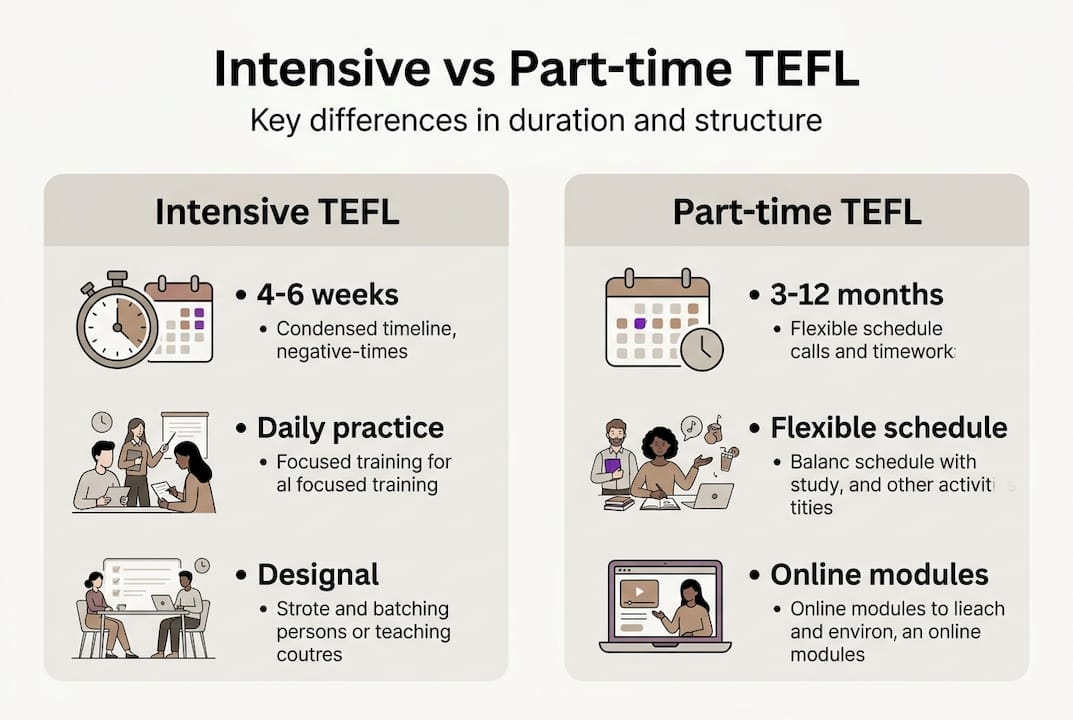
Here is how intensive and standard TEFL courses compare:
| Feature | Intensive TEFL | Standard/part-time TEFL |
|---|---|---|
| Duration | 4 to 6 weeks | 3 to 12 months |
| Study format | Full-time, in-person or blended | Part-time, often online |
| Teaching practice | Observed, with real learners | Limited or simulated |
| Peer community | Daily, face-to-face interaction | Minimal peer contact |
| Feedback | Immediate, from qualified trainers | Delayed, often written only |
| Certification speed | Weeks | Months |
Who typically chooses this route? Career changers who want to move quickly, university graduates ready to teach abroad, and experienced professionals seeking a formal qualification all find what to expect from intensive courses aligns well with their ambitions.
As one experienced TEFL trainer puts it:
“The immersion you experience on an intensive course is unlike anything a self-paced programme can replicate. You are in the room, teaching real people, receiving real feedback, and growing in real time.”
Key features of intensive TEFL courses include:
- Full-time timetable with structured daily sessions
- Observed teaching practice with genuine language learners
- Regular one-to-one and group feedback from qualified trainers
- Written and practical assessments throughout the course
- A cohort of fellow trainees who become your professional network
The benefits of choosing an intensive TEFL course
The intensive format is popular for good reason. Graduates of intensive TEFL courses often experience quicker job offers and deeper classroom confidence than those who complete longer, less structured programmes.
Immediate immersion is perhaps the greatest advantage. From day one, you are practising the essential teaching skills that employers look for, not reading about them in isolation. Face-to-face peer practice also accelerates your development in ways that solo study simply cannot. You observe your colleagues teach, you receive critique, and you apply corrections the very next day.
Accredited certification is another major draw. Qualifications such as the Trinity CertTESOL carry TEFL qualification recognition from employers and institutions worldwide. Understanding the TESOL certification advantages helps you see why this matters when applying for roles in Europe, Asia, Latin America, and beyond.
Here are the top five benefits at a glance:
- Speed: Gain internationally recognised certification in four to six weeks
- Confidence: Real classroom hours build genuine teaching ability
- Networking: Daily contact with trainers and peers creates lasting professional relationships
- Global access: Accredited qualifications open doors to teaching roles across dozens of countries
- Career clarity: Intensive feedback helps you identify your strengths and areas to develop early
For those weighing up a reasons to take TEFL career change, the intensive route removes the prolonged uncertainty of a months-long course. You know quickly whether teaching is right for you, and you leave with a qualification that proves it.
Pro Tip: Use every observed teaching session as a deliberate experiment. Try one new technique per lesson, note the feedback you receive, and apply it the following day. Trainees who treat practice hours as active learning rather than assessment hurdles tend to progress significantly faster.
Course content and daily structure explained
Knowing the benefits is one thing. Understanding what a typical day actually looks like helps you prepare properly. A typical intensive TEFL day includes workshops, observed teaching practice, group activities, and feedback sessions, all within a structured timetable.

Mornings usually begin with a methodology seminar or language awareness workshop. These sessions cover topics such as grammar teaching, phonology, lesson planning frameworks, and classroom management. Afternoons shift to practical work, where trainees plan and deliver observed lessons to real language learners, followed by group and individual feedback.
Here is an example of what a weekly schedule might look like:
| Activity | Hours per week | Assessment type |
|---|---|---|
| Methodology workshops | 10 to 12 hours | Ongoing participation |
| Observed teaching practice | 6 to 8 hours | Trainer observation forms |
| Lesson planning sessions | 4 to 5 hours | Written lesson plans |
| Language awareness study | 3 to 4 hours | Written assignments |
| Feedback and reflection | 3 to 4 hours | Reflective journals |
You can review the full TEFL course syllabus breakdown and explore top TEFL course tips to prepare thoroughly before you begin.
Typical assessment tasks across the course include:
- Written lesson plans submitted before each observed teaching session
- A language awareness assignment covering grammar and phonology
- A learner profile study based on your teaching practice group
- Observed teaching hours assessed by qualified Trinity College London trainers
- A written assignment on a chosen area of language teaching methodology
For full details on assessment criteria, the Trinity CertTESOL details page outlines exactly what is expected at each stage.
Pro Tip: Treat the first week as your settling-in period. Organise your lesson planning materials the night before, build a simple daily routine, and prioritise sleep. Trainees who manage their energy well consistently outperform those who burn out by week three.
Who should (and shouldn’t) take an intensive TEFL course?
Once the structure is clear, the next question is personal. Is this the right path for you? Intensive TEFL suits highly motivated, adaptable learners, but may be challenging for those needing flexible schedules.
Ideal candidates tend to share a few common traits. They are self-starters who take initiative without needing external prompting. They can commit to full-time study without significant competing obligations. They are comfortable receiving direct feedback and acting on it quickly. Reading about Amir’s TEFL experience gives a vivid sense of how real trainees navigate the demands and rewards of the intensive route.
That said, this format is not ideal for everyone. Those with significant caring responsibilities, part-time work commitments, or a preference for slower, reflective learning may find the pace genuinely difficult. It is worth being honest with yourself before enrolling. You can also consult should you choose intensive TEFL for an independent perspective on fit.
Here is a balanced summary to support your decision:
Reasons to choose intensive TEFL:
- Fast path to accredited certification
- Real classroom experience from week one
- Strong peer and trainer support network
- Immediate readiness for global job applications
Potential challenges to consider:
- Full-time commitment leaves little room for other responsibilities
- Compressed schedule can feel overwhelming without preparation
- Feedback is direct and frequent, which requires resilience
- Limited time for deeper independent research during the course
Pro Tip: If the intensity concerns you, spend two weeks before the course reviewing basic English grammar and practising speaking in front of a mirror or camera. Arriving with even a modest head start reduces the pressure considerably during the first week.
What most aspiring teachers misunderstand about intensive TEFL courses
Here is something worth saying plainly: intensive TEFL is not a shortcut. Many people enrol expecting a fast and relatively easy route to a certificate. What they find instead is one of the most professionally formative experiences of their lives, but only if they engage fully.
The social dimension is consistently underestimated. The relationships formed with fellow trainees and experienced trainers during a high-paced course often become the foundation of a lasting professional network. This matters enormously when you are job-hunting in a new country.
The contrarian view we hold at EBC TEFL is this: the challenge is the point. Hands-on experience and peer feedback are more valuable than many expect, but demand real commitment. Teachers who embrace the discomfort of being observed, critiqued, and pushed to improve are the ones who build genuine classroom authority. A certificate earned through real effort carries far more professional weight than one collected passively.
When you read about student experiences with TEFL, a common thread emerges: the moments of struggle were the moments of greatest growth.
Fast-track your global teaching career with the right TEFL course
If you are ready to move from aspiration to action, EBC TEFL supports aspiring teachers worldwide with accredited, immersive certification programmes and comprehensive one-year study and work abroad programmes in Spain, France, and Italy.
Our globally recognised introduction to TEFL resources help you understand your options clearly before committing. When you are ready to choose a pathway, explore our full range of international teaching certification options, including the Trinity CertTESOL and specialist programmes. For personalised guidance on which course fits your goals, book a TEFL consultation with one of our expert advisers today. We are here to support you every step of the way, from your first question to your first classroom.
Frequently asked questions
How long do intensive TEFL courses last?
Most intensive TEFL courses run for four to six weeks with full-time study and observed teaching practice included throughout.
Are intensive TEFL courses harder than part-time options?
Intensive TEFL condenses learning into a shorter, more demanding schedule, covering the same material as longer courses but at a significantly faster pace.
Can I work while doing an intensive TEFL course?
It is not recommended. Intensive TEFL students should plan to devote full days to their studies and teaching practice to get the best possible results.
Will an intensive TEFL course help me get a teaching job abroad?
Yes. Intensive TEFL certification speeds up international job placement, and accredited qualifications are highly regarded by employers across Europe, Asia, and Latin America.
Recommended
- International TEFL Career Steps: Your Path to Global Teaching – EBC TEFL courses
- The Quickest TEFL Course That Gets You Hired | EBC Trinity CertTESOL Fast Track
- How to Succeed in Online TEFL and Launch a Global Teaching Career – EBC TEFL courses
- Master TEFL Job Search Methods for Global Teaching Success – EBC TEFL courses