
Navigating the unpredictable journey of language acquisition feels challenging for many aspiring English teachers preparing to work abroad. Understanding how learners create a unique communication system known as interlanguage is essential for effective teaching. This article helps you decode the adaptive nature of interlanguage, showing how its stages and patterns can shape your classroom practice and support students’ individual growth.
Table of Contents
- Interlanguage In Language Learning Explained
- Stages And Types Of Interlanguage Systems
- Key Features Of Interlanguage Development
- Common Challenges And Fossilisation Issues
- Teaching Strategies For Interlanguage Progression
Key Takeaways
| Point | Details |
|---|---|
| Understanding Interlanguage | Interlanguage is a unique linguistic system developed by learners, distinct from their native and target languages, which evolves through various stages. |
| Stages of Development | Language learners progress through four stages of interlanguage: Pre-systematic, Emergent, Systematic, and Post-systematic, each characterised by evolving communication skills. |
| Fossilisation Risks | Fossilisation occurs when errors become permanent in a learner’s language use, often due to psychological barriers and limited exposure to authentic language contexts. |
| Effective Teaching Strategies | Educators should create interactive, supportive environments that encourage exploration, error correction, and learner autonomy to foster interlanguage progression. |
Interlanguage in Language Learning Explained
Interlanguage represents a fascinating linguistic phenomenon where language learners develop a unique communication system while acquiring a new language. Unique linguistic patterns emerge as individuals navigate the complex journey of second language acquisition.
The concept, originally coined by linguist Larry Selinker in 1972, describes a dynamic intermediary language system distinct from both the learner’s native tongue and the target language. This transitional linguistic framework encompasses multiple linguistic dimensions:
- Phonological development: Sound production and pronunciation patterns
- Morphological evolution: Word formation and grammatical structure modifications
- Syntactical adaptations: Sentence construction and arrangement rules
- Semantic transformations: Meaning interpretation and communication strategies
Language learning dynamics reveal a complex process where learners unconsciously generate systematic rules, make strategic errors, and progressively refine their communication skills. These evolving linguistic systems are heavily influenced by psychological, sociological, and educational factors.
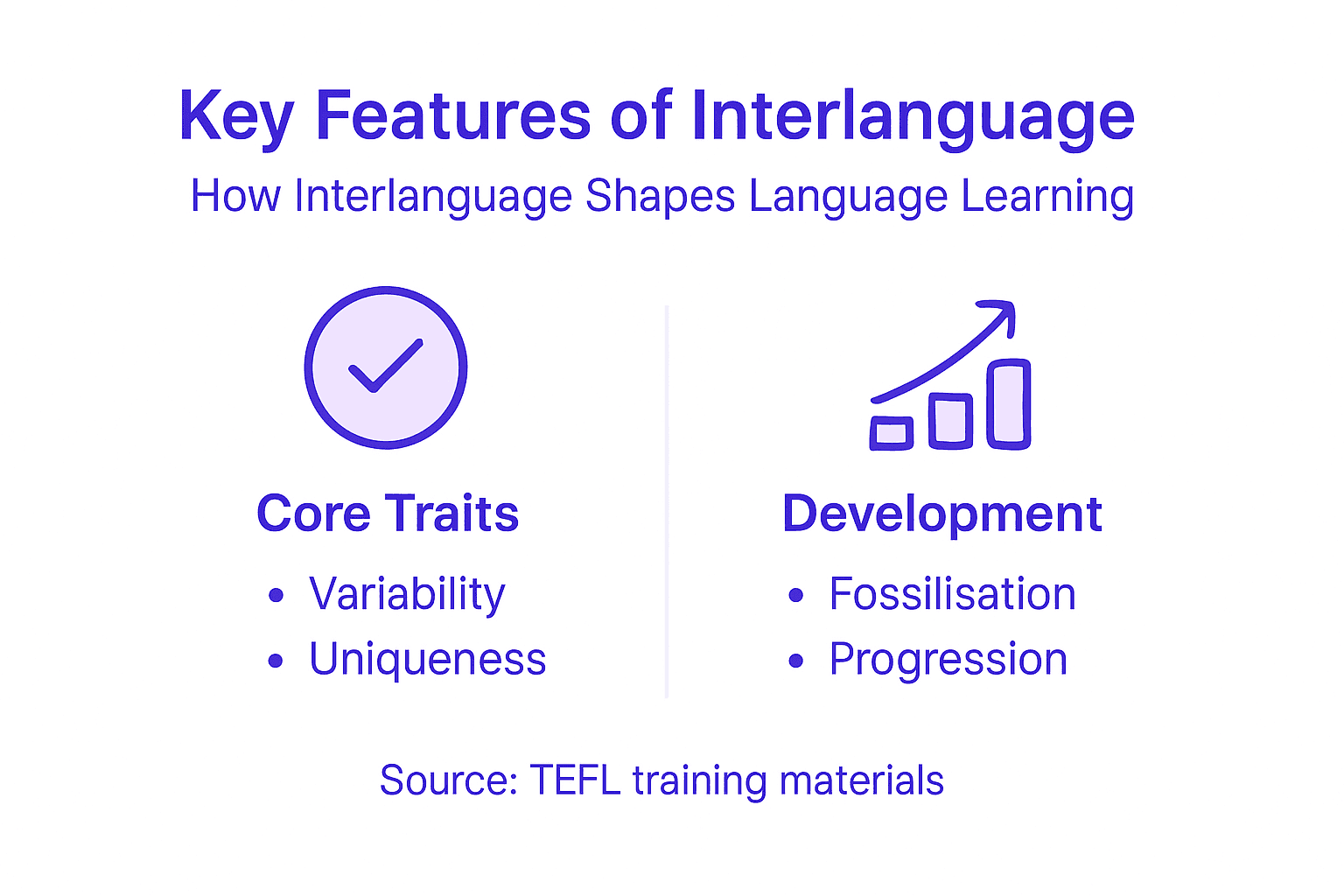
Key characteristics of interlanguage include its inherent variability, individual uniqueness, and potential for fossilisation—a phenomenon where language development stabilises before achieving complete target language mastery. Language educators recognise that each learner’s interlanguage represents a unique developmental trajectory, requiring personalised teaching approaches.
Pro tip: Embrace your interlanguage as a natural, dynamic stage of language learning, viewing mistakes as essential stepping stones towards linguistic proficiency.
Stages and Types of Interlanguage Systems
Interlanguage systems represent a complex linguistic journey with distinct developmental stages that reflect learners’ evolving language acquisition processes. Learner language progression reveals fascinating insights into how individuals navigate second language learning.
Researchers have identified four primary stages of interlanguage development:
- Pre-systematic Stage: Initial language exposure where learners have limited understanding
- Emergent Stage: Basic communication attempts with rudimentary linguistic structures
- Systematic Stage: More consistent language rule application and increasing comprehension
- Post-systematic Stage: Advanced linguistic competence with refined communication skills
Interlanguage systems demonstrate remarkable complexity, incorporating features from both the learner’s native language and target language. Key characteristics include:

Here is a summary of the main stages of interlanguage development and their defining characteristics:
| Stage | Communication Ability | Rule Consistency | Common Features |
|---|---|---|---|
| Pre-systematic | Very limited expressions | Inconsistent | Heavy reliance on first language |
| Emergent | Basic and often incorrect usage | Emerging regularity | Experimentation with new forms |
| Systematic | Greater fluency and accuracy | Increased consistency | Use of self-made rules |
| Post-systematic | Advanced and refined language | Consistently applied rules | Continuing minor imperfections |
- Continuous linguistic system modification
- Significant influence from first language transfer
- Individual variability in language learning strategies
- Potential for fossilisation at any developmental stage
The development of interlanguage is profoundly influenced by multiple factors, including psychological predispositions, learning environment, motivation levels, and exposure to authentic language contexts. Language learners unconsciously generate unique communication strategies, making each interlanguage system a personalised linguistic landscape.
Pro tip: Document your language learning journey by maintaining a reflective journal that tracks your evolving linguistic strategies and communication development.
Key Features of Interlanguage Development
Interlanguage development encompasses a complex linguistic phenomenon with distinctive characteristics that shape language learners’ communication strategies. Systematic linguistic evolution reveals intricate processes of language acquisition and transformation.
The primary features of interlanguage systems include:
- Systematic Variability: Dynamic linguistic structures that continuously adapt
- Permeability: Open to external linguistic influences and modifications
- Instability: Constantly evolving communication mechanisms
- Individual Uniqueness: Personalised language learning trajectories
Cognitive and sociolinguistic factors significantly influence interlanguage development, creating a multifaceted linguistic landscape. These factors include:
- Psychological predispositions
- Social learning contexts
- Cognitive processing capabilities
- Cross-linguistic transfer mechanisms
Fossilisation represents a critical phenomenon within interlanguage development, where language learning plateaus and progression becomes challenging. This state occurs when learners stabilise their linguistic structures before achieving complete target language proficiency, potentially limiting ultimate language mastery.
Language learners navigate these complex developmental processes through continuous interaction, exposure, and strategic learning approaches. The intricate nature of interlanguage underscores the importance of understanding individual differences and creating supportive, adaptive learning environments.
Pro tip: Embrace linguistic variability by consistently exposing yourself to diverse language contexts and maintaining a growth mindset throughout your language learning journey.
Common Challenges and Fossilisation Issues
Fossilisation represents a critical challenge in language learning, where linguistic errors become permanently embedded in a learner’s communication system. Language learning obstacles reveal complex psychological and environmental barriers to language progression.
The primary causes of fossilisation encompass multiple interconnected factors:
- Psychological Resistance: Mental barriers preventing linguistic adaptation
- Cognitive Habits: Ingrained language processing patterns
- Motivational Deficits: Reduced enthusiasm for language improvement
- Limited Exposure: Insufficient authentic language interactions
Multifaceted language learning challenges demonstrate that fossilisation can occur across different learning stages and contexts. Key challenges include:
- Persistent grammatical errors
- Pronunciation difficulties
- Lexical limitations
- Pragmatic communication barriers
External factors significantly contribute to fossilisation, including inadequate teaching methodologies, limited language input, and sociocultural constraints. Learner motivation plays a crucial role in overcoming these challenges, with individual psychological factors often determining the extent of linguistic progress.
The following table contrasts fossilisation in interlanguage with successful language progression:
| Aspect | Fossilisation | Progression |
|---|---|---|
| Error Correction | Errors persist and stabilise | Errors are reduced over time |
| Learner Motivation | Often decreases | Remains high or increases |
| Language Exposure | Limited and repetitive | Regular and varied |
| Communication Skill | Plateaus prematurely | Continues improving |
Language educators and learners must develop targeted strategies to identify, address, and prevent fossilisation. This requires a comprehensive approach that combines personalised learning techniques, continuous exposure to authentic language contexts, and adaptive teaching methodologies.
Pro tip: Regularly record and analyse your language production to identify recurring errors and consciously work on systematic improvement strategies.
Teaching Strategies for Interlanguage Progression
Language teaching approaches must evolve to support learners’ dynamic interlanguage development. Effective pedagogical interventions create facilitative environments that stimulate linguistic progression and counter potential fossilisation.
Key strategies for supporting interlanguage development include:
- Interactive Communication: Encouraging spontaneous language use
- Cross-linguistic Awareness: Recognising learners’ existing language knowledge
- Error Correction: Providing constructive, non-punitive feedback
- Learner Autonomy: Promoting self-directed language exploration
Language learning methodologies demonstrate that viewing learner utterances as independent linguistic systems can transform educational approaches. Practical implementation strategies involve:
- Designing tasks that encourage linguistic hypothesis-testing
- Creating supportive environments for language experimentation
- Developing personalised learning pathways
- Implementing adaptive assessment techniques
Teachers play a crucial role in nurturing interlanguage progression by understanding the complex, individual nature of language learning. This requires a nuanced approach that balances structured guidance with learner-centred exploration, recognising each student’s unique linguistic journey.
Successful language education transcends traditional instruction, focusing instead on creating dynamic, responsive learning environments that validate and support learners’ evolving communication strategies.
Pro tip: Maintain a reflective teaching journal to track individual learners’ linguistic development and adapt your strategies accordingly.
Unlock Your Teaching Potential by Understanding Interlanguage and Advancing Your TEFL Career
Mastering the concept of interlanguage is essential for effective English teaching and overcoming challenges like fossilisation in language learning. At EBC TEFL, we integrate this deep linguistic insight into our Trinity College London accredited training courses, empowering you to deliver clear, adaptive lessons that address learners’ unique language development stages. Whether you are aiming to refine your teaching methods or break through common learning barriers, our practical, hands-on programmes prepare you for success in diverse global classrooms.
Step into a rewarding teaching career supported by EBC TEFL’s internationally recognised Trinity CertTESOL and specialised certifications such as Business English and Online Teaching. Our one-year study and work abroad programmes in Spain, France, and Italy combine high-quality accredited training, language study, visa assistance, and part-time work opportunities, providing a comprehensive path for professional and cultural growth. Start transforming your passion for teaching into global opportunities today by booking your free consultation at EBC TEFL. Discover how understanding interlanguage can enhance your classroom impact and open doors worldwide on our TEFL certification page and find out more about our immersive study and work programmes. Your future as a confident, well-prepared English teacher begins now.
Frequently Asked Questions
What is interlanguage in language learning?
Interlanguage is a unique communication system that language learners develop as they acquire a new language, distinct from both their native language and the target language.
How does interlanguage affect language learning strategies?
Interlanguage influences learners’ strategies by creating personalised linguistic systems that reflect their individual progress and experiences, necessitating tailored teaching methods.
What are the stages of interlanguage development?
The stages of interlanguage development include the pre-systematic stage, emergent stage, systematic stage, and post-systematic stage, each representing a level of proficiency and rule consistency.
What is fossilisation in the context of interlanguage?
Fossilisation refers to the phenomenon where linguistic errors become ingrained in a learner’s language use, preventing further progress toward complete mastery of the target language.
Recommended
- TEFL Blog: Teaching Tips, Stories & Career Advice | EBC
- Intercultural Communication in TEFL: Key Skills and Challenges
- Cultural immersion: Why move abroad to teach English? – EBC Trinity CertTESOL and TEFL courses
- Language acquisition: Staying updated and relevant in TEFL – EBC Trinity CertTESOL and TEFL courses