
TEFL is a genuinely good career for people who want flexible, meaningful work with a low barrier to entry and a fast route abroad, provided you choose a properly accredited course like a Trinity CertTESOL and go in with realistic expectations about pay and progression. It suits career changers and new graduates far better than it suits anyone chasing a fixed salary ladder. Outcomes still hinge on your qualification level and the market you target.
Key Points
- A properly accredited TEFL course like Trinity CertTESOL is essential to access better contracts and visa sponsorship in international English teaching markets.
- The strongest demand for qualified teachers persists into 2026, with tightening supply giving certified candidates more leverage on pay and contract terms worldwide.
- Early career challenges include cultural adjustment, visa bureaucracy, and unpredictable workload, making careful contract review crucial before signing.
- Salary should be analyzed in the context of local cost of living, with online or short-term placements offering flexible, less costly entry points.
- Progression opportunities include senior teaching, management, or building a freelance client base, while longevity depends on continued skill development and market adaptability.
Table of Contents
- What are the main benefits of a TEFL career?
- What are the realities and challenges of working in TEFL?
- What qualifications do you actually need for TEFL?
- What career paths and progression exist in TEFL?
- How much can you realistically earn, and does it cover the cost of living?
- How do you find TEFL work and what do employers look for?
- Why this matters for actually getting hired, not just getting certified
- How long do people usually stay in TEFL, and does age matter?
- Is TEFL a sustainable, secure long-term career?
- How does TEFL compare with ESL teaching or private language tutoring?
- Where EBC TEFL Course fits if you’re ready to start
- Sources
- FAQ
What are the main benefits of a TEFL career?
The biggest draw is flexibility. You can teach online from a laptop, take a short six-month contract, or commit to a full academic year in one country. Nobody is forcing you into a single city or a single employer for the next decade, which is precisely why so many career changers look at TEFL as an escape route from rigid nine-to-five structures.
It’s also one of the fastest legitimate routes into paid international work. Compare it with trying to land a graduate job abroad through a conventional employer, and TEFL usually wins on speed and accessibility.
The skills stick with you too. Lesson planning sharpens your organisational thinking, classroom management builds genuine authority under pressure, and public speaking becomes second nature. Careers advice from the University of Oxford points to exactly this kind of transferability as one of the strongest arguments for TEFL as a stepping stone, not a dead end.
Then there are the niche earners:
- Business English tuition for corporate clients, often paid at a premium
- Exam preparation coaching (IELTS, Cambridge, TOEFL)
- Freelance or platform-based online teaching that runs alongside or instead of in-country work
What are the realities and challenges of working in TEFL?
Nobody should sugar-coat the early months. Cultural adjustment, visa paperwork and slow bureaucracy are the three things that catch out almost every first-time TEFL teacher, and they tend to arrive all at once.
Contracts vary enormously, so read the fine print before you sign anything:
- Check whether accommodation is provided or just “assisted”
- Confirm paid holiday, sick leave and contract length in writing
- Ask whether flights are reimbursed and when
- Clarify actual teaching hours versus unpaid admin or observation time
Day-to-day, the job is heavier than the brochure photos suggest. Lesson prep, marking, parent communication and behaviour management eat into hours that don’t always show up on the payslip.
The most avoidable mistake is enrolling on an undercertified course that looks cheap but locks you out of better contracts later, or skipping the fine print on an employment offer because you’re excited to leave home.
Pro Tip: Ask any prospective employer for the names of two current or former teachers you can contact directly. A reputable school will not hesitate; a poor one usually stalls.
What qualifications do you actually need for TEFL?
Employers filter candidates by certification level long before they read a CV properly, so the course you choose determines which doors open.
A 120-hour course with supervised teaching practice is generally the minimum for language-school and many public-school contracts, particularly where visa sponsorship is involved. Shorter, practice-free certificates tend to suit casual tutoring or some online platforms only, and rarely satisfy sponsors.
A Trinity CertTESOL sits a level above the standard 120-hour certificate, and it’s recognised specifically because it includes assessed, supervised classroom practice rather than theory alone.
When comparing courses, check for:
- Recognised accreditation (Trinity College London is one benchmark employers know)
- A genuine practicum with real students, not simulated peer teaching only
- Written trainer feedback you can show future employers
- Job placement support built into the course, not bolted on afterwards
Certified teachers often recoup their course fees quickly once placed, because certified roles typically pay more than casual, uncertified tutoring. Certification level also tends to influence whether a school will sponsor your visa at all, so it’s worth understanding qualification requirements by market before you commit to a course.
What career paths and progression exist in TEFL?
Most people start in one of four places: language centres, private academies, summer schools, or online tutoring platforms. None of these require years of experience, which is exactly why TEFL appeals to career changers wanting a quick, low-risk entry.
From there, progression looks like this:
- Mid-career: senior or head teacher roles, exam-prep specialism, examiner work, or in-company corporate training
- Longer-term: academic management, running your own school, teaching at university level, or specialising in high-value exam coaching
- Hybrid models: many experienced teachers now split their week between in-country classroom hours and online private students, smoothing out income across the year
The freelance route rewards teachers who build a reputation and a steady client base over time, which is why mapping out realistic career steps early tends to pay off later.
How much can you realistically earn, and does it cover the cost of living?
A headline salary figure means nothing without local context. $1,200 a month sounds modest in London but comfortable in many parts of Southeast Asia or Latin America, so always convert pay into local purchasing power before comparing offers.
Look beyond the base salary to the full package:
- Accommodation provided or subsidised
- Flights reimbursed at the start or end of contract
- Health insurance included
- Contract length and renewal terms
Online teaching or short placements can make more financial sense than a full relocation if you’re testing the waters or building savings before committing longer term, since online TEFL routes let you earn without relocation costs.
Pro Tip: Before accepting any offer, ask a current teacher what they actually spend monthly on rent, food and transport in that city. Recruiters rarely volunteer this.
Check typical salary ranges by market against your own cost-of-living calculations before signing anything.
How do you find TEFL work and what do employers look for?
- Start with reputable channels. Language centres, established recruitment portals, employer websites and course-provider placement services are all more reliable than random social media job posts.
- Prepare your paperwork early. A verified certificate, an up-to-date CV, references, and any required background checks should be sorted before you start applying, not scrambled together after an interview request.
- Expect a demo lesson. Hiring managers assess classroom presence, timing and how you handle a room going quiet, not just your qualification on paper.
- Sort visa logistics before you travel. Reputable schools generally prefer to arrange sponsorship before you arrive, since applying from abroad is often more complicated. Rules vary by country and change often, so verify directly with official immigration sources and never assume a school’s promise guarantees approval.
Demand for qualified English teachers remains strong into 2026, and tightening supply has shifted some negotiating leverage toward qualified candidates across dozens of countries worldwide. That’s good news if your certificate and CV are in order, less useful if they aren’t.
Why this matters for actually getting hired, not just getting certified
A certificate on its own gets your CV noticed. What gets you hired, and rehired, is proof you can actually run a classroom: lesson plans that hold a group’s attention, calm behaviour management, and written feedback from trainers who watched you teach real students. Employers screening dozens of applicants consistently favour candidates who can demonstrate supervised practice over those with theory-only certificates, because it removes their guesswork. This is also why networking matters more in TEFL than in many careers. A recommendation from a current teacher or a placement adviser who knows the school’s reputation carries real weight, often more than a polished CV alone.
How long do people usually stay in TEFL, and does age matter?
There’s no fixed career length in TEFL, and that’s part of its appeal. Some teachers do one or two contracts before returning home with a strong CV line and international experience. Others build a decade-plus career, moving between countries, specialisms and eventually management.
Age is rarely the barrier people assume it will be. Language schools generally care far more about your certification, classroom presence and reliability than your date of birth. Career changers in their thirties, forties and beyond regularly retrain into TEFL successfully, often bringing workplace maturity that schools value in senior or corporate training roles. Where age can matter is visa eligibility in a small number of countries with specific age brackets for work permits, so it’s worth checking the rules for your target country directly rather than assuming.
What determines longevity isn’t age but adaptability: teachers who keep upgrading their skills, whether through exam-prep specialisms, business English, or online tutoring, tend to stay in the profession longer and command better contracts. Those who plateau on the same basic certificate for years are the ones most likely to drift out of teaching after a contract or two.
Is TEFL a sustainable, secure long-term career?
Job security in TEFL doesn’t look like a traditional pension-and-promotion ladder, and it’s worth being honest about that upfront. Contracts are typically fixed-term, renewal isn’t automatic, and demand shifts between countries as economies and immigration policies change.
That said, sustainability is achievable if you treat TEFL as a skill you keep developing rather than a static job you land once. Teachers who add specialisms such as exam preparation, Content and Language Integrated Learning (CLIL), or online teaching platforms tend to have more consistent income and more employer options across market downturns in any single country. Diversifying across in-country and online work also protects against a single school’s financial troubles or a sudden policy change affecting foreign teachers.

The current market backdrop helps. Persistent global demand alongside a tighter supply of qualified teachers gives certified candidates more negotiating power on pay and contract terms than in previous years. That’s not a guarantee of permanent security, but it’s a meaningfully better starting position than many other entry-level career paths offer right now.
How does TEFL compare with ESL teaching or private language tutoring?
The terms get used loosely, so it’s worth untangling them. TEFL generally refers to teaching English to speakers of other languages in a non-English-speaking country, often through language schools or international programmes. ESL teaching (English as a Second Language) usually describes teaching English within an English-speaking country, often to immigrants or students in the local school system, and frequently requires local teaching qualifications rather than a TEFL certificate. Private language tutoring sits somewhere else again, usually freelance, one-to-one, and built entirely around your own client base rather than an employer’s timetable.
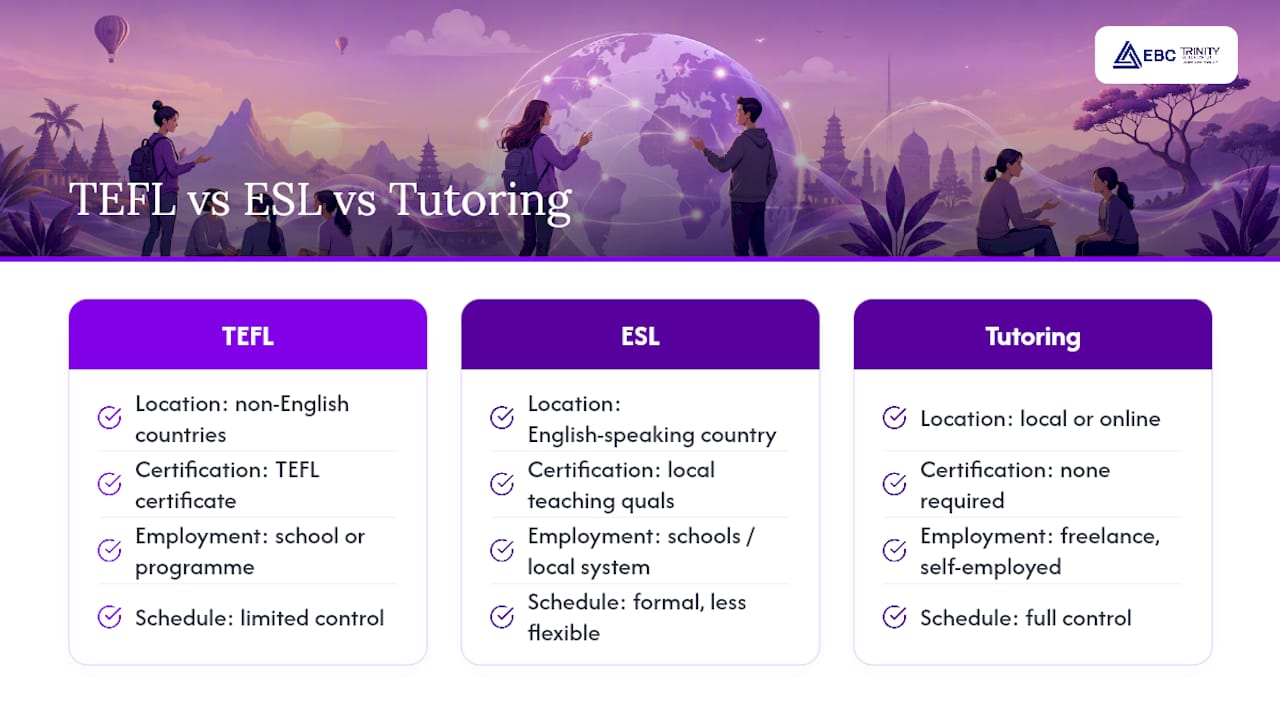
For someone wanting international travel, structured onboarding and a built-in professional community, TEFL tends to be the more accessible route. ESL teaching in your home country often demands longer, more formal teacher-training pathways and local certification. Private tutoring offers more control over your schedule and rates but leaves you responsible for finding every client yourself, with none of the structure or placement support a TEFL programme typically provides. Many experienced teachers eventually blend all three, using TEFL training as the foundation, tutoring as flexible extra income, and occasionally moving into ESL-style roles once they’re settled somewhere long-term.
Where EBC TEFL Course fits if you’re ready to start
There are providers offering courses with Trinity CertTESOL accreditation, hands-on practicum with real students, written trainer feedback, and worldwide job-placement assistance once certified.

Trinity College London accreditation is recognised by language schools and immigration authorities across many markets, which matters when a visa officer or hiring manager is deciding whether your certificate is worth trusting. Beyond the classroom, EBC also runs one-year study and work abroad programmes in Spain, France and Italy, combining accredited training with language study, visa support and part-time teaching or work opportunities. It’s a structured route for anyone who wants more than a short course, without promising an outcome no honest provider can guarantee.
If you’re weighing up whether to commit, the sensible next step is to look at what the certification actually unlocks and book a free consultation to talk through which pathway fits your goals, timeline and target country.
Sources
- Why now might be the best time to become a TEFL teacher | EFL Magazine
- Teach English Abroad: TEFL, TESOL and What It Pays | Pack Lightly
- Goabroad
- Teaching English as a foreign language (TEFL) | Careers Service, University of Oxford
FAQ
Is TEFL still in demand?
Yes. Demand for qualified English teachers remains strong heading into 2026, and tightening global supply has given qualified candidates more leverage on pay and contract terms across many markets.
Which is better, TEFL or CELTA?
They’re not direct competitors so much as different tiers: a standard TEFL certificate can be enough for casual tutoring or some online platforms, while a Trinity CertTESOL or CELTA-level qualification with supervised teaching practice tends to open language-school and public-school contracts that a short course won’t.
Is TEFL hard to get?
A basic online certificate is easy to obtain, but a properly accredited course with a real practicum and trainer feedback, like Trinity CertTESOL, takes genuine commitment and assessed classroom teaching, not just watching videos.
Is TEFL a good choice for a career change?
For most career changers, yes, largely because it offers a faster, lower-cost entry into meaningful international work than retraining into most other professions, provided you choose an accredited course over the cheapest option available.
Does EBC guarantee a teaching job after certification?
No reputable provider can guarantee employment or visa approval. EBC TEFL Course offers lifetime worldwide job-placement assistance and career guidance to support your search, but the outcome always depends on your qualifications, the market and the employer’s own decision.
Recommended
- Why Gen Z Is Choosing the Trinity CertTESOL to Teach English
- Trinity CertTESOL Certification: Boosting Global Teaching Careers
- Career shift: Why the Trinity CertTESOL is a great option
- What is the difference between the Trinity CertTESOL and CELTA?
This page provides commentary based on information, facts, and experiences available at the time of publication. It does not constitute legal advice, and EBC accepts no liability for decisions made based on the information provided. If you require legal advice, please consult a qualified lawyer.