
The JET programme stands as one of the most prestigious government-backed teaching opportunities in Japan, yet only 25-30% of applicants succeed in securing a placement. This competitive selection process reflects the programme’s exceptional value: structured support, superior pay compared to private alternatives, and genuine cultural immersion. Understanding what sets JET apart, who qualifies, and how to navigate the application process can transform your aspiration of teaching in Japan into reality.
Table of Contents
- What is the JET programme and why it matters for aspiring teachers
- Eligibility and requirements for the JET programme
- Application process: Steps, timeline and tips
- Placement, roles and life as an ALT in JET
- Advantages and professional growth with JET
- Next steps: Preparing for your JET journey and widening your teaching possibilities
- Frequently asked questions
Key Takeaways
| Point | Details |
|---|---|
| Government-backed opportunity | The JET programme provides prestige, support, and accredited teaching placements across Japan. |
| Competitive acceptance | Only about a quarter of applicants succeed, so preparation and evidence of relevant skills are crucial. |
| Eligibility is strict | A Bachelor’s degree and participating country citizenship are required, along with health and clean record checks. |
| Rural placements common | Most JET teachers are sent to rural areas, providing deep cultural immersion and unique challenges. |
| Professional and personal growth | JET teachers gain valuable experience, better pay and support, and enhanced CVs for future international teaching roles. |
What is the JET programme and why it matters for aspiring teachers
The Japan Exchange and Teaching Programme is a government-backed initiative that places qualified graduates in paid teaching roles across Japan. Unlike private ALT dispatch companies such as Interac, JET provides accredited government placement with comprehensive orientation, ongoing mentorship, and significantly better working conditions. Most participants serve as Assistant Language Teachers, supporting Japanese educators in developing students’ English communication skills.
What makes JET exceptional is its structured approach to teacher development. You receive thorough orientation before placement, access to experienced mentors throughout your contract, and professional development opportunities that private programmes rarely match. The programme welcomes applicants without prior teaching experience, making it an accessible entry point for graduates passionate about education and cultural exchange.
Key programme features:
- Government-backed placement with full legal employment status
- Comprehensive orientation covering teaching methods and cultural adaptation
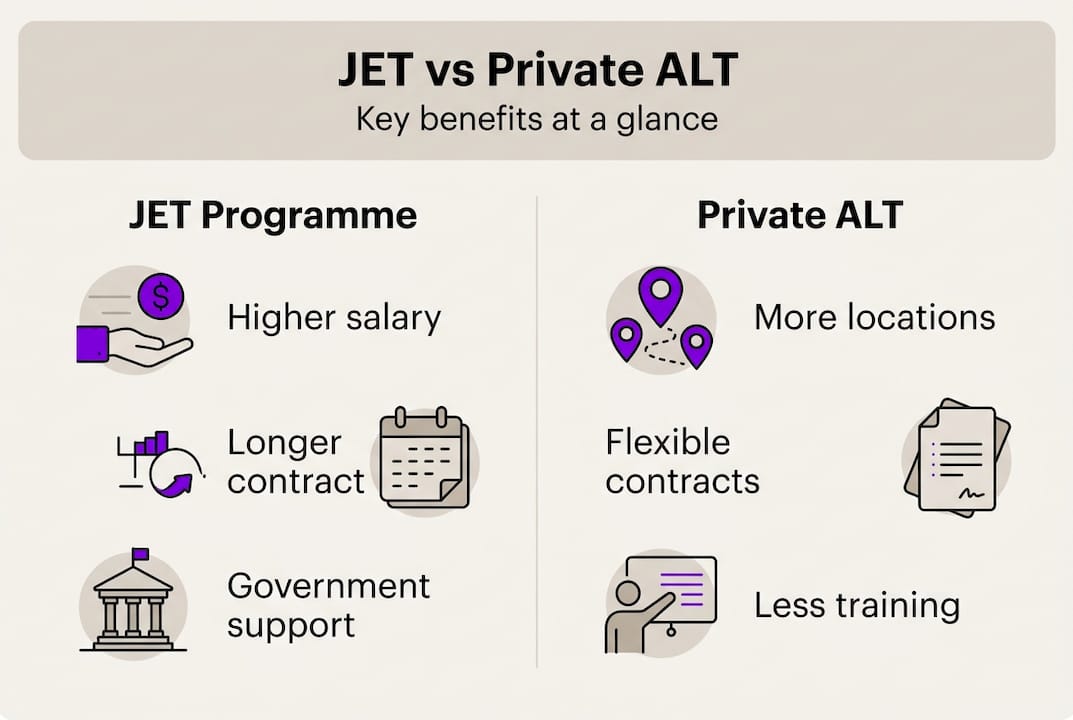
- Competitive salary exceeding private ALT positions by 20-30%
- Contract duration of one year, renewable up to five years
- Structured support network including supervisors and fellow JET participants
- Opportunities for professional growth and career advancement
| Feature | JET Programme | Private ALT Companies |
|---|---|---|
| Monthly salary | ¥280,000-¥330,000 | ¥200,000-¥250,000 |
| Orientation | Comprehensive multi-day programme | Brief or minimal |
| Contract security | Government-backed | Private employer dependent |
| Support network | Extensive mentorship system | Limited or none |
| Professional development | Regular training opportunities | Rarely provided |
Pro Tip: Research your potential placement region before applying. Rural placements offer deeper cultural immersion and stronger community connections, whilst urban positions provide more amenities and networking opportunities. Both paths deliver valuable teaching experience that strengthens your CV.
The JET programme represents more than a teaching job. It’s a structured pathway into Japanese society, offering insights into education systems, cultural practices, and community life that tourists never experience. This depth of engagement explains why JET alumni often describe their participation as transformative, both professionally and personally.
Eligibility and requirements for the JET programme
Before investing time in your application, confirm you meet the essential criteria. The programme maintains specific standards to ensure participants can fulfil their roles effectively and represent their countries professionally.
Core eligibility requirements:
- Hold a bachelor’s degree by your departure date
- Possess citizenship from a participating country
- Demonstrate genuine interest in Japan and cultural exchange
- Meet health standards for living and working abroad
- Have no criminal record
- Not have participated in JET for the maximum duration previously
- Not have lived in Japan for extended periods recently
| Requirement | Details | Documentation Needed |
|---|---|---|
| Education | Bachelor’s degree by departure date | Official transcripts |
| Citizenship | Participating country national | Passport copy |
| Health | Good physical and mental health | Medical examination form |
| Background | Clean criminal record | Police clearance certificate |
| Language | English proficiency (native or fluent) | Varies by country |
The bachelor’s degree requirement is non-negotiable, but your field of study matters less than your enthusiasm for teaching and cultural exchange. Successful applicants come from diverse academic backgrounds including sciences, humanities, business, and arts. What unites them is adaptability, cultural sensitivity, and commitment to education.
Pro Tip: Start gathering documentation early. Police clearance certificates and official transcripts can take weeks to obtain. Beginning this process three months before the application deadline prevents last-minute stress and ensures you submit a complete, polished application.
Your interest in Japan should extend beyond anime or tourism. Application reviewers seek candidates who understand the commitment required for effective cultural exchange. This means researching Japanese education systems, learning basic Japanese phrases, and demonstrating awareness of the challenges and rewards of living in a different cultural context.
EBC TEFL supports aspiring teachers in preparing for opportunities in Japan through accredited training programmes that build the skills and confidence needed for successful applications. Our Trinity College London certified courses provide practical teaching experience that strengthens your candidacy, whilst our global network offers insights into living and working abroad.
Application process: Steps, timeline and tips
The JET application process follows a structured timeline with specific deadlines that vary by country. Understanding each stage helps you prepare thoroughly and present your strongest candidacy.
Application timeline and steps:
- September-November: Application period opens through your country’s Japanese embassy or consulate
- October-December: Submit complete application package including all required documents
- January-March: Shortlisted candidates invited for interviews
- April: Successful applicants receive placement offers
- July-August: Departure for Japan and participation in orientation
Your application package must include several critical documents. The Statement of Purpose carries significant weight, as it reveals your motivations, cultural awareness, and suitability for the programme. Write authentically about your interest in Japan, your teaching philosophy, and how you’ll contribute to cultural exchange. Avoid generic statements about loving Japanese culture. Instead, share specific experiences or learning that sparked your interest.
Required documentation:
- Completed application form
- Statement of Purpose (typically 2 pages)
- Academic transcripts from all universities attended
- Two letters of recommendation
- Medical examination form
- Copy of passport or citizenship proof
- Recent photograph
The interview stage separates strong applications from exceptional ones. Panels typically include embassy staff, former JET participants, and education professionals. They assess your communication skills, cultural sensitivity, adaptability, and genuine commitment to the programme. Prepare by researching common interview questions, practising responses that demonstrate self-awareness, and developing thoughtful questions about the programme.
Acceptance rate insight: With approximately 25-30% of applicants receiving offers, competition remains significant. However, this statistic shouldn’t discourage you. Many unsuccessful applicants fail to demonstrate genuine cultural interest or submit incomplete documentation. Thorough preparation dramatically improves your chances.
Pro Tip: Connect with current or former JET participants through online communities before applying. Their insights into the application process, interview expectations, and programme realities prove invaluable. Many are happy to review Statements of Purpose or conduct practice interviews.
EBC TEFL’s comprehensive application support helps candidates navigate complex international teaching applications. Our advisors understand what programmes like JET seek in successful applicants and provide personalised guidance that strengthens your candidacy. We’ve supported numerous graduates in securing positions through the JET programme, combining our training expertise with practical application strategies.
Placement, roles and life as an ALT in JET
Receiving your JET acceptance marks the beginning of a new chapter. Understanding what follows helps you prepare mentally and practically for the transition ahead.

Most JET participants receive placements outside major cities like Tokyo or Osaka. Rural and regional assignments are common, reflecting where English education support is most needed. Whilst this might initially disappoint those dreaming of urban life, rural placements offer profound cultural immersion and community integration that city positions rarely match.
Your role as an ALT varies significantly depending on your school, supervisor, and initiative. Some ALTs primarily assist Japanese teachers of English, preparing materials and supporting classroom activities. Others take leading roles in lesson planning and delivery, particularly in schools with limited English teaching resources. This flexibility means your experience depends partly on the effort and creativity you invest.
Typical ALT responsibilities:
- Supporting Japanese teachers during English lessons
- Planning and delivering conversation practice sessions
- Preparing teaching materials and visual aids
- Assessing student progress and providing feedback
- Participating in school events and cultural activities
- Engaging with the local community as a cultural ambassador
Your contract runs for one year initially, with the possibility of renewal up to five years total. Many participants renew at least once, as the first year involves significant adjustment whilst subsequent years allow you to deepen relationships and refine your teaching practice.
Adapting to rural Japanese life presents unique challenges and rewards. Limited English speakers in your community push you to develop Japanese language skills quickly. Local festivals, community events, and neighbourhood interactions provide authentic cultural experiences. The slower pace compared to urban centres offers time for reflection, skill development, and genuine connection with students and colleagues.
Pro Tip: Embrace your role as a cultural bridge, not just an English teacher. Share aspects of your culture through cooking classes, music, sports, or art. These informal exchanges often create the most memorable learning experiences for students and strengthen your community bonds.
Support structures help you navigate challenges. Your contracting organisation provides a supervisor who assists with work-related questions and cultural adjustment. Fellow JET participants in your prefecture form a ready-made social network. Regional and national JET events offer professional development and community building throughout your contract.
Advantages and professional growth with JET
Participating in JET delivers benefits extending far beyond your contract period. The experience shapes your professional trajectory, personal development, and global perspective in lasting ways.
Government-backed teaching experience carries significant weight on your CV. Employers recognise JET as a selective, prestigious programme that develops cross-cultural communication, adaptability, and independence. Whether you continue in education, transition to international business, or pursue other fields, JET experience demonstrates qualities employers value.
Professional and personal benefits:
- Enhanced CV with government-recognised international experience
- Development of cross-cultural communication skills
- Improved adaptability and problem-solving abilities
- Language acquisition through daily immersion
- Global professional network spanning education, business, and government
- Clarity about career direction through hands-on teaching experience
The orientation and ongoing training provided through JET surpass what private ALT companies offer. You receive practical teaching strategies, cultural competency training, and professional development opportunities that build genuine expertise. This structured support helps you succeed in the classroom whilst developing transferable skills applicable across careers.
Financially, JET offers stability and fair compensation. Your salary covers living expenses comfortably, even in expensive areas, whilst allowing savings. Health insurance, return airfare, and other benefits provide security that private teaching positions often lack. This financial foundation lets you focus on teaching and cultural exchange rather than economic survival.
Networking opportunities through JET prove invaluable. You connect with fellow participants from dozens of countries, Japanese educators and community members, and JET alumni working globally in diverse fields. These relationships often lead to future collaborations, job opportunities, and lifelong friendships.
Pro Tip: Document your JET experience through a blog, portfolio, or journal. Recording lessons learned, challenges overcome, and achievements gained creates a resource for future job applications and personal reflection. Many successful applicants to graduate programmes or international positions credit their JET documentation with helping them articulate their growth and capabilities.
Cultural immersion through JET transforms your worldview. Living in Japan, navigating daily life in a different language, and building relationships across cultural boundaries develops empathy, flexibility, and global awareness. These qualities prove increasingly valuable in our interconnected world, both professionally and personally.
Next steps: Preparing for your JET journey and widening your teaching possibilities
Whilst JET represents an exceptional opportunity, preparing thoroughly and considering alternative pathways ensures you’re ready for success in international teaching. EBC TEFL supports aspiring teachers in accessing the JET programme and other global teaching opportunities through accredited training and comprehensive placement support.
Our Trinity College London certified TEFL courses provide the practical teaching skills and theoretical knowledge that strengthen JET applications. Whilst TEFL certification isn’t required for JET, it demonstrates commitment to professional teaching and gives you classroom confidence from day one. Many of our graduates have successfully secured JET placements, crediting their training with helping them stand out during the competitive selection process.
EBC’s global network extends beyond Japan, offering pathways to teaching positions worldwide if JET doesn’t align with your timeline or circumstances. Our one-year study and work abroad programmes in Spain, France, and Italy combine accredited teacher training with cultural immersion and professional experience. These alternatives provide similar benefits to JET whilst offering different cultural contexts and programme structures.
Our lifetime job placement support means we’re with you throughout your teaching journey. Whether you’re preparing your first JET application, seeking alternative opportunities, or planning your next career move after completing JET, our advisors provide personalised guidance based on your goals and circumstances. We understand the international teaching landscape and help you navigate it successfully.
Book a free consultation to discuss your teaching aspirations in Japan or explore other international opportunities. Our team will assess your current qualifications, recommend appropriate training pathways, and develop a strategy for achieving your teaching goals. We’ve helped hundreds of graduates launch successful international teaching careers, and we’re ready to support your journey.
Frequently asked questions
Can I apply to the JET programme without prior teaching experience?
Yes, prior teaching experience isn’t required for JET applications. The programme provides comprehensive orientation and ongoing support to help you succeed in the classroom regardless of your background.
Are placements guaranteed in urban areas of Japan?
No, placements aren’t guaranteed in cities. Most JET participants receive rural assignments where English education support is most needed, though these often provide richer cultural experiences.
What documents are needed for the JET application?
You must provide a Statement of Purpose, transcripts, references, and medical form along with your completed application form and proof of citizenship.
How long can I participate in the JET programme?
You can participate for up to five years total, with contracts renewed annually based on performance and mutual agreement between you and your contracting organisation.
Is TEFL certification useful for JET applicants?
TEFL certification strengthens your application by demonstrating teaching commitment and provides practical classroom skills that help you succeed once placed, though it’s not a formal requirement for applying.