
What makes learning to communicate naturally in English so challenging for many language learners? The answer often lies in relying too heavily on strict grammar rules rather than mastering lexical chunks. For aspiring teachers planning to gain Trinity College London accreditation and build a teaching career in Spain, France, Italy, or beyond, understanding this shift is crucial. This introduction cuts through common misconceptions, clarifies what the lexical approach truly involves, and reveals why it matters for fluent, confident communication.
Table of Contents
- Lexical Approach: Core Definition And Misconceptions
- Types Of Lexical Chunks And Their Distinctions
- Principles And Classroom Implementation Strategies
- Benefits For Fluency And Real-World Communication
- Challenges, Criticisms, And Alternatives In TEFL
Key Takeaways
| Point | Details |
|---|---|
| Focus on Lexical Chunks | Prioritising lexical chunks over individual words enhances language acquisition by promoting contextually appropriate communication. |
| Natural Communication | The lexical approach emphasises the use of pre-constructed phrases, facilitating more fluent and authentic interactions. |
| Effective Classroom Strategies | Implementing this approach requires innovative teaching methods that foster exposure to lexical units in meaningful contexts. |
| Fluency over Grammar | Success in communication derives from understanding language as interconnected units rather than merely adhering to grammatical rules. |
Lexical approach: Core definition and misconceptions
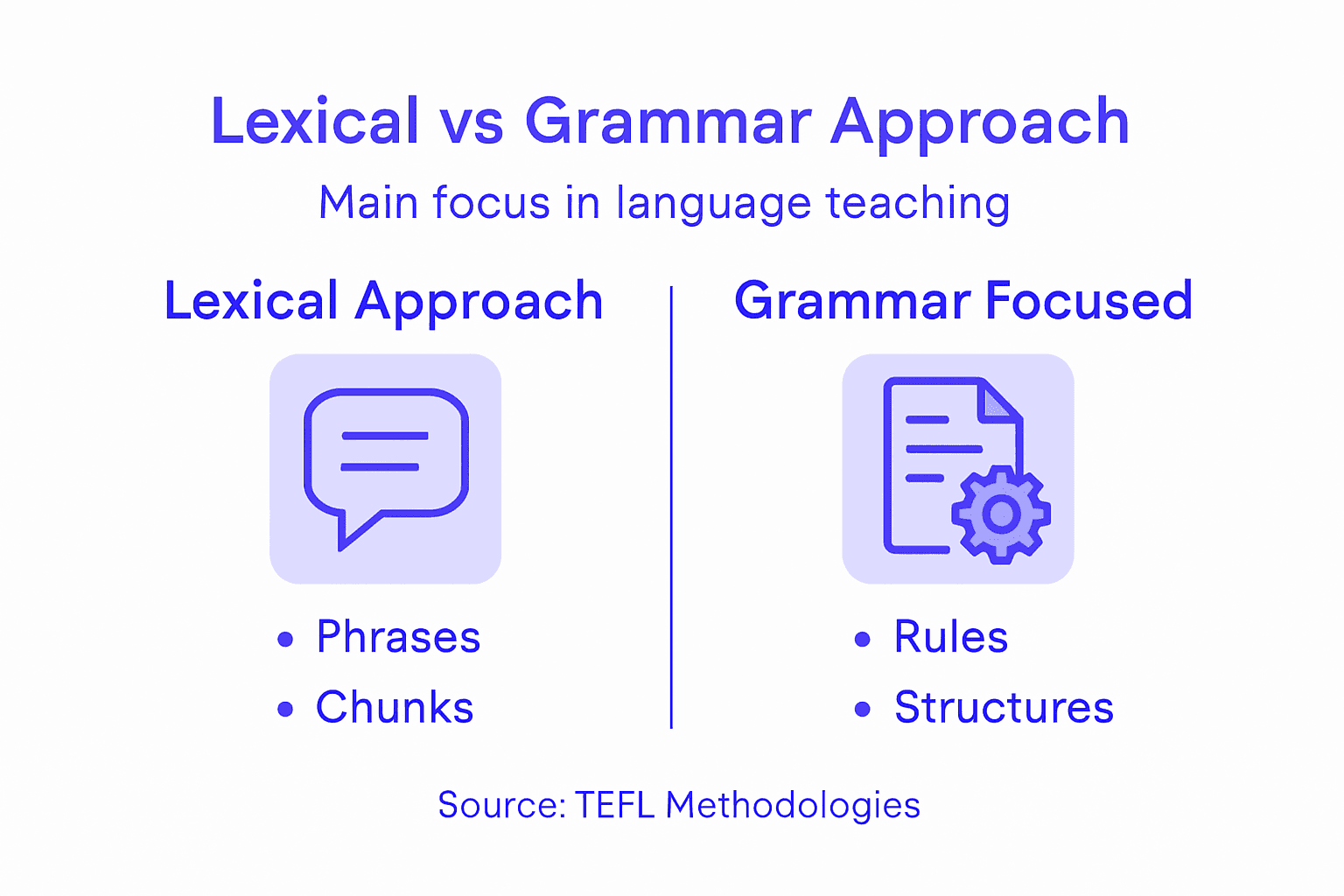
The lexical approach represents a fundamental methodology in language teaching that shifts focus from traditional grammatical structures to understanding language through lexical units and chunks. Unlike conventional grammar-based teaching, this approach emphasises learning language as interconnected word combinations rather than isolated rules.
At its core, the lexical approach challenges several long-standing misconceptions about language acquisition:
- Traditional grammar is not the primary mechanism of language learning
- Words do not exist in isolation but in meaningful patterns
- Language learners should prioritise understanding lexical chunks over individual word meanings
- Communication relies more on prefabricated expressions than purely grammatical constructions
Language researchers have demonstrated that native speakers predominantly use pre-constructed phrases and lexical chunks in communication, rather than generating sentences through strict grammatical rules. These lexical units, ranging from two-word phrases to entire idiomatic expressions, form the foundation of natural, fluent communication.
Lexical chunks are the building blocks of authentic, contextually appropriate language use.
Most English language learners struggle because they attempt to construct sentences through rigid grammatical frameworks, whereas native speakers rely on complex, embedded lexical patterns learned through exposure and repetition. The lexical approach advocates for teaching these naturally occurring word combinations as complete communicative units.
Key characteristics of the lexical approach include:
- Prioritising lexical chunks over individual words
- Recognising patterns in language usage
- Teaching collocations and fixed expressions
- Understanding contextual language deployment
Pro tip: When learning a new language, focus on memorising complete phrases and expressions rather than isolated vocabulary words.
Here is a comparison of the lexical approach with traditional grammar-focused methods:
| Aspect | Lexical Approach | Grammar-Focused Approach |
|---|---|---|
| Primary Focus | Lexical chunks and phrases | Grammar rules and structure |
| Communication Style | Natural, context-driven | Constructed, rule-based |
| Classroom Activities | Phrase identification tasks | Drills and sentence parsing |
| Typical Outcome | Fluent, authentic usage | Accurate, sometimes stilted |
Types of lexical chunks and their distinctions
Lexical chunks represent a complex linguistic landscape with multiple categories that language learners and teachers must understand. Linguistic researchers have identified various types of these multi-word units, each serving distinct communicative functions and presenting unique learning challenges.
The primary categories of lexical chunks include:
- Fixed expressions: Completely unchangeable phrases like “How do you do?”
- Semi-fixed expressions: Phrases with slight grammatical variations
- Formulaic sequences: Culturally embedded language chunks
- Collocations: Words that frequently appear together naturally
- Idioms: Figurative expressions with meanings beyond literal interpretation
Each lexical chunk type requires a nuanced approach to learning and understanding. Collocations, for instance, represent word combinations that native speakers intuitively use but language learners must consciously study. These might include phrases like “heavy rain” or “strong coffee” – combinations that sound natural and fluent.
Not all lexical chunks are created equal: some are rigid, while others offer grammatical flexibility.
Formulaic sequences present another fascinating dimension of lexical chunks. These are pre-fabricated language units that function as complete communicative tools, such as greeting phrases, discourse markers, and situational responses. They enable language learners to sound more natural and native-like in their communication.
The complexity of lexical chunks means that language acquisition is far more sophisticated than simply learning individual words or grammatical rules. Understanding these nuanced language units requires extensive exposure, contextual learning, and strategic memorisation of complete phrases.
Key distinctions between lexical chunk types include:
The following table summarises the main types of lexical chunks and illustrates how they differ in everyday language use:
| Type of Chunk | Flexibility Level | Typical Examples | Learning Focus |
|---|---|---|---|
| Fixed Expressions | Completely rigid | “How do you do?” | Memorisation of set phrases |
| Semi-fixed Expressions | Some grammatical change | “I’d rather ” | Noticing patterns and variations |
| Collocations | Frequent associations | “heavy rain”, “make a decision” | Natural grouping recognition |
| Idioms | Figurative, less flexible | “Kick the bucket” | Understanding cultural meaning |
| Formulaic Sequences | Varies | “Nice to meet you” | Contextual usage in communication |
- Grammatical rigidity
- Cultural embeddedness
- Frequency of usage
- Literal versus figurative meaning
Pro tip: When studying a new language, prioritise learning complete phrases and expressions instead of isolated vocabulary to develop more authentic communication skills.
Principles and classroom implementation strategies
Implementing the lexical approach requires a fundamental transformation of traditional language teaching methodologies. Classroom strategies must shift from isolated grammatical instruction to a more holistic, chunk-based learning environment that prioritises authentic language usage.
Key principles for implementing the lexical approach include:
- Treating words as complex, contextual units
- Emphasising phrase learning over individual word memorisation
- Creating opportunities for extensive language exposure
- Developing learners’ pattern recognition skills
- Encouraging spontaneous language production
Teachers adopting this methodology must design innovative instructional techniques that expose students to lexical chunks in meaningful contexts. This involves curating authentic materials, creating communicative activities that highlight natural language patterns, and developing learner awareness about how language genuinely functions in real-world interactions.
Effective lexical approach implementation transforms language classrooms from grammar-translation models to communication-driven environments.
Practical classroom strategies might include activities such as:
- Corpus-based language analysis
- Chunk identification exercises
- Contextual phrase mapping
- Collocation discovery tasks
- Dialogue reconstruction using lexical chunks
Successful implementation requires teachers to become facilitators of language discovery rather than traditional grammar instructors. This means creating learning environments where students actively explore language patterns, analyse authentic communication, and develop intuitive understanding of lexical combinations.
Critical considerations for lexical approach implementation:
- Developing teachers’ metalinguistic awareness
- Creating resource-rich learning environments
- Designing scaffolded learning experiences
- Promoting learner autonomy in language exploration
Pro tip: Design classroom activities that focus on discovering and using entire phrases rather than isolated grammatical rules to enhance natural language acquisition.

Benefits for fluency and real-world communication
The lexical approach offers transformative benefits for language learners, fundamentally reshaping how students acquire and deploy linguistic skills. Language acquisition dramatically improves through chunk-based learning by enabling more natural, contextually appropriate communication strategies.
Key benefits of the lexical approach for real-world communication include:
- Enhanced spontaneous speaking abilities
- Reduced cognitive load during conversation
- More authentic and native-like language production
- Improved listening comprehension
- Greater confidence in unprepared communication scenarios
Learners adopting this methodology experience significant advantages in practical language use. Lexical chunks enable students to process language more efficiently, bypassing the traditional, time-consuming grammatical analysis that typically slows down real-time communication.
Fluency emerges not from grammatical perfection, but from understanding language as interconnected meaningful units.
Practical communication benefits manifest through several critical mechanisms:
- Faster language processing
- More intuitive conversational responses
- Reduced translation dependency
- Enhanced contextual understanding
- Greater linguistic flexibility
The lexical approach fundamentally transforms language learning from a rules-based exercise to a more organic, communication-driven experience. By focusing on how language actually functions in real-world contexts, learners develop more adaptive and responsive linguistic skills.
Critical communication advantages include:
- Developing instinctive language patterns
- Understanding cultural nuances
- Responding more naturally in conversations
- Minimising grammatical overthinking
Pro tip: Practice using complete lexical chunks in context rather than memorising isolated vocabulary to accelerate your communication skills.
Challenges, criticisms, and alternatives in TEFL
The lexical approach, while innovative, encounters significant challenges that language educators must critically examine. Scholarly research highlights substantial implementation complexities in systematically teaching the vast array of lexical chunks required for comprehensive language learning.
Key challenges in lexical approach implementation include:
- Overwhelming volume of lexical chunks to teach
- Potential neglect of formal grammatical structures
- Resource-intensive instructional methodologies
- Difficulty in standardised assessment
- Complex learner progression tracking
Critics argue that the lexical approach may inadvertently compromise grammatical precision by prioritising communicative fluency. Linguistic competence requires a nuanced balance between natural language production and structural accuracy, which some practitioners believe the approach potentially undermines.
Not all language learning strategies are universally applicable; contextual adaptation remains crucial.
Alternative methodological approaches to the lexical approach include:
- Integrated grammar-lexical hybrid models
- Communicative language teaching strategies
- Task-based language learning frameworks
- Eclectic teaching methodologies
- Comprehensive input-output approaches
Successful language instruction often demands a flexible, adaptive approach that synthesises multiple methodological perspectives. Experienced educators recognise that no single method provides a comprehensive solution to language acquisition challenges.
Critical considerations for methodology selection:
- Learner individual differences
- Contextual teaching environment
- Specific language learning objectives
- Available instructional resources
Pro tip: Develop a flexible, adaptive teaching approach that integrates multiple methodological strategies to address diverse learner needs.
Unlock Authentic Language Teaching with the Lexical Approach and Trinity-Accredited Training
Mastering the lexical approach means embracing language as natural, meaningful chunks rather than isolated words or rigid grammar rules. If you want to guide your future students towards fluent, authentic English communication using this modern methodology, EBC TEFL Course offers exactly the trusted, internationally recognised training you need. Our Trinity College London accredited programmes equip you with practical skills to teach phrase-based learning and support you to become a confident, real-world English instructor.
Join our comprehensive courses including Trinity CertTESOL and specialised pathways like Business English or Online Teaching. Benefit from our hands-on training, global job placement assistance with lifetime support, and unique one-year study and work abroad programmes in Spain, France, and Italy. These immersive programmes combine accredited teacher training with cultural and language study plus visa and part-time work opportunities to prepare you fully for an international teaching career. Explore how the lexical approach fits into your teaching toolkit today by visiting EBC TEFL Course. Start your journey to becoming a globally employable English teacher now.
Frequently Asked Questions
What is the lexical approach in language teaching?
The lexical approach focuses on teaching language through lexical units and chunks rather than traditional grammatical rules. It emphasises understanding language as interconnected word combinations, aiding more natural communication.
How does the lexical approach differ from traditional grammar-focused methods?
Unlike traditional methods that centre on grammar rules and structures, the lexical approach prioritises natural language use through phrases and collocations, leading to more fluent and authentic communication among learners.
What are some examples of lexical chunks?
Examples of lexical chunks include fixed expressions like “How do you do?”, collocations such as “heavy rain” and idioms like “kick the bucket”. Each type plays a role in enhancing language comprehension and usage.
What are the benefits of using the lexical approach in language learning?
The lexical approach improves spontaneous speaking abilities, reduces cognitive load during conversation, and fosters more native-like language production, leading to greater confidence in communication scenarios.