
Key Points
- Reflective teaching in TEFL involves systematic self-examination to connect classroom practices with learner outcomes. It enhances teacher growth by encouraging ongoing adaptation, especially in multicultural contexts, through tools like Gibbs’ Cycle and collaborative models. Incorporating reflection improves student engagement, task design, and overall classroom effectiveness, making it essential for successful international teaching careers.
Many people assume that teaching English abroad simply requires fluency and enthusiasm. The reality is quite different. The teachers who truly thrive internationally are those who develop the habit of examining their own practice, questioning what works, and adjusting their approach with every lesson. Reflective teaching is not an optional extra in professional TEFL development. It is one of the most powerful tools you can build into your daily classroom routine, and understanding it fully can be the difference between a good teacher and an exceptional one. Reflecting on classroom performance is especially valuable during a TEFL teaching practicum, when trainees can apply feedback, identify areas for improvement and develop their teaching skills.
Table of Contents
- What is reflective teaching in TEFL?
- Structured models: How does reflection actually work?
- Collaborative and contextualised reflection: Beyond solo introspection
- Impact: Does reflective teaching improve student outcomes?
- Practical strategies: Tools and tips for reflective TEFL teaching
- A fresh perspective: True reflection goes beyond ticking boxes
- Next steps: Develop your TEFL expertise with accredited courses
- Frequently asked questions
Key Takeaways
| Point | Details |
|---|---|
| Reflective teaching defined | It means systematically examining your classroom actions to improve future lessons. |
| Structured reflection models | Tools like Gibbs’ cycle help teachers organise their thinking and draw actionable conclusions. |
| Collaboration strengthens reflection | Working with peers and supervisors leads to deeper insights and better teaching outcomes. |
| Student outcomes improve | Research shows reflective teaching, especially with explicit instruction, boosts language learning. |
| Tools for practical application | Journals, feedback loops, and lesson analysis help you grow as a thoughtful TEFL teacher. |
What is reflective teaching in TEFL?
Reflective teaching is more than simply thinking about how a lesson went. It is a systematic process of self-examination that connects what you do in the classroom to why you do it, and whether it genuinely serves your learners. As the Role of Reflection in Effective Teaching explains, reflective teaching means teachers examine what they do, why, and whether it works, using information from practice to improve future lessons.
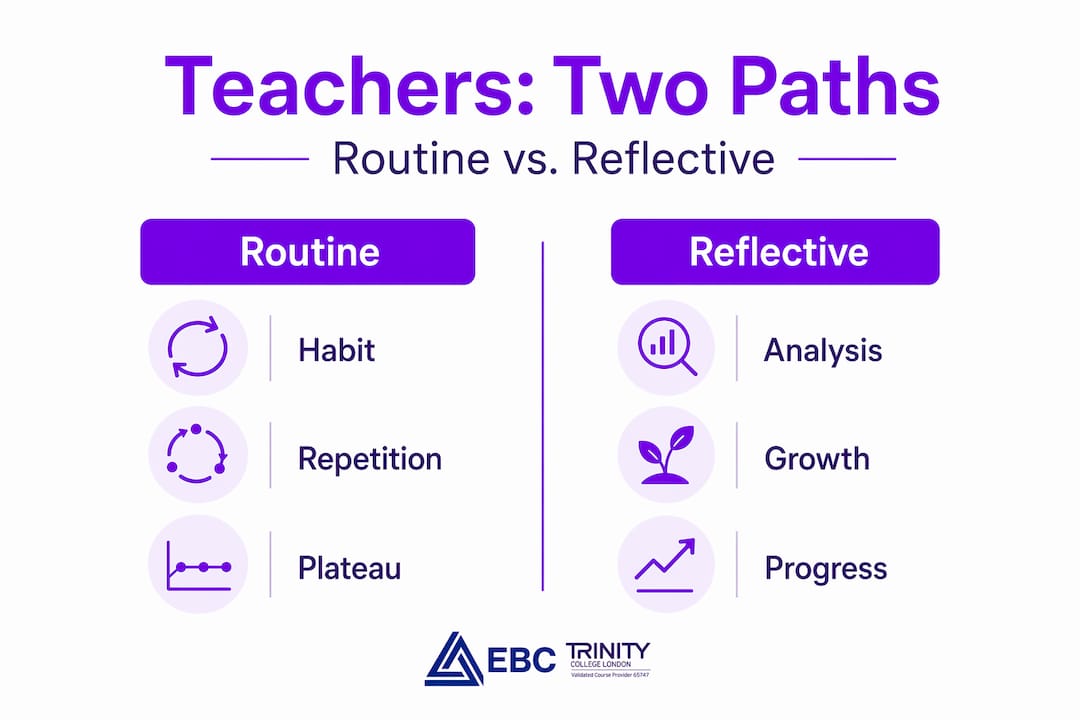
The difference between routine teaching and reflective teaching is significant. Routine teaching relies on habit and repetition, often without questioning whether those habits actually benefit students. Reflective teaching treats every lesson as a source of information. You observe patterns, identify challenges, and actively adapt your methods rather than repeating the same approaches regardless of outcome.
Understanding teacher reflection in TEFL is especially important for those teaching in international or multicultural contexts, where student expectations, learning cultures, and classroom dynamics can vary enormously from one country to the next. What worked in a classroom in Spain may not work in the same way in Italy or Japan.
As you reflect on your teaching, understanding assessment in TEFL can help you measure your learners’ progress, identify gaps in understanding and adapt your lessons more effectively.
Reflective teaching in TEFL typically involves the following features:
- Keeping a regular record of classroom observations and personal responses
- Actively seeking feedback from supervisors, peers, and learners
- Connecting theory from teacher training to real classroom experience
- Revisiting lesson plans in light of what actually happened
- Recognising patterns in student engagement and adapting accordingly
- Using lesson observation in TEFL as a structured window into your own teaching style
“Reflective teaching is not about self-criticism. It is about building a professional mindset that treats practice as ongoing evidence for improvement.”
This mindset separates TEFL teachers who plateau early from those who continue developing throughout their careers. Peer teaching in EFL training is one of the most effective ways to build this habit early, as it introduces structured observation before you even set foot in your own classroom.
Building positive routines can help teachers approach each day with greater focus and motivation. Discover this morning mantra for a personal perspective on maintaining motivation and reflecting on teaching experiences.
Structured models: How does reflection actually work?
Now that we understand what reflective teaching is, let us explore the structured methods teachers use to put reflection into action.
Several evidence-based frameworks support reflective practice in TEFL. The most widely used is Gibbs’ Reflective Cycle, which provides a clear structure that moves a teacher from experience to learning to planning. According to research on Gibbs’ Reflective Cycle and TESOL practice, the cycle lays out six stages from describing to planning future action, giving teachers a logical pathway through the reflection process.
| Stage | Question it asks | Purpose |
|---|---|---|
| Description | What happened? | Establishes the factual account |
| Feelings | What did you think and feel? | Surfaces emotional responses |
| Evaluation | What was good or bad? | Makes an honest judgement |
| Analysis | Why did it happen? | Seeks deeper understanding |
| Conclusion | What could you have done differently? | Generates alternatives |
| Action plan | What will you do next time? | Connects reflection to future teaching |
Applying this cycle in practice is straightforward. After a lesson, work through the stages in order:
- Write a brief description of the lesson as it unfolded, focusing on a specific moment or challenge.
- Note your emotional response. Were you frustrated, surprised, or uncertain?
- Evaluate honestly. What went well and what did not?
- Analyse the reasons behind the outcomes. Was it the task design, your instruction, student readiness, or classroom dynamics?
- Draw a specific conclusion about what you would do differently.
- Write one or two concrete actions for your next lesson plan.
The microteaching benefits for TEFL trainees are particularly strong here, as microteaching sessions create a safe environment to apply this cycle repeatedly in a short time. The more you practise the cycle, the more natural reflective thinking becomes.
If you want to improve your classroom skills in a focused setting, explore what microteaching is used for and how practising short lessons can help you develop your teaching techniques and confidence.
Pro Tip: Do not stop at the description stage. Many trainee teachers write detailed accounts of what happened but skip the analysis and action planning. The final two stages are where real growth occurs.
Building essential TEFL skills requires more than classroom hours. It requires a structured method for learning from those hours, and Gibbs’ cycle is one of the most practical tools available.
Collaborative and contextualised reflection: Beyond solo introspection
Many teachers think of reflection as a solitary activity, but research reveals a richer collaborative and contextual dimension.

Solo reflection is useful, but it has clear limits. Without external input, teachers can develop blind spots, reinforcing their own assumptions rather than genuinely questioning them. Collaborative reflection addresses this by bringing in the perspectives of colleagues, mentors, and supervisors. As research on contextualised reflective practice in junior high schools confirms, reflective practice can be embedded in collaborative models involving colleagues, supervisors, and lesson study principles.
| Approach | Strengths | Limitations |
|---|---|---|
| Solo reflection | Flexible, private, builds self-awareness | Risk of blind spots and bias |
| Collaborative reflection | Multiple perspectives, deeper insight | Requires trust and time |
| Lesson study | Focused, evidence-based, action-oriented | Needs structured facilitation |
| Supervisor observation | Expert feedback, formal accountability | Can feel evaluative rather than supportive |
Context also matters enormously. A reflective practice that works in a language school in Barcelona may need adjusting for a primary school in Rome or a university in Lyon. Local educational culture, student expectations, and institutional support all shape how and when reflection is most effective.
Collaborative reflection tools commonly used in TEFL training include:
- Structured peer observation using agreed observation criteria
- Post-lesson discussion with a teaching partner or mentor
- Group lesson study sessions where a shared lesson is observed and discussed
- Collaborative journalling or shared digital reflection platforms
- Video recordings of lessons reviewed with a peer or trainer
Using peer observation techniques within your training programme gives you direct experience of collaborative reflection before you begin teaching independently. This is particularly valuable in school-based TEFL training environments, where you are surrounded by a community of practice.
Research suggests that teachers who engage in collaborative reflection are significantly more likely to make sustained changes to their classroom practice compared to those who reflect alone. The social dimension of reflection makes growth more durable because you are held accountable to shared insights, not just private intentions.
Impact: Does reflective teaching improve student outcomes?
Having explored approaches to reflection, let us consider the real-world impact for learners and teachers alike.
The evidence is clear. Reflective teaching does not just benefit the teacher. It directly improves student outcomes, particularly when combined with deliberate instructional strategies. A study published in 2024 found that reflective teaching and pragmatic competence improvements are closely linked, specifically that reflective teaching, when combined with explicit instruction, significantly enhanced learners’ pragmatic competence in EFL contexts.
Pragmatic competence refers to a student’s ability to use language appropriately in real-world social situations. This is a high-level language skill, and the fact that reflective teaching influences it directly shows just how far-reaching the impact can be.
Here is how reflective teaching influences student outcomes in practice:
- Identifying engagement gaps. When you reflect systematically, you notice when students disengage. This prompts you to experiment with new tasks, grouping strategies, or pacing before disengagement becomes a habit.
- Adapting to learning styles. Reflection reveals patterns in who succeeds with which activities. You can then diversify your approach to reach more learners.
- Improving task design. By examining what students actually produce, you learn where instructions were unclear or tasks were too challenging, enabling you to refine them for the next group.
- Strengthening teacher-student relationships. When students see you adjusting your teaching based on their responses, trust increases. This creates a more positive classroom environment.
“A reflective teacher treats every lesson as both a teaching event and a learning event. The classroom teaches the teacher as much as the teacher teaches the class.”
Student engagement strategies become far more targeted when informed by reflection. Instead of applying general engagement techniques, you begin applying specific solutions to specific problems that you have identified through careful observation.
Pro Tip: At the end of each week, write three sentences summarising one thing that worked, one thing that did not, and one specific change you will make next week. This simple practice compounds over time into genuine professional growth.
Practical strategies: Tools and tips for reflective TEFL teaching
Finally, let us move from theory to action with practical strategies any TEFL trainee can use immediately.
Reflective practice does not require complex processes. Some of the most effective tools are simple and sustainable. As the research on TESOL critical reflection and action shows, structured tools such as journals and feedback loops connect reflection to actionable planning rather than retrospective description. The key word here is actionable. Reflection must lead somewhere practical.
Practical tools and strategies for TEFL teachers include:
- Teaching journal. Write briefly after each lesson. Focus on one specific event rather than the whole class. Over time, patterns emerge clearly.
- Observation checklist. Use a standard checklist during peer observations to give structured, consistent feedback to colleagues and to receive it in return.
- Audio or video recording. Record a lesson occasionally and watch it back. You will notice things that are invisible to you in the moment, particularly in your use of teacher talk time.
- Student feedback forms. Short, anonymous questionnaires at the end of a unit reveal student perceptions that you may never discover otherwise.
- Mentor dialogue. Regular conversations with a trainer or experienced colleague create a dialogue around your reflections rather than keeping them purely private.
- Lesson study cycles. Plan a lesson collaboratively, observe it together, and debrief with a structured focus question.
Consulting a teaching practice guide during your training will help you understand how these tools are applied in the context of observed teaching sessions, which are a core part of accredited TEFL programmes.
Pro Tip: Keep your reflective journal entries brief and focused. Long, unfocused entries are hard to revisit and often miss the specific detail that matters. One paragraph per lesson, centred on one clear observation, is far more useful than a page of general impressions.
Reflection also needs to be contextualised. Teaching English in France requires you to reflect on very different classroom dynamics than teaching in a language school in Madrid or a private academy in Milan. Building cultural and contextual awareness into your reflective practice makes you a much more adaptable and effective teacher across the international settings where TEFL opens doors.
A fresh perspective: True reflection goes beyond ticking boxes
Here is something that TEFL programmes do not always say clearly enough. Reflective practice is frequently reduced to paperwork. Trainees fill in a reflection form after their observed lesson, write what they think the assessor wants to read, and move on. That is not reflection. That is performance.
Real reflective teaching is uncomfortable at times. It requires you to question beliefs you have held for a long time about how students learn, about your own strengths, and about what good teaching looks like. A surface-level reflection asks “did the lesson go well?” A genuinely critical reflection asks “why do I keep defaulting to teacher-led explanations when my students consistently learn better through guided discovery?”
We have seen this pattern repeatedly. Teachers who complete their TEFL training with strong grades but a habit of surface-level reflection often struggle when they move into independent teaching roles abroad. Without the structure of a training programme, they have no internal framework for continued growth. Teachers who have genuinely internalised teacher reflection insights continue improving year after year because they have built a habit of questioning their assumptions.
The most effective reflective practice connects your classroom behaviour to your underlying beliefs about language learning and teaching. When you notice a mismatch between what you believe about how students learn and what you actually do in the classroom, that is where the most powerful professional growth happens. Collaborative models make this easier because another person can often see the mismatch before you can.
Treat reflection as a professional discipline, not a training requirement. The teachers who do this become the teachers who build long, successful, globally mobile TEFL careers.
Alongside reflective practice, mentoring in TEFL can help you identify development goals, learn from experienced colleagues and build confidence as you progress in your careers.
Next steps: Develop your TEFL expertise with accredited courses
If this article has shown you anything, it is that great teaching is built through deliberate, structured growth. Reflective practice is at the heart of that process, and the best place to develop it is within an accredited TEFL training programme that embeds reflection into every stage of your learning.
If you want to keep improving after you begin teaching, learn why continuing professional development matters for practising English teachers and how ongoing learning can help you strengthen your classroom practice.
At EBC TEFL, we offer globally recognised Trinity College London accredited programmes that place reflective practice at the centre of teacher development. Whether you are starting with a TEFL course introduction or pursuing TEFL certification for teaching abroad, our programmes are designed to build the skills, confidence, and reflective habits that international employers value. We also support your long-term global TEFL teacher development with free lifetime job placement assistance. Book a free consultation today and take the first concrete step towards a rewarding international teaching career.
Frequently asked questions
Is reflective teaching mandatory in TEFL programmes?
Most accredited TEFL programmes require some form of reflective practice, often built into assessments and feedback routines, as reflective practice is embedded in recognised teacher training and professional learning models.
What reflective tools are most effective for new TEFL teachers?
Journals, structured feedback from peers, and lesson study models are widely recommended. Research confirms that structured tools such as journals and feedback loops connect reflection to actionable planning rather than retrospective description.
How does reflective teaching improve classroom results?
Reflective teaching helps you identify what works for your specific students and adapt lessons for stronger engagement and learning outcomes, with evidence showing that reflective teaching and explicit instruction together enhanced learner competence in EFL settings.
Can reflective practice be done alone, or does it require collaboration?
While solo reflection builds self-awareness, the most effective models incorporate feedback and peer collaboration. Research confirms that reflective practice in collaborative models involving colleagues and supervisors produces deeper and more sustained professional growth.
Recommended
- Lesson Observation: Enhancing TEFL Success Abroad – EBC TEFL courses
- Essential skills every TEFL teacher needs to succeed – EBC TEFL courses
- Six great tips to keep your students attentive and focussed – EBC TEFL courses
- Senior learners, how to teach English to them
- Continuing professional development options for practising teachers