
Key Points
- Effective feedback accelerates language acquisition, builds learner confidence, and fosters autonomy in TEFL classrooms.
- Using varied, timely, and culturally-sensitive feedback methods enhances teaching effectiveness and international employability.
Feedback is one of the most powerful influences on learning and achievement in any educational context, and in TEFL and EFL classrooms, its impact is particularly direct. When you give a learner clear, targeted information about their language performance, you are not simply correcting errors. You are accelerating acquisition, building confidence, and shaping the conditions under which real communication becomes possible. Research consistently identifies effective feedback as a transformative pedagogical tool that increases learner motivation, language proficiency, and supports teacher growth. Trinity College London, whose accreditation standards underpin programmes like the Trinity CertTESOL, recognises feedback as a core competency for any qualified English language teacher globally.
The role of feedback in TEFL operates on several levels simultaneously:
- Corrective function: Identifies and addresses language errors before they become fossilised habits.
- Motivational function: Reinforces what learners are doing well, sustaining engagement and effort.
- Diagnostic function: Reveals gaps in understanding that inform your next lesson or unit.
- Developmental function: Encourages learner autonomy by guiding students to self-correct and reflect.
- Professional function: Sharpens your own teaching practice by revealing what your instruction has and has not achieved.
Feedback is not a one-way broadcast from teacher to student. At its best, it is an interactive process, learner-centred and responsive, shaped by who is in the room, what they are trying to do, and what the cultural context makes appropriate.
What types of feedback work in TEFL and EFL classrooms?
Understanding the full range of feedback forms available to you is the foundation of effective classroom practice. No single approach suits every learner, level, or task, and the most skilled TEFL teachers draw on several modalities within a single lesson.
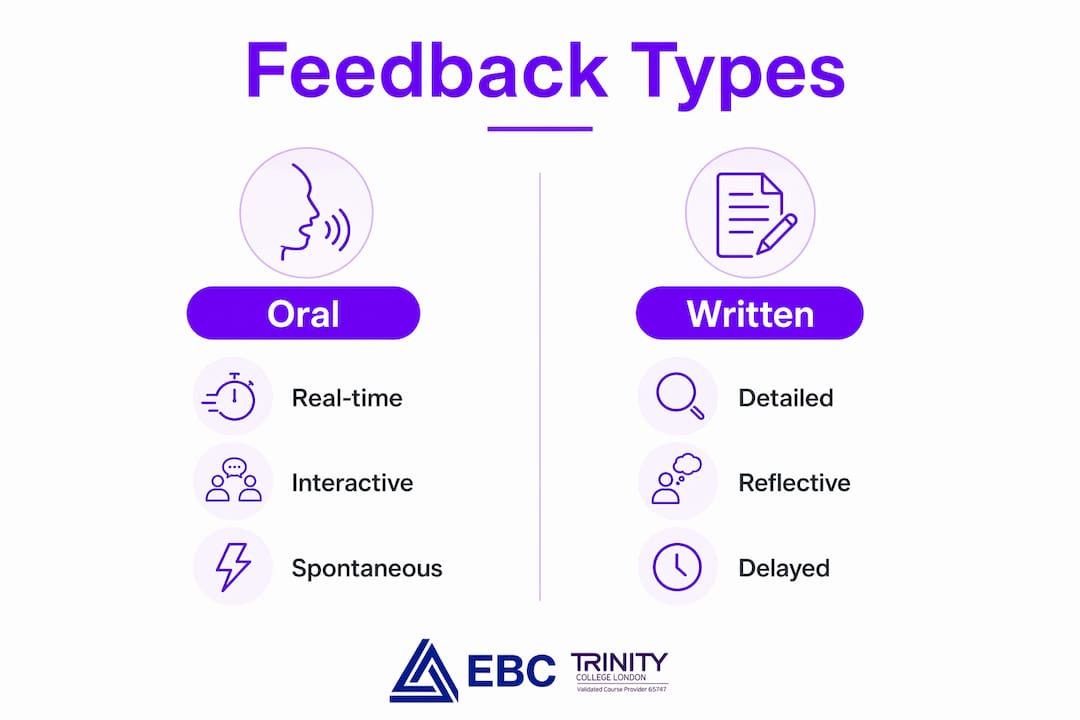
Oral vs written feedback
Oral feedback happens in real time, during or immediately after a speaking or listening activity. It is fast and responsive, but it disappears the moment it is spoken. Written feedback, by contrast, gives learners a record they can return to, making it particularly valuable for composition tasks, grammar exercises, and longer written assignments. Both forms carry weight; the choice depends on the task type and the learner’s needs.
Corrective vs non-corrective feedback
Corrective feedback focuses a learner’s attention on errors, whether through explicit correction, recasting, or elicitation. Non-corrective feedback takes the form of praise, encouragement, or commentary on successful language use. Research on oral corrective feedback in second language classrooms confirms that both types serve distinct purposes and that mixing them produces better outcomes than relying on correction alone.
Formal vs informal feedback
Formal feedback follows a structured format: written reports, end-of-term assessments, or graded rubrics. Informal feedback is spontaneous and conversational, the quiet word after a role-play or the encouraging nod during a presentation. Both matter. Informal feedback builds rapport and keeps learners engaged moment to moment; formal feedback provides the structured record that supports longer-term progress.
Immediate vs delayed feedback
The timing of feedback is one of the most consequential decisions you make as a teacher. For accuracy-focused tasks, immediate correction prevents errors from being reinforced. For fluency-based activities, interrupting communication to correct grammar can break a learner’s confidence and derail the task entirely. Delayed feedback, given after the activity is complete, protects the flow of communication while still addressing language points that need attention.
Peer and self-assessment feedback
Peer feedback supports reflective learning and deeper understanding, benefiting both the learner who gives it and the one who receives it. When students evaluate each other’s work, they engage analytically with language in a way that passive reception of teacher correction does not always achieve. Self-assessment, guided by clear criteria or prompts, builds metacognitive awareness and learner independence.
Cultural considerations
How feedback is received varies considerably across cultural contexts. Learners from educational traditions that emphasise deference to authority may find peer correction uncomfortable or even disrespectful. Others may interpret indirect feedback as unclear or unhelpful. A mixed approach tailored to learner age, level, and culture combining implicit and explicit methods is consistently recommended over any single fixed strategy.
Key feedback types at a glance:
- Oral feedback (real-time, spoken)
- Written feedback (recorded, revisable)
- Corrective feedback (error-focused)
- Non-corrective feedback (praise, encouragement)
- Formal feedback (structured, graded)
- Informal feedback (spontaneous, conversational)
- Immediate feedback (accuracy tasks)
- Delayed feedback (fluency tasks)
- Peer feedback (collaborative, reflective)
- Self-assessment (metacognitive, autonomous)
What are the benefits and challenges of feedback in TEFL?
The importance of feedback in TEFL is well established, but delivering it well is genuinely difficult. Knowing both sides of the equation helps you make better decisions in the classroom.
Benefits
Effective feedback accelerates language acquisition by closing the gap between what a learner currently produces and what they are aiming for. When feedback is constructive and well-timed, it builds trust. Learners who feel supported take more risks with language, attempt more complex structures, and participate more actively in speaking tasks. That willingness to experiment is where real acquisition happens.
Feedback also develops learner autonomy. When you guide a student to self-correct through a prompt or a questioning technique rather than simply providing the answer, you are teaching them a skill they can apply independently. Over time, this reduces dependence on teacher correction and produces more confident, self-directed language users.
From a teacher’s perspective, the feedback you receive from student performance is equally valuable. A learner’s consistent error pattern tells you something specific about your instruction that no lesson plan review can reveal.
Challenges
Constructive, supportive feedback builds trust and confidence, while overly critical feedback creates learner anxiety. In speaking tasks especially, anxiety about public correction can suppress participation entirely. Learners who fear being corrected in front of peers often choose silence over risk, which is the opposite of what a communicative classroom needs.
Large classes present a practical constraint. Providing individual, targeted feedback to thirty or forty learners in a single lesson is not always possible, and the quality of feedback can suffer when teachers are stretched. Cultural diversity adds another layer: what reads as encouraging directness to one learner may feel harsh or embarrassing to another.
Balancing praise with correction is a skill that takes time to develop. Too much praise without correction leaves errors unaddressed; too much correction without acknowledgement of success undermines motivation.
Benefits and challenges summarised:
| Benefits | Challenges |
|---|---|
| Accelerates language acquisition | Learner anxiety, especially in speaking tasks |
| Builds confidence and motivation | Large class sizes limiting individual attention |
| Develops learner autonomy | Cultural differences in feedback reception |
| Informs and improves teaching practice | Balancing praise with correction effectively |
| Supports self-correction and reflection | Linguistic diversity requiring tailored approaches |
Effective feedback strategies every TEFL teacher should know
The best feedback strategies in TEFL are not universal prescriptions. They are a toolkit you adapt to your learners, your context, and the specific task at hand. The following approaches are grounded in classroom evidence and widely applied by experienced EFL teachers across the world.
Take notes during tasks
Active note-taking while learners complete speaking or writing activities allows you to select specific, accurate examples for feedback rather than relying on memory. Note-taking during tasks provides concrete material for delayed feedback sessions and supports the use of visual tools like colour-coding, which increases student retention of corrections. Writing examples on the board, mixing errors with instances of good language use, turns the feedback session into a shared learning opportunity for the whole class.

Match timing to task type
For accuracy tasks, such as grammar drills or controlled writing exercises, give feedback immediately. Letting an error pass unchallenged in an accuracy context risks reinforcing it. For fluency tasks, such as discussions, role-plays, or presentations, delay feedback until the activity is complete to protect the communicative flow. This distinction is one of the most practically useful principles in TEFL feedback methodology.
Use implicit before explicit correction
Explicit correction tells a learner directly that they are wrong and provides the correct form. Implicit correction, through recasting or elicitation, signals the error without breaking the communicative exchange. Starting with implicit techniques preserves learner confidence and encourages self-correction. Move to explicit correction when implicit approaches have not worked or when the error is likely to cause persistent confusion.
Promote learner autonomy through prompts
Rather than correcting directly, try asking: “Are you sure about that verb form?” or “How would you say that in the past tense?” Guiding questions and prompts encourage student-led discovery and self-correction, which produces deeper and more durable learning than passive reception of the correct answer. This approach also builds metacognitive habits that transfer beyond the classroom.
Integrate peer feedback purposefully
Peer feedback works best when learners have clear criteria and some preparation. Asking students to evaluate each other’s work without guidance often produces vague or unhelpful responses. Structured peer review tasks, where learners respond to specific questions about their partner’s language use, generate more useful feedback and deepen both parties’ engagement with the material. The role of peer feedback in EFL is well supported by research, though it requires scaffolding to reach its potential.
Build a feedback ecology
Modern TEFL feedback extends beyond the teacher-to-student channel. Combining traditional teacher feedback with peer review and, where appropriate, technology-assisted tools creates a personalised and scalable feedback environment that supports mixed-ability classrooms. Online platforms, recorded speaking tasks, and collaborative writing tools all open additional feedback channels that complement what happens face to face.
Select errors strategically
Attempting to correct every error in a lesson overwhelms learners and dilutes the impact of each correction. Selective error correction, focusing on the errors most relevant to the lesson’s learning objectives or most likely to impede communication, produces better outcomes. Decide in advance which error types you will address in a given session and let others pass without comment.
Pro Tip: When giving delayed feedback after a fluency task, write a mix of errors and successful language examples on the board without labelling them. Ask learners to identify which is which before you discuss corrections. This technique activates attention, reduces the anxiety of being singled out, and makes the feedback session genuinely interactive.
Effective feedback strategies at a glance:
- Take notes during tasks for specific, accurate examples.
- Match feedback timing to the task type: immediate for accuracy, delayed for fluency.
- Use implicit correction first; move to explicit when needed.
- Ask guiding questions to promote self-correction and autonomy.
- Structure peer feedback with clear criteria and preparation.
- Combine teacher, peer, and technology-assisted feedback channels.
- Select errors strategically based on lesson objectives.
How feedback skills open doors in the global TEFL job market
Mastering feedback is not only good pedagogy. It is one of the most employable skills a TEFL teacher can develop, and it sets you apart in a competitive global market. Employers across Asia, Europe, Latin America, the Middle East, and beyond consistently look for teachers who can demonstrate pedagogical awareness, and feedback competence sits at the heart of that.
Feedback literacy is increasingly recognised as a career-defining skill. Balancing content and language corrections, knowing when to intervene and when to hold back, and being able to articulate your feedback rationale in an interview or observed lesson all signal the kind of professional maturity that language schools, universities, and corporate training providers actively seek. Teachers who can demonstrate this in a demo lesson or teaching portfolio have a clear advantage.
The ability to deliver lesson observation quality feedback, the kind that is specific, balanced, and learner-centred, also matters during teacher training programmes. Trinity College London’s Trinity CertTESOL, for example, assesses trainees on their ability to respond to learner needs in real time, which includes the quality and appropriateness of feedback given during observed teaching practice. Performing well in these assessments directly strengthens your certification profile and your readiness for international employment.
Peer and technology-assisted feedback tools are also becoming competitive advantages in themselves. Teachers who can integrate collaborative review processes and digital feedback channels into their practice are better equipped for online teaching roles, blended learning environments, and the increasingly tech-forward classrooms found across East Asia, the Gulf states, and Western Europe. Teaching English online now represents one of the fastest-growing employment sectors in EFL, and feedback delivery in digital contexts is a distinct skill set employers value.
Career benefits of feedback competence:
- Demonstrates pedagogical awareness in interviews and observed lessons.
- Strengthens performance in Trinity CertTESOL and other accredited assessments.
- Signals professional readiness for roles in schools, universities, and corporate training.
- Supports effective online and blended teaching, expanding your employment options globally.
- Builds the reflective practice habits that underpin long-term career development.
- Positions you as a teacher who can support diverse learners across cultural contexts.
EBC’s globally recognised programmes, including the Trinity CertTESOL, are designed to develop exactly these skills. With lifetime job placement support and a network spanning teaching markets across the world, EBC connects feedback-literate graduates with the international opportunities their training has prepared them for.
Ready to develop your feedback skills with an accredited TEFL qualification?

Feedback is a skill you can learn, practise, and refine. The right training programme gives you the frameworks, the observed teaching practice, and the expert guidance to develop feedback approaches that work across diverse global classrooms.
EBC offers Trinity College London accredited TEFL certification programmes that place feedback methodology at the centre of practical teacher training. Whether you are taking your first steps into English language teaching or building on existing experience, our courses prepare you to deliver feedback that genuinely moves learners forward. With one-year study and work abroad programmes in Spain, France, Italy, and beyond, plus lifetime job placement support across global teaching markets, EBC gives you the skills and the network to build a teaching career anywhere in the world.
Book a free consultation with our team today and find out which programme fits your goals.
Key insights on the role of feedback in TEFL
Effective feedback is the single most direct lever a TEFL teacher has for improving learner outcomes, and developing it as a deliberate, evidence-informed skill transforms both your teaching and your career prospects.
| Point | Details |
|---|---|
| Feedback drives acquisition | Targeted, timely feedback closes the gap between current performance and learning goals. |
| Timing shapes impact | Immediate feedback suits accuracy tasks; delayed feedback protects fluency and communication flow. |
| Autonomy over correction | Guiding questions and prompts produce deeper learning than direct correction alone. |
| Cultural context matters | Adapting feedback style to learner background and cultural expectations improves reception and outcomes. |
| Feedback literacy builds careers | Teachers who demonstrate balanced, learner-centred feedback stand out in global TEFL job markets. |
Core roles of feedback in TEFL, summarised:
- Corrects errors before they become fossilised habits.
- Motivates learners by acknowledging what they are doing well.
- Diagnoses gaps that shape future lesson planning.
- Builds learner autonomy through guided self-correction.
- Develops teacher practice by revealing the real impact of instruction.
- Adapts to cultural context, task type, and individual learner needs.
- Extends beyond the classroom through peer review and technology-assisted channels.