
Key Points
- Spain’s education system offers diverse opportunities for international teachers across public, concertado, and private schools. Bilingual and CLIL programs create strong demand for English speakers, especially at primary and secondary levels. Regional languages influence classroom practice, requiring adaptability and cultural awareness from teachers.
Spain is not the monolithic, Spanish-speaking classroom you might picture. Across its 17 autonomous communities, students learn in Catalan, Basque, Galician, and Valencian alongside Castilian Spanish, and the demand for qualified English speakers has never been stronger. Spain’s education system is structured into clear stages from Educación Infantil through to vocational training, each offering distinct opportunities for international teachers. Whether you are considering a language assistant role, a full teaching position, or a one-year study and work programme, understanding how Spanish education is organised will give you a genuine advantage before you arrive.
Table of Contents
- How Spain’s education system is structured
- Types of schools and what they offer
- Legislation, policies, and inclusion in Spanish classrooms
- Bilingual education, CLIL, and opportunities for English speakers
- The real classroom experience: What most TEFL guides miss
- Next steps: Start your teaching journey in Spain
- Frequently asked questions
Key Takeaways
| Point | Details |
|---|---|
| Education structure | Spain’s system includes multiple stages, with compulsory attendance from ages 6 to 16. |
| School types | There are public, concertado, and private schools, each offering unique environments and hiring practices. |
| Bilingual focus | Bilingual education and CLIL create growing demand for native English speakers, even without full teaching credentials. |
| Regional diversity | Classrooms are shaped by both Spanish and regional languages, especially in Catalonia or the Basque Country. |
| Teaching pathways | International teachers can engage as assistants or in bilingual roles in both public and private schools. |
How Spain’s education system is structured
Spain organises its education into five main stages, and knowing where each one sits helps you identify exactly where your skills are needed most.
| Stage | Age range | Compulsory? |
|---|---|---|
| Educación Infantil | 0 to 6 | No |
| Educación Primaria | 6 to 12 | Yes |
| ESO (secondary) | 12 to 16 | Yes |
| Bachillerato | 16 to 18 | No |
| Formación Profesional (FP) | 16+ | No |
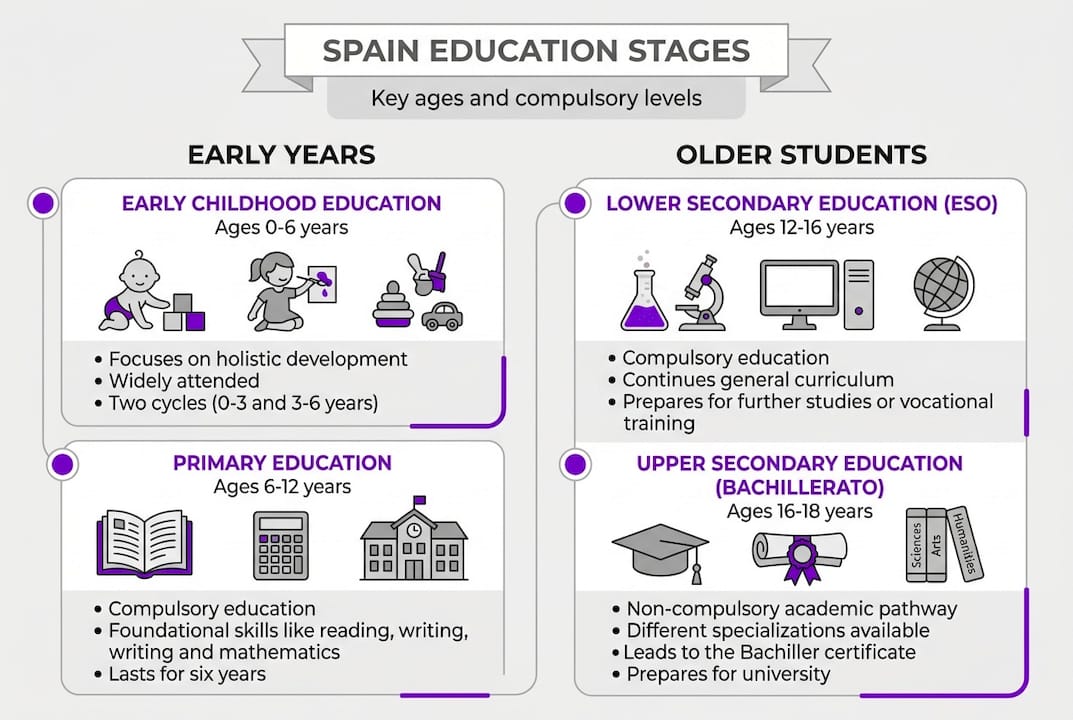
Education is compulsory from ages 6 to 16, covering Primaria and ESO. This means every child in Spain must be in school during those years, which creates a stable, well-funded demand for teachers at both primary and lower secondary levels.
Here is how each stage typically works in practice:
- Educación Infantil focuses on play-based learning and early language development. It is free in state schools but not obligatory.
- Educación Primaria runs for six years and introduces core subjects including a first foreign language, almost always English.
- ESO (Educación Secundaria Obligatoria) deepens subject knowledge and prepares students for either Bachillerato or vocational routes.
- Bachillerato is a two-year pre-university track with a strong academic focus, where English is a key subject.
- Formación Profesional offers vocational qualifications and is increasingly taught in bilingual formats.
“The transition from ESO to Bachillerato or FP is a critical decision point for students, and English proficiency often influences which pathway they can access.”
For international teachers, the most active hiring happens at Primaria and ESO level, where bilingual programmes are most widely implemented. If you want to work in Spain, understanding these transition points helps you target your applications effectively and match your experience to the right age group.
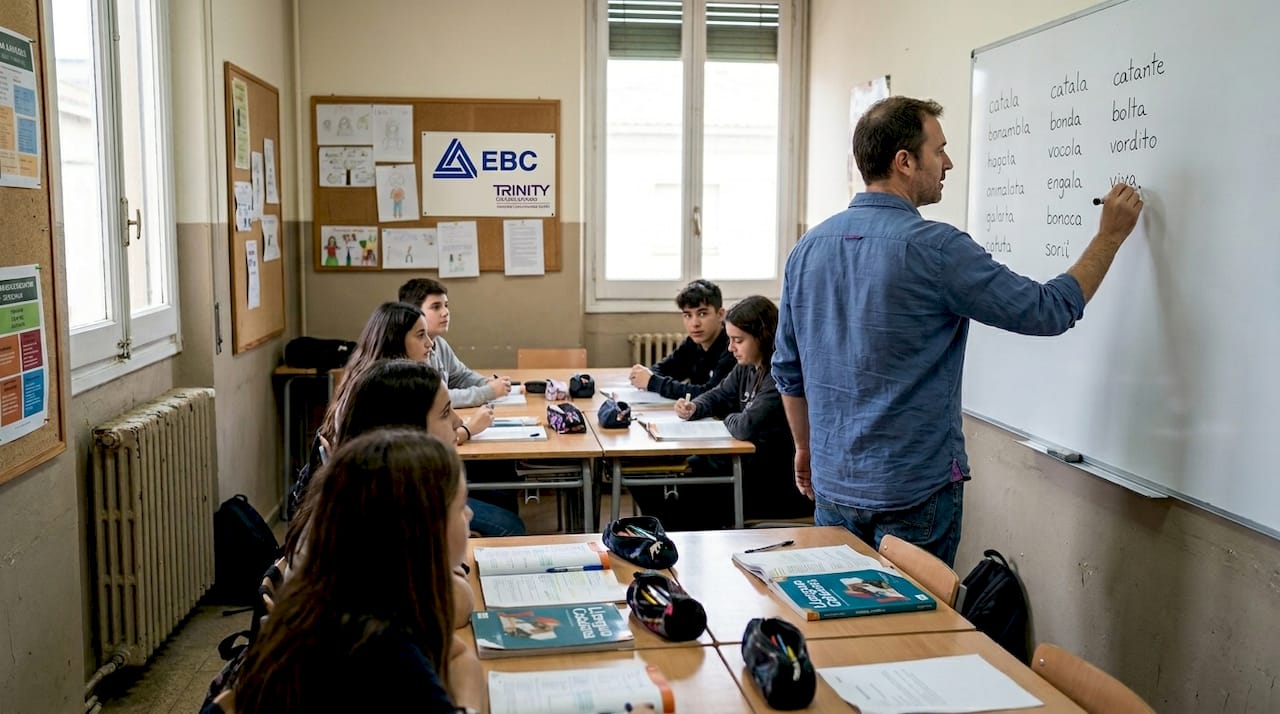
Regional differences add another layer of complexity. In Catalonia, the Basque Country, and Galicia, regional languages carry co-official status, and schools may use them as the primary medium of instruction. This affects timetabling, subject allocation, and how much English teaching time is available.
Types of schools and what they offer
With the basic structure in mind, let us explore the schools themselves and what makes each type unique.
Spain has three main school types, each with a distinct culture, funding model, and approach to hiring international staff.
| School type | Fees | Curriculum | English teaching demand |
|---|---|---|---|
| Public (Público) | Free | National/regional | High, especially in bilingual schools |
| Concertado | Modest | National, often Catholic ethos | Moderate to high |
| Private/International | Fee-paying | IB, British, or American | Very high |
Public schools are free and secular, concertado schools are semi-private with modest fees, and private or international schools are fully fee-paying, often following the International Baccalaureate or British curriculum. Each type presents different opportunities for you as an international teacher.
- Public schools run the majority of Spain’s bilingual programmes and actively recruit language assistants through government schemes. The atmosphere is inclusive and community-focused.
- Concertado schools often have a Catholic ethos and strong parental involvement. They hire English teachers directly and value reliability and cultural sensitivity.
- Private and international schools offer the highest salaries and the most structured English-medium environments. They typically require formal TEFL or TESOL certification and relevant experience.
Pro Tip: If you hold a Trinity CertTESOL or similar accredited qualification, private and international schools are far more likely to interview you. Public school language assistant roles are accessible without full teaching credentials, making them a strong entry point if you are building your CV.
Understanding which visa route applies to your situation is equally important. If you plan to study while you teach, exploring the student visa Spain option is a practical first step. You can also discover the range of student visa activities available to you, which go well beyond the classroom.
Legislation, policies, and inclusion in Spanish classrooms
Knowing where students learn is only half the story. The rules and values shaping learning in Spain matter just as much.
LOMLOE (2020) governs Spain’s education system, emphasising competency-based education, continuous assessment, inclusion, and bilingual programmes. This legislation replaced the previous LOMCE and shifted the focus from standardised exams towards ongoing evaluation and real-world skills.
For international teachers, LOMLOE has several practical implications:
- Continuous assessment means students are evaluated throughout the year rather than through a single final exam. You will need to keep records and contribute to ongoing progress reports.
- Competency-based learning asks teachers to design activities that build transferable skills, not just subject knowledge. English lessons should connect to real-life communication.
- Inclusion is a core principle. Classrooms are increasingly diverse, with students of varying abilities, learning needs, and linguistic backgrounds learning together.
- Bilingual programmes have expanded significantly under LOMLOE, creating more roles for English speakers across all school types.
“Inclusion in Spanish education means every student, regardless of ability or background, has the right to learn in the mainstream classroom with appropriate support.”
Pro Tip: As an international teacher, embracing inclusion from day one builds trust with Spanish colleagues and school leadership. Observe how local teachers differentiate their instruction and ask questions. Adaptability is valued far more than perfection.
Regional languages also interact with national legislation in complex ways. In bilingual regions, schools must balance Castilian Spanish, the regional language, and English, which can limit the hours available for English instruction. Exploring inclusion and diversity in international classrooms prepares you for this reality. You should also look into the evolving landscape of language assistants in Spain, as new programmes are actively creating paid roles for qualified candidates.
Bilingual education, CLIL, and opportunities for English speakers
Policy shapes practice, so how do bilingual education and classroom integration actually work for English speakers?
LOMLOE promotes immersive bilingual English through CLIL in public schools, creating assistant roles for native speakers without full teaching qualifications. Regional languages such as Catalan and Basque dominate instruction in some areas, which shapes how and where English is taught.
CLIL teaching, which stands for Content and Language Integrated Learning, is the method at the heart of Spain’s bilingual push. Rather than teaching English as a standalone subject, CLIL delivers geography, science, or art through English. Students absorb the language naturally while learning real content.
Here is what this means for you in practical terms:
- Language assistants support CLIL lessons by working alongside a Spanish teacher, modelling pronunciation, leading conversation activities, and providing authentic English input.
- Qualified TEFL teachers can lead CLIL lessons independently, particularly in private and concertado schools with established bilingual programmes.
- Volunteers and language coaches work in after-school programmes or language exchanges, often as a first step towards a paid role.
- Online English teachers are increasingly employed by Spanish schools to supplement in-person CLIL delivery.
Pro Tip: If you are placed in a region where Catalan or Basque is the dominant classroom language, do not be discouraged. Your English skills are still highly valued, and many students are eager to practise with a native or fluent speaker. Learning a few phrases in the regional language builds goodwill quickly.
Spain’s enthusiasm for bilingual education also extends to early language learning. Research consistently shows that learning Spanish with music accelerates acquisition for young learners, and understanding the benefits of songs for Spanish can inspire creative lesson planning in your own classroom. These approaches align naturally with CLIL methodology, making them practical tools for any international teacher.
The real classroom experience: What most TEFL guides miss
Most guides stop at the legislation and the job titles. What they rarely tell you is that teaching in Spain is as much a personal transformation as a professional one.
The gap between official policy and daily classroom reality is real. LOMLOE sets ambitious goals, but individual schools interpret them differently. One school may run a highly structured CLIL programme with dedicated resources; another may ask you to improvise with minimal support. Flexibility is not just a nice quality to have. It is the skill that determines whether you thrive or struggle.
Regional identity also shapes classroom culture in ways that no policy document captures. In Catalonia or the Basque Country, your role as an English speaker sits within a layered linguistic landscape. Students may switch between three languages in a single lesson. Embracing this complexity, rather than treating it as an obstacle, is what separates effective international teachers from frustrated ones.
We have seen, through EBC’s global network, that the teachers who gain the most from Spain are those who arrive curious rather than certain. They observe before they assert, ask before they assume, and invest in real diversity insights that go beyond surface-level cultural awareness. Spain will teach you as much about teaching as any certification course will.
Next steps: Start your teaching journey in Spain
If you are inspired to teach in Spain, the clearest next step is to get the right certification behind you.
A strong foundation starts with understanding what TEFL involves and choosing the pathway that fits your goals. EBC TEFL offers Trinity College London accredited programmes, including the Trinity CertTESOL, alongside one-year study and work abroad programmes in Spain that combine language study, teacher training, and visa support. Explore your certification options for teaching abroad and see which route aligns with your ambitions. Ready to take the first step? Speak to the EBC team and book a free consultation today.
Frequently asked questions
What are the compulsory school ages in Spain?
Education is compulsory for all children in Spain from ages 6 to 16, covering both primary and lower secondary education. Children outside this range may attend school voluntarily.
What types of schools can foreign teachers work in?
Foreign teachers are welcomed into public, concertado, and international schools, most commonly as language assistants or qualified English teachers. Each school type has different hiring requirements and salary structures.
What does CLIL mean in bilingual education?
CLIL stands for Content and Language Integrated Learning, a method where subjects such as science or geography are taught through English to promote natural bilingual development. It is widely used in Spain’s state bilingual programmes.
How do regional languages affect teaching in Spain?
In regions like Catalonia and the Basque Country, instruction is often primarily in the regional language, which can reduce English teaching hours and requires international teachers to adapt their expectations and approach.
