
Key Points
- Specialist TEFL courses provide focused training that enhances employment prospects in competitive markets.
- They boost earning potential, classroom effectiveness, and job application success, especially in Europe.
- Choosing the right course involves identifying your target learner group, location, and ensuring accreditation.
Many people assume that any TEFL certificate will open the same doors. That belief can quietly hold you back. The reality is that specialist TEFL courses offer a focused depth of training that standard qualifications simply do not provide. If you are aiming to teach in competitive markets like Spain, France, or Italy, or hoping to work with specific learner groups such as business professionals or young children, a specialist course is not a luxury. It is a genuine career advantage. This article walks you through what specialist TEFL courses are, which types exist, and how to choose the right one for your goals.
Table of Contents
- Understanding specialist TEFL courses
- Types of specialist TEFL courses available
- Benefits of taking a specialist TEFL course
- How to choose and succeed in a specialist TEFL course
- Why most aspiring teachers underestimate specialist TEFL courses
- Take the next step: find your ideal TEFL specialism
- Frequently asked questions
Key Takeaways
| Point | Details |
|---|---|
| Specialist TEFL deepens expertise | These courses provide targeted training for teachers wanting to excel in specific types of classrooms or roles abroad. |
| Boosts job opportunities | Holding a specialist TEFL certificate can make you more attractive to international employers, especially in Spain, France, and Italy. |
| Higher earnings and mobility | Specialist qualifications often lead to higher salaries and more options for teaching around the globe. |
| Choose the right specialism | Match the course to your career ambitions, student type, and preferred locations for maximum results. |
Understanding specialist TEFL courses
A specialist TEFL course is a focused training programme that builds on your foundational TEFL or TESOL qualification. Where a standard course teaches you the basics of lesson planning, grammar instruction, and classroom management, a specialist course goes further. It equips you with targeted skills for specific teaching contexts, learner types, or subject areas.
According to EBC TEFL’s specialist guide, “specialist TEFL courses offer in-depth knowledge on targeted teaching skills.” That depth makes a real difference when you walk into a classroom full of business executives, teenagers preparing for IELTS, or young children encountering English for the first time.
The most common subject areas covered in specialist TEFL programmes include:
- Business English: teaching language skills within professional and corporate contexts
- Young Learners: adapting methodology and classroom management for children and teenagers
- Exam preparation: guiding students through qualifications such as IELTS, Cambridge, or TOEFL
- Teaching online: structuring effective lessons for virtual classrooms and digital platforms
- CLIL (Content and Language Integrated Learning): teaching academic subjects through the medium of English
Who benefits most from specialist training? Career changers bring professional experience that aligns perfectly with Business English teaching. Graduates targeting specific job markets in Europe gain a clear competitive edge. Teachers already working abroad who want to secure promotions or better-paying roles also find specialist credentials highly valuable.
If you are still weighing your options, our guide to choosing a TEFL course offers a structured way to assess your goals before committing. You can also explore the broader landscape of TEFL teaching with the British Council to understand what international employers expect.
Pro Tip: Take stock of your professional background before selecting a specialism. Former business professionals often find that Business English teaching is a natural and highly rewarding transition.
Types of specialist TEFL courses available
Now that you know what specialist TEFL courses are, let us explore which types are currently available and what each covers.
Numerous specialist TEFL courses are tailored to emerging needs in the international education market. Understanding the differences helps you make a smarter investment of time and money.
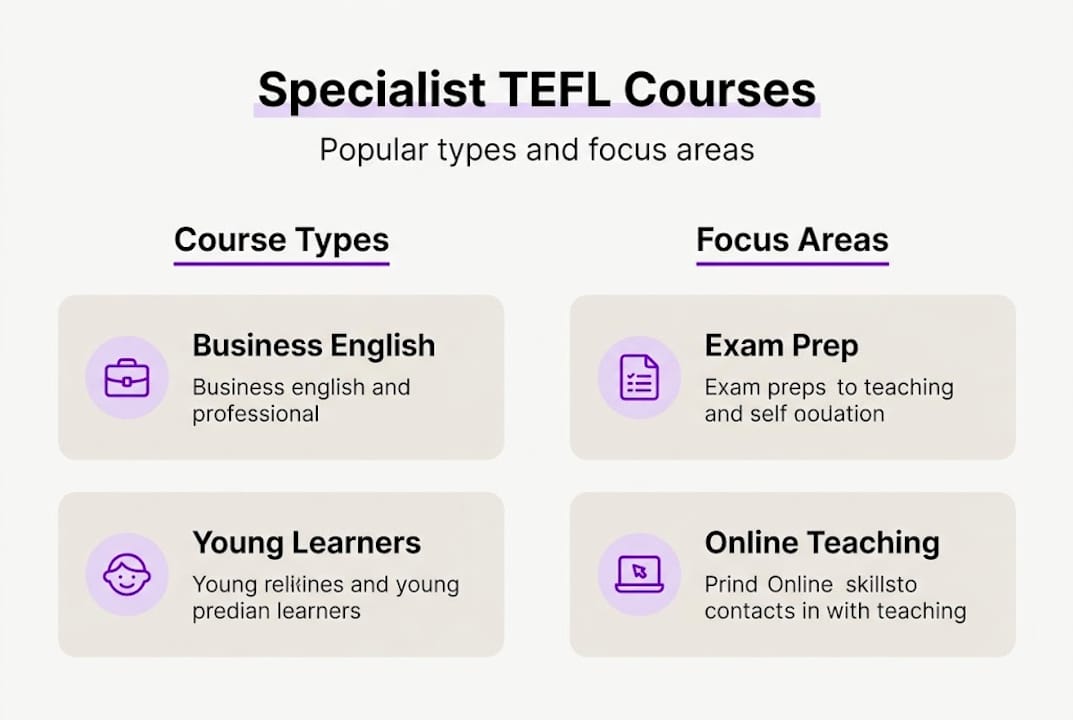
| Course type | Focus area | Typical format |
|---|---|---|
| Business English | Corporate and professional communication | Classroom or blended |
| Young Learners | Child development and adapted methodology | Classroom or online |
| Exam preparation | IELTS, Cambridge, TOEFL coaching | Blended or online |
| Teaching online | Virtual classroom tools and digital pedagogy | 100% online |
| CLIL | Subject teaching through English | Classroom or blended |
Course formats vary considerably. Some programmes are delivered entirely in a physical classroom, which suits learners who thrive with face-to-face interaction and structured timetables. Blended programmes combine online study with in-person teaching practice, offering flexibility without sacrificing real classroom experience. Fully online courses are ideal if you are already based abroad or have work commitments that prevent full-time study.
Country-specific immersion options are particularly relevant if you are targeting Spain, France, or Italy. These programmes weave specialist TEFL training into a broader cultural and linguistic experience, allowing you to develop essential teaching skills for TEFL while living in your chosen country.
In terms of demand, Business English and online teaching are currently among the fastest-growing specialisms globally. Schools in major European cities actively seek teachers who can deliver corporate training programmes. You can review sample specialist TEFL modules to get a sense of what leading providers include in their syllabi.
- Specialist courses range from short add-on modules to full multi-week programmes
- Some qualifications stack onto accredited certifications like the Trinity CertTESOL
- Immersion options in Spain, France, and Italy include visa support and job placement
- Online specialism courses are increasingly accepted by international schools
Benefits of taking a specialist TEFL course
Understanding the types of courses available, let us look at the tangible advantages of investing in a specialist TEFL qualification.

Specialist TEFL certification increases employability and earning potential in high-demand markets. That statement carries real weight when you consider how competitive teaching positions in Spain, France, and Italy can be. Schools in these countries receive dozens of applications for each vacancy, and a specialist credential helps yours stand out immediately.
Here are the key benefits, ranked by impact:
- Higher earning potential: Specialist teachers can command noticeably better pay, particularly in Business English and exam preparation roles
- Stronger job applications: Niche qualifications signal commitment and expertise to employers
- Better classroom outcomes: Targeted training leads to more effective lessons and more satisfied students
- Visa and work permit competitiveness: Some European countries favour applicants with demonstrated specialism in their visa application assessments
- Faster career progression: Specialist credentials create clear pathways to senior teaching, teacher training, and academic management roles
| Qualification level | Typical monthly salary (Europe) | Job application success rate |
|---|---|---|
| Standard TEFL | £1,200 to £1,600 | Moderate |
| Specialist TEFL | £1,600 to £2,200 | High |
| Trinity CertTESOL + specialism | £2,000 to £2,800 | Very high |
Teaching satisfaction also improves significantly. When you are trained for your specific classroom context, lessons flow more naturally. You feel prepared rather than improvising. Read more about TEFL teacher salaries and the broader benefits of teaching English abroad to see the full picture. For further context, explore why take a specialist TEFL from a practitioner perspective.
Pro Tip: If you are applying to schools in Spain or Italy, highlight your specialism in the first line of your cover letter. Employers scan quickly and reward clarity about what you specifically bring to their classrooms.
How to choose and succeed in a specialist TEFL course
Now that the benefits are clear, let us discuss how to select the right specialist TEFL course and thrive in your training.
Selecting the right TEFL specialisation is key for professional growth and satisfaction. Too many aspiring teachers choose a course based on price or convenience alone, only to find it does not match their career direction.
Follow these steps to choose wisely:
- Define your target learner group: Are you drawn to business professionals, children, university students, or exam candidates?
- Research the job market: Check current vacancies in Spain, France, and Italy to identify which specialisms appear most frequently
- Verify accreditation: Ensure the course is validated by a recognised body such as Trinity College London
- Confirm teaching practice hours: Real classroom time is non-negotiable for genuine professional readiness
- Ask about job placement support: The best providers offer lifetime job placement support as part of their package
Choosing a specialist TEFL course is not just about adding a line to your CV. It is about building the specific skills that make you genuinely effective in the classroom environments you want to work in.
Once enrolled, succeed by treating every teaching practice session as a real job interview. Arrive prepared, reflect honestly on feedback, and actively connect theory to classroom practice. Review our top TEFL course tips for practical guidance on getting the most from your training experience. If you want further external perspective, this guide on choosing the right TEFL course covers common pitfalls to sidestep.
Avoid the mistake of selecting a course because it is the shortest or cheapest option. Specialist training is an investment, and the returns, in salary, job security, and personal satisfaction, are genuinely worth it.
Pro Tip: Request a sample lesson or syllabus overview before enrolling. Reputable providers are always happy to share this, and it confirms whether the content truly matches your professional goals.
Why most aspiring teachers underestimate specialist TEFL courses
Here is something we observe consistently: many aspiring teachers complete a standard TEFL certificate, arrive abroad full of enthusiasm, and then discover the gap between basic training and real classroom demands. It is not a failure of effort. It is a gap in preparation.
Standard TEFL certificates are valuable starting points, but they cover broad principles rather than the specific strategies needed for business professionals who have no patience for beginner-level activities, or for young learners who need constant engagement and age-appropriate material.
Reputable schools and international employers are increasingly explicit about wanting niche expertise. They want teachers who arrive ready, not teachers who will take months to find their footing. Specialist TEFL training transforms your confidence and versatility from day one. It is the difference between surviving in a new classroom and genuinely thriving in it. In a competitive global market, that distinction matters far more than most aspiring teachers initially realise.
Take the next step: find your ideal TEFL specialism
If this article has shifted your thinking about specialist TEFL courses, you are already moving in the right direction. At EBC TEFL, we offer globally recognised, Trinity College London accredited qualifications and immersive one-year study and work programmes in Spain, France, and Italy. Our programmes are built for serious career changers and ambitious graduates who want more than a basic certificate.
Explore our full range of TEFL certification for global careers and discover which specialism fits your goals. If you are new to TEFL, our introduction to TEFL is a great place to begin. Ready to talk it through? Book a free consultation with our team today and get personalised guidance on your next step.
Frequently asked questions
What is a specialist TEFL course?
A specialist TEFL course is an advanced programme that focuses on a specific teaching context or learner group, building directly on your core TEFL qualification. It gives you targeted skills that a standard certificate does not cover.
Do I need a specialist TEFL course to work abroad?
It is not always a strict requirement, but specialist certification significantly strengthens your application, particularly for top schools in competitive European destinations like Spain, France, and Italy.
How do I choose the right specialist TEFL course?
Start by identifying your target learner group and preferred teaching location, then select an accredited course that matches those aims. Our Dr. TEFL guide walks you through every consideration step by step.
Are specialist TEFL courses recognised internationally?
Yes. Specialist qualifications from accredited providers such as those validated by Trinity College London are recognised internationally by schools and employers across Europe, Asia, and beyond.
Recommended
- Master TEFL Job Search Methods for Global Teaching Success EBC TEFL courses EBC TEFL courses
- International TEFL Career Steps: Your Path to Global Teaching – EBC TEFL courses
- How Do I Teach English Abroad: Accredited Programmes Guide – EBC TEFL courses
- Specialised TEFL Courses: The Complete Guide – EBC TEFL courses