
Structuring an English course feels different when you know your choices will shape real classrooms. For many aspiring teachers, understanding syllabus design opens doors to meaningful cultural exchange and purposeful teaching. This article will clarify the frameworks, approaches, and collaborative methods that set professional TEFL training apart, ensuring your lessons are both impactful and recognised across Europe.
Table of Contents
- Defining Syllabus Design In TEFL Contexts
- Major Syllabus Types For English Teaching
- Essential Steps In Syllabus Creation
- Challenges And Common Misconceptions
- Impact On Accreditation And Employability
Key Takeaways
| Point | Details |
|---|---|
| Importance of Syllabus Design | Syllabus design is vital for structuring effective TEFL instruction, emphasising learner needs and cultural contexts. |
| Collaborative Approach | Modern methods call for incorporating student perspectives in syllabus creation, making the process more democratic and responsive. |
| Types of Syllabi | Different syllabus types (Structural, Communicative, Task-Based, Content-Based) serve distinct educational contexts and objectives. |
| Continuous Improvement | Regularly adapt and review syllabi to remain aligned with evolving learner needs and educational methodologies. |
Defining Syllabus Design in TEFL Contexts
Syllabus design in TEFL represents a strategic framework that shapes language learning experiences. Unlike generic curriculum planning, it offers a nuanced, purposeful approach to structuring English language instruction. Structured course planning involves carefully considering learner needs, cultural contexts, and pedagogical objectives.
At its core, syllabus design serves multiple critical functions in language education:
- Provides a comprehensive roadmap for language instruction
- Establishes clear learning objectives and progression
- Allows for systematic assessment and skill development
- Enables flexibility for teacher and student engagement
The traditional approach to syllabus design often centred on instructor-led strategies. However, contemporary TEFL methodologies emphasise a more collaborative model. Incorporating student perspectives transforms syllabus development from a top-down process into a democratic, responsive educational experience.
Modern syllabus design recognises that effective language learning extends beyond rigid content delivery. It requires understanding learner backgrounds, interests, and cultural contexts. By creating flexible frameworks that adapt to diverse student needs, educators can craft more engaging and personalised language learning experiences.
Pro tip: When designing a TEFL syllabus, always prioritise learner agency and create space for student input and cultural representation.
Major Syllabus Types for English Teaching
In English language teaching, several distinct syllabus design approaches provide educators with strategic frameworks for language instruction. These varied approaches reflect different theoretical perspectives on language learning and communication, each offering unique advantages for specific teaching contexts.
The primary syllabus types in TEFL include:
- Structural Syllabus: Focuses on grammatical structures and language forms
- Communicative Syllabus: Emphasises real-world language use and interaction
- Task-Based Syllabus: Centres on practical language application through meaningful tasks
- Content-Based Syllabus: Integrates language learning with subject matter instruction
Theoretical foundations of language teaching reveal that each syllabus type addresses different learning objectives. The structural syllabus prioritises systematic language development, breaking down linguistic elements into progressive components. Communicative and task-based approaches, by contrast, emphasise authentic language production and practical skill development.
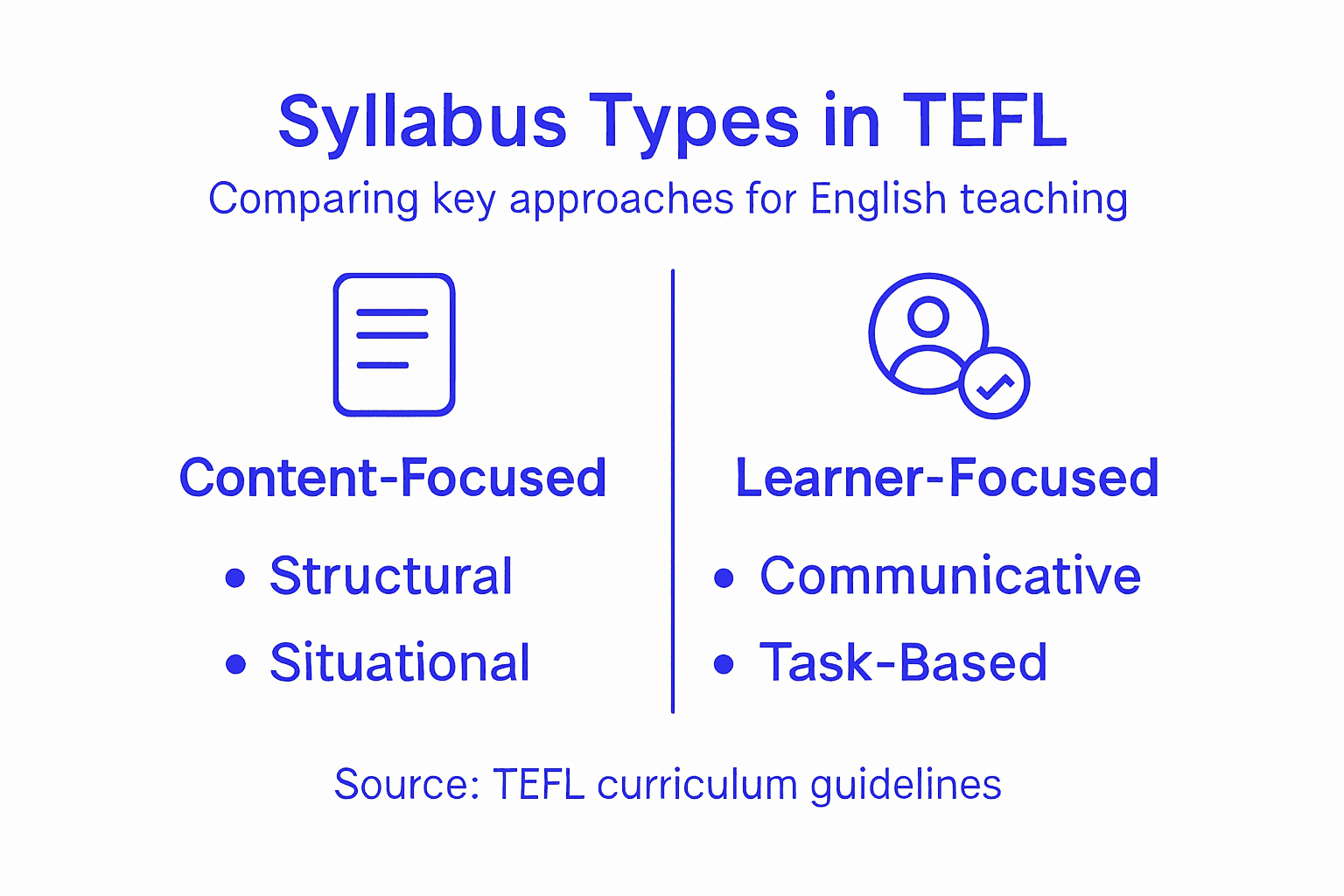
To clarify the distinctions between TEFL syllabus types, here is a comparative table highlighting their core focus and teaching contexts:
| Syllabus Type | Main Focus | Ideal Teaching Context | Typical Outcomes |
|---|---|---|---|
| Structural | Grammar and language forms | Academic or exam preparations | Systematic language foundation |
| Communicative | Real-world language use | Everyday conversation courses | Enhanced interaction skills |
| Task-Based | Practical task completion | Vocational or project classes | Applied language proficiency |
| Content-Based | Subject matter integration | CLIL or themed modules | Deeper academic understanding |
Choosing an appropriate syllabus type requires careful consideration of learner needs, educational goals, and contextual factors. Educators must evaluate their students’ linguistic backgrounds, learning styles, and specific language acquisition objectives to design the most effective instructional framework.
Pro tip: Always match your syllabus type to your specific learner group’s needs and language learning context for maximum educational impact.
Essential Steps in Syllabus Creation
Creating an effective syllabus requires a methodical and strategic approach that balances pedagogical objectives with learner needs. While no universal template exists, certain fundamental steps can guide educators through the complex process of syllabus development.
The key stages of syllabus creation include:
- Needs Assessment: Thoroughly analyse learner backgrounds, linguistic levels, and learning objectives
- Learning Outcomes: Clearly define specific, measurable language acquisition goals
- Content Sequencing: Develop a logical progression of language skills and knowledge
- Assessment Strategies: Design evaluation methods aligned with learning outcomes
- Resource Selection: Choose appropriate materials supporting syllabus objectives
Successful syllabus development demands careful consideration of multiple interconnected factors. Educators must balance theoretical frameworks with practical implementation, ensuring that instructional design remains flexible and responsive to individual learner requirements. The process involves continuous refinement, integrating feedback and adapting to emerging educational technologies and methodological innovations.

Implementing a comprehensive syllabus requires understanding the intricate relationship between curriculum design, instructional methods, and learner engagement. By adopting a holistic approach, teachers can create dynamic learning experiences that effectively support language acquisition across diverse educational contexts.
Pro tip: Regularly review and adapt your syllabus, treating it as a living document that evolves with your students’ changing needs and learning dynamics.
Challenges and Common Misconceptions
Syllabus design in TEFL is fraught with complex challenges that extend beyond simple curriculum planning. Syllabus development misconceptions often stem from fundamental misunderstandings about the nature of language learning and instructional design.
Common misconceptions in syllabus creation include:
- Treating syllabi as rigid, unchangeable documents
- Excluding student perspectives from the design process
- Assuming a one-size-fits-all approach to language instruction
- Overlooking individual learner differences and contextual factors
- Prioritising grammatical structures over communicative competence
Graduate student perceptions reveal that many educators struggle to understand syllabus design as a dynamic, collaborative process. The most significant challenge lies in moving beyond traditional, instructor-centric models towards more inclusive and adaptive approaches that genuinely respond to learner needs.
Navigating these challenges requires a paradigm shift in understanding syllabus development. Successful educators recognise that a syllabus is not a fixed contract, but a living document that evolves with learner feedback, emerging pedagogical insights, and changing linguistic landscapes.
Pro tip: Approach syllabus design as a collaborative dialogue, not a monologue, by regularly seeking and integrating student perspectives and experiences.
Impact on Accreditation and Employability
Syllabus design serves as a critical mechanism for determining professional credibility and career prospects in the TEFL landscape. Curriculum alignment with industry standards determines an educator’s professional recognition and employability potential.
Key aspects of syllabus impact on professional development include:
- Direct correlation with institutional accreditation
- Alignment with international language frameworks
- Demonstration of pedagogical expertise
- Evidence of contemporary teaching methodologies
- Reflection of learner-centred instructional approaches
Workplace English competencies are fundamentally shaped by syllabus design. Syllabi incorporating real-world communicative tasks significantly enhance teachers’ marketability, presenting them as adaptable professionals capable of meeting diverse linguistic challenges.
Successful TEFL professionals understand that a meticulously designed syllabus functions as more than an instructional document. It represents a professional passport, signalling competence, adaptability, and commitment to dynamic language education practices.
Below is a summary table outlining how robust syllabus design can influence both accreditation and teacher employability in the TEFL sector:
| Aspect | Influence on Accreditation | Impact on Employability |
|---|---|---|
| Alignment | Satisfies institutional standards | Demonstrates adaptability |
| Methodologies | Meets international frameworks | Showcases pedagogical expertise |
| Learner-Centred | Supports quality assurance | Appeals to diverse employers |
| Innovation | Enables curriculum updates | Highlights professional growth |
Pro tip: Continuously update your syllabus design skills to remain competitive and attractive to potential employers in the global TEFL market.
Elevate Your TEFL Career with Expert Syllabus Design Training
Designing an effective syllabus is essential for guiding your learners’ success and enhancing your teaching portfolio. If you want to master the art of creating flexible, learner-centred syllabi that align with international standards and boost your professional credibility, EBC TEFL offers tailored solutions for you. Our Trinity College London accredited courses provide practical, hands-on teacher training that equips you with the skills to develop dynamic and impactful syllabi ready for today’s global classrooms.
Take the next step with our comprehensive Trinity CertTESOL and specialised certification programmes. Benefit from lifetime global job placement support and explore unique 1-year study and work abroad programmes in Spain, France, and Italy that combine accredited training with cultural immersion and professional development. Start designing your future with confidence and secure your place at EBC TEFL today.
Frequently Asked Questions
What is syllabus design in the TEFL context?
Syllabus design in TEFL refers to the strategic framework that structures English language instruction, focusing on learner needs, objectives, and cultural contexts to create effective language learning experiences.
Why is syllabus design important for language educators?
Syllabus design is crucial as it provides a roadmap for instruction, establishes clear learning objectives, supports systematic assessment, and allows flexibility for both teacher and student engagement in the learning process.
What are the main types of syllabi used in English language teaching?
The main types of syllabi in English language teaching include structural syllabi, communicative syllabi, task-based syllabi, and content-based syllabi, each with different focuses and ideal teaching contexts.
How can teachers ensure their syllabus meets learner needs?
Teachers can ensure their syllabus meets learner needs by conducting thorough needs assessments, defining clear learning outcomes, sequencing content logically, selecting appropriate resources, and regularly reviewing and adapting the syllabus based on student feedback.
Recommended
- What Is a TEFL Course Syllabus? Complete Breakdown – EBC Trinity CertTESOL and TEFL courses
- Task-based Language teaching – EBC Trinity CertTESOL and TEFL courses
- Specialised TEFL Courses: The Complete Guide – EBC TEFL courses
- Teaching IELTS, everything you need to know – EBC Trinity CertTESOL and TEFL courses
