
More than half of TEFL teachers now start their careers abroad, drawn by accredited programmes that promise real-world experience and lifelong opportunities. Teacher development is no longer limited to a single classroom or country—it shapes how you engage with global learners, adapt to cultural challenges, and build cutting-edge skills. Discover how refining your practice as an English educator can open new doors, strengthen your credentials, and give you the confidence to succeed worldwide.
Table of Contents
- Defining Teacher Development In TEFL
- Types Of Teacher Development Programmes
- Key Features Of Internationally Accredited Courses
- Requirements For Trinity College London Certification
- Study And Work Abroad Programme Benefits
- Lifetime Global Job Support For Teachers
Key Takeaways
| Point | Details |
| Ongoing Professional Growth | Teacher development in TEFL is a continuous process, emphasising lifelong learning and adaptation to new methodologies and technologies. |
| Diverse Programme Types | Various teacher development programmes exist, including initial training, continuing professional development, and specialised courses tailored to specific educational contexts. |
| Importance of Accreditation | Internationally accredited TEFL courses ensure high-quality training, including comprehensive curricula and practical teaching experiences to prepare educators for global environments. |
| Lifetime Job Support | Comprehensive global job support services provide ongoing career assistance, including job placement, mentorship, and networking opportunities for teachers. |
Defining teacher development in TEFL
Teacher development in Teaching English as a Foreign Language (TEFL) represents a comprehensive, dynamic process of ongoing professional growth and skill enhancement. At its core, this approach recognises teaching as a complex, evolving profession that demands continuous learning and adaptation. Professional learning in global teaching contexts involves systematic strategies designed to improve pedagogical practices and maintain high educational standards.
The landscape of teacher development encompasses multiple dimensions, including formal training, reflective practice, peer collaboration, and self-directed learning. Educators engage in various activities such as workshops, conferences, online courses, mentoring programmes, and action research to expand their instructional capabilities. Critically, this process is not limited to new teachers but represents a lifelong commitment to professional excellence. Continuous professional development supports teachers in understanding emerging methodologies, technological innovations, and diverse learner needs across international contexts.
Key components of effective teacher development include critically examining existing teaching practices, developing specialised skills, understanding cultural dynamics in language education, and maintaining adaptability in rapidly changing educational environments. Teachers must continuously update their knowledge of language acquisition theories, instructional technologies, and intercultural communication strategies. This holistic approach ensures that English language educators can provide high-quality, contextually relevant instruction that meets global academic and professional standards.
Pro tip: Consider documenting your professional development journey through a reflective teaching portfolio, tracking your learning experiences, challenges overcome, and skills acquired to demonstrate continuous growth and commitment to excellence.
Types of teacher development programmes
Teacher development programmes in TEFL represent a diverse and dynamic range of educational experiences designed to enhance professional capabilities across different stages of an educator’s career. Professional development models encompass multiple formats, including intensive courses, online training, workshops, and specialised certifications tailored to specific teaching contexts and learner demographics.
These programmes typically fall into several key categories. Initial training programmes provide foundational pedagogical skills for new teachers, often including classroom management techniques, lesson planning, and language teaching methodologies. Continuing professional development (CPD) programmes support experienced educators in refining their practice, introducing innovative teaching strategies, and staying current with emerging educational technologies. Specialised programmes focus on niche areas such as business English, young learner instruction, online teaching, and intercultural communication, allowing teachers to develop expertise in specific domains.
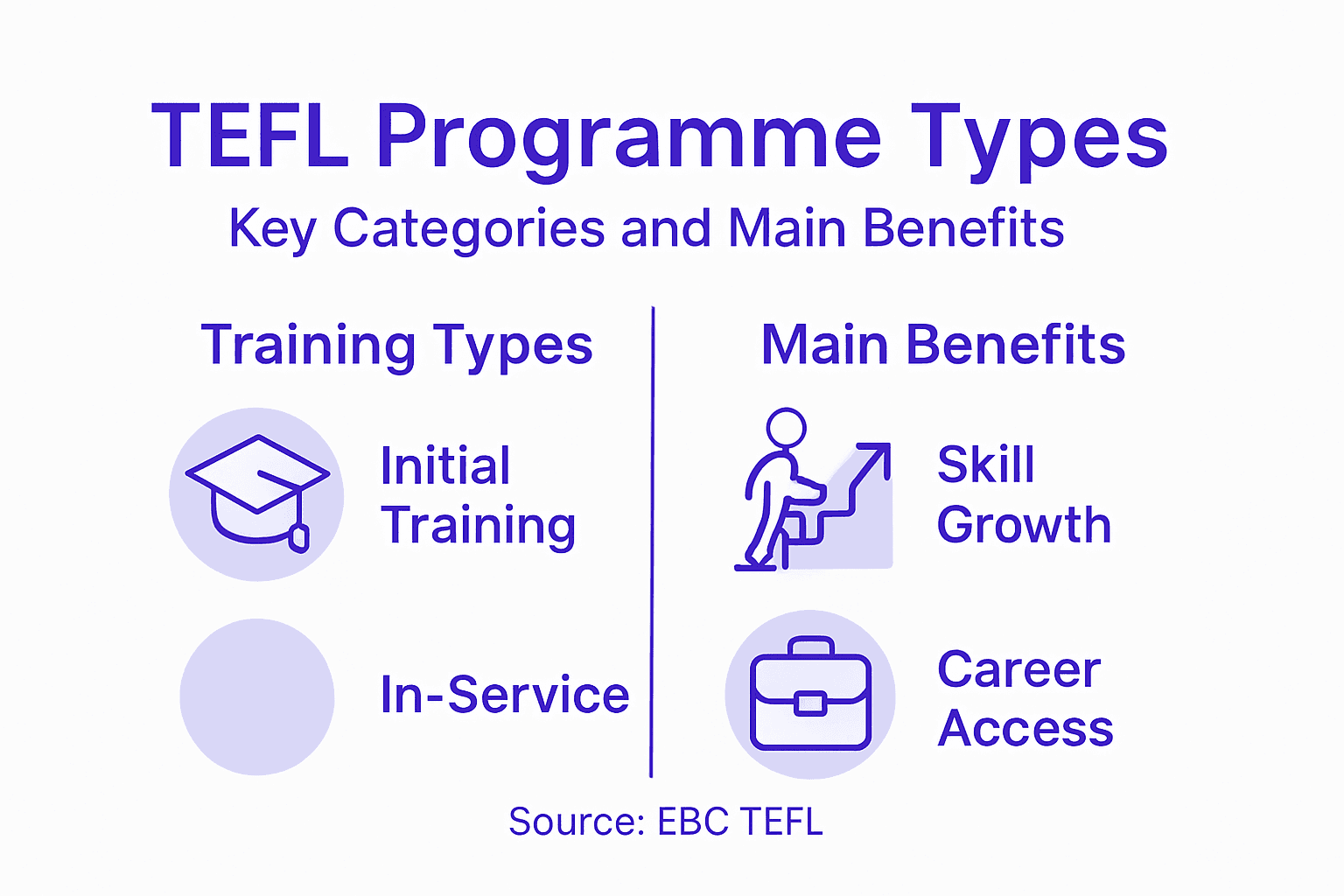
Moreover, contemporary teacher development approaches emphasise collaborative learning and skill enhancement through structured mentoring, peer observation, action research, and reflective practice. These models recognise that professional growth is not a linear process but a complex, contextual journey involving ongoing learning, adaptation, and critical reflection. By engaging with diverse programme types, English language educators can continuously expand their instructional repertoire, respond to evolving educational challenges, and maintain high-quality teaching standards across international contexts.
Here’s a comparison of common TEFL teacher development programme types and their unique advantages:
| Programme Type | Focus Area | Main Advantage |
| Initial Training | Fundamental pedagogy | Builds essential classroom skills |
| Continuing Professional Development | Practice refinement | Updates methods and technologies |
| Specialised Courses | Niche teaching skills | Enables expertise in specific domains |
| Collaborative Learning Models | Peer interaction | Fosters professional networking |
| Self-Directed Study | Independent learning | Encourages individual growth |
Pro tip: Create a personalised professional development roadmap that identifies your specific learning goals, tracks your progress, and proactively seeks opportunities for skill expansion and specialisation.
Key features of internationally accredited courses
Internationally accredited TEFL courses represent the gold standard in English language teacher training, providing comprehensive educational experiences that meet rigorous global quality standards. Accredited TEFL courses distinguish themselves through several critical features that ensure high-quality professional preparation for aspiring language educators.
Key characteristics of internationally recognised courses include robust academic frameworks, practical teaching components, and comprehensive curriculum design. These programmes typically incorporate extensive theoretical training complemented by hands-on teaching practice, ensuring teachers develop both conceptual understanding and practical classroom skills. Accreditation from respected international bodies like Trinity College London guarantees that course content meets stringent educational benchmarks, covering essential areas such as language pedagogy, learner psychology, curriculum development, and cross-cultural communication strategies.

The most prestigious internationally accredited courses emphasise holistic teacher development through multiple learning dimensions. This approach includes structured classroom observations, micro-teaching sessions, peer feedback mechanisms, and detailed reflective practice modules. Professional validation comes through recognised certification that demonstrates a teacher’s competence across linguistic, pedagogical, and intercultural competencies. Such comprehensive training equips educators with adaptable skills necessary for teaching English effectively in diverse global contexts, from traditional classroom settings to online and specialised language learning environments.
The following table highlights the differences between accredited and non-accredited TEFL courses:
| Aspect | Accredited TEFL Course | Non-Accredited TEFL Course |
| Recognition | Internationally recognised certificate | Limited or no official recognition |
| Curriculum | Comprehensive and regulated syllabus | May lack quality assurance |
| Practical Training | Includes supervised teaching practice | Usually theory-based, little practical |
| Career Impact | Strong global employment opportunities | Restricted job prospects internationally |
Pro tip: Research potential TEFL courses by examining their specific accreditation details, practical teaching components, and alumni success rates to ensure you select a programme that genuinely supports your professional development goals.
Requirements for Trinity College London certification
The Trinity College London CertTESOL certification represents a globally recognised professional qualification for English language teachers, with comprehensive entry and performance requirements designed to ensure high-quality teacher preparation. Trinity CertTESOL certification demands candidates meet specific academic and linguistic standards that demonstrate their potential for effective language teaching.
Candidates must satisfy several crucial prerequisites to be eligible for the certification. Minimum entry requirements include being at least 18 years old and possessing educational qualifications that enable higher education entry. Critically, participants must demonstrate advanced English language proficiency, typically at the CEFR C1 level, ensuring they can effectively communicate and teach complex linguistic concepts. The comprehensive programme encompasses 130 hours of guided learning complemented by 70 hours of independent study, providing a robust educational experience that balances theoretical knowledge with practical application.
The certification process involves rigorous assessment across five distinct units, each designed to evaluate different aspects of teaching competence. These units focus on teaching skills, language awareness, materials development, learner profiling, and understanding language learning experiences. Participants must complete six hours of observed teaching practice, demonstrating their ability to apply theoretical knowledge in real classroom scenarios. This multifaceted approach ensures that successful candidates possess not just theoretical understanding, but also practical skills necessary for effective English language instruction in diverse global contexts.
Pro tip: Prepare thoroughly for your Trinity CertTESOL by developing a comprehensive portfolio documenting your teaching experiences, reflective practice, and professional development journey.
Study and work abroad programme benefits
Study and work abroad programmes offer transformative opportunities for aspiring English language teachers, combining professional development with immersive international experiences. Study abroad TEFL programmes provide unique pathways for personal and professional growth, enabling participants to simultaneously acquire teaching credentials and explore global cultural landscapes.
These comprehensive programmes typically integrate multiple strategic components that enhance participants’ professional capabilities. Language learners can simultaneously pursue accredited teacher training, undertake part-time work, engage in language study, and experience cultural immersion. Key benefits include developing advanced linguistic skills, gaining international teaching experience, building professional networks, and experiencing personal transformation through cross-cultural interactions. Participants can choose targeted destinations like Spain, France, and Italy, which offer structured support systems, visa assistance, and opportunities for meaningful professional engagement.
Beyond traditional academic training, study and work abroad programmes cultivate essential global competencies. Participants develop adaptability, intercultural communication skills, and independent problem-solving capabilities. The multifaceted nature of these programmes allows individuals to simultaneously advance their career prospects, expand their linguistic repertoire, and gain profound personal insights through structured international experiences. By combining rigorous professional training with meaningful cultural engagement, these programmes create holistic educational journeys that extend far beyond conventional classroom learning.
Pro tip: Research programme details meticulously, understanding visa requirements, work permissions, and specific support structures to maximise your international teaching and learning experience.
Lifetime global job support for teachers
Lifetime global job support represents a comprehensive commitment to teachers’ ongoing professional success, extending far beyond initial certification. Global TEFL opportunities provide teachers with strategic resources designed to navigate complex international employment landscapes, ensuring continuous career development and professional mobility.
This holistic support model encompasses multiple dimensions of career assistance. Professional guidance includes comprehensive job placement services, detailed recruitment networks spanning multiple countries, personalised career counselling, and ongoing mentorship programmes. Teachers receive targeted support such as curriculum vitae refinement, interview preparation, international recruitment connections, and advice on navigating diverse cultural workplace environments. These services are particularly crucial for educators seeking opportunities in regions like Spain, France, Italy, and various Asian countries, where understanding local employment contexts is essential for successful professional integration.
The most effective lifetime job support programmes offer dynamic, adaptable assistance that evolves with teachers’ changing career aspirations. This approach involves continuous skills update workshops, networking platforms, alumni connections, and proactive job market intelligence. By providing resources that help teachers transition between different teaching contexts, upgrade their qualifications, and explore emerging educational technology opportunities, these support systems ensure professionals remain competitive and relevant in the rapidly changing global language education landscape.
Pro tip: Maintain a comprehensive professional portfolio documenting your teaching experiences, skills, and international certifications to maximise your global employability and demonstrate your professional growth.
Unlock Your Potential with Trinity-Accredited TEFL Training and Global Career Support
The article highlights the crucial journey of continuous teacher development and the challenge of gaining internationally recognised certification to thrive in a competitive global TEFL landscape. At EBC TEFL, we understand the importance of robust, hands-on training paired with credentials that open doors worldwide. Our programmes are accredited by Trinity College London, ensuring you receive the highest quality preparation with practical teaching experience crucial for your success. Our specialised courses and comprehensive study and work abroad programmes in Spain, France, and Italy combine accredited teacher training, immersive language study, visa support, and real-world teaching opportunities, addressing the career advancement goals and cultural adaptability discussed in the article.
Experience lifetime global job placement assistance with expert guidance tailored to your aspirations, ensuring you stay connected with vibrant professional networks and job openings long after certification. Whether you seek to refine your teaching practice with advanced specialised courses or embark on an exciting year abroad to grow both personally and professionally, EBC TEFL supports your journey every step of the way.
Start transforming your passion into a rewarding global career today. Explore our fully accredited Trinity CertTESOL and specialised courses and discover how our study and work abroad programmes will immerse you in culture and teaching excellence. Ready to elevate your teaching career with worldwide opportunities and unmatched lifetime job support
Take your next step now by scheduling a free consultation with our expert advisors at EBC TEFL and unlock the door to global teaching success.
Frequently Asked Questions
What is teacher development in TEFL?
Teacher development in TEFL refers to the ongoing professional growth and skill enhancement of educators, focusing on comprehensive learning strategies and practices to improve teaching effectiveness.
What types of programmes are available for teacher development in TEFL?
Teacher development programmes include initial training for new teachers, continuing professional development for experienced educators, specialised courses targeting niche areas, collaborative learning models, and self-directed study opportunities.
What are the key features of internationally accredited TEFL courses?
Internationally accredited TEFL courses include robust academic frameworks, practical teaching components, and adherence to quality standards set by respected bodies, ensuring comprehensive training for educators.
How does lifetime global job support benefit English language teachers?
Lifetime global job support offers ongoing professional assistance, including job placement services, mentorship, and career counselling, helping teachers navigate international employment challenges and continuously develop their careers.
Recommended
- What Is EFL Teaching and Global Career Impact
- Professional Development TEFL: Pathways to Global Teaching – EBC TEFL courses
- What Is International TEFL? Complete Guide and Benefits – EBC Trinity CertTESOL and TEFL courses
- International TEFL Career Steps: Your Path to Global Teaching – EBC TEFL courses
- 6 Ideas to Improve Your Homeschool Curriculum – The Modern Way – The World Game
