
To teach English in South Korea you need a bachelor’s degree, a passport from one of seven designated English-speaking countries, a clean criminal record check, a good bill of health and a job offer that sponsors an E-2 teaching visa. A TEFL or TESOL certificate is also needed unless your degree or licence is already in education. Below we set out each requirement, the order to tackle the paperwork and what happens if you do not tick every box. Because EBC trains and places teachers around the world, we also show how a Korean post fits into a wider international career.
Key Points
- You need a bachelor’s degree (any subject), citizenship of Australia, Canada, Ireland, New Zealand, South Africa, the UK or the US, and a clean criminal record.
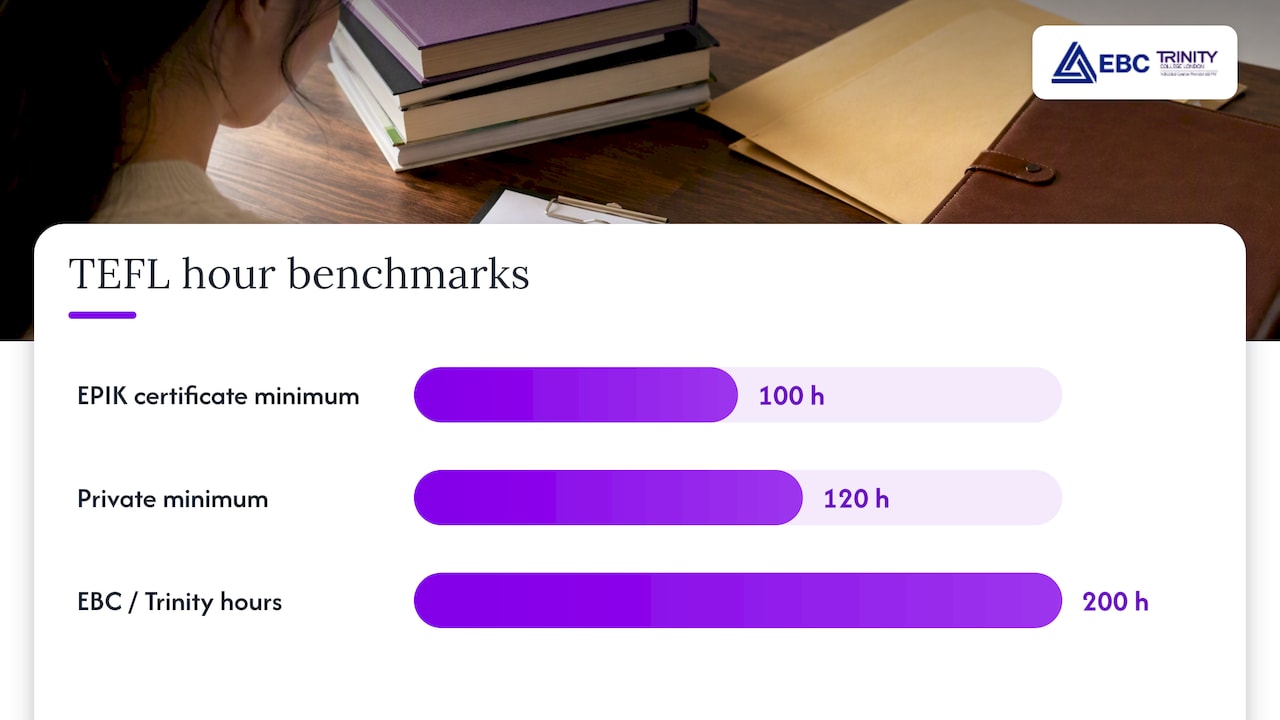
- Unless your degree or licence is in education, you need an accredited TEFL/TESOL certificate of at least 100 hours. Many employers prefer 120 hours or more.
- The E-2 visa is tied to a signed employment contract. No contract, no visa application.
- Your criminal record check must be national level and apostilled. Start it first, because it is the step that most often runs late.
- Nothing here is a guarantee: visa decisions rest with Korean immigration authorities and consulates.
Table of Contents
- The core requirements at a glance
- Nationality and the native-speaker rule
- Degree requirements
- TEFL and TESOL requirements
- Criminal record check and apostille
- Health and background
- The E-2 visa: how the process fits together
- Public school or private academy?
- Working hours and your rights
- Why these requirements are good for your career
- If you do not meet every requirement yet
- Start with the right qualification
- FAQ
- Sources
The core requirements at a glance
Korean schools and the immigration service ask for the same short list almost everywhere, whether the job is in a public school, a private academy (a hagwon) or a university programme.
| Requirement | What it means in practice |
|---|---|
| Nationality | Citizen of Australia, Canada, Ireland, New Zealand, South Africa, the UK or the US |
| Degree | Bachelor’s degree from an accredited university, usually any subject |
| Teaching qualification | TEFL/TESOL certificate (100 hours minimum), unless you hold a teaching licence or an education/TESOL degree |
| Criminal record | Clean national-level check, apostilled |
| Health | Good health, with a medical check as part of the process |
| Employment | A signed contract from a sponsoring school or education office |
| Visa | E-2 foreign language instructor visa |
The seven-country list and the degree rules come from the eligibility page of EPIK, the national public school programme. Private employers apply the same immigration rules because the visa is the same.
Nationality and the native-speaker rule
This is the requirement that surprises people most. For the E-2 visa, Korea looks at your passport, not your fluency. EPIK’s eligibility page names seven countries: Australia, Canada, Ireland, New Zealand, South Africa, the United Kingdom and the United States. It also expects you to have completed your education in English from around the seventh grade through university.
If you are a fluent English speaker with a passport from elsewhere, that does not mean teaching English worldwide is closed to you. It means Korea’s main teaching visa is not the right route, and other destinations may suit you better. EBC supports teachers in many countries, which is why we always ask where you hold citizenship before recommending a route. Our guide on whether you can teach English in Korea without a degree covers the related question of qualifications.
If you want a sense of why employers and learners care about the teacher’s background, this Spanish-language piece explains the case some language academies make for native-speaker teachers when learners prepare for certification exams. Korean schools place similar weight on it, and it is written into the visa rules.
Degree requirements
You need at least a bachelor’s degree from an accredited university. The subject normally does not matter: English, history, engineering and business graduates all qualify. The degree must be genuine, accredited and, for the visa, verified with an apostille from your home authorities.
Two practical points:
- Final-year students cannot apply yet. You need the completed degree and the certificate in hand to start document verification.
- Order matters. Request your degree certificate and apostille early. University offices can be slow in graduation season.
If you do not have a degree, the E-2 route is generally unavailable, and we explain the alternatives in our article on teaching English in Korea without a degree.
TEFL and TESOL requirements
Here sources differ slightly, so it helps to be precise.
- EPIK’s eligibility page says that applicants whose degree is unrelated to education need an accredited TEFL/TESOL certificate of at least 100 hours.
- Applicants with a recognised teaching licence, a B.Ed. or M.Ed., or a major in Education, Teaching or TESOL are exempt from that certificate requirement.
- The certificate can be finished during the application process, provided it is completed at least six weeks before your expected arrival.
- Many private employers and online job boards quote 120 hours as their own minimum. Treat 120 hours as the safe target.
Accreditation matters as much as hours. A certificate that cannot be verified can hold up your application. The Trinity CertTESOL is regulated at Level 5 in England, and Trinity College London states that it totals 200 hours of qualification time and includes at least six hours of supervised teaching practice with real learners.
If you prefer to study flexibly, our EBC Online TEFL Certification Course is a 200-hour course with trainer support, priced at €500 one-off. If you want the full observed-practice qualification, the Trinity CertTESOL is €1,450 one-off.
Criminal record check and apostille
A clean criminal record is non-negotiable. The checklists published by Korean consulates ask for a national-level record check, dated within six months of your contract start, with an apostille. Typical examples from the EPIK documents guide:
- United States: the FBI check, apostilled by the US Department of State in Washington, D.C. A state-level apostille is rejected.
- Canada: the original RCMP fingerprint check, apostilled federally by Global Affairs Canada. A provincial apostille on a notarised copy is not enough.
- United Kingdom: the equivalent national record certificate, then an apostille from the UK’s authority. Check the current process with your consulate, as it changes.
If you have lived in another country for a year or two or more, immigration may ask for a check from there as well. Be ready to explain your residence history at interview. Missing supplementary documents is a common cause of delay.
Our advice: apply for the criminal record check before you accept an offer, since federal apostille timelines can be long and unpredictable.
Health and background
Korean employers require you to be in good health, and a medical check is part of the process. The exact form depends on whether you apply through a public programme or a private employer, and your employer or consulate will give you the current format. Do not guess: ask for the checklist in writing.
Be honest on every form. Korean consulates state that false or falsified information leads to automatic denial and may affect future applications. Never accept an agent’s offer to “smooth over” a gap in your history.
The E-2 visa: how the process fits together
The E-2 foreign language instructor visa is an employment visa tied to a specific sponsor. That has one big consequence: you cannot get the visa first and look for a job afterwards.
A typical sequence looks like this:
- Choose your qualification route. Confirm whether your degree exempts you or whether you need a TEFL/TESOL certificate.
- Start the criminal record check and apostille. Do this immediately.
- Apply for jobs. Public programmes, private academies and universities all recruit throughout the year, with peaks around the school terms.
- Sign an employment contract. Read it carefully and keep a copy.
- Submit your documents. These include the contract, passport (with at least six months’ validity), degree and apostille, criminal record check and the visa form.
- Apply at the consulate. Consulate processing has been reported at around three to four weeks, and fees vary by nationality and location.
- Travel and complete your arrival formalities. Your employer should guide you.
We cannot guarantee a visa, and neither can a school or recruiter. The decision is made by Korean authorities, so a clean, complete and honest file is your best preparation. Our step-by-step guide to teaching English in Korea walks through the same journey in more depth.
Public school or private academy?
The requirements are the same, but the working life differs.
Public programmes such as EPIK, GEPIK and SMOE place teachers in state schools, usually with set hours and structured support. Read our explainer on what EPIK, GEPIK and SMOE are to see how they differ by region.
Private academies (hagwons) recruit directly, often with afternoon and evening classes. Contract quality varies, so check hours, pay date, housing arrangements and holiday entitlement in writing before signing.

Graduate Tyler followed the public school route, and you can read Tyler’s story of teaching English in Korea with EPIK and his later check-in.
Working hours and your rights
Korea’s Labor Standards Act sets a maximum of 52 working hours a week (40 regular hours plus up to 12 overtime) for workplaces with five or more employees, and foreign teachers are protected by the same labour law as Korean nationals. Some sectors have special exceptions, but schools rarely fall under them. Your contract should state your teaching hours, any office hours and overtime arrangements.
Keep copies of your contract and any amendments. If something differs from what you were promised, raise it early and calmly, then use the proper channels of your employer or the education office.
Why these requirements are good for your career
Meeting the Korean requirements is more than a hurdle. The same qualifications that open the door in Seoul, Busan or Daegu travel with you.
- Portable credentials. A degree plus an accredited certificate is the entry ticket in much of the world. Employers across Europe, Asia and the Middle East look for the same foundation, which is why EBC teaches and places teachers globally.
- Observed teaching practice. Real classroom hours with feedback make your first weeks in front of a Korean class less daunting and give you stories to tell at interview.
- Specialisation. After a first year, many teachers add skills. Our CertPT courses in Business English, CLIL, CLT and Teaching Online are €999 each, one-off, and can lead to better-paid or more specialised roles.
- Professional networks. Organisations such as IATEFL connect English teachers internationally, and conferences are a good place to meet employers and peers.
- Lifetime job placement support. EBC graduates receive free, lifetime worldwide placement assistance. Read how the job placement process works.
A year in Korea also makes the next step easier, whether that is another Asian country, a role in Europe or online teaching. See what EBC graduates are doing around the world.
If you do not meet every requirement yet
Most gaps can be closed with planning.
- No TEFL certificate: enrol now. Finish at least six weeks before your planned arrival.
- Degree in progress: wait until you graduate to apply, and use the time to complete your certificate.
- Passport outside the seven countries: look at other destinations where your profile fits. Our guide to certification for teaching abroad shows how requirements vary by country.
- Little classroom experience: choose a course with observed teaching practice, and consider the one-year study and work abroad programmes in Europe, which combine training, language study and part-time work opportunities.
Start with the right qualification
If Korea is your goal, begin with the part you control. The Trinity CertTESOL, costs €1,450 one-off and gives you an internationally recognised, regulated qualification with supervised practice. The EBC Online TEFL Certification Course costs €500 one-off if you need a flexible start. Both come with EBC’s global job placement support. When you are ready, book a free consultation and we will help you map the route to Korea or anywhere else you want to teach.
FAQ
Can a foreigner become a teacher in South Korea?
Yes, if you meet the E-2 visa criteria: a passport from one of the seven designated countries, a bachelor’s degree, a clean criminal record and a sponsoring employer. A TEFL/TESOL certificate is also required unless your degree or licence is in education. Visa approval is never guaranteed.
What is the 52-hour rule in South Korea?
It is the maximum working week under the Labor Standards Act: 40 regular hours plus up to 12 hours of overtime, for workplaces with five or more employees. Foreign teachers are covered like Korean staff. Check that your contract states your hours clearly.
How many TEFL hours do I need to teach in Korea?
EPIK asks for at least 100 hours if your degree is not in education, and many employers prefer 120 hours. A 200-hour course such as the Trinity CertTESOL or our online certification comfortably exceeds both. Always confirm the figure with your specific employer.
Can I get the E-2 visa before I find a job?
No. The visa is an employment visa tied to a specific sponsor, so you need a signed contract first. Start your criminal record check and apostille early so you can move quickly when an offer arrives.
Sources
- Trinity College London: CertTESOL qualification page
- IATEFL: International Association of Teachers of English as a Foreign Language
Recommended
- How to Become an English Teacher in South Korea Easily
- How to Teach English in Korea: Step-by-Step Guide
- Can You Teach English in Korea Without a Degree in 2026?
- What are EPIK, GEPIK, SMOE? – teaching English in South Korea
This page provides commentary based on information, facts, and experiences available at the time of publication. It does not constitute legal advice, and EBC accepts no liability for decisions made based on the information provided. If you require legal advice, please consult a qualified lawyer.