
Bold career moves start with solid credentials. For British, Canadian, American, Australian, and New Zealand graduates, the global demand for certified English teachers continues to climb, with over 250,000 TEFL teachers hired every year across in Spain, France, and Italy alone. If you dream of authentic immersion and want to stand out in vibrant classrooms, understanding the right TEFL programme unlocks real opportunities. This guide unpacks how accredited TEFL training can open doors to rewarding year-long teaching roles abroad.
Table of Contents
- Defining Teaching Practicum In TEFL Programmes
- Types And Formats Across TEFL Certifications
- Key Components And Learning Outcomes
- Accreditation And Assessment Standards
- Practical Benefits For Employability Abroad
- Common Challenges And How To Overcome Them
Key Takeaways
| Point | Details |
|---|---|
| Importance of Teaching Practicum | Engaging in a teaching practicum is essential in TEFL programmes as it provides vital real-world experience and helps develop practical teaching skills. |
| Variations in TEFL Certifications | There are various TEFL certification formats, including intensive, online, and hybrid courses, tailored to different learning preferences and career aspirations. |
| Accreditation and Assessment | Rigorous international accreditation standards ensure quality and comprehensive assessment frameworks in TEFL programmes, validating the educator’s competencies. |
| Challenges and Strategies | Aspiring TEFL professionals may face cultural and professional challenges abroad, which can be mitigated through thorough preparation and adaptability. |
Defining Teaching Practicum in TEFL Programmes
A teaching practicum represents the cornerstone of practical training within TEFL programmes, providing aspiring language educators with critical real-world classroom experience. Unlike theoretical coursework, this immersive component transforms academic knowledge into actionable teaching skills through direct engagement with students and authentic instructional environments.
The teaching practicum typically involves supervised teaching sessions where trainee teachers develop and deliver actual language lessons under expert guidance. During these sessions, participants design curriculum materials, implement instructional strategies, manage classroom dynamics, and receive structured feedback from experienced mentors. Teaching practice fundamentals require trainees to demonstrate competence across multiple pedagogical dimensions, including lesson planning, classroom management, student interaction, and assessment techniques.
Professional TEFL programmes structure teaching practicums to progressively build instructor confidence and capability. Initial sessions might involve micro-teaching scenarios with peer groups, gradually advancing to supervised lessons with actual language learners. Participants learn to adapt instructional approaches, manage diverse classroom environments, and develop responsive teaching methodalities that address individual student learning needs.
Pro Tip: Document every teaching practice session meticulously, recording lesson plans, student interactions, and mentor feedback to create a comprehensive professional development portfolio.
Types and Formats Across TEFL Certifications
TEFL certifications encompass diverse training formats designed to equip language educators with comprehensive professional skills. These programmes range from intensive classroom-based courses to flexible online learning pathways, each tailored to meet different professional development needs and career aspirations. TEFL certification variations demonstrate remarkable diversity in curriculum structure, assessment methods, and practical training components.
Primary certification types include intensive in-person programmes, which typically span 4-6 weeks and provide immersive, hands-on training, and online self-paced courses offering greater flexibility for working professionals. Hybrid models have also emerged, blending online theoretical modules with in-person teaching practicums, allowing candidates to balance theoretical learning with practical classroom experience. Professional-level certifications like Trinity CertTESOL and CELTA represent globally recognised credentials that require rigorous training and comprehensive assessment of teaching competencies.
Here is a comparison of the main TEFL certification formats to help you choose the best fit for your goals:
| Certification Format | Duration | Training Style | Suitable For |
|---|---|---|---|
| In-person Intensive | 4-6 weeks | Classroom-based, hands-on | Those seeking immersive experience |
| Online Self-paced | Flexible (2-6 months) | Online modules, remote support | Working professionals or remote learners |
| Hybrid | Varies (1-3 months) | Online coursework plus in-person practicum | Learners wanting both flexibility and classroom practice |
Accredited TEFL programmes differentiate themselves through specific focus areas and training methodologies. Some specialise in business English instruction, while others concentrate on young learner pedagogy or digital teaching technologies. Advanced certifications might include specialised modules in curriculum design, educational technology integration, or specific regional language teaching approaches. These nuanced programme structures enable teachers to develop targeted expertise aligned with specific career trajectories and regional employment markets.
Pro Tip: Research multiple certification options comprehensively, considering your specific career goals, preferred learning style, and potential international teaching destinations before selecting a TEFL programme.
Key Components and Learning Outcomes
TEFL certification programmes are meticulously designed to develop comprehensive teaching competencies through structured learning modules. TEFL certification differences reveal that core learning outcomes typically encompass linguistic knowledge, pedagogical skills, classroom management techniques, and intercultural communication strategies.
Key learning components are strategically organised into interconnected modules that progressively build professional capabilities. Theoretical foundations include advanced language analysis, understanding learner psychology, and exploring second language acquisition principles. Practical training segments focus on lesson planning, instructional design, assessment strategies, and developing interactive teaching methodologies. Participants learn to create engaging curriculum materials, design differentiated learning experiences, and adapt instructional approaches to diverse student needs and cultural contexts.

Advanced TEFL certifications integrate specialised learning outcomes that extend beyond traditional language teaching paradigms. These might include digital teaching technologies, curriculum development skills, educational psychology insights, and nuanced understanding of cross-cultural communication dynamics. Comprehensive programmes ensure graduates can demonstrate advanced professional competencies such as developing personalised learning strategies, implementing inclusive classroom practices, and navigating complex multicultural educational environments.
Pro Tip: Document your skill progression systematically throughout the certification programme, collecting evidence of your developing teaching capabilities to build a robust professional portfolio.
Accreditation and Assessment Standards
Professional TEFL certification programmes adhere to rigorous international accreditation standards that ensure consistent quality and comprehensive teacher preparation. TEFL certification differences reveal the critical importance of robust assessment frameworks that evaluate candidate performance across multiple professional competency domains.
Accreditation processes typically involve comprehensive multi-stage assessments designed to measure theoretical knowledge, practical teaching skills, and professional adaptability. These assessments include written examinations testing linguistic understanding, teaching methodology comprehension, and pedagogical theory. Practical components involve observed teaching demonstrations, lesson planning exercises, and microteaching sessions where candidates must showcase their ability to design, deliver, and critically reflect on instructional experiences. External moderators and experienced educators evaluate candidates against standardised professional benchmarks, ensuring that only those demonstrating exceptional teaching potential receive certification.
International recognition relies on stringent quality control mechanisms that validate the depth and breadth of TEFL training programmes. Advanced certifications incorporate sophisticated assessment strategies including portfolio development, reflective practice documentation, and comprehensive teaching practice evaluations. These multi-dimensional assessment approaches ensure that certified teachers possess not just theoretical knowledge, but also the practical skills, cultural sensitivity, and adaptive teaching strategies required in diverse global educational contexts.
Pro Tip: Maintain meticulous documentation of your teaching practice sessions, including lesson plans, student interactions, and mentor feedback, to demonstrate your professional development journey.
Practical Benefits for Employability Abroad
A comprehensive TEFL certification transforms career prospects by providing internationally recognised qualifications that unlock global teaching opportunities. Benefits of teaching abroad demonstrate how professional language education credentials create pathways for meaningful international employment and personal development.
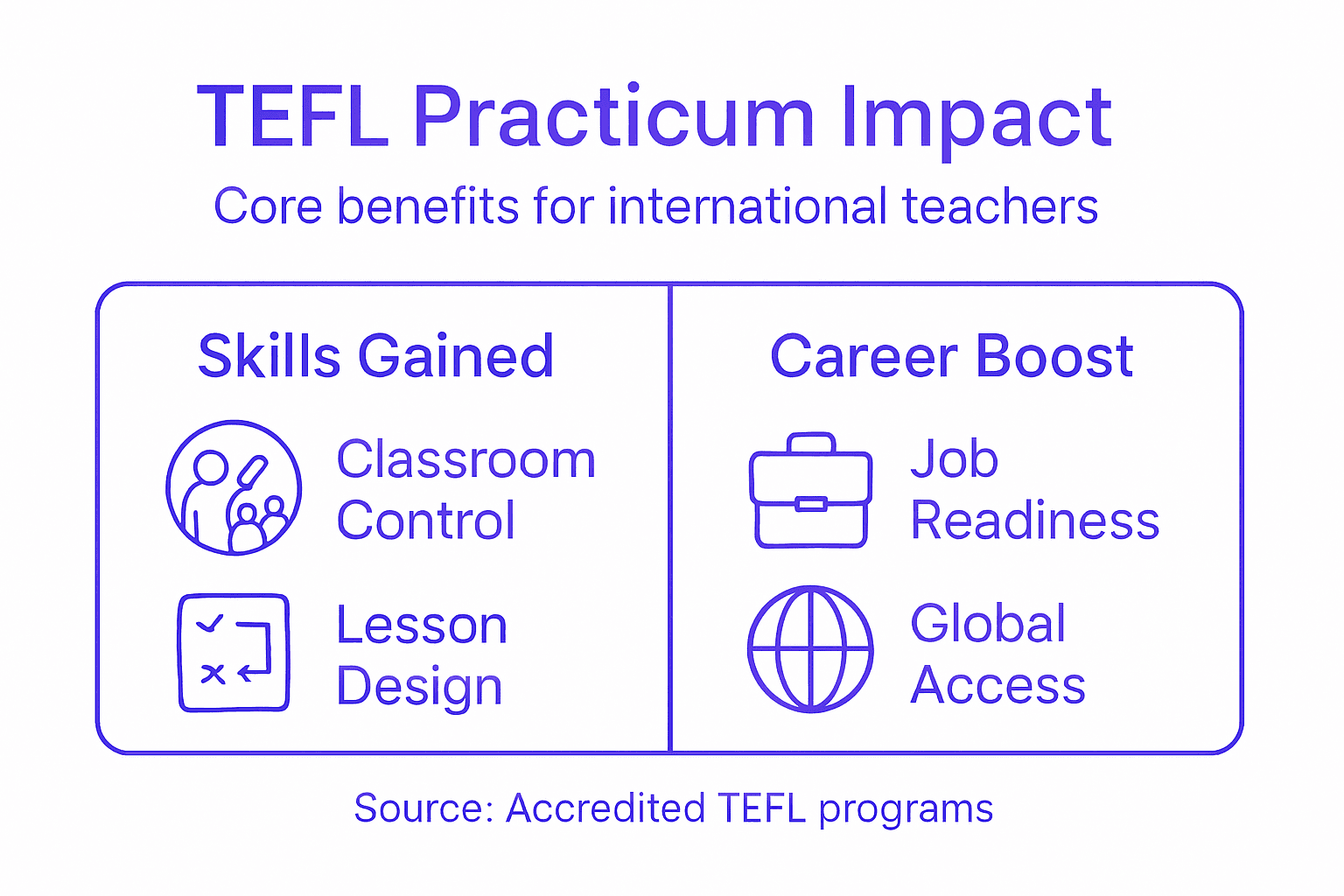
Employment advantages extend beyond traditional classroom roles, enabling graduates to access diverse professional environments across multiple sectors. International employers value TEFL-certified professionals for their demonstrated linguistic expertise, cross-cultural communication skills, and adaptable teaching methodologies. Graduates can pursue career opportunities in multinational corporations, educational institutions, online teaching platforms, language schools, and cultural exchange programmes, with certification serving as a globally recognised credential that validates their professional capabilities.
The practical benefits of TEFL certification include enhanced employability in emerging international job markets, particularly in regions experiencing rapid economic growth and increasing demand for English language instruction. Certified teachers gain competitive advantages through specialised training in curriculum design, educational technologies, and intercultural pedagogical approaches. These comprehensive skill sets enable professionals to navigate complex global educational landscapes, offering flexibility in career trajectories and opportunities for professional advancement across different cultural and professional contexts.
Pro Tip: Continuously update your professional portfolio with teaching experiences, demonstrating your adaptability and commitment to ongoing professional development in international education settings.
Common Challenges and How to Overcome Them
Aspiring TEFL professionals encounter multifaceted challenges that require strategic preparation and adaptive thinking. Teaching jobs abroad highlight the complex landscape of international language education, where cultural adaptation and professional resilience become critical success factors.
Cultural adjustment represents a significant challenge for many international teachers. Language barriers, differing educational expectations, and unfamiliar classroom dynamics can create initial stress and professional uncertainty. Successful educators develop robust cross-cultural communication skills, demonstrating flexibility and emotional intelligence. Strategies include thorough pre-departure research, language learning, engaging with local communities, maintaining an open and non-judgmental mindset, and seeking support from experienced expatriate networks.
Professional challenges extend beyond cultural adaptation, encompassing complex pedagogical and administrative hurdles. Navigating diverse educational systems, understanding local curriculum requirements, managing varied student learning styles, and addressing potential institutional bureaucracies demand sophisticated professional skills. Experienced TEFL practitioners recommend continuous professional development, maintaining comprehensive documentation, building strong relationships with local colleagues, and developing adaptive teaching methodologies that can be customised to different educational contexts.
Below is a summary of key challenges TEFL teachers face abroad paired with effective strategies to overcome them:
| Challenge | Typical Impact | Recommended Strategy |
|---|---|---|
| Cultural Adjustment | Can cause stress and confusion | Learn local customs, join expat networks |
| Language Barriers | Hinders communication and rapport | Study basic phrases, use visual aids |
| Varied Student Needs | Difficult to meet learning goals | Adapt lesson plans, differentiate instruction |
| Institutional Bureaucracy | Slows down classroom progress | Establish good relationships with colleagues |
Pro Tip: Cultivate a growth mindset by treating every challenging experience as an opportunity for professional learning and personal development.
Accelerate Your TEFL Career with Hands-On Training and Global Opportunities
The teaching practicum is essential for transforming theory into practice and building confidence in real classrooms abroad. If you are ready to overcome challenges like adapting to new cultural settings and mastering effective teaching methodologies, our Trinity College London accredited courses offer exactly what you need. Benefit from practical teacher training, expert mentorship, and comprehensive assessment to ensure you develop the skills that global employers seek.
Join one of our specialised TEFL certification pathways such as Trinity CertTESOL or Trinity CertPT and unlock worldwide employment possibilities with free lifetime job placement support. Explore our unique 1-year study and work abroad programmes in Spain, France, and Italy, combining accredited teacher training, immersive language study, visa support, and paid teaching opportunities. Take the next step to shape your international teaching career by booking a free consultation today at Book a Call. Don’t wait to turn your teaching practicum experience into a life-changing professional adventure.
Frequently Asked Questions
What is the purpose of a teaching practicum in TEFL programmes?
A teaching practicum provides aspiring language educators with essential real-world classroom experience, transforming theoretical knowledge into actionable teaching skills through direct engagement with students.
How do teaching practicums enhance employability for TEFL graduates?
Teaching practicums enhance employability by equipping graduates with internationally recognised qualifications, practical teaching experience, and critical classroom management skills that are valued by employers in various educational sectors.
What types of assessments are involved in a TEFL teaching practicum?
Assessments in a TEFL teaching practicum typically include observed teaching demonstrations, lesson planning exercises, and reflective practice evaluations to ensure candidates demonstrate effective teaching competencies.
What challenges might TEFL teachers face during their practicum, and how can they overcome them?
TEFL teachers may face challenges such as cultural adjustment and varied student needs. To overcome these, it is recommended to engage in thorough research about local customs, establish good relationships with colleagues, and adapt lesson plans to meet diverse learning styles.
